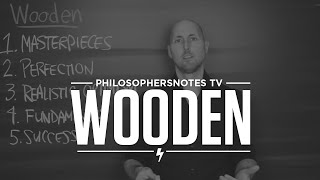
Brian Johnson presents a brief Philosopher's Notes TV episode summarizing key lessons from the book Wooden (about coach John Wooden). He opens with a short bio (Wooden coached many years before his first championship, later winning 10 of 12) then distills five central ideas: (1) make today a masterpiece (focus on process and present moment), (2) aim for perfection while accepting it's unattainable (healthy "optimalism"), (3) practice realistic optimism—idealism + realism + hard work, (4) obsess over fundamentals (even tiny actions, illustrated by Wooden teaching players how to put on socks), and (5) define success as giving full effort. The video closes by inviting viewers to apply these principles in daily life.
Chapters
Hi, this is Brian. Welcome back to Philosopher's Notes tv. Today we've got another great book, Wooden. Wooden, all about John Wooden, lifetime of wisdom. John Wooden is extraordinary. As you've heard me say many times. ESPN voted him the best coach of the 20th century. Effectively the best coach ever. Go Bruins. What's interesting about John Wooden though is he coached. He was a head coach for 17 years before he won his first championship. It was in his 18th season as a head coach that he won his first championship and, and then he won 10 out of 12. So it took him some time to really become a master and then he just crushed it. I love the guy. Alright, we have a philosopher's note with a bunch of big ideas. Five of my favorite ones here. Let's jump in. Big idea number one is to make today a masterpiece. So John Wooden, uber successful coach, did he focus on winning championships? Not at all. He focused on making today a masterpiece. He told his players, look, we can't do anything about yesterday, we can't do anything about tomorrow. But right now, can we make today a perfect practice? Can we have a perfect practice? Can you make today a masterpiece? That's all we have control over. Let's do that. Masterpieces. This is what we talk about a lot. In terms of process is primary. You want to make process primary. Quit leaning forward in your goals or getting anxious or looking back and ruminating on the things you wish were different. Live in the moment, right? We hear this all the time. But the best way to do that, that I found is make today a masterpiece. How can you make today amazing? What can you do in this moment to help you make today a great day? That's big idea number one. Big idea number two is perfection. So John tells us you want to go for perfection knowing it's impossible to attain, huh? Yeah, go for it, but know that it's impossible to attain. That's really, really cool. Talbin Shahar talks about this. We're going to reflect on this in these two ideas. You want to become an optimalist. Optimalist. An optimalist, that's basically a healthy perfectionist. So Tal Ben Shahar says an unhealthy perfectionist has really, really, really, really, really high standards and they think they can reach them and they think they need to reach them all the time. He says, no, no, no. A healthy perfectionist is so different. He calls them an optimalist. They embrace the constraints of reality. And he says that what you want to do is you want to imagine your ideals and as a distant star, not as some shore that you're going to someday get to. So as you're on your journey, know that your ideals are just a distant star that's giving you a sense of what's possible. It's not some shore that you're ever going to reach. So you go for perfection, knowing you're never going to hit it. As you make today a masterpiece. That's the way that you hold the constraints of reality in a healthy way. You want to keep that in mind. So go for it. Have really high standards. That's beautiful. No, you're never going to hit them perfectly. Abraham Maslow says there are no perfect human beings. I like to joke. I hate to break it to you, but you're not going to be the first one. So let's get over ourselves. Go for perfection. No, we're not going to hit it. Create a masterpiece. And part of that is realistic optimism. Realistic optimism has three parts quite according to John Wooden. Number one, we have idealism. We have those ideals, the distant stars that are guiding us. Then we have realism, which is what we just talked about. You're never going to get to that distant star period, nor are you going to get to that distant shore. Just go for it. Use it as a navigational tool. Be realistic, your idealistic, and then work really hard. Those are the three components to his realistic optimism, his functional optimism. We've been talking about that. You believe that you can create whatever you want to create in your life because you know you're going to put in the effort it takes to achieve those goals. Idealism plus realism plus hard work equals realistic optimism. Super big idea. Next one is fundamentals. This is one of my favorite ones. So John Wooden was all about mastery on the tiniest things. He says some of these things are laughable in their simplicity, but they're unbelievably important. So John Wooden, best coach of his era, arguably of all time, worked with the best athletes of his era, Basketball players. They came into his gym. What did they do first? What did he have them do? The first thing he had his players do was learn how to put on their socks. Literally. He would get all these great athletes and he'd sit down and he'd teach them in his old school, Midwest style, how to properly put on a sock. You didn't want to mess that up. You had to get that just right. Because if you got a little wrinkle in your sock, that might lead to a blister, which might lead to a little less practice time or even some missed game time. Certainly not at your perfect striving for performance, you needed to do the littlest, tiniest things as well as you possibly could to have a foundation on which you can build peak performance. Unbelievably cool. Now, we tend to ignore the little things, but they're so incredibly important. So when you look at that masterpiece, think of the smallest things. Can you get up by a certain point in time? Can you meditate? Can you do your movement? Can you show up for your family the way that you want to show up? Find all of your tiny little socks that you want to put on well throughout your day and execute that as flawlessly as you can. Fundamentals. As I say often throughout my work, if you want to see how tall a building is going to be, tall building that's trying to reach that star, you need to look at the foundation if you're going to build a tall building versus a single story house. Very shallow foundation for that. But this big building needs a really deep foundation. Same with our lives. We need to have really strong fundamentals if we want to reach our highest potential. That's the fourth big idea. The fifth one is success. What does John Wooden say success is all about? He says it's not about winning or losing. Success is about one thing. Success equals full effort. Success equals full effort. Do your best, forget the rest. Do your best. Show up with full effort, day in and day out. That is success. And only you know if you're showing up fully or if you're leaving some behind or a lot behind. So use that as your metric for success. It's within your control. You can show up a little bit stronger day in and day out. Get a little bit better. That's what the masterpieces are all about as well. It's not about perfection. It's about getting just a little bit better. When you strive for perfection, you just get 1% better. You compound that over time. It's huge. Have realistic optimism, idealism plus realism plus hard work. Master your fundamentals and then achieve success. Full effort equals full success. And then all the things you aspire to achieve will be natural byproducts of your full effort, your mastery, etc. As S.N. guenca says, work diligently, diligently. Work patiently and persistently. Patiently and persistently. And you're bound to be successful. Bound to be successful. So let's do that. Full effort. Hope you enjoyed this. Quick look at John Wooden. What was your favorite idea? What landed? What resonated? How can you bring that into your life more consistently today? Move from theory to practice. That's what this is all about. I hope you enjoyed and I look forward to sharing more with you soon. Have another awesome day. See you.