Relationships 101: How to Optimize the Love in Your Life
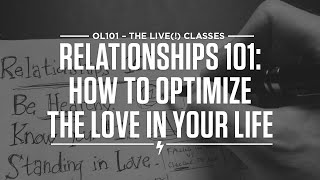
Brian Johnson outlines ten practical ideas for healthy relationships, starting with the zero principle: get your own house in order first. He covers knowing your partner's self-care needs, practicing active love during conflict, and maintaining Gottman's 5:1 ratio of appreciation to criticism. The core move is treating relationships as something you practice deliberately, not something that just happens.
Chapters
Hi guys, this is Brian. I'm sitting here preparing for my next class, Relationships 101. And I thought I'd flip on the old camera here and give you a quick overview of my top 10 big ideas on how to create an awesome relationship. I'm going to focus more on intimate relationships for this class and we're going to share an extended class, audio only. Then I'm also going to do a bunch of micro classes on this as well. Really excited about it. You can sign up and get instant access to prior classes which include confidence 101. We've got our 10 big ideas there, getting stuff done, one on one, 10 big ideas there, and then most recently meditation, one on one and all that good stuff. And of course you get access to the philosopher's notes and everything else. So relationships 101. The very first thing we need to do if we want to have awesome relationships. 0 We need to be healthy. It's hard enough to have a good life when you just have one person involved in the equation. When you add two people to the equation, it becomes incredibly more challenging to optimize that relationship. And if you don't have this solid base in place, you can have a really hard time having a solid relationship with someone else. You got to have a solid relationship with yourself before you can hope to have a solid relationship with someone else. And then if a married couple decides to bring in little ones, little kids, and you don't have this solid and then this solid, good luck with that. That's why we have a 50% divorce rate. We need to start with ourselves and then figure out how we can support the other in actualizing their potential. Which kind of begs the question, what is love? Longer conversation. We'll talk about it more in the class. But Alexandra and I, my wife, our first date. One of the things that helped us fall in love was the fact that we had both read Leo Buscaglia's book Love more than once. Leo Buscaglia, fantastic teacher. He said that, look, the point of life is to actualize your potential. That's what this individual wants to do. Therefore, the point of a healthy relationship is to together actualize your potential. Where you're doing so as an individual, they're doing so as an individual. Healthy, high functioning, actualizing. You come together and your relationship supports. Supports each other in actualizing your potential. We both agreed to that and here we are eight years later. So. And a lot of other things that I'll talk about in the class between here and there. It wasn't like it was a straight upward spiral. But anyway, be healthy, focus on your fundamentals. Exercise, nutrition, rest, mental training, etc. That's a long look at the zero principle. Yes, I know I repeat myself because that's where it all starts. Fundamentals, optimize yourself. If you want to optimize relationship, then you've done that. And then the first big idea here beyond that is know your partner's number ones. So one of the things we talk about a lot is the fundamentals. And then recently we've been talking about the number one, non negotiable self care practice. What's your number one thing? Is it exercise? Is it nutrition? Is it rest? Is it meditation? Is it fill in the blank, what is it? And the way that Michelle Seeger described it is what's something that if you don't do it, your day is just not going to be awesome. You need to know what that thing is for yourself and you need to know what it is for your partner and then support them in doing that consistently. We'll talk about it in the class, what I do for Alexandra and what she does for me. But it's really, really important that you know yours and you know your partners and then you support them in doing it. That's how you're going to have a chance of having an optimal relationship. Second big idea here is standing in love. Standing in love. There's falling in love, then there's choosing to love or standing in love. It's a heck of a lot easier to fall in love than it is to choose love. After the honeymoon comes in, we need to deliberately, consciously recommit. Recommit. Recommit. Stand in love. I used to have a naive idea that if something was wrong with our relationship, then it was just broken. It just was. Something was wrong. I didn't realize that. No, it's just all relationships have their challenges to give. And now even when I say that out loud, it's like, duh. But I didn't get that for a long time. I thought if we didn't always get along as well as I thought we should, that something was wrong. Not good. Can't build a sustainable relationship on that. You need to choose love again and again and again. And then for those of us who are married, let's remember that I do or those of us who are going to get married. Married means I do. It doesn't mean I'll try. We need to seal off the back door. There's no getting out here. We've committed. Now we need to choose love and do the work such that we can stand in love and grow in love rather than just continue trying to fall in love again and again and again. Third, big idea. Active love. This is an idea from the tools guys. They say oftentimes when we're in an argument with someone, we get caught in a mental maze. We loop patterns again and again and again and again and again about how wrong the individual is. We need to stop doing that. We need to get out of our heads, out of the maze, into our hearts, and then beam the individual love. This is a really cool practice. Try it. We'll talk about it more in the class, obviously, but when you're in the maze and you're finding all the things that are wrong with someone, stop doing that. Drop into your heart and literally just send them love. It's an amazing way to short circuit what could de escalate into some negative stuff. Fourth, big idea needs work. We talked about this in the Confidence 101 class. When you have an argument and something goes wrong, rather than hanging out in the maze, beam them love. But then also notice that what you tend to do after an argument is you focus on what they could have done differently. We want to stop doing that. We want to focus on what you could have done differently, not them. Big distinction here. You want to realize that, wow, your performance needs a little work. You don't need to get emotional about it, but go back into the scene and then see what you did that could have been better. And then replay the ideal scene in your mind with you doing what you could have done, not them doing what they could have done, but you doing what you could have done. Really powerful thing. Needs work. Then after you've done that, you let it go and you go apologize or you do whatever you need to do. And again, we'll talk about that more. Needs work. Really, really cool idea. Focus on what you could have done differently, not your partner. Which brings us to the fifth big idea. Three fingers. Anytime you point at someone, I'm pointing at you, giving you a lecture. There are three fingers with a lot of ink stain on them pointing back at me, right? Three fingers pointing back at me when I'm pointing at you and lecturing you. Lesson here is eat your projections when I'm telling you that you did something wrong. There are three fingers reminding me that I need to attend my own lectures. Anything we find annoying in someone else is really just a projection of our own disintegrated stuff. We need to eat those projections. We'll talk about how to go about doing that. And then you want to remember you have the one finger pointing at you. You have three fingers pointing, pointing at them. Three fingers pointing back at you. And you have a thumb going up. That thumb going up represents what you're capable of doing. Do that. That's three fingers. Sixth, big idea here is don't take anything personally. Someone's getting all up in their stuff about you. Remember, they need to follow the three fingers lesson as well. They might be having a rough day. Don Miguel Ruiz talks about this in his four agreements. We will talk about it more. Seventh, big idea is appreciation. This is huge. This has been the cornerstone of Alexander and I's relationship. John Gottman, fascinating guy, studies relationships. He says that a healthy relationship needs to have a 5 to 1 ratio, positive to negative interactions. He can bring people into his lab and with something like 92% accuracy, in a matter of minutes, he can tell you which couple is going to stay together and which couple is going to divorce. And he does it by measuring their number of positive to negative interactions. Appreciation is a great way to drive up the positive number. And appreciation is awesome because it has two meanings. When you appreciate someone, you're being grateful for them. But as you do that, they appreciate in value, both in your eyes and in their own eyes. Really cool concept. A great micro practice here. Super practical. You can start right now. Appreciate one thing about your partner every day. Literally before the day ends, make sure that you tell them, wow, I really appreciate that you did this today or that you do this in your life or for our family. Appreciation is amazing for relationships. Number eight, big idea. This really became even more obvious to me as we had a kid. Our son Emerson is now almost three years old. As I record this, turn off your phone. If you want to show someone you love them, give them the gift of presence. That's the greatest gift we can ever give anyone. And unfortunately, most of us have our phone on all the time. We're constantly being distracted. And that's basically the easiest way to say, I don't care about you, I don't value you. My phone that's going off is more important to me than you. Learn how to slide that little bar so you've got airplane mode activated. And be present. Give that gift to your intimate partner, to your kids, to anyone else who you're choosing to spend time with. Big idea number nine, love letters. This is a great one for people looking for relationships. If you're not in a relationship right now, then map out your ideal what would your ideal partner look like? Seriously, Map out all their characteristics. Alexandra and I synchronistically did this before we met, and we described each other almost perfectly. It was pretty awesome. But what's your ideal partner? Who are they? How do they show up in the world? Write that letter and then see the S here. This is a plural love letters. And then write another letter. That is you. And who your ideal version of yourself is going to be. Who you are going to be in your ideal sense, such that you can attract and maintain a relationship with this person. If you're already in a relationship, do this exercise if you're feeling it. What would your ideal partner do? The ideal version of your current partner. Awesome. Take some time, think about that, but spend way more time thinking about what you need to do, who you need to be, so you can create the relationship you want to create. That's the ninth big idea. Tenth one is an acid test. This is from Gay and Katie Hendricks. They say that an acid test of a relationship is, are you talking to other people about stuff going on in your relationship that you're not talking to your partner about? Don't do that. Don't criticize, don't complain. Don't gossip about your partner. That's not cool. And that's a sign that something's not going right with your relationship. Whatever it is that's going on, think about whether or not it makes sense to have what Gay Hendricks calls a five minute sweaty palm conversation. The stuff that you avoid is better off not being avoided. So keep this in mind. Acid test. We'll talk about more that more. And then finally, our 11th big idea, which is always our 11th big idea. Practice, practice, practice. Back to Leo Buscaglia. He says that if you wanted to master being a chef or being a mechanic or art or a musical instrument or a sport, what would you do? You'd study. For some weird reason, people don't think they need to actually work at relationships, but we do. We need to study and then we need to practice. You want to master anything in your life, you need to put in the time. You need to put in the effort. Practice, practice, practice. There you go. That's a super quick look. It's an emphasis on the top part here. Relationships 101. Really excited to share the class. Sign up, join us and sending you lots of love, Appreciate all of your support and hope you and your loved ones are doing great. All right, more soon. Have an awesome day.
More from Brian

Heroic +1: What’s THE Most Creative Act in the Universe?: Turning Around Glitches (#2024)









