The Procrastination Equation by Piers Steel
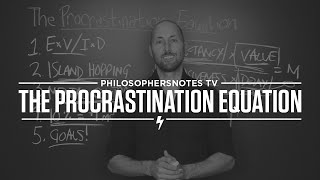
Piers Steel's motivation formula breaks procrastination into four factors: expectancy, value, impulsiveness, and delay. Five strategy clusters help beat it: island-hopping toward wins, mental contrasting, cutting distractions for 10% efficiency gains, micro-goals with routines, and raising expectancy and value.
Chapters
Hi, this is Brian. Welcome back to Philosopher's Notes tv. Today, another great book, the Procrastination Equation. The Procrastination Equation by Piers Steele, Ph.D. subtitle how to Stop Putting Things off and Start Getting Stuff done. Piers is one of the world's leading researchers on the science of motivation, specifically procrastination. And this book is awesome. Super smart, funny, good read. He walks us through kind of the evolutionary and biological underpinnings of procrastination, then walks us through the costs of procrastination personally and as a society. It's nuts how much wasted time we have out there. And everyone procrastinates, as I discussed in the last episode we had on procrastination called Solving the Procrastination Puzzle. And then of course, he walks us through some practical ideas on how to deal with our procrastination. Philosopher's Notes. Bunch of big ideas. Let's jump straight in. Makes sense to start with the equation, right? So Piers created an equation that captures basically all the research in motivational science. E times V divided by I times D equals M motivation. Let's unpack that. We start with E expectancy. I will walk us through what all these things mean. Expectancy times value divided by impulsiveness. This is our number one thing we've got to deal with. Impulsiveness times delay equals motivation. So those mathematicians among us don't need me to tell you this, but for the rest of us, you want this to be very high and you want this to be low if you want to have a high level of motivation. So expectancy, what does that mean? Expectancy means that you expect whatever it is you're working on to succeed. You have the ability, you have the confidence, the intense trust in yourself to create the outcome that you aspire to create. You can finish the project, you can write the book, you can do all these different things, you can build the business, whatever. You need high levels of self efficacy and high resulting levels of self expectancy. If you want to have high motivation, so you take expectancy, then you times it by value. Value is what the scientists describe as your perceived meaning. If you value something, you're obviously more likely to engage in it. If you don't value something, you're more likely to find it boring, you're more likely to procrastinate, your motivation will be lower. So we want to drive up our expectancy, our confidence, and our ability to do what we say we want to do. And we want to really tie it to something meaningful. We want to increase the Value. That's our numerator denominator. Impulsiveness. Piers says that without impulsiveness, there'd be no. Without chronic impulsiveness, there'd be no such thing as chronic procrastination. Right. If impulsiveness did not exist, chronic procrastination would not exist. But the reality is we are hardwired to be impulsive. We want immediate gratification, but only all the time. We want to feel good right now and right now and right now. So when we have a project in front of us, we're almost always going to be drawn to do the more exciting. Right now, pinball is a lot more interesting than studying for your exam. The Internet and all of its distractions, which we'll talk about a little bit more later, is incredibly attractive and addictive. And. And we need to control our impulsiveness if we want to increase our motivation. So your level of impulsiveness is your number one driver. And again, the book is all about helping us optimize each of these points. We're going to talk about some of them, but then the next variable is delay. Delay is basically, how far into the future do we need to complete our project? The further out, the lower our motivation is to do it right now. Right. Which is why most of us crammed in college. I certainly did. I did some prep, but I also had fun seeing how much I could get done right before. Right. Procrastinated, the delay needed to be very short for me to take acute action. Right. As it became very short and this became lower, my motivation went up. So those are our four variables. Expectancy times value divided by impulsiveness times delay even equals your level of motivation. Now let's look at that and see what we can do to optimize some of these variables. Very cool equation. Island hopping is our second big idea. So if you want to increase your expectancy. Right. Let's say that your self confidence can use a boost. Right. And we can all always afford to boost it. Whatever level you're at, you always want to dial that in even further. He says you want to create what he calls success spirals, where you're spiraling up by creating a series of wins. You want to have many successes. And he uses the metaphor of Polynesian explorers. So if you're sitting on an island, here you are, and you look forward and you see an island in the horizon, and you go for it. You sail to that island, you get there, and then from that island you see another island, and then you set sail for that, and the Process continues. That's success spiraling. Each time you succeed, you have more confidence you can do it again. Another metaphor that I like to use is dominoes. Dominoes can knock over another domino that's 50% larger than it. So then what you want to do is focus on this domino, knowing that if you hit that one over, you can knock this one over and so on. Building success spirals. I talk about it a lot more in the note. The strategy that I've used to build the business that I'm building is basically all about this. Identify the next small target and go out and hit it. I talk about that more in the note. I'll leave it at that for now. Mental contrasting is our third big idea. Mental contrasting. This is huge. Mental contrasting is greater than creative visualization. So if you are into your vision board and the secret, you may want to listen up right here. In particular, research has has been done for decades that shows that merely visualizing your little creative fantasy about what you want to see come to fruition in the future is incredibly ineffective. You need to add something to your creative visualization. It's fine and awesome to imagine your ideal outcome, but that by itself is not enough. What you need to do is mentally contrast your ideal outcome with your current reality. You need to hold an expectancy that you can achieve the outcome you want to see. Whether it's getting a job that you want again or building the business or writing the book or whatever, creating the relationship, etc. You got to see that and feel it, right? High expectancy, high value that goes with the two. It really means a lot to you. But then you need to juxtapose it, mentally contrast it with your current reality. Wow, you know what? I'm not currently in a relationship or I don't currently have the health that I want. Creative visualization experts never have you do that. You can't do that, right? Law of attraction. You can't think of anything negative, okay? Science says that's not the way to go. You want to juxtapose it, hold both. Then you want to see the steps in between. And what that does is it creates a necessity to act. You know that there are going to be challenges in between your ideal outcome and your current reality. That's the source of true confidence. You don't brainwash yourself into thinking that you can just think about it hard enough to get the outcome you want and deny the fact that there will be struggles, there will be setbacks. In the note, I referenced Heidi Grahn Halverson who we profiled in her great book Succeed, where she talks about the fact that women who wanted to lose weight, the ones who thought that it would be easy, and just imagine the ideal, lost a ton of weight less than the group that thought it would be hard. You want to have true confidence where you have your ideal, you believe you can get it, and you know you're starting from a place that's going to make it challenging to get there. Then you do the work required. A necessity to act is born. That's really powerful. That's mental. Contrasting. Fourth big idea is a really cool one as well. Pierce makes the point that if you can improve your efficiency by just 10%, and he gives us a way to do that that I'll share in a moment. 10%, if you can do that doesn't sound like a ton, right? But if you boosted your performance by 10%, you would literally create more than an extra month's worth of work in the course of a year. You'd be able to get a month's more work done in a year by simply becoming 10% more effective. That's crazy. One more month a year. What can you do with that? You can do a crazy amount with that by boosting your efficiency by 10%. And his idea on how to do that is very simple. He says, quit distracting yourself. This is an idea from the impulsiveness section. He says the number one thing that increases our impulsiveness, which decreases our motivation and increases our procrastination, is being distracted. He says, never before have we lived in a society that has so many distractions that are so attractive and so well marketed to us that we need to be really, really paying attention to deal with that. His number one tip is to remove the notifications on your emails. He says that alone will increase your productivity by 10%. Stop getting dinged every time you get a new email. Focus on your task. In the note, I talk about time blocking, which we talked about in the one thing Gary Keller calls that the power tool of productivity. To block out time where you're completely unplugged, no one can bother you, and you go crush it. I've mentioned a number of times that's what I do when I'm working on a note. No distractions off. Internet is off. When I'm doing this, I do the MP3, then I do the TV, then I do my micro classes in one chunk, 90 to 120 minutes of a time block. No way am I going to distract myself during that. If I had my email open and right now it's going ding. I'm not going to get a whole lot done. But I get into that. No distraction, don't allow impulsiveness to come in. And I get it done. So turn off the email notifications, turn off your push notifications. God forbid, right? You don't get notified instantaneously when every single thing is happening in your life. You might actually get something done, right? Go into airplane mode as often as you can. And remember, a 10% gain can result in a month more of activity in a given year. That's nuts. And I mentioned in the note too that. I've mentioned that. I've mentioned a lot of things in the note in this episode, but it's crazy. This is why I'm so excited about these big ideas. Any one big idea can literally change your life. You implement it and then when you aggregate all of them and you practice different ones, some will stick, some won't. The aggregate impact of that is mind boggling. It's truly, truly mind boggling. As we have fun exploring these, that's our fourth big idea. The fifth one is goals. Goals are the number one way to deal with procrastination. If you want to increase your motivation, increase your goals. Have a clear sense of what you expect to see. Have a clear sense of value around it. That's going to be the best way to help you accelerate and then chunk it. Create your islands. What you do when you chunk your goals is you remove the long term delay. You take a huge project, you get really specific on what you want to do. Then you break it down into small components and then you create routines to execute against those goals. Those are the three steps he recommends. One, specific goals. Two, you break them down into little incremental modules, micro goals. And three, you create routines, non negotiable things that you do during your day, AKA systems that allow you to execute those small goals in pursuit of your big one. Right? But this is how we are able to increase our motivation. Use goals. They're huge. 10%. Way more than you think. When you compound that over time, mental contrasting beats creative visualization every time. Visualize your ideal, that's fine, but then contrast it with your current reality. See the challenges and have a necessity to act. Get to action on what you want. Island hopping AKA success, spirals AKA dominoes. Hit the next one over and success will compound on itself. And then our equation expectancy times value divided by impulsiveness times delay equals motivation. I hope you enjoyed if you did. I think you'll love the book and and here's to taking action, consistently optimizing, actualizing our potential and enjoying the process. Alright, look forward to sharing more. Have another awesome day. See you. Hi, this is Brian. I hope you enjoyed that PNTV episode. A lot of people don't know all the stuff I do beyond these free videos I share on YouTube, so I thought I'd do a quick video to give you an overview of our membership program that you can get access to and get a ton of other stuff. So here's a quick look. 10 bucks a month Join the Optimal Living Membership program. You get Instant Access to 250 Philosopher's Notes on some of the best Optimal Living books out there. Old school classics, Positive Psychology, Modern stuff, Mindfulness, Peak Performance, purpose, neuroscience, wealth, etc. And what you may not know is that in addition to the PNTV episodes, I create PDFs on all these great books. So six page PDFs. Let's take a look at one of them. Joseph Campbell, you want to figure out how to live your hero's journey? Well, this is a great place to start. I basically pull out my favorite big ideas, riff on them, connect them to other books and other ideas and help you apply this wisdom to your life today. That's what the PDF looks like. Again, we have 250 of these on all these different great books. And then I record those PDFs as an MP3 so you can listen to that MP3 while you're on a walk or working out or doing some errands or whatever that is. Philosopher's Notes. A lot going on there. And then in addition to Philosopher's Notes you get access to Optimal living classes. Optimal Living 101 idea here is that all those great teachers come back to the same big ideas again and again and again. I distill those ideas into classes. Super practical, fun, inspiring classes ranging from habits101, confidence101, getting stuff done, one on one, meditation one on one, instant access to all those classes and then future classes include relationships, one on one, energy 101, purpose, one on one, business goals, etc. Those are our full length classes. And then I create micro classes. Two to three to five minute little bursts of wisdom on my favorite great ideas from these great books across the domain that you want to optimize in your life. So we have dozens of these so far. I create 50 new micro classes every month and 10 new philosopher's notes every month for 10 bucks a month. So we're blessed to have thousands of members who are enjoying the program and sharing some incredibly kind words with us. And super simple. 10 bucks a month. Cancel anytime. We'd be honored to be a bigger part of your life. And. And I appreciate your support. And here's to optimizing and actualizing.
More from Brian

Heroic +1: What’s THE Most Creative Act in the Universe?: Turning Around Glitches (#2024)









