Who are your heroes? Meet the ones in Brian's office. (Part 2)
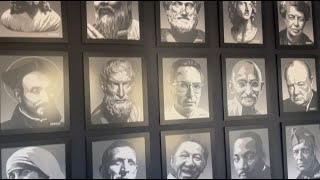
Brian Johnson walks through 25 heroes on his office wall, from Jesus to Churchill, and explains what each teaches him about meditation, courage, and living well. He returns to figures like Epictetus, Viktor Frankl, and John Wooden to show how their ideas shape his daily practice.
Chapters
Hi there, my name is Colton and I'm the Director of Growth at Heroic. Before you dive into more wisdom in less time, we wanted to quickly let you know about our Heroic movement and invite you to join us in creating a world in which 51% of the population is flourishing by the year 2051. For more about how HEROIC will help you flourish and to become a founding member, head to www. Heroic.us. and if you'd like to own part of the movement by becoming a heroic investor for as little as $100, check out the invitation letter from our founder and chief executive, philosopher Brian Johnson at www.heroving.us invest. You can also find those links as well as required investment related legalese in the description below. Let's change the world one person at a time together starting with you, me and us today.
Carrying on part two of our hero story. We featured these guys yesterday and quick overview of or in the last video anyway, quick overview of basic training. Zeus made a cameo. Today we're going to go through my other wall. I don't invite these 25 heroes in every single morning because it takes some time. But I do most mornings during my hour of meditation. As I said in the other video, Jesus, Ignatius, Mother Teresa represents my Catholic upbringing. Then we've got Confucius, Epictetus, John Wooden, hardcore philosophers. Then we've got Aristotle, Viktor Frankl, Maslow scientist philosophers. Then we've got Alexander the Great, Gandhi, MLK leaders. Then we've got Eleanor Roosevelt, Churchill and Eisenhower war leaders. So Jesus tells me a number of different things, but my favorite go to is the discipline shall inherit the earth. Sorry, you're a little bit tilted, Jesus. I got to fix that. So we mistranslated. The meek shall inherit the earth. Meek isn't quite the right word. If you look at the word in Ancient Greek, which of course was from the Aramaic that Jesus spoke. The word praise roughly means something more like tamed or disciplined. Eric Butterworth, the great spiritual teacher. The disciplined, the tamed, the meek. Those who submit to God, the higher force that is within each of us. Those are the ones who will inherit the earth. So that's what he says to me. And then of course, lead with love. Be love. This is what this part of my wall represents. Ignatius took this sense of service and love and brought that out into the world. So he challenges me to go Poosh. He founded the Jesuit movement. I went to Catholic school for 12 years. I wasn't raised Jesuit. Frankly, I wish I was in that tradition. An amazing story of how he educated people and created a truly heroic organization hundreds of years ago. The way he led inspires me deeply. Mother Teresa tells me, love, serve people, especially those most in need that other people may be ignoring. I'm proud of what we've done with our optimized community, what we will do with heroic to make sure that money doesn't get in the way. We've got a lot of exciting plans on that in terms of the heroic foundation and other things we're going to do. But she reminds me to take care of people. One of the things I cherish about my Catholic upbringing. Get emotional, take care of people, do the right thing. Then we've got our hardcore philosophers, Confucius, Epictetus and John Wooden. Check out this picture of John Wooden. Everyone thinks of John Wooden as like that 90 year old something guy who is soft and awesome and sweet. But I knew there was a hard, hard, hard coach in there Again. ESPN tells us that John Wooden was the greatest coach of the 20th century, which makes him arguably the greatest coach in history. I'll just start with him. He tells me, put on your socks. Literally, that's what he tells me. Put on your socks. As you know, if you follow my work, that was the first thing he taught his players. Best players in the country of that age wouldn't let them touch a basketball, wouldn't let them go onto the court until they knew how to do the most fundamental thing right. Put on your socks. He'd literally show them how to do it, which I do in my own life, aspire to do my own life and I use as part of my teaching. Put on your socks. Dominate your fundamentals. Eating, moving, sleeping, breathing, focusing, celebrating, prospering. That's how you play the ultimate game well. Forge antifragile confidence. Optimize your energy, work and love. Make today a masterpiece. Master yourself and activate your soul force. It's not the big big fancy things. He wouldn't even let his players do slam dunks when those were new. Lay it up, son. Practice your fundamentals. Don't get fancy. Do the right thing. Everyone else is selling a lot of people in self development, personal growth. They're selling the get it quick side of things. The great teachers never did that. The great teachers sold you on arete. They sold you on virtue. That's how you change your life. Eris and I'll get to you in a second. Then Wooden tells me, make today a masterpiece. It's all we can do. Confucius heads up the hardcore philosopher list. Ancient Chinese philosopher of course. Basically the opposite of Lao Tzu Laosu is like, hey, let it go, let it rip. No discipline is necessary. Just let it go. Confucius was the other side of the spectrum. Check out the notes on Trying not to try, in which a great neuroscientist who also happens to be a Chinese philosophy scholar unpacks Wu Wei effortless right action where you just naturally do what's best for you. There were different ways to arrive at that in Chinese philosophy. Lao Tzu was on one end of the spectrum trying basically don't try. And Confucius was on the other end of the spectrum, which is where I tend to fall, which is discipline yourself. The more you discipline yourself, the more natural it becomes to do what is best for yourself without effort. He reminds me of that every morning. He also reminds me of the tattoos our chief operating officer has. Shayna Lee and Zhren. I'll skip the long aside on this, but I was already a fan of Shana, our coo. She was an optimized coach, heroic investor, and all the other things. But then she told me she had the Chinese equivalent tattoos of mine, essentially arete and heroic, Li and Zhen. Li is basically be good, you know, open the door for someone who's walking into a building behind you, that's Li. And then Zhen is basically, do it with heart. A robot can open a door. Do it with warmth, do it with care. Do it like you mean it, like you really care. Have some love, right, which is basically arete. Do the right thing, open the door and do it for something bigger than yourself. Do it with love, heroic, etc. Epictetus is my all time favorite teacher. If you've studied Epictetus, you know how intense he is. He encourages me to embody that same level of intensity every morning. I also imagine one of his lectures he said. He said to his students, I'm tired of talking about heroes from the past. How about one of you steps up and acts like a hero so I can talk about you? He was awesome. He also said that life is like boxing match, you know, and when you train for boxing, you go into the gym, go into the ring, and you expect to get hit in the face. That's part of what happens when you're a boxer. Imagine a boxer who trains for that and the first time they get hit in the face, they walk out of the ring and they complain. He said, you act like that you're training for the most important event, which is showing up powerfully. Yet the moment life knocks you down, you Walk out of the ring. What are we doing together? Why are we studying this stuff if it isn't to get stronger the more life kicks you around. That's what Epictetus tells me every morning. Aristotle reminds me, eudaimonia via orite, the ultimate game, the summum bonum of life, is to express the best version of yourself, to be a eudaimon, to fulfill your potential. How do you do that? By living with Areta. He's our ancient wisdom proxy again. Amazing thinker, teacher, etc. His ethics deeply inspires me to go put virtues in action. Of course, he tutored Alexander the Great, which we'll talk about in a moment. Viktor Frankl, practicing stoic Holocaust survivor who played his role well. That's what he tells me. Play your role well today. Then he tells me, step in between stimulus and response. Practice your reactive discipline, which we talked about in our last little video. Stimulus response. In that gap between a stimulus in your life and your response, there's a gap in which exists your freedom. Quit responding habitually. Choose a more proactive response. Response ability is a huge part of being a hero. Abraham Maslow tells me, make your sacred vow. So I've got a vow. A sacred vow that I made before I accepted the investment from 2,500 investors from 75 countries in the world. When we made history with the crowdfunding last year, I had to digitally sign the documents. That was a big deal. So I didn't do it immediately. I went on a walk on our trail on our property here outside of Austin, and I thought about it. I'm like, damn, this is like, as close to a commitment as I'm going to make. It's almost like getting married to Alexandra. We celebrate our 15 years together, by the way, on April 9th when we launch Heroic, which is kind of cool anyway. He made a sacred vow when he was a young man to make a contribution to. To the fields of philosophy, psychology and anthropology, I think were his things. So I make a sacred vow every single morning. I recommit to this. I, Brian Johnson, absolutely and fiercely commit to honoring your investment in me. End in Heroic by doing my best to make you proud to be a part of our movement. I hereby make a sacred vow to you and to everyone else in our community to honor my fundamentals and to practice my philosophy. Of course, I will not be perfect, and I cannot promise any particular outcomes, and I will certainly make mistakes. But I promise you that I will show up day in and day out and do everything in my power to fulfill Our mission, to change the world one person at a time, together, starting with you and me today, with love, wisdom, self mastery and courage. I say heroes unite. That's Maslow's vow that he made to himself. And he said, look, if he had lived in the middle ages, he would have been like a knight who would have done a vigil by his sword and stayed up all night. Sacred vow. Most of us start something and we're heroes in the beginning. And there's actually a Hindu ancient Sanskrit word for being a hero in the beginning, which one of Gandhi's students talks about. Eknatheswaran arambasura. It's easy to be a hero in the beginning. Arambashura is what they called it in Sanskrit, but. But then when things get hard, you tiptoe out the back door. But if you make a sacred vow, you don't. You expect it to be hard. You expect to get hit in the face. You step in between stimulus and response. You forge your antifragile confidence as you play your role well and you go do your best. The worse you feel, the more committed you are to the protocol. All the other things we've talked about. Maslow also reminds me there are no perfect human beings, that I won't be the first. To which I thank him. And he reminds me what one can be, one must be. What one can be, one must be. We call that soul oxygen. He came up with the hierarchy of needs. Of course, soul oxygen is almost exactly what Aristotle talked about with Eudaimonia. You got to be a good soul. That's the impulse we all have within ourselves. It is the most fundamental human need to flourish in service to something bigger than ourselves. Aristotle tutored Alexander the Great who conquered the material world. And he's related to Phil's admonition to me to conquer the impossible. And then Alexander the Great has another more meaning to me. I got a note from one of my favorite philosophers and new now dear friend Tom Morris, PhDs in Religion and philosophy from Yale, who was generous enough to say that, commenting on the fact that Aristotle tutored Alexander and that he sees me as embodying the wisdom of Aristotle and the vision and the energy of Alexander the Great. So I reflect on that in my morning meditation and that he would even consider saying something like that and how do I be worthy of that? Is a big part of it. Now again, conquering the material world is one thing. Conquering the spiritual world is an entirely different thing. Can you combine the two but lead with the spiritual soul? Force of Gandhi, while going out and winning the game everyone else says is so important on the material level, by we're committed to making history again. Can we be one of the fastest growing startups to an enterprise value of a billion dollars? Can we do it in 3.33 years? Super aggressive, obviously not impossible. But can we conquer the material world from the spiritual world? Which is what Gandhi reminds me every morning. Be the change you want to see. Gandhi was fiercely disciplined, all in Soul Force. He reduced himself to zero to allow soul force to come through. Which again is our seventh objective connected to Gandhi Launder chat. His entire movement was called Satyagraha. We called it in the west, non violent resistance, which MLK was inspired by and of course emulated in his own way. But Satyagraha means truth force or love force or Soul force. That was what Gandhi had. That was what all these great teachers had, was Soul Force. That's the hero superpower and what we're so committed to helping you cultivate in your own idiosyncratic way. He reminds me of that every morning. Bless you. Thank you, Gandhi. And then Martin Luther King used the phrase soul Force in his I have a dream speech, which we talked about in the last video. I have a dream, he says to me every single morning as I can hear his voice in my head. I've studied his speech deeply. I have a dream, he says, that my children live in a world in which they are not judged on the basis of the color of their skin, but on the content of their character. To which I reply every morning, I too have a dream. And I want to extend your dream that your children's children's children and mine and everyone else is in the world, live in a world in which they are taught how to cultivate the content of their character, AKA to live with more virtue and to embody all these other ideals, deeply inspired, of course, by their leadership. And then we got Eleanor Roosevelt. We named our daughter, as I mentioned, after Eleanor, of course. She was married to Franklin D. Roosevelt, helped him lead World War II. And again, we're starting with love. We're ending in war here, representing the invisible war within each of us and in the world at large that we need to win one virtuous act at a time. She's actually the most intense person on my wall. Every morning she challenges me by saying, what's one thing you're gonna do today that scares you? It's one of her quotes, right? And she was a very timid, scared girl, much like I was a very timid scared boy. She cultivated her courage. We've got a great note on her great book. What's one thing you're going to do today that scares you? Literally? She asked me this question and I respond to it. Whatever arises for me that I pass through a test of, yep, that's appropriate. I do it every single day. Since I started doing this meditation, I have followed her advice I would offer. That is my most powerful practice in my life. I identify every single morning. What's one thing I don't want to do, I'm scared to do. And then I say to myself, perfect. That's exactly what I'm going to do today. And again, remember Aristotle told us that the virtue that vitalizes all the other virtues is courage comes from the same root as the word heart in ancient Greek and French and all that good stuff. Courage, like your heart, vitalizes all the other virtues. So your heart vitalizes pumps blood to your arms and legs and other vital organs. Courage is the virtue that vitalizes all the other virtues. If you don't have courage, there's no way you're going to move from theory to practice to mastery if you don't cultivate the habit of doing, which you're afraid to do, which is our expansive discipline that we talked about in mastering yourself. So anyway, thank you, Eleanor. My kids can tell you high level about these heroes as well. They know who they are and what they've done. Again, it's a huge thing to think about. Our heroes, not heroes, you know, pseudo heroes, most of them sports and entertainers, some of them are true heroes, but we just got a distorted sense of what it means to be a hero. We want to soak our consciousness in people that are worthy of our emulation. Winston Churchill. Winston Churchill liberated Viktor Frankl. So these three people literally helped liberate Viktor Frankl from the concentration camps and helped us win World War II. Churchill. I'm deeply inspired by him. Again, none of these people are perfect. But without his leadership and his vision, we'd live in a very, very, very, very different world. His willingness to stand up to viciousness and to protect his country and by extension our world deeply inspires me. He goosebumps, barks at me and reminded me of that other qualities he has that I admire. The guy was unbelievably, fiercely ambitious and intense, much like Abraham Lincoln and everyone else on here, and committed to victory at whatever cost. Yet he would also weep in Parliament. He got so emotional and so passionate about his ideals and I cry easily. If you've watched any of my investor presentations. You know, I get emotional pretty easily. He reminds me of that. And then we've got Eisenhower, who led the D Day invasion. As I've shared, if we qualify with the sec, we intend to open our next big crowdfunding round on D Day 2022 as a symbolic representation that we need more love practicing of our philosophy and we need to go win the invisible war between vice and virtue that exists in the world and the sacrifice that the soldiers made on D Day. I mean, it's insane if you study what I mean. It's just amazing how that turned the tide of the war. But he reminds me of all the warriors who have fallen to protect our freedoms, give us an opportunity to even have this discussion, and reminds me to play my role well. He was also an exemplary leader before D day. He wrote two letters. One taking 100% responsibility for the defeat and failure that he led and the other letter celebrating those who won victory. Not taking, you know, the celebration, etcetera, but praising others. And that that noble willingness to embrace the responsibilities of being a worthy leader is something that he brings into my consciousness every morning. Anyway, there you go. Two somewhat long videos. But this is how I start every single day, soaking my consciousness in some of my favorite individuals who most deeply inspire me to show up as the best, most heroic version of myself. We're going to make this part of the Heroic app as well. We've got a heroic meditation. I'm working on that, that will be integrated. But for now, who are your favorite heroes? What qualities do they embody that you most admire? What might they say to you if you took the time to introduce them or to welcome them into your life more and more consistently, Whether that's in a meditation practice or throughout the day. Get on that if you feel so inspired. Let's show up today as the best, most heroic version of ourselves in service to something bigger than ourselves. Colton.
It's Colton again, and we hope you enjoyed getting more wisdom in less time. We're also excited to invite you to join our movement to create a world in which 51% of the population is flourishing by the year 2051. For more about how heroic will help you flourish and to become a founding member, head to www. Heroic.us. and if you'd like to own part of the movement by becoming a heroic investor for as little as $100, check out the invitation letter from our founder and chief executive, philosopher Brian Johnson at www.heroving US invest. You can also find those links as well as required investment related legalese in the description below. Let's change the world one person at a time, together, starting with you, me and us today.
More from Brian

Heroic +1: What’s THE Most Creative Act in the Universe?: Turning Around Glitches (#2024)









