Why Howie Liu of Airtable is going all in with Hyperagent
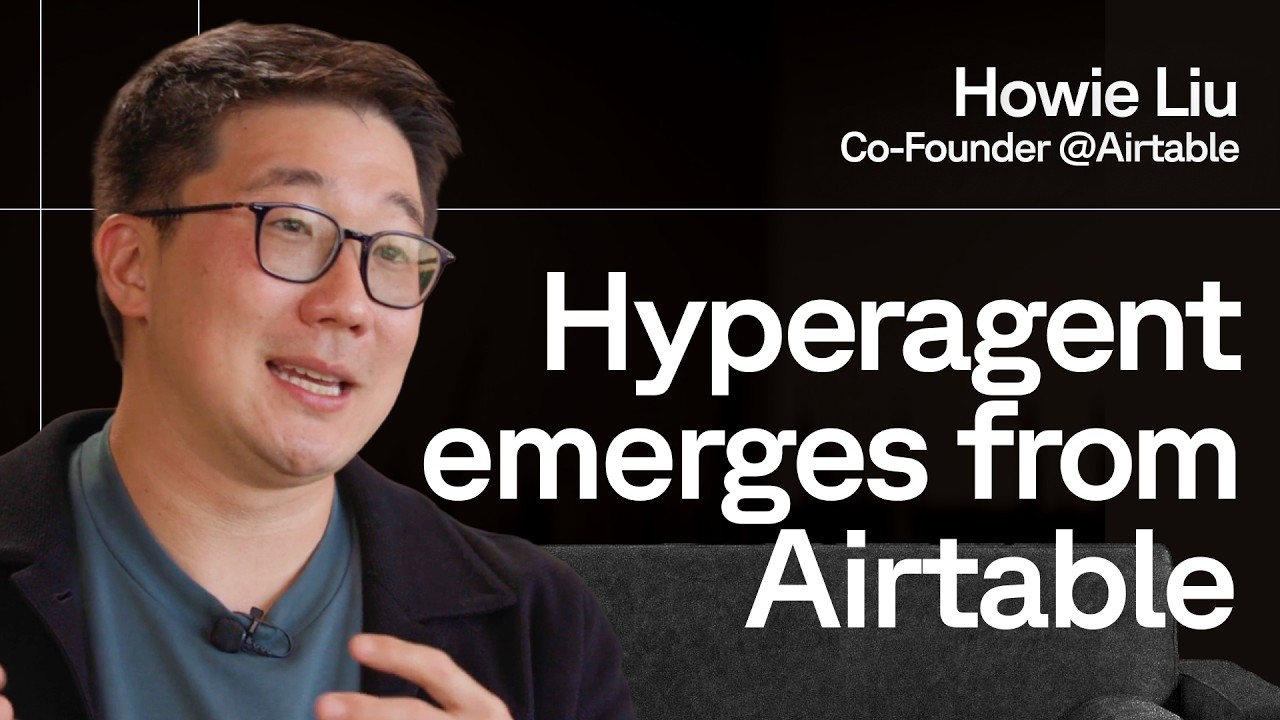
In this interview, Airtable founder Howie Liu discusses the motivation, design, and future of HyperAgent, Airtable’s new meta‑agent platform. He explains his macro thesis that model progress occurs in step‑function jumps, prompting a shift from simple completions to fully autonomous agents. Liu describes the engineering philosophy of keeping the agent harness minimal and introduces the concept of a “harness squared” – a richer context layer that adds memories, skills, policies, and fine‑grained tool access. He contrasts HyperAgent with the risky, unrestricted OpenCLAW and positions HyperAgent as a secure, cloud‑native, UI‑driven alternative. The conversation also covers product‑design lessons from building Airtable as a horizontal app platform, the importance of intuitive UX for non‑technical builders, and how HyperAgent enables both existing businesses and new “agent‑first” startups to automate and scale work. Liu shares personal anecdotes about building the MVP over the holidays, the transformative impact of agents on software engineering productivity, and surprising use‑cases such as automated landscaping proposals. Finally, he outlines three layers of disruption: agents amplifying existing work, enabling new product categories, and reshaping entire markets, hinting at an emerging agent‑first economy.
Chapters
Every software engineer should be using agents every single day, every minute.
Where did you start first on building a great harness for HyperAgent? And where do you think you need to continue to improve upon to make it as best as possible?
I think the best practice now for harness engineering is to keep the harness as minimal as possible, kind of let the model, you know, take charge and like be as open-ended as possible.
Where do we go from here? What's next for HyperAgent? Will it be running the company at some point? Like, how far can this thing go and really being powerful? Hey everybody, I'm Paul, founder of BrowserBase, and I'm here on Navigators, our series with leading AI builders talking about the products they're building that are pushing our frontier forward. I'm here with Howie, founder of Airtable. Howie's been around for quite a long time, but has really reinvented himself with HyperAgent, an exciting new product. Howie, thanks for coming on today.
Of course.
I'm super excited. What's something, as you start to build with AI more and more, what's been really surprising for you in the last few months as models have gotten better? Things are more possible than ever. What's been new?
Yeah, so I have this kind of macro thesis, which is, if you look too closely at model progression on a week-by-week basis, you kind of lose the forest for the trees, right? And it's like, is GPT-5.5 that much better or not? And I think the point is, if you zoom out, there are these kind of big step function changes that if you really kind of step back and think about what you can do with the models, um, you know, is quite different, right? Like there's a step function inflection. You know, my thesis is that like the product form factor needs to structurally and quite dramatically change with each of these subfunctions. So, you know, tangibly, like we started with basically LLM, you know, kind of, uh, response completions, right? So you give it some like string of text, it completes, you know, kind of the rest of the string. And before InstructGPT, like it was only like kind of modestly useful, right? And then InstructGPT came out where like it became more and more of a natural interaction style of chat. you know, bot. And so ChatGPT comes out, that's like the first killer form factor of AI. But of course, like, as we're now talking about, like, you know, chatbots are no longer the right form factor, right? As the models became more and more capable, like, you know, it enabled an even more autonomous form of agent, right? And so, you know, going from like the original, let's say, like precursor, like GitHub Copilot autocomplete experience, right? Like that was more of like the completions model. And then we went to like Cursor 1.0, right? For development where you could go and like talk to this agent composer, Like their original Composer agent, not like the model agent, but like, you know, you could go and like basically talk to Composer and have it do, you know, much more complex changes, right? But it was still very, you know, mostly a synchronous interaction. Like you would tell it to do something, it would do some stuff, it'd be like a minute or 2 max. But now we're at this point where you have fully autonomous agents, right? And so I think for me, the big, like, kind of light bulb moment was, you know, really with this latest generation of models. Um, and, you know, I think Opus 4.5, as many people discovered, was kind of the first aha moment model that, that kind of like broke the dam for this new era, like was so capable that you could just set it off to do like a really, really open-ended and long-running task and get pretty good results, right? So it was the first model that to me felt like it was, you know, more or less like AGI capable, right? Like it's, it's capable of doing work that truly would otherwise feel like you'd have to find a human to do it. And so I just was very enamored by this model. Like it was exciting to play with. I think like we all kind of had this like model psychosis, you know, or agent psychosis moment where you would just like, you know, set off your agents to work and like be mesmerized by what they could do and how much they could do. You know, I wanted to go as meta as possible in a way, like, you know, mirroring what I did with Airtable. Like, you know, if I thought like building, you know, database-powered apps was really cool, like what's the best version of that? Well, it's an app to build database-powered apps, right? Like kind of the meta app platform. And I think like with agents, you know, I was really excited working with these frontier agents. And the most meta thing I could think of was like, what if I could build like a meta agent platform where anyone can go and like, you know, kind of configure and build and deploy their own agents? So that was kind of the genesis of the HyperAgent product within Airtable, but really just kind of was born out of like a personal, you know, kind of passion and like, you know, perhaps product, you know, kind of curiosity. Around what was possible in the space.
Yeah, it's so fun when you can see model capabilities change and start to really shift your roadmap.
Yeah.
Because Airtable wasn't an agents company a year ago.
Right.
And you've really put out a lot of interesting stuff with HyperAgent that I want to get into. But before we get to that, tell me more about what got Airtable to now and what do you see as the inflection point with AI for the business that you've been building for a long time now?
Yeah, so I mean, the founding vision for Airtable was always to democratize app creation, right? And so just you know, we have this strong and still, you know, present belief that like building application software is just like a fundamental like medium and need, right? Especially in a like increasingly digital economy. And so instead of having to like accept that every app you use, like CRM, inventory management, et cetera, is gonna be off the shelf by somebody else who, you know, tries to build a vertical solution for your needs, everybody, every customer should be able to go and create their own custom applications, right? So if you want a CRM, want it to be lightweight and fully configurable, like you should use Airtable to do that, right? Like if you want to build like a content production pipeline, you should be able to do that. And so that's been the vision of Airtable. I think it's still constant today, right? Um, and if anything, like I think the fact that now humans alongside agents are there to both create the applications, the building step, but also to use the applications and arguably need even more than ever a source of truth. Like for the same reason that like humans need to centralize, you know, kind of a source of truth for whatever work we're doing, right? If you're a developer, you need like a source of truth for your literal code, right? You need like something like Git, um, source control, but you also need a way to like manage your issues or your product roadmap. You know, I think agents also really benefit, especially as you scale them up and they start becoming more and more autonomous. Like they all need to share a centralized source of truth. So that's kind of really the, the continuation or the evolution of the Airtable vision. Is it's not a radical pivot, um, but it's really just kind of like progressing that same, you know, constancy into now an era where agents and humans need to coincide along, uh, you know, around a system of record.
And I mean, the, the Airtable product, it's so broadly horizontal. There's a lot of stuff that you can do in it. I imagine the same is true with the agents being built on top of Airtable on HyperAgent. How do you think about the blank canvas problem of your customers where they're like, what do I use this for? How do I get started? When you're thinking about building an agent, it seems like it has to be pretty open-ended because anything can go into that text box. When building HyperAgent, how did you get started imagining that your customers might put anything in here and you gotta make sure it works pretty well or the experience is really solid?
For sure. Well, you know, it's funny, like when we went out to pitch Airtable in the early days of the company, we were a pre-seed company, you know, kind of relatively nobodies. You know, the number one piece of feedback we got from every investor was, look, like you seem like a bright team, you know, you've built like kind of a cool product, like MVP, it's clearly very technically sophisticated, But it is impossible to go and like get product market fit for a horizontal platform, right? Like you're saying you can be this app platform for anyone, right? Every use case instead of centralizing on one.
I think I've heard that before for my company too.
Exactly. So that was like the number one consistent piece of feedback we got. And we kind of defied the traditional wisdom. Like I think, you know, I think you do need to like have some kind of like, you know, secret in Peter Thiel's terms or like just, like a non-conventional way about thinking about the problem to win. So that was kind of our unique take on the space was like, look, like, I don't think we have to go and revert into being a vertical solution company, like build like dental CRM software, which personally wouldn't have excited me nearly as much as building a horizontal platform. But I think instead, like, I looked at a different dimension for Airtable, which was, you know, while we're not going to be able to like gain the benefit of just like vertically marketing and like building the functionality for this product, what if we just like focused on making the barrier to entry, like, The, you know, the, the reason why horizontal products typically have a struggle, um, is because like the user has such a hard time grokking like what they can build on it and then how to build the thing they want to. And then even if they know how and what to build, they might still run into limitations if your product doesn't have the right building blocks to do so, right? So there's kind of 3 extra hurdles for a horizontal platform versus if you've built the vertical solution like dental CRM, you know, it works for that use case and the customer, right? And yet, you know, like to me, maybe like I just love like solving hard problems and, you know, wanted the challenge, but like those 3 problems actually can be distilled into like a product UX and design problem fundamentally, right? Like, you know, you think about like the advent of personal computing and it was a similarly, you know, maybe even like more ambitious horizontal problem to solve. Like how do you create the right GUI or like the right operating system metaphors so that anyone can figure out any personal computing interaction, right? All the different types of apps and interactions you might want to do. And so, you know, we were very inspired by like the origins of like personal computing, Apple Macintosh, like Xerox PARC, et cetera, and applied a lot of that same design philosophy into distilling every single part of app building into the most, in our opinion, like intuitive form. And I think that's really what it came down to. And it was, it turned out like it was just intuitive enough. To get a large class of builders who are not technical, not necessarily your typical, like, you know, kind of Power Apps admins or like, you know, people who would have built with like an existing app platform or a Salesforce admin. But instead, just like, you know, people in their business, right? It could be a small business owner. It could be, you know, an operator within, you know, a function like marketing, but they were able to just go in and build it because it was intuitive enough. And I think Solving for that untapped demand or that underserved demand with a product that for the first time enables the people who know what they want to do, but are prevented from doing it because they haven't had the product that's intuitive or delightful or capable enough to do it is a really fun kind of product design challenge. So in many ways, like HyperAgent is applying that same design philosophy. Obviously the actual building blocks are different from relational database with like, you know, business logic on top of it and interface customizations. For agents, it might be more like, okay, what kind of system prompt do you want? What kind of model do you want? What kind of behavioral guardrails do you want to impose? How do you want this agent to be invoked, right? Do you want it to be always on listening in Slack? Do you want it to be explicitly invoked? Um, which tools should it have access to? What integrations? And so on. But like, there's kind of a very, very parallel kind of design problem to thinking about these different building blocks for agents. Uh, as we applied to app building. So it's really fun and kind of a same adventure, but like applied to a new playing field now. Yeah.
The continuation of, hey, how do I build the right building blocks to solve this problem? Starting with the broad challenges and really, you know, meeting the technology where it is. What's interesting, we were talking about OpenCLAW before we got on here, right? And I imagine like that, that same winter break we all had where we're all cloud coding like crazy, OpenCLAW 4.6 came out. That really was kind of inspirational for you, but you probably ran into a lot of the same problems that people do run into with things like OpenCLaw. Like, it's hard to productionize, and it's hard to imagine a lot of people setting up an OpenCLaw and configuring it, even doing it like a safe way. Would you say that things like OpenCLaw and the problems you face when building with them inspired a lot of HyperAgent and really inspired what you want to do for your customers? Tell me more about that journey.
Yeah, absolutely. I think To me, OpenCLAW was a great demonstration of what frontier models were capable of, right? The kind of default and magical experience of OpenCLAW is that you just give it access to all your stuff on your computer, right? And people were doing it on their actual real machines, right? Not like a separate sandbox machine, but they would just install it on their local machine or locally on their machine. access to all their credentials. It would have like full unadulterated ability to do pretty much anything you could, right? And it's, it's that very fact that like the models were now capable of performing these really long horizon tasks. Um, people would like tweet about how, you know, they had their agent overnight, like, you know, try to find them a really hard to get reservation at some restaurant. And overnight the agent to do so not only figured out how to like, you know, navigate the, you know, the, uh, the website of the restaurant, figure out like what days were available and get the number, but then like would write a script to maybe execute against the Twilio API and perform an actual voice synthesis call, like synthesize a voice to have like a voice call to like a real human and negotiate with the human to get a reservation that otherwise wasn't available. Like it was these kind of like sensational stories of like how far the agent could go when it was given a very clear goal, but then like a lot of like open-ended capability, like very few guardrails. And lots of like basically token bandwidth to go and achieve its goal, right? And so I think like, you know, that kind of experience could not have worked with prior model generations, right? Like if you tried it a year ago on SOTA models, like it just would not have worked, right? Like we actually saw what happened when, uh, when you tried to do this with like, you know, AutoGPT at the time and, uh, BabyAGI. Like there were these kind of like experimental early efforts to do something very open-ended, but the models just weren't there. So. To me, OpenCLAW was a really great, almost like spec implementation of how can you most take advantage of the long horizon autonomy of these frontier models. And yet, to me, it was mostly just that, right? It was a cool demo, but it's obviously really, really limited in terms of it's missing the necessary behavioral and policy guardrails. It's kind of a hard experience to set up, right? It kind of feels like You know, back in the day, I was a nerd, you know, I would install like Linux onto my computer or even like install multiple different variations of Linux and like partition my hard drive. You were still a nerd. Oh yeah. I mean, okay, fine. Fair enough. Um, but you know, like it felt like it was very, very hard and clunky to do that. And that's kind of what OpenCLaw feels like today, right? Like to do it like period, let alone safely, requires a lot of like technical know-how and kind of like being a hacker to make it work. If you can do it, it's awesome and it can do really awesome things. But like, it's very, you know, kind of fraught with like a lot of complexity and error, uh, and potential for like errors and security holes. So, you know, in many ways, like HyperAgent is to OpenClaw, like what maybe like a Macintosh is to like a Linux box, right? Like we wanted to just build like a cloud-native, secure by default, and also just like a beautiful, delightful UI around all of the above. And, you know, because we own kind of the entire, uh, verticalized experience, right? Like You know, we get to, you know, define how memories and skills work within our system. We get to define, you know, how tool calling works and which tools we get to use, including browser-based. But like, we get to control that entire experience in a way that makes it really, really effortless and allows us to add new enhancements. Like, one of the big things we're working on now are the kind of policy and behavioral guardrails that allow you to set free, like, an agent to be increasingly autonomous. and just run on its own, like all the time and do, you know, pretty open-ended things while also having the right level of guardrails. So it doesn't just do something crazy or get prompt injected to leak data or secrets.
And as I understand it, you actually started building this first on your own. And that's not uncommon as I talk to AI CEOs, people who are building. Was your first pass of this, how close was that to the reality version of HyperAgent? And what were some of the decisions you made when building it that you're building your agent? What did you choose? This is going to, being the design of this agent for a very long time, I'm sure you're very thoughtful about the design constraints of HyperAgent.
Yeah. So yes, I built the MVP of the product over the holidays. I think a lot of people, a lot of especially AI-excited operators and founders just spent all of the holidays into New Year's building with especially Opus. And I think the reason I did that was A, I just believe that like the frontier is moving so fast. The only way to stay at the edge is to go and like get directly hands-on with it. Like you can't read just like tweets about it or like get upwards updates from your team. Like it's just, it would be like, you know, back in like 1997, not actually using the internet yourself and like learning about the internet and like trying to develop an understanding about the internet and how it could profoundly disrupt your own business. By listening to other people, right? Like you just kind of have to use it, right? And, and so, you know, I think one, like you just have to be fluent with it yourself, but then 2, I think like, you know, there's this very meta-ness to, again, like HyperAgent in that, you know, it's not only a product that I built originally agentically and now our team on, you know, building HyperAgent, which is still a very small leveraged team within Airtable, is fully agentically leveraged in building the product. But obviously it's an agent product itself. And so I think like the very act of building the product agentically and developing like best practices and really good intuition for what you can do with agents in the development of the product also lends to giving you like better product intuition for how to make the agent product itself behave really well. Right. So the quirks and things we notice with like, you know, let's say using 5.5, you know, GPT-5.5 versus like Opus 4.8 versus like Fable 5, like. We can now learn how to kind of productize that into hyperagent for our own customers. So, you know, I think it's it um it just kind of becomes like this very virtuous cycle where if you get hands on, you get to be part of the flywheel. And and ultimately, like I think you know if you really love thinking about products, like this is a new medium. Like in the same way that like mobile versus desktop required just like an intuition that could only be developed through like actual hands on practitioner being a hands-on practitioner, you know, if you didn't use an iPhone yourself, it'd be really hard to design for iPhone form factor, right? Or like internet versus pre-internet. And so I think here, you know, you're able to just express more product vision directly. And it's really exciting because like the speed between coming up with an idea, coming up with that vision, and then being able to actually express it in a real functional form has just, you know, compressed by like quite literally 10 to 100x versus before, right?
I'm speechless.
There's a lot to unpack there.
I completely agree. Maybe the question that's on my mind as I think about HyperAgent is that a lot of the challenges or advancements in agents have come down to engineering and our ability to engineer well. It's not a model problem anymore. It's actually an engineering problem to solve. And your team's accelerated engineering by being agent-first. But once you think about like the agent harness, it's the model and the surrounding tools around it. What parts of the harness have been the bottleneck for HyperAgent? Because the models are something you're not really touching right now, but you're really adding all the parts around it. Where did you start first on building a great harness for HyperAgent? And what do you think you need to continue to improve upon to make it as best as possible?
Yeah. So we started using this term within HyperAgent, which was like the harness squared, right? So like there's the literal agent harness, which is like OpenCode or like Agents SDK, you know, the Codex harness. Like, but that's fairly simple, right? In fact, like, I think the best practice now for harness engineering is to keep the harness as minimal as possible, kind of let the model, you know, take charge and like be as open-ended as possible and have the harness be less restrictive than maybe like the earlier era types of like model implementations where you had much more heavyweight or narrow paths the models could walk down. Like, the harness is quite simple, right? And you can literally inspect like the LLM's, you know, token output, um, you know, and the input that you're passing in, that is the result of the harness and like. Arguably, you could recreate your own harness pretty easily, right? If you wanted to do a weekend project, you could implement your own very, very simplistic harness with some basic tool calling and so on. So I think the harness itself is fairly compact. And frankly, I don't think there's a ton of interesting value creation or value add for especially third-party startups like us outside of the Frontier Labs or outside of the open-source harnesses out there. to add 2. But there's this really rich layer above the harness, and that's what we're calling the harness squared. I think Databricks just put out a product and called it like a meta harness, right? But it's really like, outside of the literal loop that recurses and calls the LLM again and again and performs tool calls, returns the results back to the model, there's all of the stuff above that, right? Which I think of as basically the context and behavioral controls, uh, and access for the agent. So like the context layer is everything, right? Like the memories, um, and how the agent learns new memories, right? Um, you know, skills, right? If you have like proprietary skills, if you're a VC and you've baked into your, you know, Harness Squared or this Meta Harness, like the skills that are proprietary to your firm and how you do diligence or how you do investment analysis, right? It could be a marketing team at Nike that does like very proprietary things to create marketing campaigns. But all of that unique firm know-how goes into that context layer, right, in the form of memory skills and other customisations at the Harness Squared layer. And then separately, you also have the tools that you've chosen as a policy to give any given agent access to. So does this agent have access to G Drive, but only certain folders within there? Should it have even more fine-grained access constraints like It can only read out of these folders, but write to these folders. And you know, maybe it should be allowed to send only emails to a certain type of email. But even then, like you know, there has to be an extra kind of screening step to make sure the email it's sending is legitimate and like not you know leaking out or exfiltrating like data or secrets. And so I think like that layer above is actually going to be where the real value creation is. It's it's basically the the biggest gap between the already. capable models today. Like the models are smart enough, like they're going to get smarter for sure, but they're already smart enough to disrupt and kind of like be applied to a much wider realm of knowledge work today than even they are. Right. Um, and, you know, I think the biggest gap there is going to be this layer in between. Like, how do you give the model just like a human, like, you know, our brains are, you know, all roughly based on the same art, you know, uh, architecture, right? Like your brain, my brain, anyone else's brain. But it's like the unique stuff that we accumulate in our lived experience. And certainly within a company, like the unique know-how and like company-specific culture and policies and like, you know, and best practices that makes you far more useful than just like, you know, a generically smart person who has like no prior contacts in an industry or in a job, right? Like if they, you know, if Albert Einstein a priori tried to come in and be like a software engineer or like a marketer for Browserbase, the company, like, You know, he'd probably do an okay job, but like not the best, right?
With Fable, he'd be doing great, I think.
Um, but I think that is the layer that's really interesting. And that's really what, um, we've spent a lot of effort with HyperAgent trying to focus on. Like, we don't want to compete with the models. You know, eventually we'll probably offer some kind of like basic, um, you know, fine-tuning service on models, et cetera. But like, that's not really to us the most interesting part. Um, it's really everything above Even the harness where you get to go and like customize and deploy useful agents as they become increasingly autonomous.
And if you have this context, you have these skills and this memory, I imagine it also needs access to systems, right? Because the real work that we do every day is in systems. How have you thought about enabling easy access to, you know, all the systems a person needs to get their work done and making that useful for agents? I think it's still a major unsolved problem for people building agents these days.
Yeah, for sure. Um, so I think that, um, I think this is going to be the crux of useful agents, right? Like, Putting an agent into a constrained space where it doesn't actually have the ability to read from or act on your data sources, your tools, is basically like putting Einstein in a Faraday cage, right? It's completely constraining the natural capability of these more and more open-ended agents, right? And kind of doing the opposite of what OpenCLAW does, which is arguably too dangerous, too unrestricted. But if you give an agent access to all your stuff, It can do a lot, right? And so I think finding the right middle ground is everything. And it's really about saying, hey, look, like, how do we give the agent the right access to the right tools in an efficient way? So, you know, we have like a generic MCP connector in HyperAgent where you can connect to any tool. But also, I mean, you know, obviously, uh, you know, you're the founder of BrowserBase. Like, I think like being able to browse the web and interact with web services and do so in a way that maintains, for instance, persistent context. Is like one of the critical tools, right? It's like the meta tool, you know, for a lot of the services and data sources because like, you know, you think about like where the world has gone over the past 20 years, like everything has become webified, right? Like the whole like web revolution, like, you know, the whole rise of like, you know, the internet and like the SaaS economies, like, you know, all of the services and tools that a knowledge worker typically accesses is available on the web, right? And through a web interface. And often, you know, currently through a web interface, but not through, you know, a clean agent-friendly API or even MCP, right? And so I think this idea of give the agent a really, really ergonomic way to not only browse the web and search for results, which I think that's also a core capability, just like basic search, get back like, you know, kind of the raw search results as text or HTML. But I think more importantly, actually be able to interact with web services in the way that a human does, clicking buttons, filling out forms, browsing data dashboards, retrieving information out of that, that is a really powerful universal escape valve. So I think making the agents web-enabled by default is a really, really powerful core capability, I think, of any frontier agent.
Yeah, we're super lucky to be powering HyperAgent on the browser-based side. And I agree that You know, model capabilities are going to converge on human capabilities, right? And humans are going to keep doing work on the web as they are. And I kind of imagine it like how Waymo drives alongside us on the roads we already have. We're not going to reinvent the roads, but we'll probably give the models a car just like ours that's going to drive alongside us. And more and more, the best agents I've seen are ones that have been built to have access or function like humans. And like you said earlier, removing the constraints, let's stop coming up with ideas. It's almost funny, like prompt engineering is what we used to do all the time.
Yeah.
That's because we assumed the models wouldn't get better and actually converge on our capabilities.
Yeah.
Now that we've seen the models keep up and we're starting to do the engineering work to make agents better, where do we go from here? Like, what's next for HyperAgent? Will it be running the company at some point? Like, where do you work? How far can this thing go in really being powerful?
Yeah. I mean, I, when I zoom out, like, it feels like there's so many layers of disruption happening all at once. Right. And so, you know, to use a concrete example, like, you know, at the top level, you could say that, you know, agents are already enabling people to do their current jobs better. Right. Like, let's say software development, right? Like, you At the very least, every software engineer should be using agents every single day, every minute, right? Like, in fact, like, if they're not using agents to generate the bulk of their code, they're by definition, like, not getting nearly enough leverage, right, as they could. So there's kind of like, you know, level 1 is do the same thing that you were going to do before, but faster and arguably cheaper in the sense that, like, one developer can output, you know, 2 times more work, you know, and like, and therefore the company gets like 2 times leverage. I mean, there's some token costs, but it's negligible compared to like the value of like doubling every engineer's output. And so you get this more of the same type of output for less cost and faster, right? That's itself pretty profound. But then you have this next layer, which is, well, what if the nature of the products that you build is actually changing, right? The fact that you can do more, can do faster, means that you will bite off more ambitious projects than you otherwise would, right? Hyperagent itself is a great example of this, where we would not have Hyperagent as a product. We would not even be working on it If we didn't have this agentic leverage, right? Like I personally would not have gone and, you know, without modern, you know, kind of agents, like I wouldn't have spent the time to go and build the V1 of HyperAgent. And like, arguably we wouldn't have had the like resources to go and put a small team or a small team that we've put on it would not have been able to build a substantial product like this. Right. So there's kind of like the second layer, which is actually going out and building new products or new product surface areas. that you wouldn't have otherwise and unlocking new, you know, kind of like economic value through that. And then I think there's a third layer, which is like, well, what happens when like your customers are also themselves transforming, right? So maybe if you look at like, you know, kind of an e-commerce setting, it's like, okay, well, we can design better e-commerce, like, you know, websites and shopping and checkout flows and inventory management flows for the current customer behavior. But what if the customers themselves are changing their shopping behavior because they're using agents? Maybe they're using HyperAgent with Browserbase to go and actually shop for for them, right? And then actually the affordances of how you want to make your website more optimal for an agent, even if the agent is still using the website and browser tools, like you can still make it more agent-friendly, right? You actually may need to change like the product, uh, itself and like your, your core kind of business model to be more receptive to customers who have themselves transformed. And I think eventually you get to this point where like, it's almost like there's this whole new economy that I think is born of the agentic revolution, right? Maybe it's a little bit akin to like Stripe choosing not to go after the old incumbent, you know, kind of payment processing use cases. They weren't trying to rip and replace like, you know, Kmart's like, you know, kind of POS system, but they index entirely on this new economy, the Lyfts and the Shopifys of the world. And I think that we're seeing this like new breed of agent-first companies, like in our own customer base at HyperAgent, like we're kind of split between, we've got some existing businesses that have adopted, um, you know, HyperAgent and they're transforming. you know, kind of operations within the company at those different levels of transformation. But we're also seeing like these completely net new companies that are built agent first to begin with, right? And they're able to stay way leaner. Maybe it's one person, maybe it's 10 people, but they get the job done that like would've required 5 to 10 times their headcount. And it's almost like those companies are just operating in such a different way, and they might be able to serve their own customers who are also operating in that way. And so in a sense, there, I think there is this new agent-first economy that is being born. And those companies look a lot leaner, a lot more efficient, a lot faster to market. You know, we still want to tap into the kind of like existing economy. Like there's just, you know, obviously a really large market there, but I think it's really critical that we also, you know, and maybe first and foremost win that new economy because the speed at which it's innovating, it's growing, and like it is the future is just remarkable. So, you know, personally, I'm very, very excited about like Supporting those, that next generation of new agent-first companies that are kind of like born of the agent generation.
Yeah, it's interesting. I haven't heard that perspective before, which is like, let's double down on these new companies and bet that they're going to grow so fast because they're kind of agent-first companies that those are the next billion-dollar companies that you want to work with from the very first day. And then you think about the, the rest of the economy, that diffusion will be slower because new technology adoption is slower. I definitely thought of the former, the agent native making a lot of sense, but what are the interesting use cases you've seen of the latter, the customers that you didn't expect to use HyperAgent? I'd love to hear about some surprising customers that are using HyperAgent. You're like, oh wow, that makes a lot of sense.
Yeah, I mean, look, I think one interesting takeaway is it's actually not a necessarily industry by industry thing so much as a Like, I think frankly, company size and agility has the biggest, uh, role to play in terms of, you know, going AI native, right? So like, as an example, we've seen, you know, like traditionally offline businesses, like there's a landscaping, uh, business, right? And the owner is very agent-first, extremely agent savvy, and has like kind of like automated with agents the entire pipeline of prospecting for new landscaping clients. Like literally having an agent do research on like a, you know, potential client's lot, right? Like you can use Google Street View and zoom in on like, here's what the backyard space looks like. Here's the dimensions. Here's my quote, even. Like, here's what I could like reimagine your landscape to look like. I can use AI image gen, right? I can have the agent go and actually create like a beautiful, realistic proposal of like, here's what I can reimagine your landscaping to look like, right? Or you could do the same for like interior design or being a realtor, et cetera. But I think, you know, this idea of like, you can actually differentially win the market because you're able to do these extremely absurdly high-touch things that a normal landscaper or interior designer would never fathom being able to afford doing for just like a client pitch, right? And especially if you're doing like 50 a day, you can't afford to put that level of detail into it unless you were working on like one, you know, $50 million project a year or something. But now you can. And the fact that like once you go and do the work, you can actually automate a lot of the operations. Like it turns out even in a lot of offline businesses, the bulk of the work is actually not like the boots on the ground doing the thing. Like a lot of the overhead that causes delays and even like cost inflation is everything outside of it, right? Like the back office operations, right? And so I think that's one of the most exciting things to me is like, this is not just about like, you know, AI companies selling to AI company and like, you know, these are all like pure software companies that are benefiting, but actually like, I think we're going to see, and we're already seeing like companies in every industry and sector, but it's kind of like survival and the thriving of Not, not the biggest and not like those in the most, um, you know, kind of, uh, stereotypically like digital, uh, sectors, but really the most agile, right? And, you know, as much as like I want to root for the incumbents, uh, and the existing, like, you know, kind of large enterprises, I think that a lot of them are just slower on the draw and they kind of have too much, uh, process and like, you know, kind of restriction to be able to go and like aggressively adopt agents. In a way that fundamentally transforms their, their business model and like their, you know, kind of, uh, even like operational efficiency.
Yeah. It reminds me of, it reminds me of the amount of abundance that will be unlocked by the progression of AI where now you can have the affordances of doing a little bit extra work that you didn't imagine before. Listen, in my conversation with you, I can tell you're just super excited. And this moment for Airtable has been really big. How, how are you personally doing? I mean, this seems like AI for you has been really, really exciting. I'd love to kind of hear. You know, what this moment has meant to you as the founder of this company, as you've taken on new products and new directions.
I kind of grew up of the, you could argue like Web 2.0 age. And like, you know, I cut my teeth back in high school and college learning how to program and, you know, first C++, then PHP. It was like the early days of like, you know, real rich web applications, right? Um, and I remember like learning how to like, you know, hack together my first like single page app, learning JavaScript and like, You know, that was kind of fun in and of its own, right? It felt like there was a frontier at that time of just like, how do you build like a web application, you know, in a much more lightweight way, right? And like in a way that doesn't require like a 5,000-person traditional, you know, kind of, um, uh, you know, web engineering team. Um, and, you know, I think like we're now moving into this world that is different. Like there are some parallels, right? And that's what excites me. That's probably the sweet part is like, you know, getting to apply the same kind of like product passion and vision. as I did with Airtable into, you know, a new form factor while also stewarding like Airtable into this new era. But like, you know, in many ways, like the way that, you know, we developed, we built apps, like the form factor, the UX, and even just like the lived experience of the day-to-day, right? Like, you know, I remember back in the day it was like you would stare at your IDE, you know, if you were building a web app, right? And you'd like, there was almost a frustration and a joy of like banging your head against like some, you know, JavaScript error that you were trying to debug and having a hard time doing it and like spending hours and hours and then walking around like, you know, the street coming back and like maybe having like a stroke of like insight to get past it. Like, I think those days are kind of gone, right? Like, I think, you know, now my typical day when I'm actually doing like development IC work is like overseeing quite literally a fleet of like many dozens of agents, right? Each of which Uh, each of which has their own, like, you know, contained cloud environment. They can use browser testing to verify, like, you know, kind of everything's working. They can do their own web research and bring in best practices from the outside. And they, I mean, they, they like, you know, kind of create like merge-ready PRs. Like humans do review that, like I review it or an engineer reviews it, but like, it's almost like it is a managerial job of agents. And yet, like, in a sense, You know, to be honest, like it's more exciting than traditional, like just being a pure manager because I think you still get to be hands-on and like it's still, you have that level of interactivity with each agent, right? Like versus if you were the manager of like 50 people, like you wouldn't be able to go to the same level of depth or have the same level of like product detail, like intervention as you do with agents. So it's kind of, it's just very different. Um, but in a sense, like, It's exciting. And, you know, I'm personally having fun with it. Like, I think it is, you know, the only way to really, you know, kind of move forward in this era is to not hold on too much to the past. And, you know, the old way that we worked, the old way that we thought about product market fit, even the old way that we thought about like business models, I think you have to kind of move forward and look forward. Otherwise, it's just, there's so much change and so much rapid change. That I think it can be very unnerving and like, frankly, like, you know, kind of disheartening in some sense if, you know, if everything that you enjoyed and, you know, kind of became attached to was like the way that we worked in the past.
Yeah. Falling in love with the process of the work and not the output is a big trap because the way we're gonna work is changing a lot. Totally. But the output's gonna be a lot higher. And, you know, I'll borrow the term from researchers. We have to be hill climbing ourselves.
Yeah.
Right. And it seems like you and the team at Airtable did a fantastic job of that.
Thank you.
Congratulations on the launch of HyperAgent. I'm excited to play with it more. And thank you for coming on today. It's been really great to have this conversation. Excited to continue the partnership together.
Yeah, no, BrowserBase is a really, really core tool for us and, uh, appreciate the partnership. Love what you guys are doing and excited to follow your journey as well.
Let's go, man.
Thank you. Appreciate it.
More from Howie


How we restructured Airtable's entire org for AI | Howie Liu (co-founder and CEO)

Airtable CEO Howie Liu - Excel vs Access, Founder Mode, and the Future of SaaS
