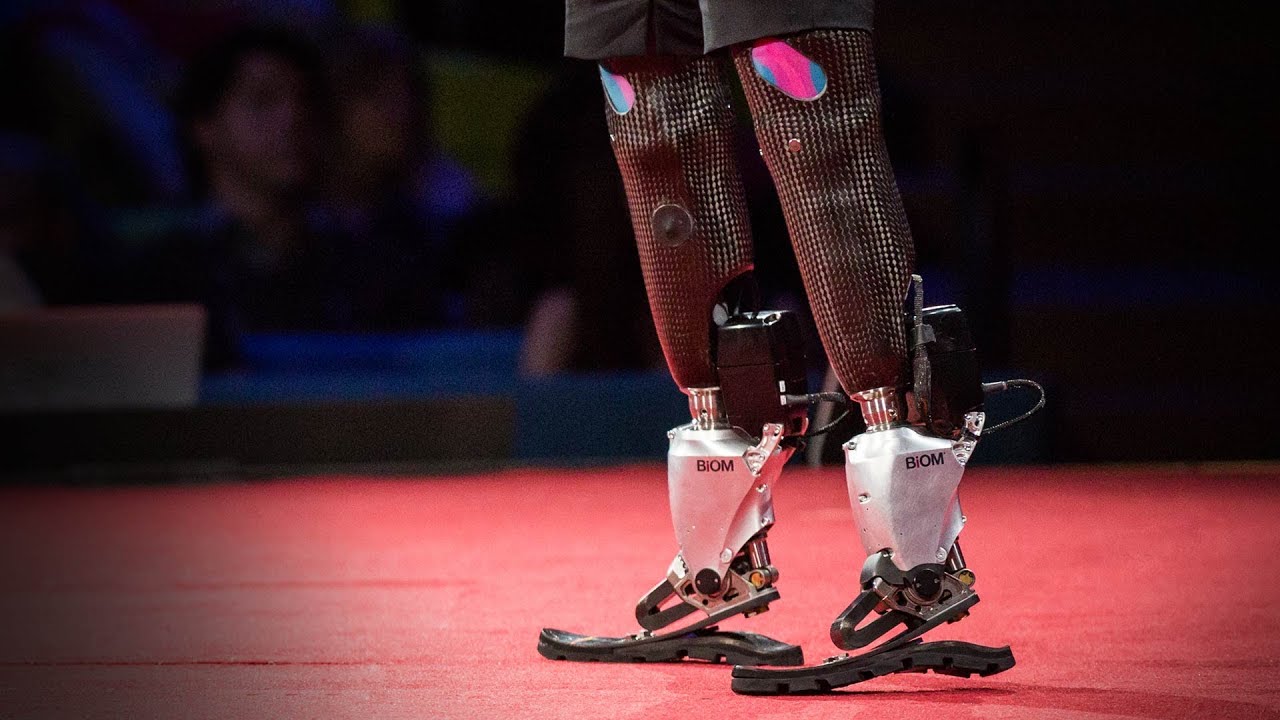
In this talk, Dr. Hugh Herr recounts his journey from a child mountain climber to one of the top U.S. climbers by age 16, and the life‑changing frostbite accident at 17 that led to bilateral below‑knee amputations. Faced with the loss of his legs, he taught himself mathematics, physics, and engineering, and used his hands‑on skills to design his own prosthetic limbs. Remarkably, he returned to climbing and surpassed his pre‑accident performance, which sparked his lifelong passion for human augmentation. At MIT, he leads a multidisciplinary effort to achieve total limb reconstruction, integrating machine learning, robotics, sensing, genetics, and tissue engineering. A central focus of his lab is creating neural interfaces that translate signals from artificial sensors into nerve signals that the brain can interpret. Herr also reflects on societal reactions to visible body differences, noting that many amputee athletes excel with bionic limbs, and he personally prefers his bionic legs over biological ones, believing they will continue to improve while his natural limbs deteriorate.
Chapters
I began mountain climbing when I was 7 years old, and by the time I was 16, I was in the top 5 climbers in the United States. When I was 17, I was on a mountain climbing venture with my partner Jeff Batzer in the Northeast. We were struck by a multi-day storm. After struggling to survive for many days, we were rescued and suffered severe frostbite and hypothermia. And after months of effort, my medical team gave up the fight to save my biological legs, and they were amputated just below the knee. I didn't pay attention a great deal in high school. If you would have asked me after graduation, Hugh, what's 10% of 100? I would just blank face. I'd have no idea. I learned how to make things out of wood and metal, and those technical skills actually came in handy because I knew something about how to cut, grind metal and other materials. I bought books on mathematics and basic biology and started reading them. I was like, oh, that's what a percent is? That's really simple. Started out in computer science and then transitioned to physics. I wanted to understand the fundamentals of the physical sciences so that I would be in a better position to design augmentation devices like artificial limbs. After the accident, I designed my own artificial limbs to return to the vertical world of rock and ice climbing. And to my surprise and everyone's surprise, I climbed better with artificial limbs than I'd climbed before the accident with biological limbs. That completely inspired me about technology and human augmentation. My goal was to not only restore my own physicality, but the physicality of broadly people with all forms of limb pathology. At MIT, we advance the fundamental science and technology to do total limb reconstruction. It spans many, many disciplines, from machine learning to robotics to sensing, genetics to tissue engineering. One of my favorite areas of our current work is our problem-solving around how to link the nervous system to a mechatronic device. that's integrated into the human body. Thinking about how to transmit signals from artificial sensors on the wearable robot into actually nerve signals that go to the brain. In today's world, when a body difference is visible, society makes such a fuss about it. There's these persons with leg amputations that are tremendous athletes. that wear these springy running legs. Some very talented athletes have even competed in the Olympics. I'm sometimes asked, if you could have biological limbs, would you? And the answer is no. Biological part of my body is getting worse in time, and actually my bionic limbs are getting better in time.