AMA with EQIFI CEO Brad Yasar and chairman Jason Blick
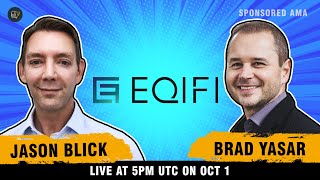
Brad Yasar and Jason Blick discuss EQIFI, a platform connecting DeFi and traditional banking through EkiBank. It offers a yield aggregator with 12-point risk scoring, fixed and variable lending, interest-rate swaps, and a crypto credit card, operating as a regulated investment manager in the BVI.
Questions this video answers
British Virgin Islands (BVI)
180 countries
White paper first iteration and platform launch both referenced as August 6 (team states the white paper's first iteration was Aug 6 and the platform went live on Aug 6)
EkiBank has been operating since 2015 (claimed by speakers)
Chapters
What's up everyone? I'm Giovanni. Welcome back to another Cointelegraph ama. Today we're going to talk about Ekify, a platform that aims to create a seamless bridge between decentralized finance and traditional finance, thus giving more user, creating a better user experience for decentralized finance. For this I'm joined by Brad Yasar, the CEO at Equifi. How are you doing Brad?
I'm doing great. Thank you for having me, Giovanni.
It's a pleasure. So probably we're going to be joined soon also by the Equifi chairman, Jason Blick. But so far we have just bread on and we can get immediately started. But before we start, I want to remind our audience that this is an interactive show. So please don't hesitate to write your questions in the chat and I'm going to ask Brad about it. Anything that sparks your curiosity about Ekify. So let's get into it. Brad, can you give us a bit of information about your background and the background of your project?
Absolutely. So my background is in technology. I introduced the computers at a very early age and started programming and fell in love with the whole process of creating something that, that makes these machines do the stuff we want and sharing that with, with other people and that, that started a lifelong journey for me with G and entrepreneurship. So that was my start. Then of course, that was the early personal computer years. Then Internet came and the connectivity and the utility of the things we can create really grew exponential. And I did a big data company at that time that was interesting to learn about, you know, how data can be really valuable. Fast forward to today, I'm on my 15th business Equifi is hopefully going to be the biggest and the most impactful. And it is basically a platform that brings centralized finance and decentralized finance together. Because for the past four years we've been talking about disrupting finance, disrupting banking, more access, more utility, inclusion. And what, what I've seen is that when you go in with the mindset that everything that's out there is broken and you have to redo everything, use a lot of resistance, people don't like it, you know, the incumbents don't like it and they start taking action against what you're building. We honestly didn't want that. What we wanted was to bridge the two universes and give people an opportunity to still be in defi pools, still earn incredible yields, still enjoy the cutting edge technology at the same time be able to use that value that they created in their everyday lives, go buy a new Car, go buy a house, go buy something nice without jumping through four or five hoops of, you know, selling LP tokens to native tokens, selling native tokens to stable tokens, selling stable tokens to fiat. Transferring that fiat to a bank account, if it's even possible, could because at certain values it's scrutiny heavily and then not be able to access it. So we are a defi platform powered by a licensed and regulated bank. We're in 180 countries and our mission is to bring DEFI to everyday people. Simplify to a point that your grandma can use it, my grandma can use it, and on the flip side, bring sustainable and supportive banking to our defi community so they don't have to worry about, oh, if I wire out $100,000, are they going to close my account going to be, you know, banned? Am I going to be suddenly on the crosshairs of the government? And by doing it in a license regulated way, we're confident that we can do that.
Awesome. Yeah, I think that's making DEFI a bit more user friendly and creating a seamless user experience. It's definitely something that the space needs right now. And you decided to find a solution about it by finding a compromise with centralized finance. I think that we have Jason on.
Yes, hello.
Hi Jason, how are you doing?
Looking forward to today.
Awesome. Okay, so let me introduce you first. So here we have Jason Blick who is the Equifi chairman. So he will join the discussion about Equifi, a seamless bridge between decentralized and traditional finance. So we were just. Brad was giving us an overview of what Ekifi is. So I want to just encourage our audience once more to write your questions in the chat. We're going to ask our guests about it also now I would like to get a bit deeper into the types of project, the types of product that you offer on your platform. So Akify offers a variety of different products. Do you mind to go through the main ones? Jason, maybe you want to take word here.
Absolutely.
And thank you. So we have four products, I'll let.
You take this, but unfortunately we don't.
Share on the platform. I'm sorry, what was that? So we have four products. We have a fixed rate lending product, we have a variable rate lending product, a money market product. We have a fantastic proprietary yield aggregator, phenomenal product. And we have an interest rate swap product, I believe the first interest rate swap product in the default space. And that allows clients floating rate lending and deposit facility. Obviously all of this powered by EKIBank, a global bank, so credit cards, services, all edge stuff.
I think that your audio is a little bit spotty, but I will summarize what you just said. So yeah, you have a lot of different interesting products, among which this yield aggregator, you have deposits, you have borrowing, you have interest rate swaps. So let's get a bit more in depth into it. So let's start from this yield aggregator. So right now earning yields in DEFI is probably one of the most attractive functions that are available in DeFi. A lot of people are attracted by the DEFI project because they promise very high yields. And that comes of course with all the disadvantages that the user experience of DEFI platforms usually have. So maybe you can tell us how your yield product solve these issues. Brad, maybe you want to get in?
Sure, yeah. I mean the biggest difference between our product and everything else out there is there was a rush to the highest APY among a lot of, a lot of protocols and platforms. And that unfortunately. Led to probably some short taken by those projects in instances of security and sustainability. Our approach is different from that in a way that, that we have a aggregator that actually the pools, a lot of the yield is out there and, and aggregates that in, in different pools. But it allows you to get exposure to projects and pools and products that you may not be able to find by yourself. Because we do the heavy lifting for you. We take the yields out and then we have a 12 point risk criteria we apply. So we look at the age of the pool, the pairs, the usage on it, the depth, the liquidity and few other things and categorize in a way that allows you to say, you know, I want to earn a conservative yield. I, I, you know, I want to de risk the, or, you know, I want medium risk, medium reward, or I want high risk, high reward. But even our high risk pools go into unsustainable products out there that are promising 400, 500,000% APY because we all know those are not sustainable. And yes, you may benefit from them for a couple of days or weeks. Those may also collapse and stop paying. So we have a much conservative approach where once we propose a yield pool, we know around a month from now, three months, six months, a year from now, and the engine behind it does all the risk analysis and allocations to make sure you're still getting the highest possible reward, but you're not getting the highest risk.
Okay, okay, that's interesting because I've been researching a little bit this risky practices that are being done in the DEFI space. And I Found out that there are a lot of projects which are essentially fraudulent in the sense that they have a huge risk of being rug pulls. So projects that have potentially have bugs, potentially have issues in the contract which are dangerous for the investors. So I guess that you, as far as you, as far as I understand from what you said, you carry out some sort of vetting process which select the projects and the kind of rank them according to the level of risk. But there are certain, certain projects which you will never deal with because they, you, you would, you would consider them as basically too risky, potentially fraudulent. Right?
I, I, I don't want to call anyone's project fraudulent. You know, that's, unfortunately there are projects that are not designed for community benefit and, and we all have heard about them, but it's more like we try for our stakeholders so they don't have to worry about where's my investment going to be in six months. And, and we do that through, you know, automated analysis that, that tell us, okay, this may be a super high yield pool, but it's not going to probably be around in two months and, or you know, this is a pool but it's very sustainable, has a lot of support and history. So, so this is a good investment for us to go into.
Okay, that sounds interesting. So let's talk about another of your projects of your products, which is the borrowing and lending side of DeFi. So right now a lot of people are interested in DEFI because they can lend, they can borrow funds which without going through. A classical KYC and credit checks, they can just borrow funds and lend funds without all these kind of procedures. In your case it's a bit different because you still have, as far as I understand KYC procedures in place. But, so maybe you can explain me like what is the difference between the product that you offer in terms of borrowing and lending from a traditional bank? So if you introduce this old KYC procedure, how is that different from getting those services from a traditional bank?
Absolutely. So RKYC is tier, not immediate to the level of a bank. What we try to do is again as a hybrid platform, we try to only have KYC when it's necessary and required. So if you want to just connect your wallet a few platforms without depositing or using large amounts, there's no problem. You can do that with minimal, just with your email address and password kind of minimal information. The KYC starts coming in, kicking in. If you trade and use really high numbers. If you want to use banking products, things that are licensed and regulated, we have to comply with regulators. But on the D side we start with very information sharing form and need more extensive use different products. We you know, ask for those questions at that, that stage.
Okay, so a very light user friendly also procedure in that, in that sense. So maybe can you talk a bit more about this lending and borrowing service that you have in place for people that might not know what is borrowing and lending in defi? Maybe you can go through that procedure on your platform. Maybe. Jason, you're back. You can maybe take this one certainly.
So we provide a variety of lending services, both fixed rate and variable rate across a whole range of asset types. So basically a client can deposit their preferred crypto with us and receive a stablecoin or indeed cash based on their needs. And we're a bit different to most platforms because we do have that option. So some clients prefer the certainty of a fixed rate lending product, say 5, 6, 7% or indeed as low as 2 or 3 and that gives them a certainty of the payments they need to make. On the variable side, a lot of clients prefer short term lending or are more comfortable with a variable rate and that variable rate adjusts with demand, etc. And the beautiful thing about our products as Brad also highlighted, was they're linked to Ekibank. So clients have a really effective way to get on and off the Fiat and crypto gateways.
Mm, okay, that's interesting. So in terms of collateralization, now I would like to understand how your platform works. So we know that in traditional banking in order to get out a loan, you need to show some sort of credit history. The bank checks your credit history and gives out a loan accordingly. The revolution in in the defi space in crypto lending is that without going through these checks, this credit worthiness history, people that have not a financial history can already access a loan. And how does it work in your case? Because in order to do that, most people have to put more collateral. These are the so called over collateralized loans in order to of course to guarantee that the money will be repaid in any way. So how does it work on your platform in terms of collateralization? Jason, maybe you want to take one.
Yes. In comparison to usual banking and as you rightly say, to get a traditional bank loan can take anything between two weeks if you're lucky and up to two months. And the amount of work that is required both by the client and the bank is enormous. With equifi we've really broken those boundaries. So the client simply lodges their collateral and we can lend significantly higher loan to value than most of the DEFI products. Now, obviously there is a call upon collateral in the event that the underlying cryptocurrency declines in value. But what we're finding is we're able to deliver loans in as little as 20 minutes. So it was really revolutionizing not only fixed rate, but variable rate products as well.
Wow, 20 minutes is very fast compared to traditional banking. But I was also wondering since you still have a connection with traditional banking, right. So as you said, EKIBank is partnering with your project and Ekibank is legacy bank in a sense that it's still a centralized entity that could still potentially carry out these credit worthiness checks. Why are loans on your platform only collateralized and you don't have also unsecured loans, for example? Is it something, what is the reason behind that, Jason?
Well, unsecured loans are a lot harder to process. With an unsecured loan, you do need to go through that enormous hard work doing the credit checks, processing the applications and the loans can be very expensive. With equifi it's very different because we can provide loans to people in 180 countries around the world, something that frankly any centralized bank in the world would be unable to do. But it does require collateral and that means we can keep the pricing down. We can provide the best service and the best LTVs to our clients.
That makes sense. That makes sense. Yeah. I think that it's a great thing that people all over the world can access your services while in traditional banking you most likely would have to be the resident of a specific jurisdiction and submit a certain amount of documents. So yeah, I think that it's great that you can find a compromise between the user friendliness of banking and the possibilities that defy has unleashed.
Also Giovanni, we just launched six weeks ago. So as we have our users build their profiles on our platform and give us the data points, we need to understand what type of user they are, what type of needs they have have. We can also do our own profiling on obviously how they're using and evolve our products in that direction. Obviously I don't want to ruin any surprises from our development and marketing team, but there are ideas that are being floated to marry the two and have hybrid products again that allow the users who've used the platforms for six months, 1212 months to prove their credit worthiness that way to us and be able to access exotic products that way. Because now we have firsthand data on are they paying on time, how much are do they borrow, what are they needs, what do they use? It for are they speculating with the loans or are they using it for a business purpose? Once we have a little more information, we have plans to introduce much more interesting products to all our user base.
Yeah, that's fascinating. That's fascinating. Maybe we can already jump into the questions of the audience since I see that there is a question here. One of our viewers is asking, does Equify has any insurance in place for all the products or services, perhaps? Yeah.
So at present there's no insurance for our product set. We are a little bit different though, because we're one of the few licensed and regulated defi platforms. So we have auditors in place that need to check every element of our capitalization, every element of our loan book, etc. So we are regulated, we're licensed. It gives that level of protection. And if clients want to open facilities with EkiBank, EkiBank has one of the best credit ratings of any digital bank in the world.
Okay, that sounds reassuring. So you said that you are fully regulated. Where exactly is the jurisdiction you are referring to in terms of regulation?
Well, we're delighted that we're regulated and licensed investment manager, which gives us an enormous amount of influence over the products we can provide. And clients have that security being audited, licensed, regulated. If there's a problem, they can go to our regulator. Our regulator is in BVI of British overseas territory. So it gives that again, that security of knowing it's being regulated by the laws of England and Wales.
Huh. Okay. So, yeah, I want to just remind our audience to continue asking questions because this is a very cool, cool product, according to me. Personally, I find myself, I find difficult to interact with Defi products. And I would actually like something that would facilitate all that and kind of bridge the user experience we usually have in traditional banking with this new fascinating space also providing additional security since the space is notoriously known for very risky, very risky, a very risky environment.
Especially Giovanni. While we wait for more questions just to add on the insurance conversation, there are some very interesting decentralized insurance projects launching right now. Unfortunately, they're not live and they're not at the maturity that we can just deploy them, but we are partnering up with two, three of them to both support their development as well as to have that option available to all our users. Because when we started building Akifi, one of the most asked questions we would get was, well, traditional banks offer insurance, whether it's FDIC or, you know, in other places by the government. How are you guys going to offer insurance to be on par with the peace of mind that those provide. And on the banking side, we're already in really great shape because a lot of the times banks have to have insurance because they lend out the money that's deposited and that's their business model. And the insurance kicks in because we don't lend out anything from the books. We don't really have that risk of not having the capital available to our banking clients. And same on the defi side. As soon as there are products that we can incorporate, that's going to be number one priority on our development roadmap. Because we want to get to a point where all the value locked on the platform, whether it's crypto or fiat, is safe and secure. And people can have the peace of mind that both technologically as well as procedurally, we're doing everything to safeguard their valuable assets.
And just building on that for a second, Giovanni, One of the incredible advantages we have is obviously it's bank proof. The compliance teams, the engineering teams, the operations teams, have been running banks for more than 150 years. So we know how to protect client money, we know the kind of products that clients want and we know how to deliver the right service. So we're a very transparent organization. You can jump on our website, you can see who's involved, you can see the corporates and institutions that are involved. And it's really giving a huge level of comfort, I think, certainly to the clients that are new to DeFi.
Yeah, for sure. So for everyone that is interested, just check out Equifi website, which is equify.com it's written eqifi.com and you can find a lot more information about this project. Now I would like to just sum up the products that you have been offering. So we mentioned the yield aggregator, we mentioned the borrowing and lending. Is there any other thing that I'm missing, Jason?
Well, it's that interest rate swap product, Giovanni. The interest rate swap product. Interest rate swap market, I should say is worth over $500 trillion. It's one of the biggest industries in the world. Equifi is the first platform in the world designed to solve and provide an alternative way to do interest rate swaps. It's a really great way to leverage perhaps loans you have with other providers to provide a level of security. So for example, if you're in a variable rate product with a different provider, you can basically swap that for a fixed rate product with us and vice versa, you can go from a fixed rate product with a different provider into a variable rate. So we provide a Huge amount of hedging and protection to clients on both of those incredible platforms.
Okay, that's also quite fascinating. But of course, your platform is also relying on a specific token. We know that EQX is your native token and it has specific functionality within your platform. So maybe you can go through the main functionalities of your native token. Brad.
Yeah, so I do want to clarify one thing. Our platform doesn't depend on eqx. You're more than welcome to come in, use your blue chip crypto assets and use the platform. We are not making it mandatory. What EQX does is it actually improves the experience on the platform. So more eqx, you have more you stake it, better rates, you get better access, you get higher limits, as well as access to different products. The bonus on all this is if you're interested in tying all your assets together so you don't want to have a separate bank account, you want to have your crypto and banking in the same place. The tokens also allow you to benefit from all our banking facilities at certain tiers with no fees. So it's an enhancer. It's a utility token that enhances the experience as opposed to being a key to unlock the platform. I mean, we want everyone to use the platform and if they choose to use it heavily and really benefit from it, of course there's a lot of opportunities and a lot of value to use EQX and, you know, improve the experience. But if you just want to test it out, you can do it with eat, usdt, usdc, btc. So there's no restrictions on, you know, using the platform if you don't have our token.
But you do get better rates, Giovanni, you get more higher LTVs. And as Brad says, we are the first defi and bank in the world that allows cryptocurrency EQX to be used to open accounts, secure credit cards, etc. So it really does have incredible use.
Case.
Yeah, I also saw that EQX can be used as a governance token. So this is, I guess, an important point to clarify. So your, your platform does allow for some sort of community governance, as far as I understand. So, as in the spirit of defi, your platform allows the community to have a saying in all the different functionalities that your platform offers. And as far as I understand, EQX plays a crucial role for people that want to participate in the governance of the platform. Maybe you can explain better how it works. Jason.
No, you, you did a good job, actually. I think it's, it's Just our motto was community governed banking and we wanted, we didn't want to build something that the community didn't find valuable and useful. We want to build things that excite our community. So the governance comes in to play there where if someone says why don't you guys incorporate this chain or that chain? We listen to them and we prioritize those developments. Because the best experience on the platform is going to be the experience you want to have with the assets you already have. It's not going to be if we go and build something tangential to what the majority of our community expects. They're not going to really benefit from it. And we wanted to give everyone a voice.
Jason, I thought that you wanted to add something about it.
No, Brad just covered it. I think it's completely unique for a licensed and regulated platform like ours to have that level of governance. There's no other platform that offers that level of security being licensed and regulated and having that open governance. So we are really excited about our EQX holders really having a voice in terms of products, rates, additional benefits, etc. And that's Brad and I's mission.
Okay, cool. And how does it work exactly? So let's say that I am a token holder. I have a large amount of your native token. How do, when and how I participate in these decisions, do I get notified every now and then about certain potential changes to be made and then I make my and then I vote about it or how does exactly work? Jason?
Yes, you're absolutely right. As and when there's broader distribution of eqx, when a decision needs to be made in terms of a new product, a new rate, etc. It doesn't go out to the community for community vote. And we're tremendously excited about getting to that point.
Awesome. Awesome. After a while I will give you the opportunity to explain exactly the process of your project, like how far it went and what are the next milestones. But first I want to give an opportunity to our audience to ask some questions. So we have a question asking, who would you say is the current leader in the CFI DeFi space and how are you different? What do you think gives you the edge? Who wants to take this one? Yeah, Jason?
Well, there are some great providers out there and it's probably best to name them, but there's probably four or five leaders in the space. But interestingly enough, each of those leaders only has one product. So for example, if you need a fixed rate product, there's some great organizations that provide you with A fixed rate loan. If you want a variable loan, there's a couple that provide that as well. And there's individual organizations that provide a yield aggregator. There is no organization in the world that provides all four like we do, fixed rate lending, rate yield aggregator and interest rate swaps. So there's nobody, and there's nobody in the world that's powered by a global, licensed and regulated digital bank. So with a lot of platforms, even the really good ones, these people still find difficulty getting on board, getting the transfers to their bank. The bank might not be crypto friendly, all sorts of problems there. But with Equifi and ekibank it's completely holistic. Everything a client needs, from a bank account to a credit card to an interest rate swap to a yield aggregator. And our two lending products is all available in one suite. So we've really had a look in the market in terms of what people have wanted, what's been successful and we've compiled them all into one platform. Giovanni?
Yeah, that's definitely a powerful formula. We have another question which is about the. It's again about your native token. So as far as I understand your native token has a limited supply, right? So it kind of wants to give this scarcity element which potentially could be good for its price in the sense that the scarcity might drive the value of the token higher. But there is a question here which asks will the limited supply cause problems in terms of sustainability in the future? Maybe. Brad, you want to address this one?
I'm not sure I'm going to address it by combining two questions because there's another question that says is there any buyback or burning program for EQX token in the future? So if we combine those two, scarcity and non infinite emission is good because we want the early adopters to benefit from the value we create on the platform, from our growth, from our increasing total value locked, from our increasing adoption of new blockchains and new products and features added to the platform. In order to do that we didn't want to have a very large number of tokens or an expansive number of tokens. We set it to a limited amount, which is, which should have the correct effect on the tokenomics after three years. Of course that also puts some pressure on the circulation and availability of the token and we managed to actively, I mean we plan to actively manage that through buybacks. We're not going to burn any tokens because it's a limited supply, but we are going to manage the circulation and velocity of our token economy with buybacks and other strategies that include staking and having an OTC desk and things like that. So everything is by design and we don't anticipate any problems at any given time in the near future, as well as maybe 10 years from now with the token supply. Now, if there is unexpectedly a strong adoption, we have other plans in place to address that in different ways. But we believe having a limited amount of token supply and a small limited amount is very favorable to early adopters, early supporters, our strategic partners, and we expect that to benefit the whole ecosystem.
Yeah, I think it's very important for every project to give an incentive to early adopters while still not penalizing the future participants. So that's sometimes a very tricky things to do. But I see that you have a solution here in place. I also want to address another question which is actually makes me think about another product that you have, which is the credit card. So you have a credit card product which allows people to spend both fiat and cryptocurrency. Can you maybe explain better how this credit card works, Jason?
Yes, we have a hybrid credit card that's available, so it's set against a particular deposit that the client lodges, but it's a completely unlimited card. So if you choose to go out and buy your Lamborghini, you can do so with our card. And the process really quite simple to load it. The client can sell their eqx, it's an OTC transaction onto their card and off they go. In the near future, we'll also be introducing a new product which will allow a direct spending of crypto on the credit card. So hugely exciting. And again, you can see the information on our website. We encourage any questions or clients.
So let me understand if I understood correctly. Basically you said that in the future there will be the possibility to direct spending crypto. Right now there is a mechanism in between that let's say you have on your card you have a deposit of 50 bitcoins and you want to buy something, those bitcoins will be transferred to Fiat and then the purchase will be made. Is that how it works?
That's absolutely correct, Giovanni, yes, but it's working incredibly well. The number of clients that are taking that. We've got one order that's coming up for nearly 30,000 of those cards. So we could be happier.
That's great. And how does it, how much time does it take for this transaction to happen, like from the, from the crypto into the actual moment you actually finalize the payment?
Well, once the client's onboarded with Us and goes through that minimal KYC process, we can undertake those transactions in as little as a couple of hours. In some instances, it's actually instantaneous.
Oh, okay. Okay, that's great. Yeah. I think that making crypto spendable in an easy way, it's something that we would like to do more often in our everyday life. Unfortunately, the space so far hasn't provided a lot of solution regarding that. But I see that products like yours are advancing also this aspect of cryptocurrency, which is just spending cryptocurrency in our everyday life.
Yes.
We're definitely ahead of the field in both being licensed and regulated on the defi side, plus being powered by the bank. I mean, everything you need is in one place.
Yeah. Now, I would like to maybe give you the opportunity to go through the stages of your product. So as far as I understand, Akify is a very, very new product you launched this year, as far as I understand. Maybe you can tell us what are the milestones that you have already achieved so far and the milestones that you aim to achieve in the following months? Maybe, Brad, you want to take this one?
Absolutely. So we are a brand new platform, but I have to give Jason all the credit here for us being able to go from a white paper to a live platform in one year. Exactly. Our white paper, the first iteration was done last August on the 6th, and the platform went live August 6th this year. But that's just the tip of the iceberg. Jason and his team started all the conversations around the banking licenses with our regulators five, six years ago, and those took a really long time to educate and get the right relationships in place. So when I say we launched in one year, it's because we kind of cheated and came to the party with all our licenses and regulator relationships. And so there was a lot of hard work done there. On the development side, again, we kind of cheated a little because we deployed our own development team, we had the resources in place and we were able to activate them. But as far as the milestones white paper was last August. We did a small fundraising round in March, April period to establish strategic partnerships. That was very well received and truly humbled us because we had five times the amount we were trying to raise in in a few days. And it was more of a challenge on on managing the cap table than raising the funds. We launched on time again this year in August with all the products we promised we would do. So we had our variable rate, fixed rate, interest rate, swaps, yield aggregator and staking available at Launch of course, you know, this is a living project. So based on the feedback we got from our users and community, we deployed some fixes, some upgrades after, after the first couple of weeks. So we already had a version up last month. We're going to do another one this month because we, we really value the data points and the feedback we get. So we're going to deploy another upgrade to the platform. We also always said we want to work with different blockchains. So we were never an Ethereum project or a Polygon project or a Polka Dot project. No, we wanted to, you know, in the spirit of bridging the divide and being the gateway to crypto for people who've never used it and be a gateway out of crypto for all these incredible defi projects, we always wanted to have a multi chain approach. So we bridged Binance Smart Chain with Ethereum at launch just because we had token distributions on both. And what's on the roadmap is all our product suite on the Binance Smart Chain because right now, you know, the staking, the yield, farming and such is not on the Binance Smart Chain. You can have our tokens on Binance side, but there's really not much you can do on the platform with it and we want to remedy that. Once we have the products on Binance Smart Chain, we're going to keep implementing other, other blockchains and building our products. We did announce a partnership with Tezos last month, so that's going to, on the, one of the sprints that's up and coming. I expect us to be on four blockchains by the end of the year and we hope to add another four next year. And we're in talks with all of them and initially we're going to start by bridging the assets, introducing our staking product and then building the lending, borrowing if possible, yield aggregation if possible, if possible, interest rate swaps and such. And these are all monumental undertakings. I mean if, if a bridge already exists, it's easy, you, you use it and you build your products, but if it doesn't, then you're basically bringing two blockchains, however closely related they may be together. And, and you know, it takes a lot of development time and hours and, and, and resources. So on the tech side that's, that's, that's our road map. On the token side, since everyone keeps asking that, you know, we launched, we said look, we're gonna try to add one exchange every month. So initially, eventually after two years we'll be on all the exchanges that all our community members want, we went a little faster than that. It's going to be our third month now, third distribution, and we're going to be on 10 exchanges at that time. So we have couple of tier one exchanges, couple of tier two, and we're going to continue every month to work with our exchange partners, with our strategic partners to add more to the point that eventually we're going to run out of places to list and that's a good thing because then, you know, our telegram chat is not going to have when binance and when this and when that, it's going to have more productive conversations. But our goal is to be on all the markets that our community members use so they don't have to create a new account, they don't have to create a new wallet. We're constantly adding new wallets with EQX as well, just to make it easy again. When Jason and I started talking and getting excited about building something, it was all about the user experience. The products exist out there. If you are a highly technical blockchain developer and you don't mind using command line interface to interact with your kusama smart contract or something like that, what we want to do is we actually want to make it simple for my parents to use the platform, your grandmother to use the platform. People who don't know anything about tokens, but would really benefit from a yield that's 3, 4%, or if they want medium risk, you know, 8%, 10%, or if they are young and they just don't know technology, but they have some wealth that they accumulated, you know, for them to be able to come and benefit from the high, high risk pool without knowing anything about wallets. And we're gonna keep working for that dream to become a true.
Yeah, that, that sounds fascinating. I mean, I'm looking forward to the future where my grandmother will be using DeFi because that means that DEFY has literally taken off and become mainstream, as people say. We should aim at the future where blockchain technology and this type of technology are invisible for users so that they just interact with them without even noticing that they are actually interacting with these technologies.
Exactly. That's key.
I think in that regard we're already succeeding. Giovanni. A lot of people feel very comfortable because Ekibank has been up and running since 2015 and we've been voted a top 10 digital bank. Accufi has been voted the number one DeFi platform countless times. And quite a significant portion of our client base is completely not Only new to DeFi, but new to crypto. So we're providing the access for hedge funds, institutions and what have you to get involved for the first time ever in a licensed and regulated platform, which is phenomenal for the crypto community as well.
Cool. So now I think that we have time for one last question from the audience and then some. Then we can wrap up the discussion. So I saw some questions during the discussion regarding regulation. So a lot of people are concerned about rumors around potential crackdown of the SEC or other regulators in the US or elsewhere, like China, on the cryptocurrency environment in general, but specifically on DeFi. So what are your thoughts about this potential crackdown that could happen? How is your company looking at these potential events?
Maybe.
Yeah, Jason.
So we're very blessed, Giovanni, because we're a bank. And as a result of that, we're incredibly heavily regulated, especially in those two pillars, aml, Anti Money Laundering and kyc Know your clients. So we were able to bring a massive compliance and operations team to bear for equifi and really future proof ourselves. So we already took the steps to ensure that our KYC is future proofed and we have the AML systems in place to ensure that everybody is protected. That isn't the case with most products and most projects. So what we're trying to do is really lead from the front by showing people and regulators that you can introduce a DEFI platform powered by a bank, and you can be licensed and regulated and you can be user friendly as well. We don't believe in cutting corners, Giovanni, so we got it right straight from the beginning.
Awesome. That sounds great. I think that it's going to wave off a lot of concerns because people want to put their money into something not only that brings high profits, but also that is not too risky. And regulatory compliance is definitely, is definitely an important component of all that. So maybe it's a good time to find some final remarks. Brad, do you have anything else that you think our audience should know?
Yeah, I mean, I think there were a couple questions about competition. We don't believe we're competing with anyone, to be honest with you. We. On a product level, yes, you can say, well, you guys are competing with, with this, this, this platform, but overall we are looking to grow through partnerships and, and we like supporting existing projects in the, in the market instead of trying to grab market share. There were issues with, you know, questions with how, you know, any clampdown or any kind of adverse action, if it would benefit equifi, if it would harm. Again, we welcome regulation. We're not trying to hide from it or run away from it. We just want it to be done in a meaningful way that allows for innovation, that allows for new things to be built and inclusion and access. So as long as our innovators are supporting us, we don't expect any challenges on the global scale of growing and future adoption. So we're excited and hopefully our community is too.
Cool. Jason, maybe you want also to add some more final remarks. Specifically, I see that there is one of our viewers who is asking about marketing approach, so you maybe want to just add something regarding this aspect. What is the marketing approach you're using?
Of course. So we're a little different in that regard as well. Of course we're heavily involved in traditional crypto media. We've got a phenomenal telegram group, etc. We reach out to people in all key media, but we also have a team that's dedicated to quite significant announcements and we bridge that traditional finance and crypto market. So you'll see a lot of our coverage in things like Wall Street Journal, Financial Times, the Economist and we're really the first people in that space as a defi and banking platform. So we're doing a really nice job of appealing to institutions, large investors, sovereign wealth funds, hedge funds, and they're seeing us as a really safe and protective way to go into the defi space. Those monies that kind of liquidity really helps all our community on EQX holders get incredible value for money.
Great. So I think this is an awesome note to wrap the discussion up. I would like to thank our audience for being so involved in the discussion. There were very interesting questions. Thank you Brad and Jason to come up on our show.
Thank you. It's our pleasure.
Thank you for having us.
Yeah. And for everyone who is interested to know more about the project, just check ekify.com eqifi.com and you're going to find much more information regarding this project. We are going to look forward to the next developments. So yeah. I'm Giovanni, your host. Thanks for watching. Don't forget to like and subscribe the video and see you next time.










