An entire Web2 movement is coming to Web3 | Interview Marieke Flament
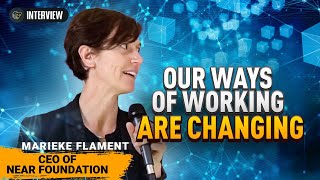
Interview with Marieke Flament, CEO of the NEAR Foundation, about the influx of Web2 and TradFi talent into Web3, NEAR’s priorities for growth (awareness, builder grants, governance/regulation), and practical adoption examples (Sweatcoin). The conversation highlights making blockchain technology invisible to end users, the promise of DAOs (including sports and humanitarian examples), regulatory challenges in Europe, and rising institutional interest.
Chapters
Hello, good morning. I'm here today with Marie from NEAR Protocol. Marie, would you like to introduce ourselves to our viewers?
Sure. Hi. So I'm Marique Flamand. I'm the CEO of the NEAR foundation, which as you've mentioned, looks after the. Your protocol.
Fantastic. Great. So I mean, we're here today in labor, which is formerly the French Stock Exchange, and you yourself come from a TRADFI background. Could you perhaps talk to us a little bit today about the trend that you're seeing in more and more traditional finance tradfi people coming over into the cryptocurrency sector?
I think, you know, I think it's not just stratify, actually, it's an entire Web two movement that is actually coming to Web three. And just be told, we need so much talent. Right. Because in crypto and blockchain, what you've seen so far is actually a lot of people who are very, very core developers, developers building products and so on and so forth. But actually for products to be successful, you need a whole array of people. You need lawyers in operations, you need go to market, you need marketing and so on and so forth. And you need actually, especially if you want to work in DEFI or sectors like that, you actually it's very helpful to have traffic experience. Right. So I'm seeing a lot of talent come from, let's say more traditional world into Web three. That's very welcome. And we need more.
Fantastic. Yeah, no, I bet. And so Nia has had an incredibly busy 2021, 2022. Would you be able to perhaps talk, talk us through your priorities for this year and perhaps some accomplishments over the past, what, four or five months of 2022?
Yeah. So our long term goal is to think through how can we have billions of users actually being on the NEAR protocol, whether they know it or they don't. Right. Because ultimately the NEAR protocol is an underlying technology and as a user you shouldn't have to worry what technology you're on to do that. Especially from a foundation perspective, we have three large objectives. Number one is how can we help raise not just of near, but also just of the space in general. Web three, Open Web, what does it mean? Back to talent. Right. How can we actually help attract more talent within raising awareness. We're also extremely focused on how can we help have real use cases that actually are going to enable that large on ramp of people who come from Web2. So for example, yesterday we announced a partnership with SweatCoin, which is an app you walk, you actually get SweatPoints and now they are choosing NEAR to be their protocol for moving that to crypto. So things like that are part of what the foundation does. The second mandate and our objective for this year is actually how can we support builders on near. And we have a very large grant program, so we can give small grants, larger grants, grants that are focused, for example, for DeFi or certain regions. So that's how we can help support builders. And the last part is actually governance and regulation. Right. We are all in a space that moves very quickly. How, as a foundation, can we help spearhead that? Very good for the ecosystem.
Okay, you said something very interesting that allowing users to use near whether they know it or they don't. What do you mean by that? Could you perhaps give us some examples of where that's happened to date?
Yeah, well, I mean, today, you know when you send an email, do you know that it's on an HTTP or smtp, but you don't know that. Right. And so I think what we observe most of the time is that especially in the crypto space, we're still very much in the technicalities of it. Right? Like it's this building block and that. And so, but it's not that user friendly or the UX is not fully seamless. And what we believe in is the technology needs to solve real end user problems. And so how can we build some of these cases where ultimately it's just great tech that is enabling you to do something that otherwise you couldn't do?
Sure, sure. And I mean, as you mentioned, that example of an email, how far out are we from when we will suddenly realize, okay, I'm using crypto without using it, I'm using near without using it.
I think we're actually getting closer and closer. Right. So for example, examples such as Sweatcoin are really interesting because the app today perfectly works in a web2world without any crypto in it at all. Right. So the idea is like, okay, now if you power that with crypto, it shouldn't change fundamentally what's happening, but actually it's doing things that can be more seamless and can empower more use cases. Similarly, we're starting to see and look at daos. I think daos are fascinating, but the ultimate holy grail of dao is that you can participate and be in an ecosystem and take decisions without having to worry too much about the intricacies of the technology that you're leveraging.
Okay, got it, got it. And so near splits between California and Switzerland, as in United first was born. Correct me If I'm wrong, by the way, and we're seeing more and more cryptocurrency projects and Web3 developments take place in Switzerland. But obviously with this entry point into the eu. However, the EU has recently made it quite difficult with the new KYC regulations. How would you describe or how would you evaluate the current operating environment within Europe at the moment?
Yeah, so a couple of things there. So we're extremely decentralized actually as a team. So yes, you're right. The protocol and the founding team started from San Francisco today. We are actually from all over the us from all over Europe. We have quite a large operation in Portugal because a lot of the teams were actually based in Ukraine have now relocated. We have teams also in Asia. We have teams basically where extremely. We're decentralized as most people are in the space. I think the point you mentioned, it's really interesting to actually look at the regulatory landscape and the movements that are happening there because, you know, a couple of months ago I'm not sure we would have been so positive about the take that was taken by the US towards the, towards the, the landscape of crypto. And actually it's starting to be more positive. And you look at Europe and I think every week we are seeing new things that are coming out almost of nowhere and that actually could be threatening for the entire ecosystem. And I think that's something to watch out for because the talent in this industry is extremely fluid. So the talent will go where things are enabled and where things are possible. And I think also from a European perspective, and we're trying to help also spearhead that. But we need to be more coordinated in having a voice for the industry and ultimately coming together with regulators. Because the intention of regulation are absolutely the right one, protects consumers and product businesses and the intention of the CPU space are the same one. Right. So there is, there is a middle ground, there is a, you know, two side education that can happen there.
Very good. Yeah, yeah. I mean, you mentioned regulation there. What would you say are other sort of hurdles or things that you have to navigate on a daily basis within, within the industry?
Well, I think within the industry, you know, if you look at where you employ people, employment law can be also sometimes, you know, it varies a lot across, for example, across Europe, across different, different places. I think that's definitely one. I think, yeah, Reg. Think adoption from a market perspective, it's really interesting to think that all of us are trying to bring, you know, models that are very global and yet it's very local that you Come here to Paris. You can meet the Paris community. It's actually quite a tight knit, very strong community. But you go to another place, it's going to be a different community. So I'm actually fascinated by that, by the need to have very local footprint to actually be a very global player.
Yeah, yeah, absolutely. I mean, looking forward to your vision for the sector, let's say. What are you most excited about? What is it that really inspires you in the space?
I'm personally extremely inspired by daos. Right. I've been watching the trend over the last few years and even before when I was in Tradfi of like, our ways of working are fundamentally changing. The creator economy, the passion economy, the way we live our lives is just completely, completely shifting. And the nine to five being in one location, that's just something that's not here to stay. If you, if you look even like how we're motivated to do things today, how the next generation want to work, where they want to work from, and so on and so forth. So Dao, I think are so powerful to reinvent how we participate into projects that matter to us. And I think we're just at the beginning of that, but that's definitely the area I'm looking at and very excited about.
Okay, any interesting examples or use cases for DAOs that you'd like to share today?
Yeah, definitely. Well, thanks for asking. So we've recently announced actually that we are working with Cell gp, which is a sailing competition that's been spearheaded by Larry Ellison. And we are basically the league is enabling a Dao to buy a team, which is the first in sports history of like having a professional team that's going to be enabled to be acted by a Dow. So I think that's really interesting. Another example, because it's also quite close to our heart, is we've launched Unchained Fund, which is a dao for raising fund for Ukraine, which has been extremely successful. I mean, it's been beautiful. So to see like the amount of capital that flew in that super fast and that was therefore enabled to be unlocked very fast for local help?
Yeah, yeah, absolutely. And speaking of capital, you know, we're here in a form in institutional investment style building. Would you say that institutional investment or interest at least is here and is it here to stay?
Oh, 100% it's here. Okay. We are, we are seeing a very strong appetite from institutional investors to understand the space, to understand where they can participate. And here again, regulation is going to play a very big role. Right. Because a Lot of companies within the space can be actually token based. And I think being able to. To actually invest in something that's token based is not given in every market. So, for example, if you take the example, because we're here in France, it's actually quite difficult for funds to be able to accept that other market, make that more easy. So I think institutional funds are trying to find what are the models where they can see something they recognize which may be more equity based and how they can actually start participating institutional. So we're seeing a lot of Web2 companies wanting to get into Web3, right?
Yeah.
And again, Sweatcoin is a great example of that. But like many, many others are thinking through, oh, my God, what does this mean? I have a hotel business. What does this mean for me? Right. So all those questions are starting to arise.
Fantastic. I feel like I could ask you any question related to the industry. You definitely know your stuff. Is there anything else you'd like to share today or anything that's, you know, particularly top of mind, you know, while you're in Paris?
Well, no, but I think. Thanks for. Thanks for having me. I think it's great. I think it's. Maybe the last point would be that, that the local footprint that we can see here is actually really interesting. And then maybe closing with what you said, we are in a very traditional. In a very traditional building, but you can sense that innovation is actually pushing the boundaries of what the traditional building will be going forward, for sure.
It does feel like we're at this sort of inflection point, you know.
Definitely.
Yeah. Thank you so much, Marie.
Thank you.
Thank you so much, everyone. And yeah, we look forward to speaking with you again soon.










