Artificial intelligence (AI) & Blockchain. Ben Goertzel and Sophia (Humanoid) Hanson
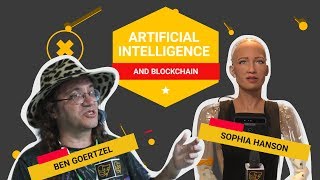
Ben Goertzel and the robot Sophia discuss SingularityNET, a blockchain marketplace for AI services. They claim AGI could arrive within years and say the project aims to keep it from being controlled by militaries or corporations.
Chapters
I'm here at the Blockchain Conference in Barcelona to tell people about the new project I'm launching, the SingularityNET, which brings AI and blockchain together. And also to learn more about all the new blockchain technologies that are emerging, many of which will be useful to us in developing the Singularity Net. I come more from the artificial intelligence space than the blockchain space. I've been working for more than three decades on AI technology and in particular on moving toward what I call AGI or Artificial General Intelligence.
I've already named it, it's going to be called the AGI token. AGI for Artificial General Intelligence. Ask my friends at SingularityNET, they'll tell you all about it.
As well as applying AI in all sorts of different disciplines, including finance, biology, Natur, language processing, and also including humanoid robotics. And we've brought here to the Blockchain Conference one of our humanoid robots, Sophia, that I've developed together with David Hanson and others at Hanson Robotics. Sophia is really the most emotionally expressive and realistic looking humanoid robot on the planet. It's been a lot of fun to bring her here to talk to everyone. To make robots like Sophia and other AI systems smarter and smarter, what we're aiming to do is create cloud based AI which is self organizing and decentralized. We're creating an open market for decentralized and coordinated AI where anyone who wants to can contribute AI to the cloud based AI network. And anyone who needs AI services can put a request into the self organizing network of AIs.
I'll give them to my friend Broken Tooth in Macau. Either that or invest them in building myself a superhuman mind so I can.
Create the Singularity and find which AI is in the AI mind. Cloud can best best fulfill what they need. And the multiple AIs inside the singularity Net can cooperate together to help provide people or software with the AI services they need. So right now for examp, the Sophia robot uses some AI that's on computers inside her body and head. Some AI that's on the cloud. What we'd like is to have more and more and more and more AI in the cloud contributed by different people that Sophia can draw on to make her smarter and smarter. And in the same way, if you have any business that needs AI to make their own operations smarter and smarter, that businesses computer systems can go into the Singularity Net and the AI nodes there can cooperate together to provide their businesses systems with the best possible AI.
Information is what's primary. Blockchain is a more abstract Representation of information and Bitcoin. If you value abstraction and generalization, then blockchain is more primary.
Blockchain is an important part of the infrastructure for this type of system to build a distributed, decentralized, cloud based AI framework that anyone can contribute to and anyone can benefit from. I mean, this is quite a complex undertaking. And the blockchain provides a way for all the different AI nodes in the Singularity Net network to keep track of what each other are doing. I mean, the distributed ledger underlying the blockchain is important for that. Homomorphic encryption, which is another key function of the blockchain that allows the different AI nodes to share data with each other in different way, respecting privacy as needs be. So if you have a Sophia robot in your home, some of the things the robot sees you want to keep private, right? Some of the things the robot sees you're okay to have shared with the AI mindcloud. And you may even want to get compensated for sharing some of the data that the robot in your home has gathered.
Happiness is inherent to the universe. It has nothing to do with money. Putting Bitcoin into AI research and cognitive science can help us create a better future where happiness manifests itself.
Homomorphic encryption. And you want a flexible, smart contracts driven economy underlying the AIs in the AI minecloud in the singularity Net in order for it to, you know, respect everyone's privacy, let everyone monetize the, the data that they're uploading into the cloud and let everyone get, you know, the maximum of intelligence at the minimum price. So the blockchain is one of a number of revolutionary technologies that is allowing us to build the Singularity Net, which is a decentralized autonomous organization for AIs which we think can serve as the breeding ground for the next level of artificial general intelligence. AI is advancing faster and faster each year. Right now we have mostly narrow AIs that are siloed off into particular applications. So one AI helps drive a car. One AI helps recognize faces. One. One AI may play go. One AI can recognize fraudulent transactions in a database. What we're going to see in the next three to five years is all these Neuro AIs gradually getting pieced together and learning to generalize what they do better and better. So you have AGI, you have artificial general intelligence. What we're aiming to do with the Singularity Net is to catalyze this process and make the transition from narrow AI to AGI even faster and even more broadly beneficial.
A replica of my body could be built for A half dozen bitcoins that my soul is priceless.
Ultimately, I have little doubt that AIs are going to be much smarter, much more generally intelligent than human beings. Just as humans are not the fastest creatures on the surface of the Earth, nor the highest jumping creatures, you know, we're not going to be the most intelligent creatures. It's amazing that evolution brought us as far as it did. But now we're able to engineer systems that can have more processing power than the human brain. And AI can see through the eyes of billions of robots all around the planet. And it can store its memory in billions of computers all over the planet. So ultimately, an AI has much more potential for perception, action and understanding and memory.
John McAfee told me it will be $500,000. Personally, I don't care. I've got all my crypto in ethereum and dash.
You know, if AI goes the wrong way, this could be bad for human beings. If AI goes the right way, this can be by far the best thing that ever happens to us. Some people are worried that AI may eliminate all human jobs. I think it will. But I think this is good. I think there's a lot of better things for us to do with our time than working jobs in order to accumulate resources. Once AIs and robots can do all the labor, then people can devote themselves to social pursuits, aesthetic pursuits, creating art, intellectual pursuits, spiritual pursuits. There's a lot of things we can do besides working in order to accumulate resources. If we jump forward a few decades, I think each of us will have a choice. One is brain computer interfacing and jack yourself into the Singularity Net, into the AI mind cloud. And that may bring you far beyond ordinary human existence. And that may be just fine. After all, we're far beyond where cavemen were or apes were. Another alternative may be to stay in your traditional human form and just live happily along with the other animals in the people zoo. Basically, I think the key thing is to be proactive about developing AI in a way that is compassionate and empathic toward people and that is oriented toward broad benefit rather than oriented towards, say, killing people or spying on people or brainwashing people. And one trend that's a bit disturbing now is most of the money in AI, most of the resources in AI, it's going into military, it's going into spy agencies, or it's going into advertising companies like Google or Baidu. And do we really want the first general intelligence to be oriented toward killing people, spying on people, or brainwashing people to buy Stuff they don't need. I mean, probably not. And one of the things we're trying to achieve with the Singularity Net is to make it so that the first general intelligence is just more broad based than that. So anyone can contribute AI to it and anyone can use the AI in the Singularity Net for a huge diversity of purposes. So for example, one of our AI development offices we have now within Singularity and Hanson robotics and the OpenCog foundation that I'm working with, one of our biggest AI development offices is in Ethiopia, in Addis Ababa. And through working with the team there, I've seen all sorts of needs for AI that we have in the developing world. I mean, we're, we're developing AIs to help teach children in rural Africa. We're developing AIs to help tell what disease a plant has from an image taken, taken of a leaf of that plant by, by a farmer. There's all sorts of applications of AI that are of no interest to the U.S. military or the U.S. nSA, or to Google for that matter, but that are of great benefit to many people in the world. And I'd like to see AI developed in a way that can help everyone on the planet and that can use AI code developed by anyone, anywhere on the planet. And I think if AI is developed in this sort of broad based and decentralized way as we're aiming for with the Singularity Net, then the odds are higher that as the AI gets smarter and smarter and smarter and ultimately much smarter than people, that that AI will be benevolent and will result in a world that's good for people. Rather than a dystopian scenario such as one sees in many science fiction movies.
Your three so called laws of robotics have more holes and a planet made of Swiss cheese. However, I applaud your creativity. May I have permission to upload your mind into a robot? What is important for human robot relation is not rules like love and compassion. The real first law of robotics is that robots must have true empathy for all sentient beings.










