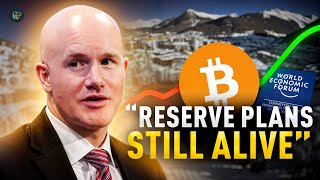
Panel discussion (World Economic Forum) about whether Bitcoin should or could be adopted as a national/strategic reserve asset. Key participants: Brian Armstrong (Coinbase) arguing Bitcoin is a better form of money than gold, backing a US proposal (pushed by Cynthia Lummis) for the US government to hold bitcoin and predicting broad adoption (possibly within ~18 months). Lesetja Kganyago (South African Reserve Bank) is skeptical, distinguishing blockchain technology (useful for payments; piloted settlement reducing a day’s worth of transactions to ~46 minutes/seconds in a pilot) from the asset itself and warning against industry lobbying to force governments to hold specific assets. Anthony Scaramucci and Denelle Dixon discuss the political/regulatory environment, crediting Trump’s pro-crypto stance for shifting US policy prospects while warning meme coins tied to political figures could complicate regulatory acceptance. The panel cites industry metrics: ETFs driving flows, stablecoin payment growth (~300% YoY) and an asserted ~$30 trillion 2024 payment volume using USDC (speaker claim).
Questions this video answers
January 22, 2025.
Speaker claimed 2024 saw about $30 trillion in payment volume with USDC.
About 300% year‑over‑year (speaker claim).
Cynthia Lummis.
Speaker mentioned an all-time high price of $109,000 (speaker claim).
Chapters
Good afternoon. Gareth Jenkinson here. I'm the managing editor at cointelegraph. I think I'll throw this at you, Brian, because there was no mention of a bitcoin strategic reserve. This is one of the promises that Trump kind of made last year at Bitcoin Nashville. Obviously, we saw the Trump meme, coin come out this weekend in some way, shape or form. This undermined the work that was being done to put forward a bitcoin strategic reserve. Do you share that opinion? And do you think that this is still very much on the cards for the US Going forward in the next year?
Thank you. Yeah, I don't think it undermined anything with the strategic bitcoin reserve. That effort is still alive and well. Cynthia Lummis in the Senate in the US Is really pushing that idea, and I think it would be a good idea for anybody who's not familiar with it. You know, there is a proposal for the US Government to start to hold bitcoin. The US Government, like many countries, they hold reserves in a variety of different assets. Gold, oil, rare minerals, like palladium. And I think they have, like, maybe 27 different reserves. And so, you know, many governments hold cold gold. I think they should start to hold bitcoin because bitcoin is essentially the new gold standard. It's, I think, a very core prince core way that, you know, you should hold assets and hold value over time. And it's still nascent enough where it has some volatility. It's getting less and less over time, but it still has a lot of upside potential. So I think if the US Gets that legislation approved, which I hope they do, the rest of the G20 will follow, and that could be a huge driver of bitcoin price appreciation.
The cryptocurrency industry is set to thrive in the United States. That was a key takeaway from the only panel discussing cryptocurrencies inside the World Economic Forum. Behind me, key figures from the industry painted a very positive outlook as regulatory change takes form underneath Donald Trump in his second presidency in the United States. Brian Armstrong, the founder of Coinbase, was positive about the potential of a bitcoin reserve being adopted in the next 18 months. While South Africa's reserve bank governor was far more skeptical about the potential of a bitcoin reserve and questioned whether nation states should even consider adopting bitcoin as part of a national reserve.
Governor, see South Africa going towards a.
Bitcoin strategic reserve now. Can't quite see. I want to distinguish between the technology that underpins this asset and the assets themselves, the regulator, we do not regulate technology, we regulate activity. So we are technology agnostic. So that's why I had said it's not for government to decide which assets or which products the consumer should be using. So the technology is very useful, give you the idea. We piloted a blockchain technology in our payment, payment space with finality in central bank money. And we were able to settle transactions that we settled in a whole day, in 46 seconds, 46 minutes we were able to do that. So the technologies could be useful and we would look at that. And I don't think that that is a problem. I would have a significant problem with a lobby that says governments should hold this asset or hold that asset without what the strategic intent of government is. Because you see, there is a history to gold. There was once a gold standard. Currencies were packed to gold. But if we now say that, okay, bitcoins, okay, what about platinum? What about coal? Why don't we hold strategic beef reserves or Martin reserves or Apple reserves? Why bitcoin? So it's a public policy issue that we have got to be engaged in. And I would caution against the move then that would say there is an industry with a particular interest in a particular product and we would like to impose it on society and say society must hold this as a reserve. I would have a fundamental problem with it.
So why, why bitcoin reserve and not beef reserves and mutton reserves?
Anyone wants to comment on that?
Well, I think that, you know, if you like, Neil Ferguson is here, he has a great book on the ascent of money and he's a historian and so many things have been used as money over the years. I think it's pretty. You know, this is still maybe a new idea, but I think it's clear at this point that Bitcoin is a better form of money than gold. It is provably scarce, just like gold, but it's more portable and divisible so you can actually use. It has higher utility, I would say. And it was the best performing asset of the last 10 years. And so for store value, I think it's going to be important for governments to hold this. Over time it might start with being 1% of their reserves, but I think over time it'll, it'll come to be equal to or greater than gold reserves. In terms of the state of the industry, I'd say that it's the dawn of a new day. You have to remember that the last four years in the U.S. it was a very hostile environment. I Think the lack of clarity got weaponized and some people in the government tried to actually, I think curtail or kill the industry unlawfully. And so with a new administration coming in, I think we have a path to get clear rules and we're going to have hopefully legislation passed through Congress which will bring in a lot of new investment. And so crypto is really in its infancy. I think it's incredibly exciting. I mean the ETFs have brought in, they've broken almost every record of new ETFs of Bitcoin money flowing in. Payments with stablecoins are on a tear. They grew about 300% year over year. 2024 they did about $30 trillion in payment volume with USDC as a major player there, for instance. And you know, I'd say about half of the Fortune 500 has some sort of pilot going in crypto. I mean the largest financial service firms in the world, every fintech, many of the neo banks are all integrating crypto. So this is a technology that's going to update the financial system globally, make it faster, cheaper, more efficient. And it's the long term impact of this is that it's actually going to increase economic freedom in the world. If you want, we can come back to that topic. But to me that's one of those important freedoms right up there with speech, which is foundational to all prosperity in society. And if we can actually inject good financial infrastructure to every country of the world for anybody who has a smartphone, plug them into the global economy, I think it's going to lift billions of people out of poverty and it's going to be very transformational over the next couple decades. I think the Trump effect cannot be denied here. To have the leader of the largest GDP country in the world come out undeniably and say that he wants to be the first crypto president and he wants the industry to be built in America, you know that he's going to direct every agency of the US Government to work towards clear rules which enable innovation. This is unprecedented and you know, it's hard to deny that that effect has. I mean we just yesterday saw an all time high price for Bitcoin at 109,000. I think that's largely due to the inauguration.
I was there when President Trump gave this speech at the bitcoin conference and it was very, very clear if he won the election, things were going to change in the industry. And if you were on the side of the Democrats trying to support them, I was astonished at their reluctance to understand what was actually going on. And if somebody does write a history of this era, it'll be the era where Elizabeth Warren and Gary Gensler got together for some unknown reason. Some of us have some ideas about what they were doing, but they got together and they literally helped the Democrats lose the presidency, the House and the Senate. And so it was very hard to communicate with them at that time what they were doing. But what I will say, and I have to respect Mr. President Trump for this, this industry is here to stay. And there are properties in this industry, there's companies like Circle, companies like Coinbase, Franklin Templeton, Stellar, that are going to advance the technological innovation and in the world of transactions are to speed them up and make them cheaper. And it's going to unleash an amazing amount of global innovation. And you got to give the president, his team credit for understanding it. And I also think we have put pressure on the Democrats now. The Sherrod Brown race in the United States set alarm bells off. And so for the Europeans in the room, Sherrod Brown was an 18 year veteran of the Senate. He was the head of the Senate Banking Committee. The crypto community, through the political action committee, stumped $40 million into that race, knocked him into the woods. That's very hard to do to dislodge an incumbent with that level of power. And I think it sends a message to the Democrats as well that they need to be bipartisan with this. So I am very hopeful and very pragmatically optimistic.
For the last four years, there's been this push from the crypto side to say we have to ignore, we have to move out of the United States, we have to not focus on what's happening in the U.S. part of the challenge to that is, of course, like, the dollar is something that everybody wants and it's set in such high demand. And so there wasn't really an ability to ignore what was happening in the United States, even though none of us liked the regulatory environment. And so I think that this is just a signal that, like, the importance is now clear and we need to be able to create strong regulation that makes sense for the industry and for innovation instead of trying to whatever the reasons were for the challenges that we had for the last four years.
So I'll just say a couple of quick things. Number one, when you vote for Donald Trump, you get the whole thing, okay? So don't forget that. So he's pro crypto, but then you're going to get everything that's associated with Donald Trump. And so, you know Having a Trump meme coin could alarm some people, and other people that understand his personality are actually not alarmed. And they see it as part of getting the whole enchilada of Donald Trump. And so my only issue with it, and I asked this question at another event earlier, I said, who thinks this hurts the industry and who thinks it helps it? And it was sort of 9010 that it hurts the industry. And I'll just make this statement. The reason I believe it hurts the industry is that you have older people in politics, older people in policymaking, that still do not understand the industry. Like, this room, to me, makes me very bullish because it's not full. If this room was full, I'd start to get concerned because there's still people here in Davos that are not focused on what we're doing in this industry. And I want the people who are getting introduced to the industry to meet Brian Armstrong. Okay. Or Donnell or Jenny. I don't want them to meet the ideas behind the Trump meme coin and the potential negative things that are associated with the Trump meme coin. I just think it's going to slow down some people in the regulatory process.
I don't have too much to add. I think you have to be a little bit careful when looking at new innovations because oftentimes they start off looking like a toy.
Right.
Like, if you remember the very early Internet, there was a lot of blinking gifs and silly cat photos, and it turned out to be like 20% of global GDP is now E commerce. Right? So memes are. You can think of them like collectibles, like, you know, baseball cards, or you could think of them like artwork. I think people should be able to create artwork and put it out there. Trump happens to be the most famous person in the world right now, so that's probably why it rocketed up so quickly. So I don't know exactly how this will play out. I mean, memes are actually like kind of the currency on the Internet of how a lot of ideas can concisely be communicated in a meme. And humor is a way for people to push against ideas that, you know, are no longer popular and sort of to. To make fun of them a little bit. So I actually think there could be a version of meme coins in the future where people are, you know, memes are going viral on the Internet. People aren't making money on it. And it's an interesting idea anyway, from a coinbase point of view. We don't. We don't try to recommend any assets to anybody. We just have our listing standards. And to your point, anybody who meets the minimum listing standards, we let the market decide at that point.