Bitcoin’s ‘Hard Money’ Myth — Joe Lubin on Why ETH Is Stronger
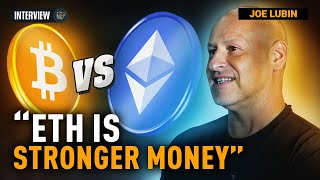
Transcript of a YouTube interview with Joe Lubin discussing why Ether (ETH) can be a superior treasury asset to Bitcoin, strategies for Ethereum-focused treasury companies (accumulation, staking, yield), comparisons between ETH and BTC, ecosystem growth and regulatory/traditional finance integrations (e.g., SWIFT, DTCC, NASDAQ), and risks/opportunities for building a decentralized global economy.
Chapters
The price of Ether is likely to grow with tightened supply demand dynamics thanks to all the Ether that we've all vacuumed up. But the real opportunity is to be the Berkshire Hathaway of the next global economy. And we can invest in the 2x or 50x or 1000x projects and just keep a flywheel going where we're building out a more decentralized civilization.
Ethereum treasuries are a big new matter. Bitcoin treasury companies were for a long time. I just want to get the backstory behind Sharplink gaming, how you got involved in that and how you feel about that whole movement.
Sure, backstory. I and many others were watching Michael Saylor invent some really brilliant constructs over the years. I was fortunate enough to sit down, have dinner with him in December, heard his rationale for doing all that. It was about basically finding better treasury capital assets for his company. I talked to my colleagues. We immediately thought it's obvious that Ether would be a better treasury asset because productive yielding asset. We were hitting our broadband moment in the Ethereum ecosystem where we were much more scalable. Horizontally, vertically scalable, scalable. Really we were affordable block space transactions were cheap, usable and there was a glut of block space essentially because we scaled so quickly. But there weren't enough builders, applications and transactions to eat up that block space essentially because the the United States was trying to either kill co opt or slow our industry. So it made it hard for builders to choose to build in our space and companies to choose to touch tokens or issue tokens or use defi. And so we really thought that there were dolphins in our ecosystem and that was all about price really because too much ether, too much ether, too much cheap block space. Maybe this would be a good solution for that. Maybe we could light a fire under the Ethereum ecosystem and maybe we could get others to start accumulating Ether as well. And so that's worked out really nicely. We got a few Ether dap companies and we're differentiating ourselves in exciting ways.
How do you view Tom Lee's approach with Bitmine and what they're doing? I mean, they're far ahead, right? Like in terms of the actual leaf holdings.
So I would say that they are not far ahead in a certain way. We initially thought that this would be a sprint, but Tong came out with the insight that, you know, they set a target 5% of the total monetary base. We weren't thinking of a limit, but we did think that we can't accumulate too much and they can't accumulate too much and the other dads can't accumulate too much and others around the world shouldn't accumulate too much. Otherwise there'd be pushback from the ecosystem. And so we always intended it to be a long term opportunity to amass a giant pile of the highest powered money on the planet. Ether is the highest powered money on the planet. Bitcoin's extremely high powered money essentially because it's uncensorable and because if you're a tyrant of a banana republic nation state, you can't financially exploit your population with your own money or financially repress them when you get into big debt because those people will now have access to stablecoins and ether etc. So politically a potential game changer. So we decided that we needed to build a team that would build infrastructure for staking to deliver best in class risk adjusted staking. And we can do that with some special opportunities on our linea Layer two network. Really it's all about three phases. It's raise money. We are instantly moving into Ether. Tom is keeping some of that I think in us like a big chunk in US dollars so they can manage the M Nav better. We're also managing the M Nav so we've got a handle on that now.
Just a bit more aggressive on the eth buying.
Yeah but, but we've got a good strategy in place so that we will continue growing the concentration of Ether for a fully diluted share while protecting the price of the equity. So phase one is that phase two just keep earning yield, get up to 5% or whatever feels right. We won't sell any of our our core stock of Ether, but we're earning more and more Ether on a daily basis. We can use some of that if we need to. And we've already got a pile of US dollar capital that we can use to keep the share price healthy. But. But the real opportunity is to be the Berkshire Hathaway of the next global economy, the more decentralized global economy and use that we can borrow against our Ether. We can invest in things, we can stake things, we can identify the cool new protoc protocols that are building out either the Ethereum layer 1, Ethereum layer 2 or other important things in the Ethereum ecosystem. And we can invest in the 2x or 50x or thousandx projects and just keep a flywheel going where we're building out a more decentralized civilization while making sure that our shareholders are getting more and more value.
What are your views on like the risks? I mean there's been a lot of talk in the bitcoin space about big drawdowns, guys with perhaps too much debt, that kind of thing. Like what are the risks for an eth?
The big biggest risk is not doing this kind of thing because it's a profound new construct. Yeah. And if, if you're capable of not participating in this kind of thing, we're not going to be very leveraged. So the price of Ether is likely to grow with Titan supply demand dynamics thanks to all the ether that we've all vacuumed up. And progressive decentralization on the planet will continue. The financial industry is rushing into our ecosystem. Other enterprises are rushing into our ecosystem. So it's our broadband moment. Everybody's paying serious attention to what we're doing and we're not going to get out over our skeets.
In terms of Bitcoin versus eth, like you said you had dinner with Michael Saylor. I don't need to explain Bitcoin to you. Like the hard money properties, a lot of people would argue that it's the beta asset for a digital asset, treasury company or the asset. What are your thoughts on that?
I'm a long time deep Bitcoiner. Back to 2011, early 2011. I love Bitcoin. I appreciate the perspective that Bitcoin is finished and perfect and only should admit necessary changes. And it's a very narrow technology. So I have been on record as saying that a, I like Ether better, I like Ethereum better. It's a far more capable industry. It's going to be the foundation of the decentralized global economy. Satoshi invented decentralized trust, the most profound form of trust on the planet and showed us how to operationalize it. Vitalik and others came along and essentially have been building the broad and diversely capable foundations of the next global economy. As a treasury asset, I'd much rather have something that, that potentially has more impact. It certainly is solid as Bitcoin. I would argue more solid because the functionality that there's, there's organic demand for it because you've got to pay for transactions and storage. You got to stake it had a stake in lots of protocols and the main protocol. So the DAT companies were very well received and it's kind of true in the bitcoin space. But Bitcoin is a one trick pony and I hope that trick remains very important to the planet. We'll see.
I think it does. My last question, just your general thoughts on the Ethereum ecosystem where it is, you know, Vectra, this year A lot of stuff has changed. The price of ETH has increased dramatically in recent months, which is a big criticism over the last year. And not a lot of people wanted.
To talk about the price criticism.
Well, from the outside, looking at holders, you know, the price being depressed for so long to where it is.
Well, I think I explained it. I think I explained one of the things that has partially remedied that. So it's a big unlock that the United States government is wind in our sails. So the SEC is wind in our sails. Stablecoins all the RWAs and that being noticed around the world is wind in our sails. Paul Atkins and Hester persis of the SEC's Project Crypto. They called it Project Crypto which is the project to re architect the securities industry. Wind in our sails. I was in Frankfurt on Monday and Javier Perez Tasso, the CEO of Swift announced that Swift is going blockchain. They're building Swift Ledger. Our company Consensys is going to be the main builder and collaborator with Swift on that. And that's a revelation. It is. Swift was a little uncertain about whether it would be embraced by their 11,500 member banks. Careful about the messaging. But he received a standing ovation in his keynote and the feedback was enormously positive from banks and central banks. Messages like thank you for doing this, it's about time. And there's a lot of discussion in Frankfurt that no longer do we think that the DEFI and Tradfi should be on parallel rails that shall never meet or there will be peril. And we're really in this moment in which it's time to a stable coins that's essentially tradfi on defi dat companies. Tradfi meets Defi opens up Defi to a giant world of huge liquidity and traditional finance. And so Swift is going to turn on the banking industry and enable them to be more comfortable with infrastructure that they provide in parallel. The DTCC is building their app chain which is real time tokenized collateral. They're building it on consensus Ethereum technology. NASDAQ just announced that they are in communication with DTCC and sec. They're going to tokenize all the equities. They're doing it on consensus Ethereum technology. So we got PvP, we got DVP. Are we in a different paradigm already or moving quickly?
100% yes. I mean it's crazy just to think the last time I spoke to you we were talking about how bad the regulatory space was in the United States and like you guys really fighting the good fights. And here we are finally. Trade fights like please help us. Thank you so much for your time. It's a great pleasure to catch up with you again and all the best going forward. Keep doing the good work for our industry. Thank you.
It.










