Build. Tokenize. Earn: The New Way to Own and Profit - Michael Healy, сo-founder of Unit
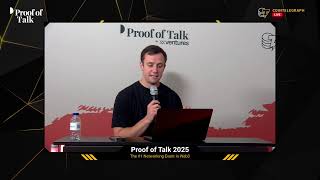
Michael Healy, co-founder of Unit Network, explains how the blockchain lets people and small businesses issue tokens to raise money. Unit is built on Substrate as a Layer-1 focused on making anyone investable, not just large real-world assets. Healy discusses the technical design, fundraising strategy, and the regulatory questions around tokenizing individuals and businesses.
Questions this video answers
June 11, 2025.
$18 million.
Approximately 57 people.
About $0.09 (nine cents) per BTC.
16 of the biggest blockchains.
Chapters
Good afternoon. Welcome back to the Proof of Talk Live Stream. My name is Gareth Jenkinson. I'm the managing, I'm the head of multimedia. I used to be the managing editor at cointelegraph. We've been live streaming all day, so as you can hear, my brain is fried. But I'm very excited to have this conversation. If you are joining us on the X live stream or the YouTube live stream, please do go ahead and drop your comments or questions. We are talking to Michael Healy who who is the co founder of Unit Network. Before we get into any of that, Michael, give me the TLDR of your history because you told me some very interesting stuff off air. You were involved in WikiLeaks all the way back in the day. Give us the summary in 30 seconds to one minute.
Most definitely. So I'm half Singaporean, half British, been building applications since the mid 2000s. So web2 effectively when the Internet post.com bubble became a bit more dynamic. And then when the iPhone came out, I was one of the early app developers on the iPhone and Android devices. And one of the first apps I built was the WikiLeaks mobile app. Right. It basically allowed people to view the documents, search through the material, and I helped with the fundraising for it. Unfortunately, until the government froze the bank accounts, blocked the PayPal, Visa, MasterCard donation channels, which got us as an organization to start using bitcoin. This was 9 cents a bitcoin, you know, very lucky and fortunate to be introduced to that world. Then built a video conferencing app similar to Zoom or Skype. Decentralized video calling, grew it to a few million users. And then I sold in 2013, worked at the third biggest venture capital fund in Europe. We were seed investors in Spotify. Wellington Partners also worked for the Founders Forum. It's one of the most exclusive, exclusive tech communities in the world. To be invited, you need to have started a half billion dollar company, rebuilt their systems and now I'm investing for my family office where we are investing in businesses which use tokens instead of equity and show what the future of the economy looks like. And then we also have a blockchain called the Unit Network which reimagines how the economic system works. And we're really excited to see how it can transform the world.
Let's talk about Unit Network. Obviously that's why we're chatting to you today. I think that there's quite a few different very decent blockchain protocols that allow you to do RWA tokenization and those sort of things. Why do we need another blockchain network? And what does unit network do that others don't?
It's a great question. I mean, a lot of times when people say tokenization or rwa, it's been so often talked about that people just switch off and they're like, do we really need another RWA tokenization? This wasn't the case two or three years ago, but now people think there's money to be made in this trend or this narrative. So a lot of people just spinning out companies. I think where unit network really stands out is most people think about tokenization RWA as traditional finance with a blockchain sort of front or marketing wrapper, right? They look at treasury bills, they look at real estate, they look at public traded companies like Apple or Google or Tesla. Right? Or they look at maybe money markets, funds or private equity. Where unit is interested in is, is the hundreds of millions of companies that exist and the billions of people in the world. You know, I would love to be able to buy a piece of you as a person and when you become even more successful, you know, get a tiny piece of your economic success or the idea that everyone listening can buy a piece of Michael. And if, you know, if people can be much more collaborative and supportive of one another, I think this is going to redefine how the role of money exists in society. You know, if you look at the smartphone, how it revolutionized access to communication, you look at the, the Internet, how it made information readily accessible. You know, no matter how much money you have, where in the world you lived, you had access to abundant information, right? Wikipedia, you know, YouTube videos, the smartphone did that for communication. I'm convinced that the unit network can take crypto from the 3 trillion it is as an asset class to hundreds of trillions and really take this technology of blockchain mainstream and really solve problems for people, make fundraising a lot easier and turn everyone into a micro investor.
Okay. When it comes to all the other chains that are out there, I mean, how do you view the competition and how are you going to approach gaining market share? Because I think that's the most difficult problem now is everyone's kind of fighting for the same piece of the pie. The protocols do different things and there will be a lot of advantages for tokenizing securities on Solana vs Ethereum vs Sui or Aptos. Like why would I do it on.
Unit network spots on. So I think, you know, we're sort of competing and operating in a completely different league. I think a lot of people are talking about Tokenization and saying, hey, you know, if you have a 50 million dollar asset or 100 million dollar fund or, you know, a company in, you know, on the stock exchange, wherever, you can use our blockchain to access that financial asset. Right? We think that's interesting, but we think the more interesting opportunity is, you know, your local coffee shop that might, you know, grow to become the next Starbucks, right? Or let's say your friend who's an aspiring actor, right. If they become the next Tom Cruise or, you know, Scarlett Johnson, you know, the idea that, you know, you can follow them and, you know, be involved in their journey. Right. That wasn't the case 10 years ago, but now it is. And the next evolution of that is people to own, effectively digital shares, which we think are tokens. So I don't think any of the blockchains that I've come across provide a super easy way for a non coder or non technologist or non blockchain person to create coins and easily fundraise with it and have the community partake in their upside. You know, the employees, the customers. The next Uber or Airbnb, you know, will be built on chain and will be cooperatively and community owned.
I've got a question coming through from the live stream and if you are watching, please do keep them coming through. You know, we're hearing about something new and innovative and I think it's great to take some questions. So this one is wifi frodo. That's a great username. Why should I trust unit to manage tokenized value when a lot of web3 projects struggle to survive a bear market?
Great question. So, I mean, we've been, I've personally been passionate about securitization and tokenization for 10 years. Right? We've been relatively quiet and low key for the past 2, 3, 4, 5 years because of regulatory reasons. You know, I had a meeting with the new crypto star, David Sachs. He basically told me, michael, the current rules and regulations likely won't change, but, but there is potential for this new technology, something like UNIT Network, to supersede the old system, to make it less relevant. Kind of like, how can I trust when I walk into an Uber, I'm not gonna be kidnapped or murdered or robbed, or if I stay in an Airbnb, am I gonna be under any risk? Or why should I put my apartment, which might be worth millions of dollars, rented out for $200 a night? So I think there is that hurdle. If someone's operating a business which makes lots and lots of money or even a small bit of money. Why should they incorporate this idea of tokenization? It's the same as social media. When it came out, you know, people doubted the potential of using social media for marketing. And then, you know, now it's common. It's like, you know, if a business does have a TikTok account, Instagram account, social media account, Telegram account, it's just not. Yeah, it doesn't make sense not to have one. So we'll convince every company in the world will have their own coin. Every person in the world will have their own coin and be investable. Their friends and family will own a piece of them. And I think the trust is we should move to a society where you do not have to trust. You can verify. So the cool thing about Unit Network is unlike most decentralized apps, it's entirely on chain. So many apps, maybe only the settlement is on chain. What we've built is a blockchain where every single piece of the software is on the runtime. Not even using smart contracts is on the actual blockchain layer. It's using the same framework as Bittensor or Tao, called Substrate. I'm really proud of the technical innovation development that we've achieved. And I think it's just a matter of time. Our goal is to get into the top 10 or 15 crypto assets in the world and then, you know, maybe even someday overtake Bitcoin and Ethereum.
Here we go. I've got another good one here. You're promoting tokenization for everything. But who profits, the users or the early insiders?
Great question. So I think we've created mechanisms to provide much more disclosure. So if there is fraud or insider trading or malicious activity, it will be much more open. Now, if you see addresses move or you see token balances, you kind of have no clue about the analytics behind them. So we've basically built 25 apps. One is a decentralized Uber, one is a decentralized Spotify, a poker app, a ticketing app. One is called Unit Screener. So this is going to be be like a Bloomberg terminal for the token economy. So you will have much more insight as to is this project legitimately generating profit, putting money into the token's treasury, which basically backs up the underlying value for that token, or is it just, you know, a bunch of people looking to pump and dump or there's no actual business behind it. So I really think that's the innovation that we have.
You, you guys recently raised $18 million. Maybe you can chat about some of the venture Funds or the people that were invested in the raise to help you scale the chain. And additionally, how hard is it to convince people to invest in a new layer one in 2025? Because I think you've got Sui, you've got Aptos and like they were really build as the next gen L1s. How do you, how do you convince people to give you money?
Definitely. So we've got some really strong backers, right? Outlier Fund, Blockchain Founders Fund, Moon Pursuit Capital X Ventures, who's organizing this and countless others. People who've been in the space for 10, 12, 13, 14 years. I think where we stand out is we're not just building a piece of technology and looking to solve a problem. I've built tech products and companies before and realized, wow, wouldn't it be cool that when I sold my app I didn't have any external investors? Wouldn't it have been cool if some of my early users could have partook in the upside, all the people that help me market and grow it. Right. Wouldn't it be cool if the fundraising process was a lot easier? I would love to invest in hundreds and thousands of entrepreneurs, but it's very difficult at the moment to not just invest that capital, but be able to get a return of them building something successful. So I think Unit Network is a layer one blockchain. We believe that we can be in the leading top five, top ten blockchains in the world. But. But we kind of take the approach of, you know, we want to create a world which is much more collaborative, cooperative. We want to make the idea of money, ownership and equity radically different. Now how do we solve that? We started off building with Ethereum, you know, with solidity. We then tried to work with Polygon, we tried a bunch of other layer one and Layer two chains, and then we opted for building our own chain. And then we realized that Substrate was the best framework to do so.
Yeah, and I mean you touched on like Bittensor being also working on Substrate. You take some inspiration from the way that they built their infrastructure.
Good question. So I actually to some extent, you know, the subnets, but I was an early investor in Polkadot in 2017. And you know, I think what Gavin Wood created with Ethereum and basically took his learnings and applied it towards building Substrate as a framework was really powerful. So I have huge respect for Bittensor. I was an investor in Tao since I think 2022. I think what's really cool there is I believe AI and robots are going to change the world and I feel as if there needs to be tools by which the value created can be properly distributed. We're speaking closely with Andrew Yang, who's the founder of who's. Who's basically behind the Freedom Party in the US and talking about universal base income, we think, and he also believes that what the unit network offers in terms of distributing ownership could be the better way by which the trillions and tens of trillions and hundreds of trillions of economic value created could ensure that people are going to live a much better life. You know, it will be basically like now we have two day weekends. I think, you know, it will extend to a four day weekend, to a five day weekend, to a seven day weekend. So what you do in your passion, you know, will be what you do for work and life.
How. Yeah, I've got a couple of. My director is pointing at me to ask some questions here. So I've got them coming from the, from the live stream as well. I know we've only got a couple of minutes left because you got to run, but one of them here is if UNIT was to disappear tomorrow, what happens to all the tokenized value built on it? Is the infrastructure portable? Is it locked in?
Good question. So we've built in a way where there is no dependency on the operating team. We have about 57 people at the moment. We expect to grow to maybe 120 people. And then we intend on decentralizing where similar to Bitcoin, the protocol doesn't change. If someone wants to extend it or change it, then they can build on top of it. But the base protocol is so simple and possible enough where none of it is centralized. One question is, hey, if I deposit Bitcoin onto Unit or I use Ethereum or Solana or BNB or Ton or Sui, where does that go? And initially we followed centralized exchanges where it was just sitting in a single wallet using a custody like Bitgo. And we thought, okay, this is not going to work because if it needs to trust a small number of people or a registered entity, that's not decentralized. So we basically built this thing called the unit vaults which decentralized the underlying wrapping and custody. So we've effectively built bridges to 16 of the biggest blockchains and built in a way where if governments, if companies, if people wanted to shut it down, it wouldn't be possible.
This is quite an interesting one from the chat. Doesn't tokenizing people in their work turn humans into commodities? What are the, what are the. I'm curious about the regulatory frameworks Here. That's awesome.
And it's not just the regulatory framework, it's also the ethical frameworks, the philosophical frameworks. I actually wrote my high school dissertation on the morality of AI in 2011, and the thesis was that was basically is a moral machine oxymoron. So is AI? Can you say a robot can make ethical or moral decisions? Right. So my perspective and thesis to tokenizing people is that, you know, you really want to optimize for a more supportive and cooperative society where people are invested in supporting one another. If your friend is struggling, you know, you don't have to think, am I going to serve myself or serve them? You know, if you look at how a lot of businesses fail and relationships, marriages fail, divorces, money is playing such a key piece. And I'm convinced that when the unit network grows to hundreds of millions of businesses and billions of people around the world, money will still exist. Right. As a, as a framework of society, but it won't play such a big bottleneck or role as it does now. Money will just flow much more freely economically. And, you know, a lot of people have a lot of trauma or bottleneck around the concept of money. Right. And I feel as if this idea of cooperative ownership is going to really make people feel much more free and liberated. You know, if someone says, hey, you know, I'm going to offer you a job and someone else offers you a better job which pays them less, but they believe in it, they don't have to worry about the money piece as much. Yeah. So I think that really solves a lot of the ethical reasons. And having this more abundant society is going to give people a lot more liberation and freedom.
My final question to you. I look at, you know, protocols like SUI and Aptos and their approach to Web3 and taking a Web2 experience and bringing that to Web3, but also bringing a highly performant blockchain protocol, do you take some inspiration out of that? And how are you going to try and take away their lunch?
Absolutely. So one simple example is we use an email password PIN to log in or to create an account with unit. And it looks like a web to login, but what that does, it generates a private key. So it's an easy way for anyone around the world, if they lose their 12 word passphrase, which is a backup, they can at least use the email password pin so they still have self custody. But the experience is just seamless. I think, you know, if you look at how the Internet sort of grew and transformed, you know, Facebook only came out in 2004 and it transformed social networking. Google came out in2027, but 2001 was when it really took off. You know, unit you could say is launching relatively late. But I really think the party is just getting started. I think, you know, the next six months are going to be incredible. Not just for the unit ecosystem, but for the token economy. And I'm optimistic that the same way, you know, ICOs, NFTs now meme coins grew as a narrative and trend the token economy where every single business in the world is cooperatively owned. The idea that customers and employees are stakeholders is what's going to make the skeptics and the majority of the world who just doesn't understand why bitcoin or crypto is important to go, wow, I would love to partake in the journey and own a piece of my favorite business. Right? And when it becomes an even more successful business, they're not just happy because of that person or business's success, but they're part along with it. And it's going to create a world where money exists but is experienced radically differently.
Michael, thank you so much for your time. It's really interesting to chat to a new founder and a new L1 in the space. We've seen the evolution of these new gen L1s and maybe you will join those ranks. It's really good to chat to you. Thank you very much for watching. We will be back in a couple of hours hours time with one or two more live streams. I'm looking forward to chatting to Paul Helgeson from Paris Saint Germain about their Bitcoin holdings and a few other touch points. But please do go ahead. Join us. From 4 o' clock onwards we'll be back on the live stream and if you enjoyed this conversation like and retweet if you're watching on YouTube please like our channel. Subscribe and be sure to be back with us here from Proof of Talk later this afternoon. Thank you and bye bye.
Thank you.










