Cameron & Tyler Winklevoss: Crypto Is the New Safe Haven | BlockShow x SFF
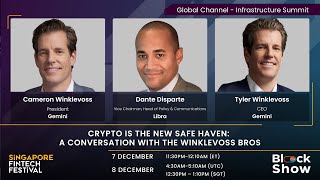
Cameron and Tyler Winklevoss argue bitcoin is a hedge against currency debasement, with its supply capped at 21 million coins. They compare it to gold but portable and digital, and defend strict regulation for crypto exchanges like their own Gemini, saying regulatory clarity will unlock institutional adoption.
Chapters
So who better than Tyler and Cameron Winklevoss to try to reconcile what has been not only a turbulent year for the entire world between a blend of macroeconomic uncertainty, the COVID 19 pandemic, an enormous strain on all systems, have relied almost exclusively on the Internet as a form of business and operational continuity. But who better to reconcile this fateful year than Tyler and Cameron Winklevoss? So it's great to see the two of you again. We've got to stop meeting in this format. Wanted to try to get a read as we look at the cusp of 2021 and the likelihood that bitcoin yet again is on track to breaking a $20,000 ceiling. You've made some very bold predictions in this space, but I want to just start by maybe getting some opening reflections from the two of you and then have a spirited conversation about the direction of travel around the world, the future of money, virtual assets, crypto assets, and how Gemini, under your leadership, has navigated the storms. So maybe, Tyler, if we could start with you just to kind of get your sense of how things are looking, the direction of travel in this space.
Yeah. Thanks for having us, Dante. Great to meet again. The story of 2020 is definitely been the pandemic, but I think it's also been bitcoin. Much of the ways that governments around the world have had to respond to the pandemic and the demand economic shock that the lockdowns have caused, those tools, such as spending money printing to get us out of that, has really put into question what the value is of fiat currencies around the world. The debt to GDP ratios are very high in the US it's 135%. The highest point before that when we measured, was 121% during World War II. But back then that we had full employment, we were building a lot of infrastructure for the. Sorry, the. The war. But now we have record unemployment. It's a very different situation. And bitcoin and hard assets like gold are your hedge to this inflation. I think that's. The pandemic is obviously the story, but it's very much been a catalyst for bitcoin, so. So sort of pass it to Cameron.
Yeah, so, I mean, with that as a segue, I didn't want to open up with the bold article that the two of you co authored, the Direction of Travel for bitcoin, looking at $500,000, if not potentially more. And it seems not only is this vindicating of your early bets in the space and Gemini's early bets in the space which we'll get into as well, around how you've navigated compliance and trust in digital assets more generally. But I would like to also, Cameron, give you a chance to say a few words at the outset in terms of digital assets and crypto assets being a silver lining in the clouds. And then this long range bet that both of you have made so ably in your op ed. How do you see things playing out here? And is this the beginning of a real transition in terms of the economy?
Yeah, no, happy to respond to that. And thanks so much for having us. It's great to talk to you, Dante. I think Tyler really said it well and laid it up. Obviously there's been a tremendous amount of money printing going on both in the US and in fiat regimes around the world. And I think that bitcoin and hard money is a really interesting alternative. I think there's a lot of people that are worried about the scourge of inflation or the specter of inflation out there. And when those things arise, historically people tend to look at things like gold, or you could store your value in the market, but that will really keep pace with inflation and get priced with that. But really, how do you outrun inflation? And what is the classic hedge and that is historically been gold. And now we have this really cool new asset called bitcoin that basically shares all the properties of gold, but actually beats it in a number of different places. For example, I'll start with the supply of gold is scarce, but actually two thirds of gold above ground gold has been mined since 1950. Technology improves or demand increases or the price of gold goes up enough where people will find gold in different ways. And that's similar to how we've managed to find a lot more oil over the past couple of decades with technological advancements like fracking and what have you. And today the US is actually a oil net exporter, which most people never thought would be the case. We thought that the US would be a importer. Whereas the supply of bitcoin is truly fixed at 21 million. So it's like gold, but actually better than gold. And also it's a lot more portable. It's very hard to move gold in the middle of a pandemic when everything seizes up or locks down. And bitcoin really works like email. So there's a lot of really cool properties that we think make bitcoin an emergent store of value that eventually overtakes gold. And that's how we got to that kind of crazy number of $500,000 per coin. Looking at the market cap of gold at 9 trillion, if you look at market cap today of bitcoin, I think it's around 330, $40 trillion. That would have to grow about 40 times from today's prices to overtake gold. I would say we're somewhat vindicated in a way, or it's playing out, but we're still actually only 1/40 of the way there if we're right. But it's been really exciting to see bitcoin get back to where it was three years ago, or just under 20,000, which is the previous high. So a lot of people are saying we're in a bull run. And actually we don't think it in many ways has actually started, which is pretty exciting. And if you look at the Google searches for the word bitcoin, it's actually still pretty flat. Which means that a lot of people accumulating bitcoin are people that are doing it quietly. More sophisticated investors who are doing research on the asset, looking around at the macro environment and saying, this doesn't add up, this doesn't work okay, how do I protect my value from that? And a lot of people who historically would go to gold are starting to look at bitcoin.
It's a fascinating set of comparisons. And in some of my early reading, writing and analysis of the space, I've often made this analogy that if data is the new oil, blockchain is the new barrel, and that in that domain you have this new set of industries being born. And another comparison that just to kind of riff off of what you were saying, Cameron, is in so many ways, digital assets in the crypto asset world is to finance what renewable energy is to the traditional energy space, that they're not necessarily producing threats to the system, that in so many ways they're completing the system. And I know as you two were building Gemini at a time when most regulators, most compliant officials, compliance officials and policymakers might have misunderstood the asset class as a form of circumvention of rules and money laundering requirements, and the rest you ran to a very high regulatory standard in New York, beginning New York, and I know you're expanding to other jurisdictions around the world and it's Only what, a 10 year run that we're talking about for the whole space, less than a 10 year run. And there's high expectations here. How do you see the next wave coming? What are the required breakthroughs to unlock this 500,000 number that you're describing? But more generally, Speaking all of the other corners of finance, payments, the movement of value and money, we still labor today. And we saw that clearly in the United States and around the world with the pandemic. We labor under very analog, slow moving systems. What stands in the way? What's next in terms of Gemini's development operationally and from a compliance and regulatory vantage point.
So, yeah, that's a really interesting point. I think some of the early rhetoric in bitcoin was sort of like, let's kill the banks or let's disrupt the financial world. And we've always viewed bitcoin and crypto writ large as really an alternative system and almost coexisting and working together. Central banks are some of the largest holders of gold in the world. So it makes sense that down the road they'll see the benefits of bitcoin and be very large bitcoin holders. And we're even seeing that in corporate treasury with MicroStrategy, which is a publicly traded company, took a 400 or $500 million bitcoin position and Square bought $50 million worth of bitcoin. So we've always viewed it as this complement or alternative. And we grew up in the wild west days and we bought some of our earliest bitcoin on Mount Gox, which is an exchange that imploded. It started as a magic, the gathering online card exchange pivoted into bitcoin and was just in over its head. And so we sort of saw a lot of this and we said, look, if this is going to go mainstream, we really have to connect this really cool niche technology to the mainland of finance. Well, how do we do that? We start talking and engaging with regulators. And we first started with the New York Department of Financial Services. We got our trust company license. Gemini is a New York trust company. And we've spent the past year or so trying to expand our license and approvals to other jurisdictions around the world. And Singapore is one of those. And we're engaged with mas and we really believe that you have to create sort of regulated on ramps for this technology to thrive. So we're very excited about Singapore and the thoughtful regulation that they are promulgating. And we're really excited to be opening there and obtaining a license hopefully very soon. We think that that is the future because if you look at the most vital and thriving markets in the world, they have some form of thoughtful regulation. So we felt that is important. That's been a big part of our mission.
So Tyler, if I can ask you maybe to opine a bit on when I look to Singapore and I look to the challenges the world has and the United States has in so many ways, we have to innovate our way through this crisis. Not to put you on the spot, but we're in the midst of a presidential transition. If you had any advice to impart to the United States. And what stands in the way of really mainstreaming not only the regulatory posture, but the opportunities for this asset class to, for lack of a better term, come in from the shadows or come out from the shadows, what would it be? What's missing, in your view, to ensure we could benefit collectively?
Right. So I think just time is important. So the bitcoin has been a retail phenomenon from the beginning. And crypto as a whole, we're starting to see very legendary investors like Paul Tudor Jones, Stan Druckenmiller get in. And so I just think more of the institutional, sophisticated, larger money coming into the play. There still hasn't been. So we have an exchange that trades commodities, virtual commodities. And bitcoin is like gold. It's like gold 2.0. We don't have the right to trade securities at the moment. So just more pathways opening up with the sec, more efforts in front of the cftc, more people getting in the game, but also more regulatory certainty around the world, like bitcoin and crypto isn't. It's not a US or Silicon Valley phenomenon, it's a global phenomenon. In some jurisdictions, it's unclear how to get licensed and be compliant and open an exchange in Singapore, it's very clear in New York, in certain states in the US it is. But there's certain parts of the world where it's unclear what you need to do to do the right thing. And so I think the regulatory uncertainty makes it hard for companies like Gemini to necessarily open up, makes it hard for customers to get involved. And overall, I think it's bad for the marketplace because then people are just sort of unregulated, doing things. It becomes a wild west, which was our early experience in crypto with Mount Gox. We bought a lot of our bitcoin there, and that was really the impetus to start building Gemini. We started. We tried to invest in other crypto exchanges, but everybody wasn't really into regulation, wanted to kind of be offshore. And so at some point we said, we'll just have to. I guess we'll have to do this ourselves. So we picked up the phone, started talking to the regulators, say, how can we get license, get a piece of paper? Because without that, we can't get a bank account to accept customers fiat currency so that they can buy crypto. So on a whole regulatory certainty has gotten clearer, that's for sure. But there's still a long way to go. And so I think time people, there was a time in the US when it wasn't clear if Bitcoin was actually going to be illegal or outlawed. And that was like an open question when we kind of first started this. I don't think most people in the US feel that's the case at all anymore. So that sort of paves the way. Efforts like Gemini paved the way. So I think it's just like more of the same really. I don't know if that's a very long winded answer to your question, but what we found is it's never really a silver bullet. There isn't this one thing like oh, it just the regulators would say this or if some companies would say that. It tends to be a constellation of things from the private sector, from entrepreneurs, from the regulators that just all of a sudden opens up this door. And sometimes it's like the bitcoin happening or it's what's being built in defi and then you get these waves like 2017 and there was ones before and I think we're upon another one now. So it's really all of it and just more of it and more time.
Yeah, and it's sort of one I could relate entirely to the concept of asking for permission rather than forgiveness as the precondition of launching something that's certainly my principal preoccupation in the project I'm helping lead. But you know, there's also this fascinating subset of opportunities that the blockchain and crypto asset space have created that are now I think being embraced by the public sector. We hear it and see it with something like 80% of the world's central banks contemplating central bank digital currencies. There are technology companies like Chainalysis and others that are getting billion dollar valuations on the basis of providing fundamental financial integrity and compliance services. And so I find it to be a bit of an irony that when the original fears of the space were always hyperinflated and the space frankly labored under some branding and communications challenges that nonetheless more and more people are starting to realize that blockchain based payment systems technologies platforms represent potential quantum leaps forward in terms of financial security, financial crime, compliance and the rest, I'd be curious also to get your read. I know Gemini early on with the trust license and others, you put some efforts into creating assurance models and insurance models to put a floor underneath basic custody services. Do you anticipate any other breakthroughs? What are the other in the gold rush, what are the other tools that you see coming out of the space or being required in addition to more regulatory certainty?
I think you make a great point. Education has always been a big challenge and it's an ongoing thing. And in the early days a lot of people thought that Bitcoin was truly anonymous and used really only by illicit actors for illegal activity. And I think what people have found out is that the blockchain is actually like it's this open ledger that you can forensically analyze. And I think recently the United States government found a billion dollars from the Silk Road bus that they previously had not identified. And they found it through the blockchain and they're going to auction that value off. So it's really fascinating how the blockchain, how powerful that ledger is. But combating some of those myths has been a challenge. But a lot of regulators around the world understand that and are forward thinking, including Singapore. And I think that there's many dozens of companies that are trying to build in Singapore and get license and there's going to be a very vibrant ecosystem that comes about from that. So I would say that. So we have insurance on our, on our custody solution. To answer the other part of your question, I think we have about $250 million and we'll scale that up as the commercial market sort of capacity is there. So it's still pretty new. There isn't billions and billions of dollars of coverage, but we will get there. That's tends to be a more later stage thing in the development of markets. There is a derivatives ecosystem that's building, so there's more ways for people to sort of express viewpoints around price discovery. And I think a lot of it will just be sort of more of the same for Gemini, getting into more countries and more emerging markets. We tend to be mostly in the developed world today, but we think that the promise of crypto is very great in the developing world. So we really look forward to trying to get to those places. And those are areas of the world where people are either underbanked or completely not in the banking system. And one of the exciting things about this technology is not only do we think we can do well, but we think we can do good. We think that we can be part of solving that underbanked billion plus people problem or moving payments and money around the world, whether it's remittances or something else. It's a multi step process. We're not going to solve that problem tomorrow. Just like the Internet in the early days was about 100 million users and now there's more devices than people on the planet and it's really changed. You know, the information revolution has been astonishing. We believe that the value revolution is coming and we look forward to playing.
A part of that.
Yeah, I mean, as you know Cameron, that whole area of financial inclusion, financial innovation and financial integrity not being trade offs is a passion project for me. And you know, and in that vein, you know, this question of regulation, it seems, you know, I wanted to. Tyler, I don't mean to put you on the spot of being our regulatory whisperer, but the Europeans are in the midst of drafting and have drafted a body of proposed rulemaking markets and crypto assets, which in my early read could be to crypto what GDPR was to privacy. In terms of setting a very high standard. There are pros and cons with any body of law like that. Not sure if you've had a chance to contemplate it yet, but between that body of work, between the Financial Stability Board, which Singapore co chairs, along with the United States coming out with some pretty strong postures of regulatory requirements for projects like the one I'm involved in, but perhaps issues that set standards for the whole industry, I'd be curious to see how you see that playing out on the one hand and on the other side you have projects in countries, particularly China, which are launching not only government backed initiatives, but have initiatives in play that support trillions of dollars in transactions and hundreds of millions of dollars of value being transferred and people being served. Meanwhile, the west seems to be somewhat slow to the table when it comes to regulatory certainty for this space. Curious to see how you see that playing out.
Well, I think regulatory certainty is huge because I can just speak from an entrepreneur standpoint. Like it's kind of murky. When it's murky of like how do we be compliant and take risks, then you can't raise capital from investors because they're going to be like, wait, is this lawful what you're doing? Do you have your bases covered with licensing? And that could be ip, right? Patents and all these other things and that's just like a normal startup.
But in crypto, crypto is sort of.
Like this really scary word bitcoin for a lot of people. So the more certainty the better. And like Cameron said, I believe regulation is a spectrum. There's very thoughtful regulation that sort of fosters Innovation and growth and there's very draconian regulation that sort of stamps it out. So you have to get a balance. What we've tried to do is open a dialogue with regulators and try and educate them and collaborate and potentially shape the regulation. Because I mean, nobody like crypto is really new. Right. So there isn't a roadmap. There's some analogies to anti money laundering laws prior to crypto, but it's also new. So I think sort of opening a dialogue and trying to shape it.
Is super positive. And just to add a little bit more onto that, if you think of some of the famous largest technology companies in the world, Apple started in a garage in Silicon Valley, I think Facebook started in a dorm room. And I think the next crypto fintech payments won't be coming likely out of those kind of environments. And I think that's probably okay because we're talking about value. But you have to be careful that overhead is not so large that a lot of people can't innovate in the space. And you really want to sort of right size it so that you know, you don't have a five or ten person startup carrying so much overhead that they can't really innovate. And I think that's where things like sandboxes are really helpful so that people can grow into the regulation. And there's learning on both sides, there's learning from both the startup and the regulators. And we have a really great collaborative relationship with our regulators and I think we help each other out figure this new thing because nobody really has all the answers. At the end of the day, we're sort of building as we go.
Yeah. And it's a bit of an irony, isn't it, that the firms and the players and the leaders such as yourselves, who embraced regulation, embraced principles, and undoubtedly in the very early days you both had to famously defend it against a lot of odds that now that that has become in hindsight, a source of advantage, it's a competitive advantage in this market. So hats off to the two of you for having been ahead of the curve. I also find it interesting that you're seeing, going back to this question of central bank experimentation in this space, when the CARES act, which mobilized $2.2 trillion initially in the US and then later $5.5 trillion of effective public money was first introduced, it called for the creation of a digital dollar and a corresponding digital wallet. And so there's this tension of as entrepreneurs, how do you manage value created and value captured when so much of the technology that we're building on, including the project that I'm involved in, is open source and is effectively Digital Commons. Right. So, you know, there is this moment in time where you should say this ought to lower the barriers of entry, it ought to increase competition. It's all pro innovation and it's also compliant. But you see the public sector now starting to figure out, well, where is the line? Where does the line begin and end for public sector involvement in this domain? And I think that's going to be something we'll have to reconcile. If you start to see wide adoption of CBDCS as one of the many solutions that could be digitized in this world, do you think that's a tension we have to reconcile, or can the private sector and public sector peacefully coexist?
I'd like to think the latter. I'd like to think the latter. We're seeing that with NASA and SpaceX in the US a lot of the space innovation and exploration, it's a public private partnership. And I think that there's things that.
The government can do that that's really.
Hard for the private sector and vice versa. So things like the Digital dollar project, I think I hope to see the government sort of working with these projects and people that are spearheading it and it being kind of a joint effort, I think that produces really fantastic results. So I don't have a ton of visibility into that, but I do hope that that outcome happens.
Yeah. How about your view, Tyler?
Yeah, I was just going to say there's this tendency to be very, for some people in the crypto community to be super antagonistic, like, oh, we're going to kill the banks, or bitcoin's going to kill the dollar. But I mean, that's sort of like saying gold and the dollar are competing for the same thing. I think they're very different from financial instruments. One's a good currency, that being a fiat currency, the US Dollar, and one's a very good store of value being gold. I think they play different roles on the money spectrum. And we work with banks. If people want to get Bitcoin, well, their values right now, it's usually not in crypto because crypto is new.
So you have to build a bridge.
Between banks and this new world of crypto, and you need banks to do that. So we work with a lot of banks. They have a place. So I understand people try and use provocative rhetoric to get excited, but I think we're all kind of working together just to build a better future. Build money, make money, better money is I think a technology in my belief, a technology. It's an experiment that's been going on for thousands of years. This is just the, you know, newest iteration of it. And ultimately we're trying to make a better world. We're trying to give people greater choice, independence, opportunity, make people more included in the financial system, less permissionless. So, and I think so that think that's what we're, you know, we're building towards that. I think ultimately it's not just like us versus them, it's a little bit, you know, it's a collaboration.
It's funny, I was on a panel not long ago hosted by the Federal Reserve bank of Philadelphia and I had a colleague on the panel from the bank for International Settlements who said if you were going to a regulator today to propose physical cash, it might not be approved. And I thought it was an irony to your point about maybe it's not revolution, it's evolution of existing systems that digital assets and cryptocurrencies represent. But I just thought it ironic that if you were going to present cash as an innovation and not necessarily a pre existing way of transferring value in the global economy, that the view of a gentleman with the bank for International Settlements is it wouldn't likely get approved because of its opacity. And then in the middle of a public health crisis, it also is the conveyor of disease, it turns out. And so to me this stuff is much more nuanced. It's about optionality and not necessarily competition with the existing systems. But I do want to get your views on a couple of other things. So far we've cast our lens around and looked at the regulatory landscape. We looked at the direction of travel from a pricing point of view and the fact that some of your financial predictions are vindicated. Certainly with institutional money starting to come in. If we look internally and you don't have to comment on Gemini, but if you look internally, a lot of times when the asset seems to fail or falter, it's for risk management. 101 failures. You started Gemini because of Mount Gox. You have cases like QuadrigaCX in Canada that are a single point of failure. Risk management, internal challenges. Do you feel like we're getting to a point where more and more users around the world can start to have fundamental faith in custodianship and security and in cybersecurity maturity in the space? Do we have a long way to go yet or is this becoming standard operating procedure, that there's just Good discipline and good basic hygiene in place.
We're definitely making progress. The number of sort of bad stories or failures, I think is getting less, and I think there's more and more positive stories and large companies like PayPal offering crypto and things like that. So a lot of great developments, but it does take time to build trust, and that is a really big principle.
And pillar of what we're doing at.
Gemini is building trust with our customers in this new asset class. Because once people say, hey, I get it, I believe in Bitcoin, but how do I then go buy it in a safe manner? We're trying to demystify that and make it super simple, easy and reliable for someone to sign up, download a mobile app, or go to our web interface and start getting involved in crypto. That's going to be an ongoing journey, building and maintaining trust forever. But I think we are making progress. And I say we, not just us, but as an industry, I think we are definitely in a better place than we were even a couple of years ago.
Absolutely. Tyler, anything to add on that, from your view?
I think no. I think Cameron covered it pretty well.
Okay, so I agree, and I think that's the right way to frame it. Oftentimes people look at the space and they say, well, why haven't you onboarded billions of people who are unbanked or underbanked in a decade? Well, it's partly because it's still a very novel technology and partly because the lack of regulatory clarity in all the jurisdictions in which it can be most valuable isn't in place yet. So we don't have a ton of time left. And I do want to make sure that as a moderator, if I didn't cover anything that you really felt we should have covered. The one last couple of ideas I wanted to explore really related to institutional entry. So you mentioned briefly the microstrategy example. You mentioned briefly the fact that PayPal is now supporting Bitcoin and aims to support other cryptocurrencies across the space and has an enormous user base and merchant services platforms and the rest, does that augur a new world or does it sort of make the last decade of effort potentially for. Not if in so many ways what this space was all about was to disrupt intermediaries and to lower fundamentals cost, is it an asset or is it a liability that this is starting to go a bit more mainstream?
So I think. Go ahead, go ahead. Sorry. Okay, okay. Your turn first. All right.
Okay.
All right. Jinx. So I think that, look, we won't build this market alone. Gemini won't. We'll do our best. But when PayPal, companies like PayPal come in or Facebook talk about crypto, it demystifies it for a lot of people. So overall it's a rising tide, lifts all the boats. Microstrategy investing in bitcoin is very different. They're taking treasury funds that would otherwise be in fiat currency and they're worried about inflation, they're worried about the value of their dollars diminishing and degrading over time. So instead of buying gold, which they might have done 20 years ago, they're buying bitcoin because it's hard money. And the supply of bitcoin is fixed at 21 million. There will never be more bitcoin found or mined because that's what the network agrees upon. So that's pretty interesting. Square's also done a similar thing. They invested about 50 million. And if every company does that and then eventually central banks do that, that's really huge for bitcoin. Acceptance for bitcoin, price for the demand for it. So two different things, but I think they're complete boons for the space.
I think that how people access crypto, I think it's a spectrum. The same way some people buy physical gold and actually store bars of gold, and others choose to buy gold through an ETF A wrapped security because they just really want the investment exposure. They're not sort of planning for the zombie apocalypse when they need their gold bars to run away to a safe haven. So I think it's all good. And I liken it back to.
The.
AOL CD ROM that was mailed to millions of people around at least the US and maybe the world. A lot of people first got onto the Internet through aol and some people still have their AOL email addresses today. And it kind of shows that they.
Onboarded the Internet with aol, but then.
A lot of people migrated into products like Gmail and then you know, a lot of messaging is done through social networks like WhatsApp, Facebook, and that's, you know, a very popular thing. So I think it's a spectrum. It's all tends to be really positive. You know, some of the die hard bitcoin enthusiasts may self custody their bitcoin and not want to use a centralized regulated exchange. And that's totally fine. I would add that we're trying to make buying bitcoin as simple as opening up a brokerage account or an online bank. It just so happens that we're a crypto platform most People don't realize that they don't have to buy one Bitcoin. So with Bitcoin hovering around 20,000, you don't actually have to pony up US$20,000. You can buy a fraction, 1/100. I think Satoshi is 1/100 millionth of a Bitcoin. So that is something that a lot of people don't understand. And I think a lot of times people get. Also they look at the price and they sort of get a sticker shock. But we were here three years ago and so much has happened in this market. Facebook did not have a crypto strategy three years ago. Today they do. So PayPal was not in the market. There's been so many amazing developments, and when we look at that 10, 20 years out and look at what's going on with the debt in fiat regimes, we think it's actually a really interesting entry point. Even though bitcoin has had a tremendous year, we think it's still just the beginning, really.
Well, gentlemen, it is a true delight to see the two of you again in this format. Thank you both for sharing not only a great amount of your wisdom, but fractions of it that I suspect will age quite well. And we'll be able to come back hopefully at the next Singapore fintech Festival, do it in person and try to work backwards and reconcile 2020 and some of the bold predictions that you both have made in the minute or so we have left. Any. Any parting words for. For the listening audience?
Ooh, that's good. You know, I would say, you know, this is. I can't give investment advice, but what I can say is pay attention to bitcoin and crypto and educate yourself, because this is the greatest money and technological revolution since the Internet itself. It's not a fad. It's here to stay. And it will transform money, the Internet, and so much of the world around you. And it's just starting, so don't write it off. I think I personally find when I invest in something even a little bit, it focuses me to learn more about it. I get more serious and disciplined. But you don't have to do that. You can also just. Just learn about it. I think it's. It's super fascinating and I feel grateful to be able to dedicate every day to working towards it and building a better world with it.
Yeah, I think that's. That's super. Well said. I think if I could go back to the late 90s of the Internet, knowing what I know today, you know, how would I. What would I have done at that? At that point, of course, I was finishing up high school, so I wasn' really in a position to invest in the next that 25 years of growth. But I think we're at one of those moments today in crypto. It's still late 90s, maybe early 2000s. And then I think you have to ask yourself, how am I going to approach the next 25 years of this amazing revolution?
Well, grateful to two titans of the industry and to the platform you're building, we have common cause in so many domains. So wonderful to share the stage with you. Thanks.
Thank you.










