Celebrate International Women's Day with Cointelegraph! Join at 3pm ET on March 8
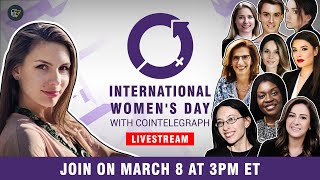
A Cointelegraph-hosted International Women’s Day panel (YouTube transcript) featuring women leaders in blockchain/fintech: Christina (host), Olivia (OKX head of content), Anino Emua (founder/MD, France; fintech for inclusion), Rachel (Cointelegraph reporter), Elissa/Elissa Shevinsky (CTO at Cointelegraph / author), Effie Pilarino (Fintech/blockchain advisor), Sanja (CEO of Utrust), Teodora (founder-team at Nexo), Molly Jane (CoinMarketCap content manager). Panelists introduce themselves, describe why blockchain/crypto excites them (financial inclusion, disrupting traditional finance, remote work, payment solutions), share anecdotes about gender stereotypes, discuss gaps in participation (user bases skew male, literacy and regional differences), and offer concrete ways to increase women’s participation: early education/toys/storybooks, role models and mentorship, inclusive product design, hiring and governance participation. The panel also shares recommended readings and closes with personal wishes for the women’s community. Transcript contains repeated lines and informal dialog artifacts.
Chapters
We are here at Cointelegraph celebrating one of the most wonderful days in the year. Celebrating spring, women's power. Hi, everyone. We are here at Cointelegraph celebrating one of the most wonderful days in the year. Wonderful. I had a YouTube channel open on my computer. So this is how women first start the panels in the modern world. Welcome, everyone. Ladies, I'm so happy to see you here. You are so beautiful.
You are so inspired.
I know that it's late for some of you. Thank you so much for joining us today. How are you?
Good, thanks, Christina.
Thank you. Doing well. Thanks.
I'm really happy to have this incredible company today gathering with our members of the staff. So we here have Rachel, our reporter, and Alyssa Chavinsky, who has just been announced officially as CTO at Cointelegraph. Congratulations, Alyssa.
Thank you.
It is official. And I'll add that this is a little bit of a promotion for me because we originally were bringing me on as both head of product, and I would be like interim cto. And it's weird to have two job titles, although sometimes one person will do both those jobs, but you pick one that you're going to use publicly. But I feel like I've really come into the role of cto, and I asked Jay, the CEO, if we can say officially that I'm wearing that role now. So I'm really, really excited about this.
Wonderful, Lisa, thank you so much. I'm really happy that more women are joining our space. More women are joining our project. And apart from my colleagues from Cointelegraph, I have my dear, wonderful colleagues and friends from other projects. And ladies, can I ask you to present yourself, please? And tell me, what is it that excites you about the space where we are all working? Effy, let's start with you. You are on my right side on the zoom screen.
Hi, I'm Effie Pilarino. I am based in Switzerland. We met with Cristina and Alino, a memorable meeting in Davos last year. And of course, it's so much more memorable after this confinement. We share a Fintech award for women. I come from the traditional finance world, from Wall street in the last six years. I'm a Fintech advisor and a blockchain advisor. And I've become an influencer in this space. And I'm deeply involved in innovations, especially in capital markets. And that's where blockchain for me is revolutionary.
Thank you.
Effy, please pass the torch. Well, you mentioned Anina, so maybe Anina will be the next one. Hi, Anina. So happy to See you.
Hi, Christina. Thank you so much to the team for having me here and good evening wonderful ladies. Happy International Women's Day. And to all who are wondering, watching us now. My name is Anino Emua. I'm from Nigeria. I actually am the founder and the managing director of a strategy and financial advisory firm in France. I started on my career in banking and this is what has led me to my interest in blockchain via fintech. Because I started out working in terms of corporate banking, but I found that entrepreneurs were not getting finance. And. And that's where I then did my doctoral studies in financing entrepreneurs in Africa. And what we found over time, of course, is that fintech has the ability to be able to overcome some of those barriers, right, in terms of cost barriers, in terms of information for lending to smaller businesses. And that has been very important, I think in Africa in terms of inclusion, really financial inclusion. And that's where it comes into it for me in terms of how blockchain can, going forward, power that industry. And also not just in terms of fintech, but just in terms of information in terms, for example, in property, in property rights, for example. Blockchain has the ability to be able to store and transfer that data seamlessly, which are, you know, these are some of the barriers in terms of acquiring property and using landed property for lending. But also I also work with lots of communities of women in business business. I host quite a few and I'm delighted to be here.
Thank you so much. Anina, by the way, just launched an incredible association of Wonderful Women, 100 women in Davos. And I have the honor to be an advising founding, advisory, founding member. Thank you so much again for the invitation and follow our activity. That's something that is very important to promote women's project within the community of women. Okay, we are in France now, so let's go to Portugal. Sanja, how are you today?
Hey, thank you so much for inviting me. I'm actually in Italy right now, but I was in Portugal for most of last year. Thank you so much for the invite and nice to be here celebrating with all of you amazing women. And yeah, I'm the CEO of utrust. We are a payment ecosystem. We are headquartered in Portugal, global company. And basically what we do is we allow buyers to pay with cryptocurrencies and sellers to be paid either in fiat or cryptocurrencies. And for me, what excites me most about this space and that's exactly the reason why I decided to leave my corporate career. So I had a career in corporate industry, in PayPal, eBay and very different companies, is that we have exactly the opportunity with blockchain to disrupt the traditional financial system. And with so many people today being unbanked or underbanked in the world, you know, traditional finance really puts a huge barrier to entry. And with blockchain, we have a unique opportunity to lower the barrier to entry in the space, especially for women who we know are the highest percentage of these underbanked people in the world. And I think, moreover, now with, you know, what happened and with COVID we also have the opportunity to work in a remote, friendly or remote, remote only way, and giving the opportunity to more women like wherever they are to work for our company. And that's one of the missions that we have at utrust as well, which is very exciting.
Thank you very much. Sanja. Rachel, sorry I just mentioned you, but I would like really to present yourself. And also, Rachel is now working on some very interesting articles for Cointelegraphy about women. Maybe you can share something that excited you this. This week, working on them.
Sure, yeah. Thank you again, Christina. Hi, everyone. I'm Rachel. I'm a reporter for Cointelegraph and I've been writing about the blockchain space since 2017. And yeah, super happy being at Cointelegraph and being a part of the team there. And so I will have a feature article out this week on women innovating in the enterprise space in particular, because that's kind of my area of focus. So, yeah, I'm excited for that. Interestingly enough, I mean, I really had to think about the list and think about the women in the enterprise space because I think, I mean, there's a lot of women that come into come to mind when I think of women in crypto and influencers and people doing stuff on YouTube and. But, but women in enterprise, it's a bit more restricted, I guess. So coming up with that list has been interesting and exciting, but I've definitely got a good list of women on there.
So.
Yeah, and I'm just really happy to celebrate International Women's Day with you all and to meet everyone and there's a few of that I've met already. So anyways, thank you again, Christina, and decoyntelegraph for organizing this.
Welcome, Rachel. Teodora. So you are now in Bulgaria. How are you doing there?
Fantastic. I'm with my team in Bulgaria, partially with my team in Bulgaria, where for those of you that haven't met me yet, I'm Teodora. I'M a founding team member at Nexo. I've been involved in a lot of disrupting since 2017, straight out of university, frankly, when we started Nexo. I am involved with another digital bank as well. And frankly, come to think about it, when we're all discussing here, I think the women in crypto group should just expand to women in tech, fintech and everything because apparently women are that amazing that we're doing everything at once. I'm currently in Bulgaria, having the best time here. Obviously a lot of work, a lot of new things coming from our teams and I'm very happy to join you lovely ladies and spend women days with you.
Happy to have you today. Data Dora, thank you very much. And I have my dearest friends and also my former colleagues here. Olivia, how about you? So you are now moving from the US to Ukraine, but working for an Asian company. Tell us a little bit about this.
Yeah, well, we are a very global company and I personally am always all over the place. Currently I'm in Kyiv, Ukraine from New York originally and just flew in the other day and yeah, I think so. I, I am head of content at OkX. So I'll just explain that first. OKX is probably just known as like a, one of the big crypto exchanges. It's also a crypto finance company, like a finance ecosystem outside of sort of what you might traditionally think of as trading. And yeah, I run the content team there. It's fairly new, very exciting. I think what I'm really. Oh, and I formerly worked at Cointelegraph, so yeah, I worked with Christina and Molly. Jane was on the call as well. And that's sort of my start in Crypto also in 2017, which feels so long ago, but yeah, so I, I'm excited and have chosen to, to stay in the industry for what feels like a long time. We're all like veterans if we've been in it for a few years because it is still very much an emerging industry. And I think that's what really, I think is really cool about it. It's so young. It's so young and it's still is so unknown in a way. So we're really forming kind of the rules of the game as we go and it has been seems like a very international space so far. But there are still of course a lot of underrepresented groups, especially in terms of people who use crypto or like own crypto. And one of those underrepresented groups is obviously women, so. So we know these statistics and I think I do see a lot of women working in crypto, and it's really, really great to be with all of you on this call tonight. So thank you for inviting me, Chris. But yeah, it's something I definitely think about in terms of how to sort of change that trajectory. Not necessarily just about women, but other underrepresented groups, because this is definitely an international and I would say, like, borderless phenomenon.
Right?
It really is. So that's something that I'm excited about.
Thank you very much, Olivia. I'm really happy, actually, and proud that cointelegraph also has been kind of an incubation hub for women. And so many wonderful women actually started at cointelegraph and then started to work on other projects. Okay, Molly, Jane, tell us what are you doing now and what excites you in the space?
Sure.
So, yeah, I'm Molly Jain. I also formerly worked with Christina and Olivia at Cointelegraph, but now I'm the content manager at CoinMarketCap, where I run CoinMarketCap Alexandria, which is an educational hub, a sort of investopedia, Wikipedia like place. Because as you all know, CoinMarketCap obviously has all of the data about cryptocurrencies, but what I'm trying to do there is also put all of the information that kind of tells the story behind the data. So we only launched that in September, but we're getting really excited. It's getting some good traction. I'm also the secretary, one of the founding members of the association of Cryptocurrency Journalists and researchers, the ACJR, along with people from CoinDesk, the Block, Decrypt, Cointelegraph, obviously. So I kind of see my role in this space because I have a liberal arts background. I don't really have a background in technology or fintech or anything per se, but I joined the space because actually, Olivia hired me a few years ago because I really just enjoy writing and telling stories. And so I kind of see my role here as bringing sort of that liberal arts background and aspect to this really complicated world of technology and making it accessible for everyone. Because I think now that it's very, very important. I've been in this space since 2017. As about the role of women in this space, I mean, I see the data. At CoinMarketCap, we're obviously one of the biggest websites in the world. Last week, we beat Bloomberg, Reuters and the Wall Street Journal in terms of traffic. And the majority of our audience is men. More than half the same thing. For CoinMarketCap Alexandria, the educational content that I do. It's basically all men, and so it's interesting to think about how to create content that people will read without alienating one of the genders. So it's something that I've been spending some time thinking about as I do my job.
Yeah.
Wonderful. Well, ladies, I think it's time to clean our drinks to celebrate our day. Ladies and also all the ladies, girls, women, and also men who are watching today, our session. Happy Women's Day.
Cheers.
Cheers.
Cheers.
Thank you.
My drink is over there.
Ladies, I wanted. Well, first, I really want to invite everyone who's watching us to post your questions. We are very much interested in knowing what are you thinking about women in tech and blockchain and how blockchain would benefit women and how women could actually bring advantages to the blockchain community. I wanted to bring our attention a bit to funny, funny stuff. Of course, we are all acquainted with different gender stereotypes while it's present everywhere. And I wanted to ask you to share your funny stories about gender stereotypes that you have encountered in your personal or professional lives. I can tell you, for example, from my side. I was once participating in a panel about women in tech, and the organizers of the event were men, and they really asked me not to ask questions about any gender discrimination or underrepresentation because he was 100% convinced that more we talk about underrepresentation of women, the more it takes place. So it was actually very interesting to also discuss with men how we approach this kind of gender biases and stereotypes. Sanja, I think one of maybe the most typical stereotype about women in blockchain and crypto is that women prefer not to trade, prefer not to invest, prefer not to use risky. They call it risky assets for payments. Could you respond to this? And I'm sure you have some justification of a country situation.
Yeah, no. I actually have a funny story about gender bias because I think a couple of months ago, I was about to go in a call with one of our partners, latest merchants in Turkey. And my name is Sanya, but actually, like, in India, it's a male name, so it's Sanjay. So I went in the call and like, we were on video and this person is a CEO in Turkey, one of our partners. And he was like, okay, when is the CEO going to arrive? I'm like, I'm the CEO of utrust. And he was so shocked. He was like, I was expecting a man, like, from your. From your name. And he was really puzzled in a way that in the end, he was really happy to see a woman, but for him. So I started to ask him questions like, you know, why you are expecting a man. Why is this so weird to you? So he explained to me that in his country it would be impossible even to today, like in the era we live, for a woman to be in the financial space and technology and innovation. And in the end, he was very happy to see a woman. But yeah, I have to say, in terms of our main customers, like, if we analyze the user base of users actually paying with cryptocurrencies, most of them are still men, but women are rising. So more and more women are choosing to pay with cryptocurrencies and more stable coins, actually for. For verticals, like luxury items, fashion. So I have to say, especially last year, I can see this trend growing, but still most of the customers are men. But it's changing. So it's good to see that there is a change happening in the market and more women are choosing to pay with cryptocurrencies, for sure.
Olivia, do you have something to add about women in trading on exchanges and maybe something about female customers of all Key X? I think that all Keyx actually is a team that has a lot of women members.
Yeah, Like I said, I think, you know, I don't have statistics off the top of my head for the company makeup or for our user base so much, but that is publicly available. But it, like I said before, I do feel like the makeup within corporate structures is often more balanced than it is in the user base. And I think, especially with exchanges, we frequently see, like Molly said, very high percentages, dominant male customer base. And I think it's. It's a lot of things. I mean, like I said, it's still a very emerging industry. So this concept of who is a trader and who uses trading platforms the way they look now is still very sort of like traditional in a way. And I hope that's going to continue to change as we've seen.
I mean.
It's a problem sort of from an engineering side. And like, how do you not only make, for example, content or something that will educate people, that will bring people into the space, but then how do you make the products themselves that are more accessible to a wider user base? It's not. Again, like, I don't want to bring it away from the question of women, but another huge pattern is age. Huge. Like really, really focused on 25 to 35. A lot of companies have that sort of specific sector that they serve. And so it's just. So it's so Limiting. I think I'm trying to think of how to answer your question, but I just think it's a really, it's a problem sort of from the inside and also from how finance in general is perceived and how tech is perceived as being for a particular group of people. One of the things I wanted to bring up is about a lot of crypto is especially trading is wealth building and women do hold wealth and are a potential customer of pretty much every crypto product, but in particular investing. And something that one of my women in crypto idols, who doesn't know she's my idol, Melton Demirs, always talks about when she's talking about women in crypto is the huge percent of women who actually control the wealth in their family, with finances in their family. Something like 80%. I believe that's a U.S. statistic. I'm just quoting her on this, just repeating her. That's huge. So when we think about this, it's not just about make products that everyone can use just because we want diversity for the sake of diversity. We're talking about making products everyone can use because from the business side that makes sense. This is a potential customer base, huge, obviously half of the population and then also from the empowerment side. So whether it's age or gender, the thing about crypto I think that we've been talking about that's exciting is this direct access to wealth creation and without the middleman of a broker or someone that you need a license for something that you need to necessarily have all of these particular qualifications to use. So yeah, I mean that's a kind of muddled answer. But it's just what I'm thinking about is this huge sector that you know.
To this as I'm listening to these known statistics that there are few women that are trading or investing in crypto but if you look at the traditional markets which have been around forever and ever, so to speak, much longer, there is the same issue. I mean of course the numbers are larger but if you look at Robin Hood and what happened with the Wall street boys and Reddit, it's, it's male dominated and if you talk to very mature robo advisors in the fintech space, fintech companies that have automated investing in the US you can look at betterment and wealth front in the uk, they're scalable and others, they will tell you the biggest problem that they have is the under participation of women and how to get to them. Even though we women have quite a bit of earning power, it might not be evenly distributed across the world and across countries. But beyond the earning power, a lot of women control the decision making in households. It doesn't. To me, it's natural, at least on the crypto exchanges that we don't see a lot of women where I would like to see more women. And it kind of saddens me that we don't have enough is in the design of whatever it is, be it a product, be it a process. Because, you know, crypto is the only bottom up thing that we've ever seen. Right. And we are risking of losing this by handing it over at the enterprise level. And if the blockchain designs and the infrastructure gets done at the enterprise level and there aren't enough women there, then it won't be the female thinking for me, the biggest, how can I say, advantage. We all talk about decentralization, even if it's not absolute. In blockchain, it's all about creating a community that can exchange value peer to peer, even if it's not completely decentralized and open. And we women should be part of that design and thinking. This is, I think, the biggest issue.
Totally agree with you, afi. Yes, thank you very much. And of course, from laughing, we are moving quickly to serious things. I would actually like to focus your attention on the fact that also the situation is quite different from country to country, from reality to reality. And out of almost 800 million illiterate adults in the world, two thirds are women. So I would like actually to read a question from our viewers, Black Bitcoin matters. I would love for someone to direct me towards any programs for young people that are focused on blockchain. I have two very bright girls that I am raising. Ladies, let's think of a piece of advice, how to educate yourself in order to make first steps in the industry. Who would like to share her thoughts?
I wouldn't mind if anybody's not going.
Thank you.
You know, I was on a conversation yesterday and this was on Clubhouse. And I started off by saying, imagine that we were in 2121, okay? And it was International Women's Day. And based on what is happening today, in 2121, in 100 years, we would be celebrating finally diversity, right? A hundred years time. Now that is frightening. If we look at the finance industry, what we are doing today is trying to unwind things that have been there for hundreds of years. We cannot afford to allow an emerging industry not to have diversity right at the very beginning. So when he's talking about how do we start this? I think, and this is where we can build on our strengths as women, right? Because one of the roles that we've had as women is in terms of bringing up children. And because that has not been valued economically, right. It's been looked down as being negative. However, we know that it is of value. So what I think that we can actually do is to start to incorporate this learning, right, naturally into children who are, right from an early age, you know, before they're even in, you know, primary school. Right. About what is blockchain? You know, toys that have, you know, that have coins, right. You know, that are suitable for young girls. Storybooks, right, that have, you know, that talk about this from an early age. And I think that we need to start now, not try and wait until we're talking about entry level, you know, at university or after, but actually start an encouraging and opening up the world for our children who are very open actually, at a very young age.
That's great thinking. Thank you very much. Sunina, there is another question that is related to education, but is a bit more delicate in my opinion. Also from the viewers, Gary, how do you get more women and young ladies interested in the crypto industry? So one thing is educate, another thing is to rise interest in it. Teodoro, I imagine that you work with a lot of interesting women and you are also responsible for VIP relationship, right? So how do you attract women to the space? And do you think that women have.
Particular.
Ideas they would like to hear first when they are introduced to the blockchain sector?
That's actually very interesting question, I think. Well, I'm going to sound as a millennial here, but I think the thing that we should do right now is actually make it cooler for people to join, like to join crypto, to join the fintech revolution that we've started, to join everything to be. It's actually being more responsible for your own future. So I think that ladies and young girls should generally be very inspired about it because this comes with a lot of freedom, like fintech revolution and managing your own finances and managing your own crypto, teaching yourself to trade and everything that comes with that, it means freedom, that's the thing. So I think this is one of the reasons why people should be inspired about it, especially young ladies, when it comes down to being a bit more particular when it comes to education. By the way, I can recommend my very own university in Vienna, who happens to be the largest economic university in Europe. Two years ago, just two years ago, they didn't have. So one of the reasons why I left Austria is Actually, because there was not a single place two years ago where you could have started being educated about blockchain. And right now they have a huge research institute which inspires a lot of young women, a lot of young people.
Overall.
It's starting to get so common that I can't keep up with the questions that come my way, frankly, when it comes down to crypto and trading and everything really related. So I think this is. We should just make it cool. I share actually the same hometown as Latina from Robin Hood, and I am a big fan of whatever, of everything that they're doing. And the very fact. Well, not exactly everything, but a lot of the things they're doing and the fact that they're getting everything. They're making it so popular. And I think that everyone should just join in, in the financial revolution that we're trying to create.
Christina, I'd really like to jump in, if that's okay.
Please do, Alyssa.
This was the topic of the book that I published, Lean Out Speaking about women and technology. Not necessarily in crypto, but I think it's almost exactly the same question and solutions. People asked, how do you get women interested in technology? And that question, it's really the wrong question to ask because women were some of the original programmers. We've seen the movies about women at NASA. We've seen the history of the early women cryptographers. I was one of the earlier women working in software. In the late 1990s, early 2000s, we were here, and then it became less welcoming, and women left, and women come into technology jobs, they come into softer jobs, and then they burn out and leave because they don't feel included. We see this now at Google, where some very prominent women of color have come forward and spoken about how they were there trying to make a difference, but they didn't feel supported, and so they left. And so we see again and again that women have the curiosity, they have the interest, they have the talent, and everything's cool enough. I mean, we can make things cooler. That's a great suggestion. But women are here, and women are awesome. That's not a problem to be solved. The question is, when women show up, how do we help women to feel included and to stay? And so what I believe is happening now with crypto is that women, along with everyone else, are seeing crypto in the news. They're seeing the price of bitcoin. They're curious. But where do they see spaces that are inclusive, spaces that they can go to learn? Where do they see role models? Where do they see a path for them. And the challenge on how to build that is, you know, on all of us. It's. It's meaningful to see all of the women here with the titles that they have and the work that they're doing. I think that makes a really big difference, I guess. Thank you, Christina, for your part in organizing. And I guess I'll just say the same thing I said in 2015, which is women are already here and women are already awesome.
So true. So true. So let's educate them and let's promote them and let's be them. You mentioned role models. I think that's very important. So definitely we have incredible women in the space, but I think that we also need to think about the language of telling success stories in the blockchain space. It's not about becoming a millionaire in a week. I don't think this is what would attract women. Rachel, you have been working with so many incredible women in the space. Maybe you have your favorite success story that, in your opinion, could inspire more young women or not young women. Young. I mean, young for the industry. That's the only connotation that I use. I think the industry is so young, and everybody who is entering the space is actually as a child, and we are all learning all together, and every woman who comes to the space in any way is learning new things. So, Rachel, what is your favorite success story? Or maybe several of them.
Yeah. Thank you. So that's a good question. So I need to think about it, but off the top of my head. Well, first of all, I think inclusion, Elisa, what you were saying is really, really important. And to feel included within an environment that's inviting and thriving is really important for women to get involved in crypto and blockchain. Because if you feel like you're part of a team, then you're going to keep working harder towards that. And if you feel encouraged, that goes a long way. So in terms of success story, I mean, like I said, I think I really need to think about that. But something that comes off the top of my head is when I was first entering the space in 2017, I went to my first bitcoin conference in Hong Kong at the end of 2017, and I brought a friend with me because I didn't want to go to Hong Kong alone, and she didn't know much about bitcoin coin, and I didn't really at the time either. But I brought her with me, and she. She ended up loving it. And to this day on, she still works in the crypto space. She's with a defi platform called Kava. But you know, just hearing her say, Rachel, you got me involved in the space. And to hear that she's still there with a great company, you know, I wouldn't call it a success story, but it's really inspiring. And I think that, that we need more people like that in the industry to show other women that this is such an awesome space to be in. I look at women like Sheila Warren with the World Economic Forum. I've met her, I've heard her speak, and I'm just, I'm so inspired by her. So I think, you know, having women like Sheila Leanne Kemp with Ever Ledger, you know, women in the enterprise space as well, that's so important. They're really inspiring and I think that they can continue encouraging other women to get involved. And it makes me feel good knowing that, like, I helped a friend get involved. And she's been in the space ever since. Just, you know, taking her to a conference in Hong Kong and it's really a space that you kind of get sucked into. And it's so interesting. I've written about other technologies before and nothing has ever caught my interest like blockchain and cryptocurrency. Specifically, the blockchain part is really interesting because it can be applied in so many ways. It's not just about getting rich quick, it's not just about crypto, but it's about supply chain management, which is one of the best use cases for blockchain in the enterprise. It's about, you know, recording data and keeping that on an immutable ledger like the Ethereum public blockchain, to have records of things that have happened, like what Oracle is doing. They're not using the Ethereum public blockchain, but they're doing record keeping with blockchain. So anyways, really interesting stuff happening.
True. And I think that the word quick is actually, it could be applied to the whole ecosystem and the industry because in my opinion, in order to be part of the community, once you enter, you really have to be speedy and you have to learn quick. And all the ecosystem is actually inspiring and motivating you to do this. It's not. It's a very efficient environment in terms of doing business. In terms of learning. My next question actually will go to Molly. So you are building now an educational platform. So I'm really interested to learn about tools that you use and also maybe gender differences in terms of presenting content, educating, what could be interesting and what could be more. Let's Put it targeted.
Sure.
So when we write content at CMC Alexandria, we don't target to different genders, if that makes sense. What we really target to are true beginners, because we've done a bunch of user surveys and we found that most of the people that use CoinMarketCap even are crypto novices. Because we're kind of this gateway between the traditional financial world and the crypto world. Because people Google bitcoin price and we come up first. And that's a lot of responsibility for us, because we want to be the ones that show people that you shouldn't just look at the price and go away, but you should stay and see that the crypto space is a lot more about how much one bitcoin is worth in dollar terms, you know, at a particular moment. And so what we're trying to do with Alexandria for women, for men, for anyone, is just make it something very, very accessible. Which means that we are doing a really large focus on guides, like really concrete guides, how to set up a bitcoin wallet, et cetera, so that when your mom or your family friend asks, what do I do? You can just send this article instead of having to explain it. We're also experimenting now with some sort of quizzes, polls, user journeys, because gamification is kind of everything for keeping people's attention. You've kind of seen that with NFTs. And just in terms, people like to collect, they like to feel like they're a part of something cool and new and exciting. And just reading long articles doesn't always do that for them. I will say that creating really basic crypto education is something that I have seen a really positive response for. Because just, I mean, talking about metrics here, the time per. Per article just blew me away. We have people reading our articles for seven minutes, for eight minutes, and that's fantastic. Shows that people really care. I also do think it's interesting that the number of men and women reading our articles is about equal, a little bit more men, as opposed to the CMC homepage, which is something more like a 70, a 70, 30, 60, 40 split. So I would love advice from anyone here. If you have angles that you think are missing in educational content that would specifically get people that wouldn't be necessarily interested in cryptocurrency, which could mean women, but it could mean any other sectors. I had a really interesting conversation already last year when I was doing these online meetups through CMC with the author of Bitcoin in Black America, Isaiah Jackson. I might be forgetting his name. But I really liked his book. I read it. It was not only an introduction to bitcoin and blockchain, but then at the end of the book, it had a list of black entrepreneurs in the bitcoin and blockchain space and their contacts so that people that were interested could then just send them a message on telegram and be like, look, I'm part of this community. How can I help? And so maybe that's something that we could do for women or for other sectors that maybe don't feel like they have support just because, like someone mentioned here, we all are working remotely. We're all working from home. I'm talking to you guys from my bedroom. So having those sort of resources, maybe something that maybe even CoinMarketCap could include in our educational platform. I just thought of that right now.
But yeah, that's it.
Great idea. Smalli. Honestly, I think one of the biggest wonders in our industry is accessibility. I worked before in, well, let's call it more traditional businesses. And I remember all these bureaucracy steps that you had to pass before having access to a person who makes decisions. Or maybe you will never have this access actually, if you are just, I don't know, a project manager in a company and not a CEO, whatever. What is incredible about our space that actually, yeah, you can just share a contact of a CEO, of a founder. And these people, they really prefer to communicate directly. Always. Maybe not having time, but still they want to share their ideas because their ideas are something that they want to really bring to change the world. Molly, you mentioned reading. So I would like to ask you all ladies to name one book that recently or before inspired you, influenced some of your decisions in the space. It shouldn't be related to blockchain, crypto and technology, but something that empowered you as a woman and as a businesswoman, as a personality. Whoever wants to start.
I can start just because. Yeah. So I love books. My undergrad degree is in English and my focus was feminist literature. So one of my favorite books to this day is Kate Chopin, the Awakening. I don't know if you ladies have read it, but I highly recommend it. Basically, it's just about women empowerment. And I grew up reading Toni Morrison and Kate Chopin and Henrik Ibsen and all of these books that are really empowering women and, you know, growing up and you're reading that literature, you think you can do anything. It's like we have. We make our own choices. We have so much power. We can do whatever we want to do if we put our mind to it. Another Book I really loved was Viktor Frankl Man's Search for Meaning, which was basically about a Holocaust survivor, and he survived the Holocaust just because he has that mindset. He had the mindset to survive. So that's another one of my favorite books. Just you can apply it to everyday life. If you want to succeed in a certain industry and you try hard enough, you can. I love blockchain. I love cryptocurrency. I've been writing about the space in 2017. There have been plenty of ups and downs in my career, lots of downs, trust me. But at the end of the day, I never gave up. And even when I did have some time where I didn't have a lot of writing going on, I wrote a book on bitcoin for beginners just because that's what I love to do. So I think that reading feminist literature like Kate Chopin, the Awakening and Viktor Frankel Man Search for Meaning really helped me in my life.
So thank you, Rachel. Noted ladies. Sanya, Theodora. I see your microphones are turned off. So you're ready?
Yeah, I can go next. So for me, it's not necessarily about women, but two books that I read recently in the last couple of years, and that made me feel more empowered as a woman. So one is called Money Master the Game. It was written by Tony Robbins and his team, and basically he interviewed 50 of the wealthiest people in the world and actually wrote a book about copying those strategies. And what it shows you is how you can really take control of your knowledge. And it's actually easy to learn about money and what money is and what the financial system is. And he gives you really practical tools to do that and actually gives you examples of strategies you can copy paste as well in your own portfolio. And the other book is called Pitch Anything, and actually it talks about how the human beings, men and women, have, like, an old brain still. So you still have an old brain inside your evolutionary brain. And when you pitch anything to anyone, you need to explain it in a really simple way. I need to understand it in less than 30 seconds. And that actually changed my way of pitching because I think as women, we tend to, like, I need to tell him everything, like, and I need to tell the whole story. And actually, like, it's really necessary to simplify so that change as well my way in explaining and pitching and telling a story.
Wonderful. Thank you, Sonia. Theodora.
So, yeah, and there's an author that I always recommend, Nicholas Taleb, obviously. I think we've all read reread the Black Swan last Year because we had to, frankly. So Taleb, I started reading him in 2013 in university, and it's just I've been super passionate about microeconomics ever since, finance, etc. He does a lot of research. I think you're all familiar with his books the Black Swan, Antifragile, and the Black Swan actually got very, very popular last year with the Pandemic. With the start of the Pandemic, he researches mostly the rare and predictable events that are affecting our daily life and how likely it is that they happen and how they impact everything around us and how to actually survive through them. So these are the two books that I recommend. And yeah, this is pretty. Oh, yes. And another one. Ayn Rand, the Fountainhead and Atlas Shrek as well. My two favorites. When, yeah, it's International Women's Day at.
The end of the day.
Beautiful selection. Thank you. Alyssa.
Yes.
My friend Tara Wheeler published a book that's called Women in Tech. You can find a blurb from me saying how great the book is on.
The back of the book.
And I found this book to be just so helpful with career advice. And it's very positive and optimistic and empowering. And it sold, like, so many copies. People just love it. So I have to recommend that, as opposed to my book that I published, which is a little bit like, Dark, my work is of a different nature. The book that I published, Lean out, gives you some feeling of camaraderie if you're in a moment where you feel like you're not being understood or it's hard to fit in. I think the tagline for my book is that making things is easy and fitting in is hard. And it's called Lean Out. All that said, if I can squeeze in one more thing on the topic of bitcoin, Christina, can I get 30 more seconds?
Okay, go for it, Alyssa.
I recommend that people with an interest in bitcoin specifically and who are technical go back and read the original PGP code. Specifically, code that you can tag is written by Hal Finney. Hal Finney is credited by many people as being at least part of the original inner circle of people who are close to bitcoin. Whether or not he was involved in the actual coding, the original PGP code and the comments and the discussion around that tells you a lot about the intentions of the original, like, cypherpunk type folks. And there's a lesson there about designing something and building something in the intentions of the original designers versus what it turns into. Because bitcoin right now for people is really about like financial freedom and making money. And the original design seems to be a lot more like libertarian anti government. There's still that overlap. But I think it's interesting to see how you can build something but then community makes it its own.
So true. That's a great point. Honestly. Effy, your recommendation?
You know, I've been thinking of what to bring up. First of all, I must share and admit that I've started writing a book around blockchain. And the reason that I wanted it and I'm still writing it is because I want more people to understand. So what is this all about? Why it resonates even if we don't really understand. Maybe the technology, maybe the intention or even the application. It's taken a life of its own and who knows where it goes. So I'm writing it at the level that anybody could read it. And I also, I'm trying to bring my own, I would say more spiritual concerns of where we are at as a species and how it relates to bitcoin and blockchain. Because I think there's a resonance there of trying to organize and collaborate in a different way than the way we are now. I'll put that aside. And of course, if there's any project that you know in the space that is looking at this from a spiritual aspect, please let me know because I'd like to talk to the people and include them in my book. And then, you know, in my favorite books, I've got one from my early Wall street years by Michael Lewis, the Liars Poker. We used to work at the same company at Salomon Brothers. So it resonates. I had two read it when I first, you know, got my job there. And it was definitely a male dominated environment, talking about no gender diversity and so on. And these days I would suggest reading the Surrender Experiment by Michael Singer, which is a story of a business person and spiritual path. Highly recommend. Very inspirational and I leave it here.
Thank you, Ashley. Olivia.
Yes. I want to also name two. It's hard to do these questions, obviously it's hard to choose. The first one is. The first one that popped into my head is Debt by David Graeber. I read this book since college and reread is. I also studied humanities, by the way, Russian literature. Not connected. Similar path as Mali actually. But yeah, so. But I read Debt and Debt is incredibly interesting because it is written by an anthropologist, but it is a history of debt. A huge history, kind of like 5,000 year scope. And in doing, in talking about the nature of Debt and the history of debt is a history of money. And I think that money and exchange, and I think that these important dynamics that cross cultures and cross time, obviously they are just so poorly understood on a kind of, I don't know, on an everyday level. And they're even like the sort of first step of the book is to break down the myths that are perpetuated in these sort of like econ 101 type classes. So they're even poorly understood in the education system. And I think, yeah, being in crypto, it's really important to understand the sort of origins of money and the origins of value transfer because we are looking at that. Right? Again, I'm just repeating what everyone's been saying, but we're looking at that on a kind of bare bones level. How does that work? Peer to peer directly. And again, the origins of bitcoin are also about that in a libertarian way, et cetera. But yeah, exactly. Like without having this larger structure like a government, so that nature is still very much part of the crypto industry, I think as it, as it expands and Debt is a really helpful book for understanding those core dynamics in human history. The other book I want to mention is called Kill All Normies. I don't know if anyone read is by Angela. Let me just get her last name. Angela Nagel. It's an incredible, just really, really good book. I highly recommend. I'm not relating it right now to crypto, it's just one of my favorite books, but it is an excellent book for understanding Internet culture. So there's a relation there, but Internet culture and the sort of cultural wars that are unfolding now on the Internet. And it's funny and witty and highly recommend.
Wonderful. I really feel that even if some of our viewers are now locked down, they will have a selection of incredible books now to fill out their time. Anina, do you have some books to share?
Yes, I do. I have four books to share now. The first two I am not particularly recommending them, but it's just to help you to understand what sort of shaped my thinking. And the other two I am absolutely recommending, especially on Women's Day. The first book is a book I read as a student and that was by the professor Amartya Senior, and it was the Economics of Famine. And what was so profound about this book as an economic student at the lse. The lse, as some of you would know, is one of this is an institution whose history was built on social inclusion. So these books are about inclusion. And what was so profound in the book is that it showed that the thinking that we had about certain things and our understanding actually was quite flawed. And trying to understand famine, we thought of famine as just really areas of the world that didn't have good harvest and therefore people starved. And when he actually showed that there were instances where it was constructed by decisions. Right. Made by governments. Right. Which then created these kinds of situations, I think that that really was profound for me. This is somebody who had gone into the LSE to become an investment banker. Right. And I began to understand how poverty could actually be created by things that we do ourselves. The second one, which is a more recent book, which is by the French economist, female economist, co authored, who is a Nobel Peace Prize laureate, which is Esther Dufloux, which is about poor economics, which is also another book about inclusion and understanding, you know, understanding how the poor make economic decisions. Right. And that helps us to find solutions. So all that we're talking about in terms of blockchain, in terms of fintech, in terms of inclusion, right. We need to understand first. Right. And not create products thinking that we understand. So that's so savings products and all of that. Right. What matters lower down the economic, shall we say, the pyramid. So those are two. Now, what I would highly recommend, nothing to do with blockchain, nothing to do with crypto directly. But these are really important books, I think, for women. One Becoming by Michelle Obama is a book that every woman, young woman, old woman, whatever woman should read. And the other one is the one by Melinda Gates. Right. The Moment of Lift. And I think that absolutely every woman must have man as well, but certainly everyone. These are inspiring motivational books written by women who have achieved incredible things. Right. But they are not women on pedestals. These are real women who are there to work, to tell us, to help us write and on how to get there. So these are incredibly inspiring books, those last two.
Thank you very much. Anina. I would like just to share one article. As a journalist. I think that's an article that every woman should read because this is something that questions the concept of like stereotype feminism, but actually asks very important questions. It's called why Women still can't have It All. It was published in 2012 in the Atlantic by Ann Marie Slaughter, the first ever woman director of policy planning under Obama, under the presidency of Obama. And I think this very long. A very well written article is actually talking about what is this all? The idea is that our all is not the same as men's all. And we also should admit that there Are these differences that we should never, never, never over? Well, we will never be able to be as men in any case. So actually, my last question is from the audience. I liked it a lot and I would like to share it with you. So, Jordan, Harry asks us, what can men in the crypto space do to welcome more women into the space and help them out? Whoever wants to share their thoughts. I think that's a very important question and already the fact that it's asked is a very important sign. And I really think that we have wonderful people in the space and it's important that there are people on different representatives of different visions that want to hear each other, to learn about each other. So what can do. What can men do for women?
Men and women, I propose, should adopt sort of speak a woman in their network. Whatever they are, it might be their social network, their work, whatever. Just one person and bring them up the curve, answer questions, make them comfortable, hold their hand, bring them into this world without, you know, all the intimidation and, and the hurdles. Just bring a person along naturally. If we all do that for just one person, then, you know, that's the network effects we have the passion, it comes, you know, it comes out naturally.
I think that's right. You don't have to be, you know, a hiring manager or someone in a position of special authority to be able to be part of this. So for sure, if you're in a position to fund women in the space or hire women in the space, then, you know, maybe do that. That would be great. But everyone has friends or, you know, a sister or a mother or neighbors. You know, we all, every man has, you know, some woman that he knows. And so I would recommend to post in a WhatsApp group or on Facebook or wherever you share with those people you're talking to. The offer to teach a little more about cryptocurrency, how to set up a wallet, or, you know, do you have any questions? And see who raises her hand and says, I'm interested to know.
Wonderful, wonderful thoughts. Anybody else? Todora, go for it.
I may jump in. Well, first of all, maybe I should have started with the fact that I don't typically differentiate with between men and women. So I've always been saying that I've been stuck standing on shoulders of giants because I've been super supported in the space ever since I started. My team is phenomenal. They're amazing. They're mentoring me, they've been helping me around. And I think that this is what men should typically do for women. In this space, they should mentor them, find their natural talents, make them just evolve these talents more, get involved, teach them entry level education about everything. Just start mentoring someone like a woman that you know, that you want to get educated, you want to get inspired or doing something more. Hire them if you have to. Like, just give them the necessary support so they can naturally involve in whatever they're good at.
Theodora.
I just wanted to second that.
I think mentorship, especially in this space, is so important. I've been fortunate enough to have both male and female mentors, but, you know, some people, like, I've had the pleasure.
Of meeting Tim Draper.
He's so inspiring, and he's kind of my bitcoin superhero. Whenever I think of bitcoin, I'm like, yeah, Tim Draper. And, you know, just because he's such a believer. But I've also met women as well.
Like Sheila Warren, where I'm just like.
Yeah, this is great. So I think mentorship and encouragement goes a long way.
And also being with a company that.
Values women, like cointelegraph for instance, like, you know, you feel valued at companies that welcome women.
And I think that's so important to.
Be in this space, to have that encouragement and value with the company that you're at. So true.
By the way, come to think about it, now that I'm thinking about it, I think the team leads at Nexo are mostly women. So this is actually interesting. I just got to the topic now, but I think we're mostly women, like the team leads. So, yeah, it's super important to be. To be flourishing within an environment like this. It's just. It's just about mentorship and inspiration.
Wonderful. When you also can be a role model for someone. So being inspiring, you actually get inspired more. Ladies, I know that it's late for some of you, so I just would like to ask you, you for the very last wish for the women community. It can be brief, it can be a little bit more elaborate. I will maybe start. Let us be strong women and let us encourage ourselves to be strong and creative. Happy Women's day. Afdi Yoesh.
My wish is again, that women get more involved in governance, because I think this is where big change can come. And more women at the enterprise level, at the protocol level, and so on, not just at the app layer, not just at customer development, engagement, and so on. I think more women at the bottom. Design is very, very crucial. So that's my big wish.
Sanja?
Yeah, for me, actually a couple of them. So the first one is really for women to believe in themselves. Because I think it starts in our own head. It's, it's our own mindset that brings us forward. The second is to really invest in our own education. Don't be afraid to invest because it's always going to come back. And the third one is to find mentors, really someone you admire who's been there, who's been in your shoes and who's going to support you and guide you. Because I think mentors and network and support is really important.
Thank you, Sanya Teodora.
Well, I have only one wish for women who would like to get involved in frankly, everything. Just move fast and break things. Don't listen to anyone who's telling you this is not going to work out. This is never going to happen. If you know how many people have told me nexo is never going to work. Just do whatever you want to do and get inspired, get involved, find a mentor. This is a very important part, as Rachel has said already, and just go for it.
That's it.
Olivia, your wish.
I just going to repeat kind of what everyone's been saying. It's. For me, it really is about representation and I kind of, I guess I wish that people who are underrepresented in a particular sector sort of persevere through that and continue to not be concerned that maybe like if you're looking to work in crypto, for example, not think about how that space is not for you, whatever. Again, like whether it's gender or some other geographic factor or age or whatever factor it is, demographic factor. I think crypto is an unusually welcoming space in a way. Like it has a lot of unwelcoming aspects as well. But I think we've, as we're talking about how young it is and how experimental it is, that makes it also very welcoming in the sense that crypto is young, as I said before, and it needs experts in their fields. So in that sense, like if you are interested in entering the space from a work perspective, it can be very open and especially on areas like product design or engineering or sort of the base layer. I think that the industry needs women for sure and needs other perspectives for sure. And I know personally, like I got into crypto by accident, like I wasn't specifically seeking it out and then ended up staying and being excited by it, but I came at it from a sort of more humanities oriented marketing content perspective. And I just, I think that sometimes that's also limiting. Like I don't, I'm not able to build products. So I think, like, the. We really, really, like, need as a space, the people who are already in positions to be speaking up and whether that's like hiring or mentoring, to not just look for women in sort of more traditional women positions like communications or content, but in all of them. And again, congratulations to Alyssa. And it's just, it's. It's just something that the industry needs as well.
So don't.
Again, like, don't. If you're a woman looking into. Looking to get into crypto, and this is one of the questions also in the audience, like, how do I go about doing it? Don't sort of feel like it's not a place for you. Like, every crypto company is hiring and every crypto company is trying to grow right now. And actually it's not the same trend as a lot of sectors. A lot of sectors during the pandemic have been obviously suffering severely. But crypto is not. So crypto blockchain companies are actively hiring. And I suggest if you're looking to get into that, especially if you're a woman, that you go. Because as a person. One more thing. In a position where I do hire people and build teams, there's actually fewer. So many fewer applicants for women. And it's really difficult because there's like a. There's sort of a supply and demand issue. So we as companies need to make ourselves more known so people know that we're looking for talent. And I also encourage people to take that risk and step into something that seems maybe scary or unfamiliar. Like, I have to understand blockchain to work in crypto. No, you don't. You don't. And you will learn about it. But you certainly don't need to understand ahead of time, otherwise we would just all continue working with each other and never hire new people. That's my wish, Anina.
Your wish to the women in the community and outside as well, I think.
To say that we are at a cusp, a cusp of great change. There is incredible awareness of the importance of diversity. Many people don't know how to deal with it and how to make it happen, but there's this incredible awareness. We are at a cusp in terms of technology and the role of technology in our lives, in blockchain, in artificial intelligence, in crypto. And this is the moment to seize the moment. I think it's an incredible opportunity for women, for organizations, and I think that this is where we need to choose to challenge, which is, of course, the hashtag, choose to dare and just choose to do it and be intentional about it. Right. Sometimes the path is not necessarily clear and straightforward, but I think that it's a moment of change, but a moment of openness as well. So I think that this is a time that I really believe that when we look back at this time, we'll see that this was a watershed movement. And therefore, I just say to women out there, just, really, just dare be intentional and just do it.
Thank you, Anina. Molly, your last wish?
Sure.
Since it's midnight for me, I'm just going to say I wish that women would just continue supporting women inside and outside of crypto.
Thank you, Molly. Alyssa.
This is my message to all of the women. I wish for you, I hope for you that you will trust your intuition. You'll trust yourselves. You'll trust and listen to your heart when it tells you something is good or something is wrong and that you'll use your imagination and dream really big. And as you do all of this, that you'll remember that there is a community of women, those of us on this call and so many others. You're strong and we believe in you.
Thank you so much, Elisa. And it's been an hour that we've heard only women's voices. I think that Jackson, who is the voice from Cointelegraph's Men community, wanted to share something with us.
I'm not going to turn my camera.
On because I'm definitely not camera ready.
But I've been sitting here through this.
Whole conversation, and it's really great to hear all of these perspectives, and it's really inspirational, and it's just really great to see how the leadership in lots of these companies and within crypto itself is evolving. So I just want to congratulate all.
You guys and say happy Women's Day and cheers to many more.
Thank you so much.
Thank you, Jackson.
Thank you.
Thank you.
Thank you so much, ladies, for being with us today. It's been a pleasure. Happy Women's Day. Thank you so much.
Thank you, Christina.
Thank you, Christina. Happy Women's Day, everybody.










