Cointelegraph Talks #3
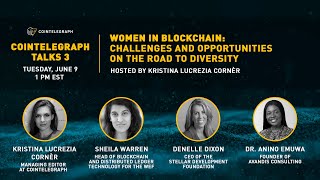
Cristina hosts Shayla Warren, Danelle Dixon, and Anina Emua on diversity in blockchain. Women make up roughly 8% of the industry, though crypto trading by women jumped 43% in Q1. The panelists push for intentional hiring, community-led design, and newcomers to learn fundamentals and join communities.
Questions this video answers
Moderator Cristina; panelists Shayla Warren (Head of Blockchain, Digital Assets and Data Policy, World Economic Forum), Danelle Dixon (CEO & Executive Director, Stellar Development Foundation), and Anina Emua (Founder & Managing Director, Avandis Consulting).
About 8% (panel discussion statement).
A reported 43% increase in women dealing in crypto assets in Q1 (as cited by a panelist).
Chapters
Hi everyone. I'm very happy and honored to host here this panel. Everyone with wonderful, very happy and auction industry with whom I will talk about challenges and opportunities on the road to diversity and inclusion. So I'm happy here to present Shayla Warren, head of blockchain Digital assets and Data policy at World Economic Forum. Hi Sheila.
Hi Christina. Thanks for having me.
Thank you.
Sheila. Danielle Dixon, CEO and Executive Director of the Stellar Development Foundation. Hi Danelle.
Good morning. Thanks so much for having me. I'm so honored to be on this panel.
Thank you. And so this is the American part of our panel and I'd like to present Dr. Anina Emua, founder and Managing director of Avandis Consulting from France.
Thank you. Hi everybody. Thank you for having me. Cristina.
So we are here to discuss very important and relevant topics. We had this very important and challenging crisis during the last months that was supposed to unite so many people in the world with the same issues, problems and fears. We are also in full pride month and we also all witnessing events in the US that definitely poses the question of diversity and inclusion as never before. So my first question to you ladies will be how is the notion of diversity and inclusion has been changing for you during these months in your professional, in your private communities environments? Let's start with Sheila.
Sure.
Thanks Christina, for the prompt. You know, I think it's really caused me to reflect on why I was drawn to this technology in the first place. And for me, blockchain technology really is about creating the potential rather to create new systems that reallocate and in some cases rectify power imbalances in our society. I think it's no secret, and it has not been for quite some time, that many of our systems are were constructed in a manner that is inequitable. Whether that was done maliciously or inadvertently is to some extent irrelevant. It is just a fact. And so part of what the promise of this technology is is that we can do better. Now my concern at the same time with this technology, this is where I think to really answer your question, the diversity, equity and inclusion lens comes in is the worst case scenario here is that we took advantage of this new technology to basically recreate our systems digitally. We took exactly the same power structures, the same people, the same kind of dynamic, and we just codified it and then we called that success. That in my mind would be a gigantic, huge missed opportunity and actually quite tragic, I think. And so part of my concern and part of the reason I was very eager to take the role I'm currently in was to help shape the narrative around this technology in a way that that would lay a foundational element that would enable the building of a world that can realize this potential and be more equitable for everyone.
Thank you, Shayla. Let's proceed with Danelle.
Thank you. So I started at the Stellar Development Foundation a year ago, just over a year that I've been there. And part of the reason why I went into blockchain and particularly stellar is because of the focus on the unbanked and the focus on financial inclusion. Not to supplant the existing financial institutions in the structure, but to enhance it. And so much of that is the focus of not just, I have to say, like, while it would be great if we could actually make all of these systems work for everywhere, we're focused on emerging markets because that to us, is the way that you can actually truly bring inclusion into this kind of technology. So I love what was just said about the notion of not just accepting the current structure. And that's definitely not how we want to do this. Like, we want to actually focus on the end being getting these emerging markets onto the blockchain so that we can actually grow greater financial stability and inclusion, rather than just looking at what we have today and saying, oh, it's okay, and let's just make it a little bit faster and a little bit cheaper, because that's definitely not the way that we see the world working. What's happened over the last three months has just made it. So it's all the more important, I think, for us as an open. We're open source and for us to be very open and not to be so focused on ourselves, but to look outside and look at the whole world and look at what's happening all over the globe and not just where we are and to really force ourselves into the openness in a really aggressive way. And I think that's how you create greater inclusion when you include more individuals and companies and businesses into what we're doing and bring those ideas into the system too.
Thank you very much. Anina, you are. You are in Europe, but you also have a very good knowledge of the African community. So how would you evaluate the situation?
Well, you know, as you know, my work is in strategy and financial advisory, and I work in Africa. We have an office in Lagos, Nigeria. Now, a large part of my work recently has been in building communities of women in leadership. And which is what brought me, brought us together in Davos. And the reason why I went into that was the realization that as women, we need to be involved at all levels and being involved where decisions are being made, where decisions are shaping our lives are important. So even if you are a leader, a CEO or founder, I thought it wasn't sufficient that you needed to be in places like the World Economic Forum, Davos, which have a community there at the UN General Assembly. We also have a community at the UN and you know, in Paris, in London, in several countries, because it's very important that women are involved at all levels. And it's easy to ignore women in leadership because the focus, especially in developing countries is, is, you know, tends to be lower down the line at the bottom of the pyramid, which is also important. And my work also on the grant advisory committee of the Sustainable and Inclusive Digital Financial Services in Nigeria. And of course the point of that is to bring in people, bring in people into the financial services. And that is especially the inclusion bit is really to do also with a lot to do with women as well. So if you have women who are in positions of leadership, they're able to shape, you know, all of these policies. And you know, one of the areas that I think is really key and important is that of innovation. We've talked about emerging technologies and blockchain. I work a lot in fintech and we build communities in all this area. So I think the point is how do we. Getting women also in leadership to be engaged, you know, at all these, at all these levels, in all these emerging industries, I think is really very important. And I think what has happened has showed us that our work is even more important. And, you know, we're really beginning to make sure that, you know, we do as much as possible in that sector to, you know, increase gender balance.
Thank you very much. Okay, we focused on women and. Well, let's, let's proceed a little bit in this direction. What is, in your opinion, the potential of our blockchain decentralized technology for women, for women's economy, for women's services, for women's daily lives? And what is the potential of women for the blockchain space? I know that Danelle has recently written a wonderful op ed on this subject, so maybe you could start with your thoughts.
Yeah, well, it's altogether clear based on the data and based on research and just based on what happens when you put, when you give women the opportunity in all countries, the opportunity to have access to financial stability and financial opportunity, it actually brings up the entire GDP and it actually creates opportunity for everyone because women do have the ability to push along the family, to be able to bring A lot more opportunity and space to families that didn't have it before. And so it's actually science. It's based on data that we can look at and point to. And so I think that we can't ignore that. And we actually just have to make that stronger and better. And I think in blockchain technology specifically, I would love to see just more and more women come into blockchain, into the technology stack, because from the standpoint of inclusiveness and the generation of new ideas and opportunity, it would just open things up so much more. We obviously have some women, and thank God for that, but I would love to see a tenfold, 100 fold more because I think that it just talks. It really outsizes that inclusiveness and makes it so that. And it's not just women, by the way. It's people of all backgrounds into blockchain. This is actually truly one of those global technologies that can actually benefit from everyone's ideas. So I think that that would be amazing if we could actually just make that happen.
Thank you. I would suppose that everybody would agree with this. Any additional thoughts? Shayla, what about the World Economic Forum and its community? I think that the fact that we have you as head of blockchain at the Web is already such a big success for diversity, for tolerance, for inclusion. Could you elaborate a little bit? What was your way of achieving this?
Oh, my goodness. That's a very different question. Now, I'll start by saying thank you for that. It is something. It's a responsibility I take very seriously. I do think that I'm sure for all of us in these positions of leadership, there's a tone that we can set. There's an element we can bring to the conversation. We can bring. Our knowledge, our backgrounds, all really bear. Bear fruit. I think when we are able to use our voices in ways that just indicate concepts that are not necessarily mainstream yet. And so part of what I see as my role is to normalize not only this technology. And I think we've done. I think we've made major strides in doing that, normalizing crypto to a large extent, but also really talking about two people who are in powerful positions, very powerful positions, talking to them about what it would mean to have the technology that could create new means of empowerment. I think that the normal place we ground this is, as Danelle noted in Financial Inclusion, we do talk a lot about access to those who are currently unbanked for a variety of reasons, and the ways that we could actually empower them through giving them access to Financial services that look different from traditional banking services example, and closing some of those gaps. But I think it's a lot bigger than that as well. It's really when you think about data, for example, when you think about the individual control you could actually have over your own data as a person of any kind of minority and the ability you'd have to basically set the permissioning around the use of your data in a way that could be much less exploitative. I think that's extraordinarily powerful. But I also think about this, you know, inclusion and equity aspect in different ways. I think there's an individual level where we can look within any individual company at our hiring practices, at our, you know, how are we doing on equity in our, in our internal companies. But to really solve some of these problems, we have to think systemically. So we have to look at how we're thinking about which countries are getting the spotlight on some of their innovations that. When I first started at the forum, one of my. I kept saying, you know, the innovation is not happening in, you know, the G7. It's really happening in emerging economies. There's no question about that. It's again as denoted, it's a fact. This is science, you know. And sure enough, we've been able to surface a lot of those voices because they really are the places that are most innovative. So whether it's the Caribbean islands, whether it's Bahrain, we had a launch this morning of a roadmap on cross border data flows that was spearheaded by Bahrain because they're doing such innovative work in that area. So a lot of these things, these conversations are not really happening in the corridor of world power. And what we can do is draw some of those connections and help help people understand that the learning is always going to be two ways. It doesn't have to be this kind of top down mentality where those who are currently in power are like educating, you know, everyone else. It is always dynamic and, and yeah, so, but I think we see that in many, many different spaces, in many.
Different contexts for sure. I would take this opportunity to invite every one of our readers and viewers to send out their questions during our streams. We will be really happy to answer them. So please don't hesitate to ask us anything about diversity and inclusion in the space. Amina, what about your views on blockchain potential for the women's economy? And I know that you are also working a lot with the Women Network. So I am pretty sure you have some wonderful stories about women who also contributed to the Space, I think you are muted.
I think the first thing to do is to look at some of the data in terms of diversity. There was a report by the Diversity in Blockchain Diversity in Blockchain report which came out at the end of last year. And when you look at the numbers, and it was quite an extensive report, very much US based, but at least it looked at not just women, but looked at minorities. And when you look at women in blockchain, first of all you look at the new companies being built, innovation and you find out that the percentage of, of women led companies are very little, you know, sort of single figure percentage. The number of women who are actually working in industry is about half of that in the tech. I mean tech is probably about maybe 17%. And when it comes to women, you know, it's even, I'm sorry, I'm just going to adjust this a little bit. When it comes to women, it's even, it's even. Sorry, when it comes to blockchain, it's even less. It's about, it's about half of that, about 8%. Okay. When you look at minorities, probably about 30%. And you know, when you look at blockchain, we mustn't look only about people, about operators. We need to look also at the whole of the ecosystem. So we need to look at academia, we need to look at conferences because that's where, you know, a lot of knowledge is being generated. And you know, so these numbers look still very low. However, you know, a recent report actually which Cointelegraph, you know, reported was that in the first quarter of this year there was a sort of 43% increase in women who are dealing in crypto assets. So you know, and interesting of course, you know, the younger, you know, between the ages of sort of 18 to maybe early 30s and also interestingly, you know, the 60 plus bracket. So you have that kind of diversity. But it's not just the differences are not just there. The differences are even in terms of geographically. For example, for the first quarter in China, for example, there was a big drop. Whereas other countries like in Greece was over 100% interest in cryptocurrencies by women. So we need to be quite granular about our data and look and see what is happening. Then of course going back to what Sheena has said and looking at not just cryptocurrencies or blockchain in itself, but what are you doing with it. And I think the central bank digital currencies are also, it's actually very interesting and there are Some early indications, very early indications that you even have governments in Africa that are looking for it. So looking at it. So where you've had resistance, you're beginning to see interest. Although regulation is still very at the early stage. So there's a lot that is actually happening. And I think that the more that we have regulators, because also look at women in regulators, regulatory space, not very many of them. So we need to have inclusion of women at all these levels and also in all the different countries and understand through data what is happening and so that we can, you know, put into effect the required interventions really to bring up, you know, the numbers.
What are the challenges? Why are these numbers so low and.
Not only for women?
Like, why do you think blockchain can be challenging for people of different minorities in terms of gender, race, religion? I don't know. Background, of course, what are the challenges and what could we as actors in the space do in order to promote diversity and inclusion in our environment? Children who.
Yeah, you know, I mean, I always, I get asked this question a lot and I kind of boiled my answer down to three words, which are fund and hire. Fund and hire. Right. I mean, we need to kind of fund people in this space who are from some of these communities so that we are ensuring that there's opportunity to really proceed with the ways, the unique ways that many people who are not part of the mainstream are going to see and use the technology. And I think that's really important. And you know, I get a lot of questions like, because I am, my team was mostly women, actually, until recently it was all women. And people were like, oh, you know, how did you come to have an all women team? And I said, well, the best people who applied for the role were women. And I hired them. It really is not rocket science, you know, you just hire them. I don't mean to oversimplify this because I think that, you know, it's not always that easy to kind of find candidates. There's, there's, there's lots of science and studies on, you know, women will only apply to jobs if they meet every criteria listed in a job description, whereas men will apply regardless. They'll just kind of like wing it. You know what I mean? I certainly was someone who I thought was winging it for the job that I have now. I thought they wanted a photographer and I just, when they recruited me, I was really confused, but then here I am. So I think there's a lot of that going on as well. But to some extent it's really a Matter of just making it a priority, like hire people, just go out and hire them. They're not that hard to find. What we're seeing coming out of schools and this, my knowledge of this is more the US and Europe, I'll confess that gap. But there are an awful lot of women who are getting this training, whether it's technical training or whether it's the kind of comms training or whatever it is you might need. There are an awful lot of women who are going through and getting credentialed in the way that you would expect in order to make the hires. And if there isn't a connection between them and roles, then that's kind of on of us. It's really on all of us to do more to ensure that those connections are made. And then on the funding side, there are several. I think you're seeing a lot of this happening in tech right now. You know, moves to basically find more black funders, moves to find more people of color funders, more women funders, more people who are on the gender spectrum of funders, and really kind of providing access to capital in a way. Andreessen Horowitz just released their new fund that's going to focus kind of on this community, which is, I think, really exciting and a step in the right direction. Fund and hire.
Very interesting. Dana, what about your activity in Stellar? How would you evaluate the way this issue is being promoted within the foundation.
And.
What is your role in the promotion of diversity?
Yeah, so let me just start first by saying we can't ignore the numbers that Anita just mentioned, which were in technology. Diversity is challenging just in the tech field alone. And the blockchain is so much smaller in terms of that. It has definitely been eye opening to me moving from tech, where I focused a lot on diversity and hiring and doing being creative in terms of making sure that there's a, you know, it's basic, right? It's actually diverse slates are just the important place to start. You actually have to start there. If you don't. A lot of times what you see is that people have friends and they refer their friends over and then those friends seem they come from their same background. And actually you need to sort of push your way through and say, that's great. We're going to listen to, we're going to interview this candidate, but we're also going to interview other candidates that come from different geographies, different races, gender, all of these different pieces. You have to focus on a diverse slate in order to make this happen. The Best candidate is going to rise to the top. Your slate has to be diverse, so that's the most important thing. But I'll tell you that for me, coming from tech and coming into blockchain, it is a much more. It's a smaller group. And the smaller group tended to lend itself to a male gender for a period of time. I think that we're now growing this and we're pushing this out, but it just takes. It takes a lot of effort to be able to do that because there are talented students, strong, capable, intelligent women out there who also do this, and minorities out there who do this and want to come into this space. But we have to get here. People want to work with people that look like and are like them. That is just, like, basic also. And so the more we bring into this space, the more we're going to get into the space. And so I love the fact that we're pointing to larger numbers where we see growth, because I think it's because the more people that we bring in that look like other people, the more we're going to get those other people to join us in here. And so I think that that's really important. But we can't ignore the challenges. And blockchain is a very passionate space. I will tell you also that I was surprised about the critical nature of it in terms of just, you have to get used to how folks are going to react to almost everything that you say. And so it's like that in tech, too, but it's a little bit stronger in the blockchain space. And so I think it's just us paying attention to all of the challenges and trying to make it easier and more streamlined for folks to be able to join that are coming from a different sector. Yeah.
And I just want to add to that. You know, I think. Well, first of all, I'll note that if you haven't been on the wrong side of crypto, Twitter, you know, you're doing something wrong. Right. It's kind of the joke we have. Right. I mean, like, that's kind of the marker of success. I think we've made it. You know, I think. I think part of it is the frame that we have. Because, you know, to your point, I think that people do prefer to work with people like them. It's kind of a natural affinity. And part of what I respond to that is to say that's problematic. I mean, we can't do good work if we don't have diverse teams. We just. It's just we're not going to get the same success, the same output. And it needs to be a priority almost to say, you know, who do I have, who do I need? Who's not in the room, who's not represented? So part of what we do at the forum is we build these communities that help us our whole, you know, shtick, right? We're like multi stakeholder communities. We work with businesses, governments, academics, civil society. We bring communities together. And we're always asking ourselves like, who is not here, who's not in the room, whose voice we are amplifying, who's not being considered? And so I take the same approach to a large extent to building my teams. And I think about what viewpoint is not here, what viewpoint am I not benefiting from? And in my mind there needs to be a just fundamental shift of how we think. And there's this idea that your team needs to work really nimbly and fluidly. And I get it, like I've worked at startups, I understand that you want to have this kind of ease of communication or whatever, but you're just not going to build as good of a product, it's not going to be as universally relevant if you don't have, have that diversity. If you don't deal with that friction in your design process and in your build coming from perspectives that are literally on your team, then how on earth are you going to be able to kind of roll it out to different communities in a way that's going to be remotely relevant to them? And you can't. Some of this you can get through focus testing data, you know, all that kind of stuff, but some of it you just can't. So in my mind, I think that's a lot of what the problem is. I think in tech writ large, blockchain as a subset of that is that there isn't this universal understanding that you really need, that you need diverse teams to succeed. If we could just get to that place, and if that was almost a metric, then I think we would be in a much different world than we are now.
What does it even mean? People ask for an easy communication. I mean, should it be, do people tend to work with people of the same cultural background? I just can't agree that gender is something that is difficult for communication. I would tend to say that cultural and educational backgrounds would be more of like limiting your environment than gender issues or race issues. Like what are the difference? Like, why are we tending to be less tolerant to people of another gender, another country, nation, language and color of the skin? What are your thoughts on this?
You know, I wonder, you know, are we becoming less tolerant or do we actually have the information available to us to actually see what is happening? You know, so that's, you know, something that, you know, I can't, you know, really tell you. But what I think it's important in any community, any industry is that, you know, we have, you know, role models, you know, people of every race or gender or whatever, and even if they're the minority, because the problem is when you are in a minority, you know, you don't get seen. So we need to have people who are in the minority, whether they're women or. Or whether it's, you know, whether it's an ethnic minority or racial minority, to be, you know, spokespeople and to be more visible, because that also encourages people, you know, other ones to come through. But I mean, specifically in blockchain in technology, I think that, you know, the emerging technologies, I think there's an educational aspect that is missing, which is right from the very beginning, because, you know, you know, the language we use, the terms I could use, are still very much, very much industry specific. But, you know, we should have our children, you know, who are talking about blockchain, about AI, about crypto, you know, these are the words that they should be using, you know, and in very simple language. So I think also educationally, we need to make sure that, you know, we have all that brought into the system, as in general knowledge. What a general. I mean, general knowledge in my time was about, you know, countries and places, but I think, you know, about technologies, and it's also important as well. So I think the educational system is actually very important there so that you don't have communities who are excluded. And you're going back to what Danelle said about people who are like us, look like us. We work in networks, so we tend to, you find one person and then that person brings in another person. And if you don't intervene to make sure you have inclusion, then you're going to have a whole stream of people who look and see sound and are like each other as well. It takes a lot of effort and not just organic growth, I think. So I think being intentional about diversity and the next, of course, inclusion is really important.
I think that's exactly right. And I think right at the end, what you said, it's not enough even to be intentional about funding and hiring, for example. You then have to support those people. So sometimes what happens is people will hire one diverse candidate and they'll Be like, oh, look, it wasn't a culture fit something. It didn't really. We tried. And there's kind of this like hand waving, right? No, you have to have systems to understand that certainly the beginning phases of that kind of integration, you need to be focused on ensuring that you are including diverse members of your team, for example, that you're kind of incorporating that view, and that is a priority to do so. So it's not enough to just kind of. Diversity is not a numbers game. It's not enough to just kind of box check and say, oh, now we have one person per team or whatever it is who's kind of, of representing a different background. You have to have mechanisms in place to ensure that those voices are heard, they're amplified, and that those people are supported. And if you don't have that, then it doesn't, you know, if you don't have the intention and you don't have a plan for how you're going to do that, honestly, it's almost better to just not do it because it winds up almost being like negative data. You know, that kind of reinforces the belief that some hiring managers have that it's, it's challenging to do this. But I think also to your point, you know, this is hard. It's not easy. It's not easy to have teams that clash. It's not easy to have viewpoints in the room that differ. This is kind of the work that my team and I do all day long and bringing together coalitions of people and trying to identify, like, where are the stress points, where are the fractured points, and how do we kind of craft policy or governance that can kind of address all the different points of view that are, that are around the table. And we deliberately, again, set up these communities to have that friction within them so that we can then try to design interventions that are more holistic in nature. But it's really, really hard work and it is almost antithetical to the kind of need to kind of show quick results and, you know, and ship, you know, and this kind of stuff, which I again am empathetic to. But I think we have to stop thinking really short term and think, you know, if not long term, at least medium term about these issues.
Yeah, I totally agree. I would also add that definitely blockchain community is more liberal than so many other communities, not only in terms of diversity, but of course we deal with visionary people who want to make this world better. My question to you ladies is what should we do to demonstrate it more? I'm not sure that the community of crypto fulfills this demonstration of its openness. I just had a comment from the audience that actually there are so many women in coins communities and we just, we are not talking about them. So what is the way to demonstrate that the bitcoin blockchain crypto community is open to diversity?
That's a great question. I'm not sure I have the full answer to it because I'm not sure that we always are. And so I just want us to be honest about that piece of it. I think that, I mean, we certainly are at the Stellar Development foundation and I think that many others out there are, but I don't think that we know how to demonstrate it quite as well. I think that for us it's the openness piece. What we've done at the Stellar DF is we focused on our open source background and what that means is that in my opinion, that you just don't stay open in your code, but you stay open as an organization. So we try to put as much information out there to have those one to many conversations as you can instead of one to one. Because one to one tend to be limiting in terms of who you're talking to. But also it doesn't allow the broader audience to come in and have perspectives and views. And you want to hear those. I want to hear those. Because in order for us to really create the impact that we want and to be able to bring that wallet to someone in Nigeria that didn't have a bank account before, but can now transact and buy stock in companies in the United States, which is incredibly important to us and exactly the kind of thing we're trying to do. You need to understand their views and their challenges and not just sit here in the United States and think about what those might be. And so, so much of it I think is the product focus. It's that the technology layer is incredibly important, but it's just another technology layer. What's most important is that user experience and how you're going to actually solve those problems that the end users face. And to be honest, those of us who sit only in our bubble in the US don't know what problems that they face in other countries. And we need to really get into that. That's how we will demonstrate openness and demonstrate our willingness to solve problems and to create real change. So it's user experience being very, very simple. It's being a primary focus on making sure that you're solving problems that are not just pretend problems that we think exist, but real problems that people are facing in countries that may be very far away from us, those of us who are developing it, but know that because you've actually gone there to understand what that's like. So this is the way that I think you can demonstrate openness and the way that I love to see us progress. Because once we get to that place with blockchain where it's not just this blockchain word or this crypto word that people sometimes shut down at because they don't really understand it because it's too complicated for them to get. And we get down to the simplicity and ease of use and those user experiences that just make sense. That's how we actually, really, really make this powerful.
Yeah.
Thank you very much. Before getting to your ideas, I just would like to invite everybody, viewer also to share their ideas how the blockchain space to demonstrate openness. And of course, every question is welcome. Sorry, Shayla, please go.
Yeah, no worries. I think, you know, kind of three things. So one is I think, amplifying voices. So I think part of what I, you know, see my role as is really amplifying voices that aren't often represented. And I try to, you know, do that through the work that we do. And I think that's kind of an obligation that every leader in this is to really. And again, like that it's easy to do because a lot of the innovation is happening in spaces that are traditionally underrepresented in technology. So there's kind of a twofer, you know, that I can talk about really exciting things happening and also they happen to be happening in places that aren't really presented. That's kind of one, that's, that's a relatively straightforward thing to do, I think, for all of us. The second, I think is public commitment. So there's Black Tech for Black Lives just launched. Right. So I signed on as an accomplice. I encourage everyone to do that. We launched the Presidio principles. So that's a document that we created using again our multi stakeholder framework to basically say here are ways you can actually center user rights and think about the user in the layer two that you're building. So we again have a lot of signatories to that and we encourage more. We think it's a way of demonstrating those commitments. There are a lot of things you can do personally and as an organization to just kind of show and then hold yourself accountable to those commitments that you make. So say, to the extent that I am aligning with the City of Principles as an example, you know, how do I demonstrate that? And am I doing my internal checks? Am I adding in a sprint to my, you know, my design process, you know, to basically ensure that I'm hitting some of these targets, that I'm really making sure that I'm being inclusive, you know, whatever it might be. So I think that's. That's really important as well. So it's really, I think, just demonstrating that, you know, that you. That you're taking it seriously and that you're putting something kind of concrete and in some cases measurable behind it. That I think is really important to do. So those are in addition to everything that Danelle said, which I, of course, agree with. I think those are additional things that.
Can be done, you know, And I think also that, you know, certainly the industry is sort of shaking off, you know, some of the sort of the kind of negative view, you know, at the beginning of it being a place of, you know, cowboys and the dark side of it. And that's why, you know, we can see, you know, you know, more women come coming into it. And also, you know, with women's incomes and with female economy as well, you know, women are interested in investing and it becomes easier to use. So, you know, those little signs I think that we see are signs that we need to encourage, you know, in order to get gender diversity and not only women in terms of, you know, investors, but, you know, also involved in the industry as analysts, developers, and, you know, company leads. You know, we have, of course, we have a Bancor and the Binance, who are led by females as well. And those give, you know, very good signals, you know, out there that, you know, on the gender side as well. And so I think that, you know, for me, I'd say that it certainly starts with leadership. Leadership is always very key and sets the tone. And frankly speaking, leaders are accountable. You know, they have to be held accountable as well. And I think that, you know, we've heard, for example, what Danalle has said she's doing in her organization, what Sheila is also doing at the World Economic Forum. I think, you know, leaders, you know, really need to set the tone in terms of diversity, inclusion, you know, at all levels, and it helps to feed down through the system as well.
There's one last thing I'd like to add or one more thing I'd like to add, which is, you know, in terms of how you do a more inclusive, inclusive build, how you think about product fit, you know, how you identify problems. The great news is There is a tremendous amount of work that's been done in a civic tech space on how to do this. This is hardly something that needs to be done from scratch. There's, of course, an element of it that's going to be unique to every product, of course, but there's just tremendous literature out there. So one of the most important things that I read when I was in law school was a book called Pedagogy of the Impressed. And it really talks about how you go into a community and you kind of assess through creative, you know, creative kind of means that our design with these kinds of processes that again, are very well documented, how you kind of surface what the needs of the community really are, and then how you ensure and create these almost checkpoints to make sure that you're not losing sight of that problem once you are away physically or whatever way from that community. And also that how to incorporate. Incorporate that community into your work on a much more frequent, ongoing basis. So there's a lot of. I mean, that's a little more of a dense read. There's a lot of kind of literature around how to do this that is very easy to access. And it's, you know, it's continually surprising to me that more people in mainstream technology don't understand the approach that's taken by civic tech and bring it into their own business models and their own design. Yeah, I think that's very. It's good news. It's all out there.
I would also like to say that in my opinion, this recent crazy times have also contributed actually to the diversity of everyday life of every person. Well, from the technical point of view, we have zoom calls with people from countries that maybe would never join a conference somewhere. I don't know. In the US in Singapore, there are people who are not speaking a good English, but they. So they are afraid or are not able to travel. While virtually they feel more comfortable to try something new, to try to communicate with new people. Crypto as a technology is definitely more accessible than banks for some people. So my question to you would be, what other opportunities can a crisis like the recent one open for promoting more diversity and inclusion in the tech space in general and in blockchain space in particular. And also, is there a challenge with a crisis that we actually make some steps to the opposite direction so we can maybe stop being so open and close to our conservative. I like this.
Well, for me, to be honest, I think it's such. I think it's such an opportunity. You know, as I say, you know, every Crisis, you know, has an opportunity, and I think it's an amazing opportunity. The fact that, you know, with technology, we're able to connect, you know, across boundaries, which, of course, brings, you know, another issue which I'm sure, I mean, both Dinelle and Sheila would be very much involved in, which is also the issue of the digital divide. That. That's also something that we need to be very careful about because that digital divide itself creates exclusion. So that needs to be. That needs to be closed. But technology has a way of uniting us across boundaries, and I think it's that amazing technology and that amazing technology that we have today which is going to improve. I think that is the basis of really of tomorrow, of how we interact as communities, how we interact across boundaries, how we see and envision things, how we make, you know, how we make change happen. And, you know, one thing that we didn't mention in terms of blockchain is what has happened in the time of COVID has been for, I mean, banks and other institutions that, you know, require, you know, documents and things to be signed now, digital encryption, you know, because you have no other way of doing your deals, you know, when everybody's sitting at home. So, you know, things are actually happening despite, you know, all the. All the, you know, the terrible things. The things that are happening are uniting people. And also look at people who are hiring through zoom or hiring through video conferencing. You know, you can hire that person across the world. You know, it doesn't matter what, you know, where he lives or she lives, you can hire that person as well. So I think that the opportunities actually are immense, and I look at it only as positive.
Yeah, I think that just to follow on that, there have been some really remarkable things that this crisis has demonstrated for us. First of all, I think just the global nature of how we all impact one another, and I think that's what I tried to highlight internally to my team and. And externally as well, is that we always have talked about our work as being global in terms of just what blockchain can do. It globally can enhance the underlying technology that exists today. But truly, with respect to Covid and this pandemic, we saw that it was impacting all of us and differently, certainly, and different times, but it's not discriminatory in and of itself. And so I think that that demonstrates this connectedness that we all have and that we have the opportunity to take advantage of that and to really demonstrate that we can work across borders. Very simply, blockchain technology can actually work across borders and actually create a lot of benefit and opportunity. But I think that if we focus on, you know, we can't ignore a lot of the downsides that has happened a lot. You know, there's been a lot of layoffs in just technology and all over the world. The opportunity there though, is you have this wonderful talent available to you and you don't actually have to consider whether or not they're going to be able to walk into your office tomorrow, because the technology that we have demonstrates that you can hire people that might not be able to show up in your headquarters, at least not right away. And we all seem to be doing okay. Given that we can still transact and do things in this time, I think that there's huge opportunity. We can't ignore the downsides that have happened, but the opportunity for us to really demonstrate this global economy and this global culture that we have to respect everyone and to really think about things happening locally. But impacting globally is a really interesting way to think about it because we've always thought the reverse. So I've loved that. And I do love the fact that if we think about the world that way, then we actually can think about our technology as just impacting one another very simply. So it's one of the things that I've really tried to focus on through this crisis is to focus on the fact that this demonstrates more than ever what our actions can actually do to help people all over the world, because we're all connected in this very unique and interesting way.
One of the latest actions from the World Economic Forum was the announcement that the next edition will be available to everybody. I think it's a great thing. It's really something incredible. And it was unimaginable this January that this could happen. So, Shiloh, the floor is yours. What other opportunities do you see?
Yeah, I mean, I certainly think that a virus is an equal opportunity offender. You know, there's no question about that. And I agree with the points that have been made about this, kind of highlighting the need for interconnectedness and the fact that we are, whether we realize it or not, we are all interconnected. And of course, the forum is very focused on thinking globally and working locally. And so that is very much a validation of our entire premise that we really need to go far, we need to go together. The thing I will note though, and I agree with all the points about remote hiring now being possible and being able to kind of leverage talent, as they say, which always that phrase, but leverage talent, you know, in other other Jurisdictions that can. That can bring a different cultural awareness or different sensibility to the work, I think is really important. A lot of people, I think the smartest companies are jumping on that right now and kind of understanding that that is something that is going to be profound and that there's going to be a divide, I think, in companies that do that and companies that don't. So that's kind of one. One piece. But I also want to note that what this pandemic has highlighted in the United States is things that were very well known to many of us, but I think that have been a shock to the system for many who weren't paying that kind of attention, namely the disproportionate impact of this virus on communities of color. And I'll specifically talk about black Americans or black people, Black people living in America, because I think that we're seeing. We already knew about maternal mortality rates being higher in that community, we already knew about. And in the Latinx community, we already knew about health, that other risk factors and adverse childhood experiences being more prominent in certain communities of color. And now we're seeing that the pandemic itself, COVID 19 disproportionately is affecting both morbidity and mortality rates. Communities of color. And in addition to that, we're now seeing the effects, you know, the latest round, I should say, of evidence of systemic violence against people of color in this country, specifically black Americans or again, black people residing in America. And so I think it's really important that we note that while there is a segment of the population, and this is kind of, to Anino's point about Digital Divide, that is going to come together and unite and be able to kind of, you know, rise together, there is an even bigger portion of the population that is going to be dramatically left behind if we don't radically alter the ways that we think about inclusion and top about inclusion. And I think that many of us, and I'm guilty of this myself, that work in technology are very guilty of defaulting in our minds without realizing we're doing it. To thinking of tech as neutral, it is the exact. It is absolutely not neutral. There is nothing that is neutral about anything. It just. It just doesn't. That is not a thing. Right?
That's just not a thing.
And so, you know, we know that remaining silent about some of these things is part of a big part of the problem. So I think we have to think and take a really critical look at ourselves. And I speak particularly to American, North American and Canadian North American And European companies and people in this space really take a very hard look at what assumptions of neutrality we've built into our systems, in our own institutions, and what that has led to and what it.
Will continue to lead to if we.
Don'T really directly critically explode. Really, those biases that we bring so opportunities, again for some often mean that there is a commensurate diminishment of opportunity for others. And it's important to remain mindful of that at all times.
It's such a big time for change for so many people. Now, what, what would you recommend for those who would like to initiate themselves to the blockchain space? Which first steps, which resources, which ideas you would like to give to representatives of all minorities? And as we discussed in the waiting room, we are actually all minorities at some point in our lives. It's not only women or men or children or any race and religion, but actually every person feels sometimes as other in a global community. So for those who would like to become closer to this other culture that is blockchain space, what would you recommend with which steps to start?
For me, what I would recommend is, first of all is the understanding, first of all, that blockchain is the foundational technology. And whilst right now it's been looked at as a separate part of technology, in a few years it's going to be foundational. So it's critical and important to be part of it in some way. There are so many resources available. So I think the first thing is, you know, basic introduction to blockchain. Read about it, understand it, you can join communities even if you're not from that industry. There's so many communities that are open that you can join. You start there and you join them. And once you start and join them, I think just going back to what was talked about, communities, global communities, have been a little bit elitist in the sense that you had to be able to travel and to be in that place. But what's been happening with technology now is that global communities are being built at all levels, so there's going to be a lot more access. So I think one thing is to look at it and say, where can I find the access? First of all, educate myself a little bit. A lot of free information out there, join the community and interact with people. And I think that if you use those as your basic steps as entry, you know, that's, you know, already a good start. But one question I'll ask you ladies later is, because I got that from a lady, was to talk about in Terms of employment, you know, what are the, it's not so clear in the industry. What are the practical steps? You know, if you're looking for employment, even if you're within industry and you want to change, you know, what are the practical steps? You know, perhaps, you know, one of the ladies can help us. But that is one.
So I'll just jump in on the first part of the question and I can go a little bit into the second in terms of what I would love to see. I think, I think people are afraid to jump into this technology because they see it as. I think back in just a little bit of that has had a little bit of dark roots to it in terms of the way that it started and it was very like anti everything. But I think that you shouldn't be afraid of that. I think that first of all it's just fascinating what this technology can do and it's also not, not that complicated in terms of what it's trying to achieve. I think you should liken it to the idea that what we're trying to do is just create. Back in the day when we were creating email and wanted to send email from one account from Yahoo to be able to send it to a Google account, you wanted to make sure that that happened very seamlessly. This is exactly what blockchain is allowing to do. So it's actually pretty simple from that standpoint. What I think, what I would love to see, what I think would be phenomenal for this space, is to find folks who want to develop products from a very simple user problem solution and also do it in a way that's simple for the user to be able to engage. Because the truth of the matter is just like most folks don't actually engage with the underlying technology behind the web, it's the same blockchain. As Anino said, it's going to be the foundational layer and there's going to be so much that piles on top of it. Not everyone needs to know how blockchain works, but they need to be able to derive the benefits from it and to be able to focus on the problem and then make it very simple for the end user to be able to make that to achieve the solution is the way to do it. And right now we don't have enough user experience, focus in blockchain and product simplicity in blockchain to be able to make it actually jump into the mainstream. So I would love to see that. And then to get to the question that you just asked about how to what are the steps to be able to get into this space. I think that there's. You don't actually, in my opinion, I didn't have a lot of blockchain background at all before I stepped into blockchain and to be able to leverage your strengths that you've been able to develop in other industries and to be able to point out that for me, I was on the content side of the web and did so much to help to create some of the underlying problems, by the way, which I didn't intend them to be problems, but around privacy and all of these things that we fought so long and hard on the content side of the web to be able to protect, but to keep the government out of. We now understand that maybe that working with regulators is the right thing to do. And I think that there's so much opportunity to leverage your background in whatever industry that you were in before and to bring that and to create this rather nascent technology to make it better. So the steps are just to look at what your skills are and to apply it to the problems that exist in blockchain. You don't have to have years of experience in blockchain to be able to come into it.
Yeah.
And I'll just add to everything that's been said, which I agree with. You know, I think people used to ask me all the time when I was practicing lawyer, you know, how do I decide what area of law to go into? And I would kind of say, let's break it down to the basics. Do you want to be in court or not? That's a huge. Know that if you know that it's going to really help you a lot and kind of really commit to that. So here I would say, do you want a technical job? Do you want to be on the coding side? Do you want to be engineering, you know, or. Or even. Even product design or. Or not. Right. You kind of have to know your strengths and then your skills. And once you make that decision, it's going to set you down two different paths. The things you're going to seek out to learn are going to be different, you know, et cetera. I think that. But regardless of what path you choose, I think it's really important to start with what I call an intuitive understanding of blockchain technology. And so this is point like, what is it for? Why is it useful? Why is it interesting? Why are so many people so excited. Excited about it and can't stop talking about it, like constantly? Right. What is that? If you get that, that is constantly going to ground you because you can go down numerous. And we all do it all the time. Rabbit holes on this stuff, right? Like use cases and coding, whatever it might be different protocol, you know, layers looking L2, all kinds of stuff you can do. But if you kind of can keep coming back and check in to say what intuitively about this is exciting, I think that really helps orient you over time to the direction that you want to kind of go. So I came into this from. To answer the very first question you asked me, Christina, way back, I think, how did I come into this space? I came into it not actually through fintech, funnily enough, even though I worked on Wall Street, I'd been an attorney, I'd worked for banks, et cetera. So I was a development economist. So you would think that would be my entry point to this would be financial inclusion and being banking and all that kind of stuff. But it really wasn't. It was around data and security and thinking about protecting organizations. So I worked for an organization that worked with civil society organizations and there was sensitive data that they did not want getting in the hands of governments or other actors. And so that is where I started and I check back in with that all the time to say, okay, does that still hold? What about that was compelling? Why was that the powerful thing that got interested in this space? And if you have something like that, it's going to really help make sure that your career is rewarding. It's going to guide you to the right kinds of opportunities that are going to get you in the communities that you want to be a part of that are going to help you grow your knowledge base as much as you can. So that's just what I would add to the excellent advice given by my colleagues.
Many wonderful insights. Thank you so much. Speaking about your question Anina about the JOBS database, we actually have a page on Cointelegraph jobs.cointelegraph.com where we post different positions open in the space. So I welcome everyone to have a look there and to be proactive. So it's not only job of the community to promote its openness to diversity and inclusion, but also being proactive as a representative of any community of any minority is a big thing to do. I have actually, before hopping on this panel discussion with you, I had two interviews with two wonderful ladies that are very experienced in the crypto space. And I was very much inspired before talking to you to have already this opportunity with some wonderful journalists who would like to join Contavra. My last question to you would be, in a very short manner. Could you please express what does diversity mean to you in terms of your professional aspirations, but also in terms of.
Your.
Fulfillment as a woman, as a.
Person.
As a representative of a country, of a culture. Whoever wants to start the last topic.
I could attempt if the ladies want. For me, I think diversity is an opportunity. It's an opportunity for organizations, is an opportunity for our world to build an inclusive world. I think that's the thing. I think it's about diversity. I think also diversity is really is. There's a human value that is, you know, as we have with technology, with automation, with artificial intelligence, with all of that as the sort of the things that we do, the everyday things that we do become automated, the routine tasks, we become more of ourselves as human beings, creative, dynamic, we can relate to each other. And I think that that opportunity, I think is critical. And I think that is important. And I think that's what I see in this technology age that we're entering into the ability to be ourselves and to be human. And being human means, you know, really caring and valuing for other people.
I think for me, diversity and the idea that we could actually achieve that is just about acceptance and respect and so much, I think in my career I've had to fight for both. And I think that I would love to not have to have people fight for that. I think that it's one of those things where if we truly look around and we have diversity of backgrounds and opinions and ideas and we can accept that they are. Accept them and respect them, even if we don't always agree with them, to me, that would be the perfect place to work and the perfect place to live.
For me, I think diversity is the recognition that there is so little that I know and there are so many points of view that are as important as mine, as essential as mine to the work that I am doing. And it is an obligation therefore to try my best every day, to include those voices, to hear those voices and to amplify those voices, where I feel that that is something that is a service I can perform or help with. And I think to me then equity is the recognition that systems that exist were set up in ways that were designed to keep certain people up and certain people down. And then inclusion again is that obligation that I have. And I think all of us have to try to do better and to understand that doing better is not a one time thing, it is a lifelong endeavor and that I will fail as much as I succeed, but that the imperfect important thing is to continue to try.
Thank you so much, ladies. That was such a pleasure to talk to you today. Thank you very much. Thank you, everyone who watched us on YouTube, Twitter and Facebook. Thank you very much. And let's keep in mind there's important issues and please stay safe.
Thank you.










