Damien Hirst's $20M NFT drop explores the nature of value, art, and currency | Exclusive interview
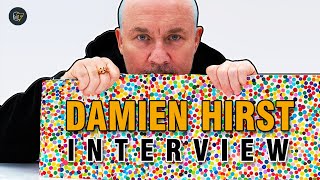
A filmed interview with artist Damien Hirst about his NFT project 'The Currency' — a drop of 10,000 NFTs each paired with a unique physical painting resembling oversized banknotes. The conversation covers Hirst's long-standing engagement with money in art, the experiment of asking buyers to choose between the physical work or the on-chain token, and broader reflections on value, belief, NFTs, and how collectors behave.
Chapters
Open just about any art history textbook and you're bound to find Damien Hirst's name. The legendary British artist has brought in hundreds of millions of dollars for his sculptures and paintings, holds numerous sales records, and has been featured on the COVID of Time magazine. But even in a career filled with faked shipwrecks, apex predators dunked into formaldehyde and diamond encrusted skulls, his new project is bringing him into uncharted territory. The currency is the title of his drop of 10,000 NFTs. Each token will be paired with a physical painting designed to resemble oversized fiat currency bills. And buyers will have to choose between receiving the physical artwork or the digital on chain representation. In an interview with Cointelegraph at one of the artist's sprawling West London studios, Hurst talked about the tension between art and money, the fleeting nature of value, and how, more than anything, this new project tests just how much his audience believes in him. Stick around to hear from one of the most influential living artists about a groundbreaking experiment with blockchain technology. But first, don't forget to like and subscribe.
So ask me any question and I'll get you the answer.
What will the price of the currency be three days after its launch?
To pile it up. Pump.
That's a moon signal right there.
To pile it up. I mean, I've always thought about money, I guess, and how it's a dirty word in art. And that's always excited me. It's like, I always like it when people say you can't or you shouldn't do that or something. And there was always this thing that it seemed that art was always associated with lots of money. And it's like. But people weren't really allowed to talk about it. And it was like. I remember at my art school. Not my art school, sorry. At my high school and middle school, my art teacher was a really great guy. He was like a theatrical guy. And he had the Dewsbury Theatre Group, and he tried to get me to act. And I played bottom in A Midsummer Night's Dream in the school play once. And I remember thinking about being an act, being an artist. And then I thought, I don't want to be an art. I don't want to spend my whole life pretending to be somebody I'm not. I want to be an artist. And then in art, he always had auction catalogues in the art room. So I remember from very early on when I was looking at all the art and an auction catalog was a good way in. And I remember, you know, they were like, you know, it was like 10 grand, 20 grand for a Picasso or something. They weren't. It wasn't a lot of money, but to me, it was a lot of money at the time.
I get a kick out of the idea that a young Damien Hirst was learning about the art market while you were learning about art.
Yeah, but I didn't realize. But, yeah, I mean, I think it's good. I mean, I think. I mean, I remember once saying to somebody that, you know, somebody once said to me, why did you get into art? And I went, money. And they were like, please don't tell me that. And it's like, no, you're all right. It's a joke.
It ruins some mystique that you're supposed to have as an artist.
Yeah, but I don't know. There's a Van Gogh thing as well, isn't there, where you're starving artists and you don't make any money. You never sell a painting. And it's kind of. Everybody wants that. I mean, it's a complicated thing. I mean, the thing about art is it's magic. You know, the whole thing's magic. You're taking really cheap ingredients and you're putting them together in a way that they become worth beyond their wildest ingredients, you know, so it's like, what's the word of the. You know, when they turn lead into basic alchemy? Alchemy, Yeah. I mean, that's what art really is. And I remember when I made the diamond skull, people said to me, you know, they kind of look at it, they don't really like it. They go, well, how many diamonds are in it? What are they worth? They take it apart into its elements when it's a sculpture, but in painting, they never do. You never look at the Mona Lisa and go, shit, that's 200 quid in canvas, and they're like 50p in paint. How can it be worth that? Nobody ever does that mathematical sum because we all believe in the alchemy of painting, but we don't believe in it as much in sculpture. And then I'd always thought that money does that. Coins and notes are that 3D and 2D version of art, because you can't get people to believe something has value without giving it a little leg up with art, because it's like, if you say this white piece of paper is worth ten pounds, people just go, bullshit. And then also, it's easy to forge, so you need art to stop people being able to forge it. And then, you know, and then when I was thinking about that, you know, I guess I had a fear very early on that money was more important than art. And then through that, I kind of challenged it. I've always sort of tried to challenge it. You know, I remember I really. When I sold a piece for a million pounds, I got total fear. And I just thought, it's not worth it. But, you know, I didn't have money in the beginning. So maybe it's to do with that.
Who's the greatest artist on earth?
You ain't really here.
I read a lot of quotes back in the day from when you were. Seemed to be wrestling with the idea of money in art a little bit bit more. You said that artists need to face money and deal with it, that art and money are like oil and water, that artists need to find a way to battle with money and sort of overcome it. And you had this fear that money might in the end turn out to be more powerful than art. I think that this project then, is a sort of unusually harmonious conclusion to, you know, something that's been on your mind a while. You're fusing these two forms of magic, these two forms of belief. What does it mean for you, and what would it mean for your sort of reputation, your Persona, if somebody could take this and use it to buy a car? If it did come to function, if the currency became a currency? What role do you personally play in that as the artist?
I mean, I'm conflicted, really, because, I mean, I would love it. I mean, it's like I sort of pervertedly would love it from. You know. I mean, you know, the whole project is really an experiment, and I don't know what people are going to do. And I'm one of the people, you know, and it's like, I kind of, you know, I guess as an artist, my whole thing. I mean, I've lived through some sort of pretty crazy times, you know, like in the 90s, when everyone. Everything I made was getting bought and sold. And it's like you kind of. I was just looking for relief. I just wanted to paint, to stay on the wall. So you kind of want things to stay on the wall. And there's this huge movement, but the movement's exciting. And staying on the wall can be frightening, too, because it's like it can just rot away and disappear and get forgotten, you know. So it's like, you know, I want to make art that's alive and moving. Art is alive, but then it can't move so fast that you don't have time to stop and look at it. So I get. I'm really conflicted with the whole thing. And I don't know, it's like, in my mind, I sort of think that the, you know, looking at the NFTs and the actual artworks, I think, well, I look at it and I kind of think, I don't know. And I'm excited by both. I don't know which is most important. But then when I think about it and I go, well, what will people do? It sort of tells me where I lie, which is, I think, oh, well, most people will keep the art, but I have to be prepared to let go of that in order to do the projects. And I actually think. I mean, whenever I say it, Joe, my manager says, maybe. And you go, oh, my God. Yeah, they might not. You know, I mean, it always amazed me, you know, I used to give a lot of art away to people, and they'd always sell it after a lot less time than I would thought. And they didn't, you know, they wouldn't sell it for leukemia treatment for their children or mother or something. They'd sell it to buy handbags. And I'd be like, damn, I hate that. You know, I have a therapist. I'm in therapy, and I spoke to my therapist about people selling artworks. And she said, you know, she goes, when you give them the artwork, do you tell them it would upset you if you sold it? Do you tell them that if they sell it, you want half the money? Do you tell them if you sell it, you want all the money? Do you tell them they can't sell it? Do you put any terms? And I go. I went, no, not really. And she goes, well, it's a test. You're testing people. And I suppose this whole project is like a test of that sort of area. I mean, I came to terms with it, that it's like there's. When you walk downstairs in your house, if you've got spot painting, it's not long before the spots represent dollar signs. And so I kind of. I've been thinking about that for a long time and then thinking, well, I shouldn't get upset by that. And it's like, in a way, it's like. It is magic. It is that thing where, you know, you can create value from, you know, base metals.
I mean, I like this idea that you're going to. You're going to test the audience, right?
Yeah, I mean, I suppose it's that, you know, we're all looking for a way through the darkness and There might not be one. So we have to. But we can't accept that. So we have to believe in something and that's what makes us who we are. And then, you know, I mean, I said a quote recently which was that, you know, we're all looking for the truth and there might not be any, so we have to invent it because it's like, you know, we can't exist without it because it's like, you know, I mean, you know, I wouldn't make art if I kind of. If the world is like that. So you have to. You have to have hope, you have to have belief. I mean, my whole show Treasures was about that. I mean, I had currency cabinets in the show I did in Venice, you know, the Treasures from the Wreck of the Unbelievable. And I was looking at money and how that's worked. And that's why I read that book as well, that David Grober book. And it's like, it's just amazing when you realize it is just trust. And when the debts get too big, they wipe it out and then they start again and then just whole cycle goes over and over again and people are getting ripped off continually as well. But, yeah, I mean, I think, you know, it's like art is. I think art is something you can always believe in. I mean, you know, it's not, you know, just by its very nature. I mean, obviously there's going to be a load of people making shit that isn't art and trying to sell it to you. But then maybe that is art sometimes, maybe it's not. It's like, who knows? But, you know, the whole thing is, you know, we need a. We need to find a pathway through the darkness and art helps us do that. Will this project be a success? I like it cold.
That brings me to sort of NFTs. I'm curious how you're thinking about them. There's just a lot of lovely sort of synchronicity with NFT projects. A lot of them often have a run of 10,000. You have that going in many ways. It feels like this project was always meant to be an nft, but there are all these concerns right now. I think the art world's really struggling to wrap their head around him, but they're nervous about how it's creating effectively a new class of commodities that's supposed to be backed by art, but might have more to do with technology and the medium on which it's printed. Why is this something that you're scared of? Is this something that you embrace what do NFTs mean for you as somebody who's practicing?
Basically, I wanted to release this project just in the art world until we discovered NFTs about three years ago. And then when we did that, we went, hold on, we got a look at this. Because, you know, my connection was that NFTs were. I don't really know why, but I didn't have that massive resistance. Like a lot of people. A lot of people I respect have got. But I just saw it as a really amazing thing. I saw it like the invention of paper. And it's like you're arguing about paper. It's like people are going, I'm never going to stop using papyrus. So it just seemed to me that it's like we already live in a world where you can have artworks, prints and editions, and then it seems like you can have artists, editions, prints and NFTs. And it just. I mean, when I was at art school, the big fashionable thing was video. And I never got into it. I'm just like, this is bullshit. And there's this really complicated thing where people are going, no, but you get a certificate and you get the video and you can delete it, but yours is the one. And the artist signs a thing. And it just seemed like a painting was a better option because this was never going to catch on. And now you look at it, there's a few great artists like Bruce Naumann, who make videos, but they're not great and there's not a whole history of it, but they were definitely. All artists were saying, all art's going to be dead, video is going to take over. This is going to be the thing. And I never believed it. Whereas with NFTs, I just think it's changing the world and it will change the world. And it's just, you know, I mean, I looked at it to do with. I mean, it always annoyed me that you can, you know, you don't own your music on itunes. You know, I hate them for that. And it's like, you just think, I can't give them to my kids or whatever. So then it seemed like if, you know, it seemed like the fact of ownership made it really exciting for artists and definitely for me in this project, it's like, you know, if you can own something digital and it can be yours. But also in a world that I was living in, where increasingly I've noticed that all art collectors are coming up to me going, I've just bought this. I've just bought this on my phone. And they're Showing me all this, you know, stuff. They're going, you know, and you're looking at Picassos and Jackson Pollock's and beyond, you know, you know, crazy stuff that they've got. And it's worth huge amounts of money, but they're sat in bars with their phones going, I've got this, I've got this, I've got this. So there's no doubt that once you go, I've got this. And it's the Beeple artwork, you know, they're going to go, wow, that's actually it. And it's on your phone. You go, yeah, that's actually it. But, you know, I mean, we've lived in a world where there's, you know, there's credit, there's currently currencies, there's credit cards, there's, you know, we live in a kind of. I mean, I had a thing with my kids when they were playing habbo Hotel like 10 years ago, and, you know, Clash of Clans, all that stuff. And I used to drive this thing into them. I was going, you cannot buy virtual goods with real money. I kind of tried to build it into them. And then they were just like, well, you f ing do, dad. And I was like, what do you mean? And they were like going, well, you do on itunes, or you do on this, or you do that, or you do that. You know, it's like. And then they came up with these examples. And I remember I couldn't make it. I couldn't square it, but it was a good idea. My son, who's now 50 Dean, spent like 11 grand on Clash of Clans. And he came up to me and he said, I've spent a lot of money, dad. And I was like, I checked all my accounts. And I said, no, you haven't. Or somebody would have told me. Somebody in the office would've told me. He goes, no, I think I have. And then eventually it came out, it was on a different account, and he did. And then when I went, oh, I got a 50 pound note and I put it in front of him and I went, do you know how much money that is? And he went, no. And I pulled out some pound notes. I went, It's 50 of these. I said, and you've spent. I told him how many of these he'd spent to get to like 9,000. And he was like, oh, my God. He goes, but I did tell you. I did tell you. And I was like, yeah. And then we managed to get the money back from itunes, but he had.
To lose all of his Clash of Clans stuff.
Yeah, exactly. I mean, it's a nightmare, isn't it? Yeah. But now I. Now I feel like a fool. I think I should have just let him and just gone, look, here's 10 grand. Play with that and learn about the world, you know, on Clash of Clans or whatever. Yeah, yeah. Habbo Hotel as well. Mental.
Who is Satoshi?
Gotta be in here, that one. It's gotta be here to be a cliche.
Oh, that's good. You wanna know something funny? We have scant biographical details about Satoshi. One of them is that he said in a forum post before he disappeared that he likes his pizza with pineapples and jalapenos.
Yeah.
What a f ing psychopath.
Yeah.
I mean, look at these two products and tell me why one has some value relative to the other.
Complicated. Well, there's lots of differences and similarities, I guess. They're both rectangular. This one's bigger. But why do you feel you're getting more for your money with this one? At first glance, the complicated thing is they're handmade and they're unique, but they all look the same. So I want them to feel like a currency but be more special. So it was really important that all 10,000 were unique. So if you had one, nobody else had one in the same way. I suppose that way they work like an NFT too. But I think it's really important. It's really important that these create confusion between a mass produced object and a unique thing like a painting. And I wanted to confuse that first and then once we've confused that, I wanted to confuse the art and the money. And then looking at these. Yeah, this is engineered, isn't it?
Those, Those would be fungible. Yeah. Unless you signed it, of course, in which case it probably would be.
I've signed a few as well. I like to sign money. I've signed a few, you know, and just spent them. And they.
Yeah, it is you infusing the value here, though. Money is based on belief, belief systems. If it's a religion, it needs a God, and if it's a cult, it needs a cult leader. In crypto we have a term pumponomics or ponzinomics. And often this is changing now as certain projects actually have real cash flows. You can value them, but often the value of a currency is based on the founder and their vision and they give these talks at conferences and that makes the value of the thing go through the roof. So as a founder of a currency now, what sort of pumponomics are you bringing to the table. Why is this valuable for people who want to be base and collect for the value of it?
I mean, I just want to really. It's like a test, isn't it, to see how, you know, to see, you know, I mean, you know, about that belief. It's like, you know, can you believe in me? Can you believe in this? Can you believe in this? How long can you believe in me? You know, does it. You know, does it last? Does it stack up? Does it spread out? And I think it's, you know, I mean, I worked out a long time ago that, you know, if there are two people with a lot of money and there's not a lot of something, they're gonna. It's gonna sell for a lot of money, and it's not really connected to it. It's like, you know, the value of this is unknown. Always. You know, the value of this is known, but this is unknown. And so I'm trying to make this look like that, to make it look like, you know, the value is known, but I don't think the value ever can be known. I mean, it can kind of find a value, but even that can change. And even. And the same as well is like I used to think, you know, with artworks, it's like, I think, you know, do I, you know, what's the best thing I can do as an artist? Should I go around and suck off all the museum directors and to get my works into the collection?
Oh, so that's how you did.
Yeah, that's how I did it. Yeah. That's the end of the interview.
When will Damien Hurst die?
That's in this one, isn't it? Let's go for the end one. You've got to be tired. I love it. You've got to be tired.
In early interviews, you talk about that a lot. Being so terrified of the money. What if in the end, the money is more important than the art? It seems to me that this. This project kind of. You're not scared of the money anymore.
I'm less scared. I mean, I think. I mean, I had a. I mean, I had a funny chat with my manager the other day where I was saying. I used to always say that, you know, I was being really serious, and I said, look, you know, it's like I really believe in. And I've been always testing it, saying, you know, I said, but if the art turns out to be more important, less important than the money, I'd stop making it. And then he laughed at me, and he said, look, and I've always said, you know, art's more important than money. And then he added up to a million pounds. And then it gets complicated and we cracked up laughing about it. But it's like, you know, I mean, that's the thing, isn't it, of how money works? I mean, everything has a value, but the value is temporary. And it's like, that's what's exciting. It's like, you know, I mean, you know, you can still go. What I was saying about that, you know, getting things into museums by, you know, sucking up to big museum directors and things like that, it's like, it's only, you know, it'll only help me in the short term. And then 200 years later, the next director of the museum will put it in the bin.
What does it look like if it's truly successful in your mind, if this thing starts circulating? Like, what would this. What is the ideal version of this to you? Because it's surely it's not people simply hanging it on their walls. You do seem to want to see this thing moving out in the world.
I mean, I think that, I mean, in a way it's already successful because it's like, it's like. I mean, what's exciting is what I'm trying to do. It's not whether I achieve it or not isn't that important. But then, yeah, I guess in this project it's more, you know, I'm sort of. I'm not 100% comfortable with the flying around the world bit, but I am comfortable from experience with the state put them on the walls. So I think, you know, in a worst case scenario, I'm kind of more comfortable than in a best case scenario. And then as long as I can make sure that, you know, when, you know, as long as I let go at the right point, then, you know, the whole thing can. Can do its thing.
Is that edition number one? Can you tell me the title?
This is edition number one. Totally gonna sell you.
Totally gonna sell you.
Yeah. I mean, it's funny you said there's something about contradictions earlier. It's like I always do that. I always think I'm. I always think I'm saying something and denying it at the same time. You know, like, you know, it's like I really want to genuinely say this is not about money, but it's all about money. Yeah. So Maybe even a 20 pound note is the same as that. And it doesn't have a fixed value, really, even though it's got £20 written on it. It's not worth what you can buy. That changes in it. Yeah, yeah. Do you trust that? Would you trust her? Would you buy a second hand car from that woman?
Again, it goes back to when people buy crypto, they're buying the founder. I'm not sure if I trust the queen, but I'll buy Damien's currency.
Yeah. I trust myself. I trust myself. I trust you. I'll trust you. Up like a chicken. Trust me. Trust me. Up like a chicken.
Did Jeffrey Epstein kill himself?
We're going for that one. It's in this box as well. Wow. We won't be rid of you.
Spooky.
That's so crazy.
No, people ask me that all the time because I work in crypto. And so they jokingly thank me, ask me, how expensive do you think bitcoin could be? And I tell them honestly, I think in US dollar terms it's eventually going to infinity. Bitcoin is going to outlast the dollar.
Yeah. Wow.
You're not going to be able. The time will come where no amount of US dollars will be able to buy you even a fraction of a coin. And you know, now that this is going on chain, it might have that same sort of durability and immortality, you.
Know, I mean, I know, you know, I know big collectors who've bought paintings for big money. And it's like anybody who buys something for 20 million and sells it for 40 million then sees it in the other guy's house worth 60 million. And they're just like an art's just got that kind of power and I love it. And even for a small thing like these, it's like you just would go, I used to have one of these. I used to have that. And it's like, you know, well, I kind of hope I've still got the fear, but I think, I just think, you know, I mean, I used to do this thing where I would like when I was thinking about paintings, I've said it in interviews before, but where I would always think if I left this painting outside a pub or a bar and it was still there in the morning, it means it's shit. You know, if it's a kind of manageable size and it's brightly colored, so you sort of think, will a drunk person take this home with them? So I always sort of have to try and make art that does that. So it just gets you on a kind of basic level. You know, you go, I want that. Wow, what's that? Oh, pick that up. I'll take that home. And so if it does that, then you're going to regret it if it's taken away from you.
Yeah. Just talking about it as a beautiful piece, then that somebody can really enjoy. It's dots. And, you know, your previous dots paintings, they're all named after drugs. Is the joke here obvious? Were you thinking about that? Is money a drug?
I mean, money is definitely a drug. Yeah. You know, it's like. It's the key and it's a drug. And it's all those things negative and positive, you know, it's like a light and it's darkness, you know, I mean, I remember when I did the Venice show, there was a great quote where somebody said to me, because I made a lot of artworks in gold, and it's kind of tacky, it's kind of gray, and it's kind of. And it said that, you know, money, because gold doesn't corrupt. So because they've been under the sea as well, it comes up perfect gold wherever you put it. And then there's that quote where it said that, you know, gold is never tarnishes, but tarnishes completely the hearts of men.
The proper name for these things. Quad tick. He just said it's a four panel.
Yeah, yeah. Quad tick. Quintic septics, right? Septic tank.
Yeah. I'm an expert in septic art, personally.
Yeah, Yeah. I don't know, man. Quad tick. Four panel painting. Yeah, yeah. Seen this that I made for painting it on my elves when Covid hit. Huh.
Nice.
So I'd have a brush over there.
You ever fallen off one of them?
No, Too scared. Too old. Oh, imagine that. Breaking your hips for your art. Breaking your hips for your art. Yeah, I love this.










