DEBATE: EllioTrades Vs. Edmund Schuster on the value and applicability of NFT technology | BlockDown
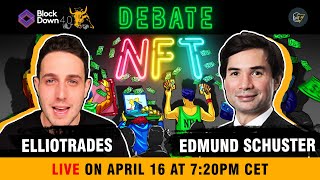
EllioTrades, a crypto YouTuber and NFT platform co-founder, debates Edmund Schuster, a Corporate Law and Finance professor, on whether NFTs have real value. They argue over security, gaming, art, and ticketing applications at the Blockdown Conference.
Chapters
Bang. Big one. Coming up next is a debate about NFTs. To moderate and introduce the members of this debate is Managing Editor and Head of Features at Cointelegraph. With an MA in Political Science and Classical Philology. She is a passionate communicator promoting innovations, translating them into simple language and and helping visionaries be heard. Put your virtual hands together for Managing Editor and Head of Features at Cointelegraph, Christina Korner. Christina, the stage is yours.
Hi everyone, I'm Christina Lucrezia Korner and we are here at Blockdown Conference for an exciting debate about NFTs. And we have here with me.
Elliot.
Trades crypto youtuber and a co founder of an NFT platform superfarm. Hi Elliot.
Hi. Thanks for having me.
You will be, I suppose today NFT beer? No. Okay, joking. So here we are, Edmund Schuster, professor of Corporate Law and Finance, I suppose in some different interesting serious institutions and also famous, no coiner. So we have here today a very interesting situation talking about NFTs in the context of a more general picture of the economics, finance and law. So guys, okay, NFT boom. We all know that like Google search for NFT in last months, like I don't know, it was like 600% more, we had all and sundry who launched their NFTs, some incredible sums of money spent on NFTs, we all know about the people, everydays, et cetera, et cetera. Why now in your opinion guys? So what is, what is it happening? Is it a natural development or is it just a hype that actually circles down all the next launches of NFTs and how will it develop in the next month or so? Will it be keeping going as it goes now or not? Okay, let's start maybe with Elliot, who I suppose is flying following and was expecting this NFT boom to come.
Yeah, thank you for that. Absolutely. The nft, the interest in the NFT industry has exploded and I believe that it is a symptom in some cases, in some senses of a larger macro bull run in cryptocurrency where you have a tremendous amount of new wealth that's been developed in the crypto industry and you have an audience willing to speculate more readily on higher valued assets. And for the most part you've seen some astronomical eye watering valuations on some of these NFT assets and a lot of those have certainly drawn headlines. Shock, awe, amazement, excitement. And I think that's all part of what can be described as a first rush, a first moment of notoriety for NFTs. Obviously if you are a Huge follower, a devout follower of crypto for years. You would have remembered a short moment in 2018 where CryptoKitties sort of took the stage. But this is really what I'd categorize as the first time that NFTs as a piece of vocabulary has made its way into the sort of mainstream lexicon. And I think that that came with a lot of discovery, not only on price, but a lot of discovery on how to use this. And what you're seeing is really just the first toe dip, the first sort of bit of exploration and experimentation by mainstream audiences into this new type of technology. And that's what's made it so exciting is a lot of new, a lot of unknown. And then of course, what we saw, which was a lot of sort of celebrity and mainstream crossover, which always tends to get the media riled up and gets the general public riled up. So that's what you're seeing right now is really people who have never heard of this before starting to learn about it. And that comes with a big dose of dopamine release, a lot of excitement and quite a bit of price discovery.
Well, before Edmund, you will take the floor. I just want to disclaim that it's not that I'm biased toward any bullish markets here and I'm honestly really interested in learning your both inputs guys, because I haven't yet decided for myself honestly what to think of this. You just told Elliot that there are a bunch of people who don't know what actually these digital assets are. And for me, this is actually a point to toward some delicate negative reception of this phenomenon. So, Edmund, what do you think? Also maybe this boom is related to the whole digitalization that is happening during the pandemic. Do you think it's a hype? Do you think it's something natural? And well, how do you evaluate what's happening in the markets now?
So I think, Cristina, you asked earlier where this market is going over the next year or so and I have absolutely no clue. I think nobody has a clue. The problem for someone like me, who is perhaps naturally more skeptic, is I need to understand what exactly it is we're talking about. So what do NFTs actually do in order to form any view as to their usefulness? And so I think there are a bunch of different types of NFTs. And everything I've seen so far leads me to believe that it has to be a hype, at least in its current form, simply because every single type of NFT I've looked At so far falls into one of two categories. It's a pure object of speculation with no intrinsic value. And I explicitly mean enjoyment value here. So not just there is no physical asset tied to it. I just don't see any enjoyment value in the first type of token.
What do you mean by enjoyment value?
I've heard a lot of people present an argument that is structured more or less as follows. Some artists scribble something down on paper that a 4 year old could do, but because they are famous, people will pay millions for it. This is irrational. So don't tell me NFTs are irrational because this is just as worst case, it's as insane. And so when I talk about rationality I look at it slightly differently because there is nothing, there is no way of assessing the rational value of art other than just looking at how people enjoy something. And they may enjoy all sorts of things. And I'm certainly not the kind of person who understands what people enjoy and why. I think there's some research on that, but I think very few people can claim that they fully understand that. So that's not what I'm talking about. What I'm talking about is if you ask people what they want from that token, what the NFT actually gives them, it's very rare that you get a coherent answer. And that is true for the kind of token that is kind of metaphorical ownership of some form of art. And then there are other types of NFTs that have a more readily understandable utility in game assets. Tokens that are connected to electronic downloads, music Kings of Leon or something like that, the NBA stuff where you have ultimately some legal rights, some legal relationship or sometimes a quasi legal relationship and the NFT is part of that ecosystem. And I think there's nothing wrong with that. It's just that what makes me worry about this market is simply that there's no technical reason why we would need NFTs for that. Every single example I've seen it's fairly obvious how you can use non blockchain solutions to achieve exactly the same. And so obviously an album download can have value and in game asset obviously can have value. But unless there's a clear explanation for why you need this particular technology, I think any hype or any, any excitement that is connected to the technology itself rather than to the actual thing that we're talking about is hype in my view, almost by definition.
I like your point about this rationality behind in my opinion, more or less everything that is related to finance is like imagine order and then it's actually us who attribute value to everything that is happening in the markets. So, Elliot, what is the value of NFTs for you? Why do you support this idea? And. Well, do you agree with what Edmund just said?
Yeah, I think what's really important to understand is that with any hype or any period of increased attention that happens so exponentially, there's going to be irrationality. And I guess you could unwind and say that we're looking at digital stores of value. Value here really, as one of the first times in history we've used this. If we extend back more than 10 years. Most stocks on the stock market don't entitle their owners to anything other than to sell it. Most of the stocks don't actually entitle them to actually have any impact on the actual underlying corporations. For the most part. You're seeing the stock market behave as a bunch of digital stores of value as well. Yes, they are loosely connected to earnings reports and stuff. But I do believe that with NFTs in specific, to address the point about why these shouldn't be or can't be addressed with non blockchain solutions is that when you have a digital store of value, a digital asset, and it's not protected on the blockchain, time has shown that at some point this digital asset will be exposed to theft and that that theft can't be protected against even by the powers such as sovereign nations or the world's biggest banks. Information cannot be protected without really a decentralized network to enforce that protection and to ward off bad actors. And so that's why the blockchain is so critical. And as we look to store more and more important assets within this digital space, which is undeniable as a trend, to try to deny sort of digitization, I think is a weak argument. So over time we have to concede that we're having more and more digitization across our lives and in this world. What we're looking to create here with NF, NFTs or crypto in general, is the concept of property rights in the digital age and property that cannot be taken from you and can be uniquely possessed by you as is commanded by the code. And hopefully over time, smart contracts and code will become more intertwined with real legal systems. We can discuss that probably a little later down the down the debate, but right now what we're looking at is the first time that you can truly protect and own an asset in a native digital space. And so while there might be a chance to replicate Some of these activities in a non digital space, the value of knowing the security that comes with the blockchain adds to the speculative value and just to unwind again, you know, digital stores of value are everywhere around us. And I have to agree with Edmund. I'm not an art collector, so who am I to really judge what people do or don't pay for art? In fact, other, you know, there might be an art collector of contemporary art who looks down upon a modern art collector and doesn't value it within the art world. There's certainly no clear rules of the road as to what something should be valued. But I think it's really important to underline what Edmund said, which is that when assets have utility and that programmable utility in the blockchain space just continues to grow and blossom over time, that's where you see the speculative value. That's what people I believe are buying into is the programmability of the assets, the unique authenticated timestamped ownership that, that capsule in time which can't be authenticated and proven in non blockchain solutions, quite the same as it can within a blockchain solution. So that's where I think you're seeing the speculative value creation is within the true ownership within the digital programmability. And of course, you know, what you're seeing is just the beginning, really the beginning of this experimentation which comes with its own value, right, this first wave approach.
So for you, potential financial return is the basic motivation for investment in NFTs. It's not the idea of ownership over collectible or exclusive token, it's more about financial return.
I wouldn't say that that was the summary of what I said, however.
No, it's the last point.
It's undeniable that people are speculating and that's nothing that I think should be denied. People are speculating and they do, I think at one point want to sell them. Just like when they buy a baseball card, they're speculating on the value, they're not buying it for its raw material value. And I think that that's normal. However, I also think that for example, there are a lot of ecosystems where the NFTs are actual access cards and unlock different features and parts of platforms within the crypto space. And that's where you're starting to see people actually buy them for the benefit, not for the collectible value or not for the underlying asset value, but for what they can do with it and for the features they can unlock with it. And that's where things get really Interesting for me, and something that has been sort of the focus of the last few years of my life with game creation and platform creation is what is the higher quality of life that can be accessed for the owner? What is the owner entitled to? And I think that's where things become very, very interesting in NFT land.
I mean, Christina, there was a lot in what Eliot just said. As a corporate lawyer, I cannot comment on your view of the stock market. Right? I mean, it's not true that you are not entitled to anything as a shareholder. Obviously you are, you have significant, both control and cash flow, right? It's true that if you have a huge corporation and you invest a typical, you know, I don't know, you invest your stimulus check or something like that, you're not going to vote out the board of Apple, right? That is absolutely true. But they are very clearly defined property rights attached to the share and corporate law rights that are attached to what happens in a corporation and how cash flows can be distributed to shareholders. So I think that's not true. Now I think we need to be precise in defining what kind of NFT we're talking about. So if you say there's an access token or there's an in game asset, anything of that sort, I think my response to that is what you define as the sovereign blockchain. Secured ownership is really of no value in that area because ultimately the value of whatever you buy, the value of your NFT is tied to an ecosystem that you do not control.
But isn't it the same with the art market, like traditional art market? Because in the end the value of any art object related to the fame of the artist, et cetera, is just a question. Because I also want to understand.
You're right, but that's exactly why I want to separate those two types of tokens, right? So if I buy a Picasso, I don't buy a Picasso as an entry ticket to a VIP area in a club. I may do so kind of metaphorically to a certain extent, but it's not that I use my Picasso. I just want to spend a moment on the kind of utility type NFT where I get a download, I get to use a special sword in my video game or whatever it is. Now the problem here is that whatever the video game is, the value of the token will depend on how that video game is constructed, improved, and what the rules are, how scarce is this object? So I get, I don't know, a special weapon, that special weapons value is ultimately a function of what else happens in that game, maybe the creators decide to make a more powerful weapon tomorrow or to give every player a shield so they are no longer. This weapon is no longer valuable. So I'm already exposed to what you could call kind of counterparty risk. And you can't. You can't solve that problem by putting it on the blockchain. I mean, Cristina, you may know that. I'm not sure if Elliot knows it. In Europe, there is this tradition for typically young children and teenagers to collect stickers of football players. It's always around the world. When I say football, I mean what you call soccer, right? So when there's a World cup, they collect all those stickers and there's a company, Panini, that produces these stickers and sells them. And the game really is. Or the enjoyment comes from you buying a bunch of stickers. You don't know what's in there. And then you trade them. And they're rarer stickers and very common stickers. And it's really enjoyable right now. In a way, the ownership of the physical sticker is not as important. It doesn't actually protect you, even though it's absolute disownership, doesn't protect you against opportunistic behavior by the company. The company could release, you know, a special edition sticker, and you don't have that and you're annoyed. Or they can release, you know, they can start printing a lot of those rarer stickers, and so that develop devalues your investment. So what that has in common, I think, with these types of NFTs, is that you're already exposed to the risk of behavior that you don't expect from the other party. So that means you trust them already. And therefore the blockchain element is an unnecessary complication and overhead that doesn't actually add anything because you can't code away that risk.
Yeah, no, I'd love to respond to this. I think that there's a few points there about counterparty risk that I think are a little bit of an aside. Because the point that you're solving with collectible ecosystems, while there is some element of counterparty risk that you're solving, what you're really solving is the concept of digital authentication. So I can print a Panini sticker and find those raw materials, copy the sticker design, and create counterfeits. You cannot counterfeit a blockchain asset because it's in the code and it's authenticated in a way that you cannot counterfeit it. So there is a huge advantage to using blockchain Even in your sticker example, that I believe is a tremendous advantage for the consumer. Now what you're saying about what's inherently risky about each collectible and that one might be essentially printed ad nauseam and lower the value. Well, yeah, that would be something that in theory could happen more in a physical realm than in a code driven realm where limited supply can be put into the code. So there's various situations where blockchain is a significant higher protection, a higher bar of protection for the consumer. But more importantly, I think it's quite foolish to say that any one sword or any one asset is guaranteed to have value because of xyz. The point is that the blockchain allows the owner of that asset more ability to show its authentication, to use it and treat it like a true asset. I can't for the most part easily transfer. Like if I'm going to have a Pokemon card, I would need to go get it authenticated, go get it rated, keep it in a perfect container and then find a party, ship it to them if I was to have a similar asset. Again, I'm not here to defend collectibles because I'm not a big collector of collectibles. I'm very much so more focused on assets with utility. But even within the collectibles industry, this is a huge step forward to have the authenticated version of this asset perfectly stored forever in a digital realm and protectable.
But still we have examples when there were NFTs based on stolen art because in the end you don't own the copyright of the art or collectible, you do not get a physical copy and it doesn't stop anyone else from copying and viewing it. So just to wrap up this collectible part, Elliot, do you have something to to comment this lack of security in the end for the real owners of the art, collectible, whatever, token, I mean.
In the end you can counterfeit anything physical or digital. What makes it special is the blockchain based authentication from the original artist. And so if that's missing and someone's just putting up a piece of art, then that doesn't make it authenticated just because it's on the blockchain. So it makes it authenticated comes from the address, the verified address of that artist, which can't be changed. And you can't unless you hold that person hostage and force them to create more, then you haven't actually gotten the real value, which is the digital authentication. Now what that is worth to someone is going to be a hugely variable factor based on the artist. Based upon the moment in time, based upon the work itself. And I believe that what you'll see over time is, is the ability for the owners of those NFTs to actually have more possession of copyright, distribution of revenues for the ownership of that copyright. I'm working with some really interesting projects to help musicians distribute the copyright and future revenue streams for their work. And of course, if you put up that song again and put it on the blockchain, that doesn't entitle you to those revenues. But I believe that this is once again a symptom of how new we are. And I do believe it'll become more commonplace over time for the owners of art pieces, the owners of ip, to ask, you know what, what are the property. Right ownership. Property rights, ownership that comes along with this asset, and that's what will really take this space into the mainstream in a massive way, is understanding that when you own this piece of art, you're actually entitled to xyz. And some people might just collect it as art. Again, I can't comment on the art market because I'm not a big art collector myself, but I respect that people do value this. And I also respect that most likely these early digital artists will continue to grow in value because of their historic nature.
Sorry, Christina, I think I need to respond to something Eliot said earlier about the Panini stickers.
I like this Italian topic from Italy, Panini.
I don't see your point, to be honest. If you say somebody could buy the raw materials and forge those stickers, what you're doing is you're comparing the blockchain solution, a digital solution, with something that exists in the physical world. And there are a bunch of differences there. And I think whether or not people like it, who am I to judge? The question for me is different. The question is, let's accept that people want a digital collectible from a central provider of those collectibles. Because, and we've seen that time and again, if you have somebody who organizes the game, these games are more fun, more engaging. Panini is a company for a reason. They know how to structure this game. So I think the difference or the reference point is what else could you do as the central organizer of a collectible game in order to have people enjoy those digital collectibles? And the answer is a simple database. There's no risk whatsoever of forging. If all you do is you have people go through your website and purchase the tokens, you can easily allow a secondary market to evolve. We have that in multiple other areas. The only Difference would be that these assets are centrally managed and centrally stored by the organizer. Now, is there a risk? Yes, there's a risk that the typical crypto fear the central counterparty will do whatever. At night they go in and change the database. But that is exactly my point. If you need to trust them to start with, this risk is irrelevant. If you need to trust the very party who organizes the game in order to enjoy your token, then it simply doesn't matter whether you have a blockchain secured version or a database administered by the same people. There is no difference.
Yeah, well, I like this, Elliot. What is blockchain versus centralized database?
Right? I mean, I'm not going to defend centralization here. I'm just going to say that essentially what you're having is a higher quality of life that's accessible by a token owner. And let me explain why. What you have is standard units that actually possess and wrap NFTs. And those standard units are being developed on by a global network of open source contributors which allow for functionality to come to any of these assets. Now, in your world, you're essentially hoping that each and every behavior that I can do with my NFT based on its standard code base would then be replicated by each centralized developer, which we know is not going to happen even if they enable secondary trading. I'm not going to be able to go rent my asset. I'm not going to be able to go get a loan against it. I'm not going to be able to have complex defi behaviors with it. And that's because you're essentially going back to a centralized model where you're taking what's fed to you. And is it the case that in this particular sticker example that that would be happy for 99% of people? Most likely. But the reason why you're seeing something like a quid, which is an app for digital collectibles which are centralized versus and Panini is actually a member of that and licenses their work to Quid. We're actually partnered with Quid and bringing them to blockchain on Superfar. The reason why you're seeing elevated price points within the blockchain realm is because of the inherent freedom of ownership that comes with these assets and the speculative value that people are putting on being able to actually take these assets into other facets and do more things with them. Now, am I justifying that some of these cards are going for $2 million in the blockchain space? I'm not a big collector of basketball cards to begin with. So it's hard for me to comment on whether that's undervalued or overvalued. But I do believe that the possession of a token of a standard unit of code is a significant quality of life improvement over a centralized database. Totally ignoring the security potential risks that come with a centralized database.
I usually try to move on.
I mean, I think the security element is completely overstated. It's much more likely that you will lose your NFT because somebody makes you enter into a transaction that you don't want to hacks your device or whatever in an unrestorable way, then that somebody hacks the database of collectible producer or organizer in a way that cannot be restored.
Sure. Again, security was not my main point. Security is definitely an advantage, and you're right, there's definitely growing pains on user experience. But what my main focus is is that there's a higher quality of life for the token owner, a higher freedom of movement and interaction with that asset.
Christina, do you want us to discuss this point further or did you want to move?
Well, I like this point because in my opinion blockchain is like either for people who do not trust others or who don't want to think about trust. Trust and blockchain is two separate and it actually depends whether you prefer to trust people or not. Also, in terms of seeing value in the technology, my question to you, Edmond, do you imagine some prerequisites that will make you see value in NFTs in the future? Like what could should happen, some application, something.
So I think Elliot mentioned this before. So Elliot talks about ownership, but of course there is no legally relevant and recognized ownership that is connected to artwork or something like that traded by way of an nft. I think there are ways in which you could design legally, design legally engineer an NFT such that you can reliably tie to it IP rights or some other related legal rights? I think to the extent that you can do that, NFTs could have intrinsic value and then I don't see a problem with people buying them. But in this case, I think again the question would be what more does it give you than what we already have? And I simply don't accept the point that there is something inherent in blockchain technology that, as Elliot says, makes your life better in an environment where you are dependent on the other party anyway, because the other party can actually see what you do. The other party can not accept, not grant you the access that you expected to get if you behave in a way that they don't want you to behave. Right. So this whole freedom and trustlessness is really just a consequence of you expecting the organizer to behave in a certain way. Take an in game asset. I can have an NFT in game asset, but whoever the game developer is, they can decide that they are not going to grant me the access I want going forward because they don't like people who lend their swords to this guy or who use their sword as collateral for Flash loan. There is this problem and I think you can't. To me it's very hand waving to say, well, but blockchain secures it. It doesn't really well.
So to respond to that, I think a really good example is in game assets because let's say you are buying an in game asset and you actually get, for example with the case of Fortnite, say you use some kind of software to help you aim better and then they actually ban your account. Well, you didn't actually own any of those assets to begin with. You owned a license to them and you're no longer allowed to actually access those. However, if I owned the token, even if my account got banned by the centralized party, I would still have that asset and I would still be able to. Yes, you would. It would be in your wallet. It would be in your wallet, right? That's something that cannot be removed, right?
I mean that's like saying I took a screenshot before they banned me, so I still have it.
No, you actually have a token in your wallet but you can't lose it. But well, you can from the game. You could sell it on the market to someone who can. You still have the actually value of that asset. How do you think that the token.
Sorry, but Elliot.
So the token. The token ceases to exist because one account gets banned even though that asset is still valuable in the game. So you think they would blacklist your single token.
The asset can be banned.
That's true.
It's trivial technically.
But that's not, that's not how they, that's not how game developers ban. They ban accounts, not assets because we.
Don'T have NFT assets at the moment.
Of course you're speculating on a behavior that's never happened.
I'll give you a scenario. Okay, so you have some bad actor who hacks the accounts of the top five players in a new game that relies on NFT assets. Now these in game assets are being sold on a platform and you think that the developer of that game will look at this and say, well, it's a blockchain asset. What Can I do? They will just say these NFTs no longer work in our game. You want them in your wallet? Of course, keep them in your wallet. Just like I can keep my screenshot in my inbox or whatever, but they can't be used anymore. I don't get anything.
I mean, quite frankly, Edmund, you're speculating on a policy that I think would be less likely to come into play. If I'm a game developer and someone's cheating in a game or someone gets banned from a game, I am trying to ban that user. I'm trying to stop the behavior which is the cheating. Now, in the event that someone's account gets hacked, most likely they still wouldn't have free flow of the assets because that would be in their blockchain wallet, which is not a direct connection to the account. Yet another layer of security. I think the description of the situation you've given is something I see as a very, very low likelihood, though possible. And I think the much higher likelihood is that the blockchain asset provides a huge amount of financial security for the person collecting these in game assets, whereas the banning of the account is an outright existential risk for any person who might offend the terms of service. The idea that that game would then blacklist their assets seems to me almost emotional and salty and vindictive more than it is trying to protect the community. And so I think that the game would be very much so more likely to ban an account than to then try to ban individual assets. So in my opinion, this would be a huge protectionary measure for the, the account holder that would potentially risk getting banned by the game. Instead of.
Your argument here is simply I trust the game developer not to do this because I would not like it. You have absolutely. I mean, yes, I'm speculating, of course, I don't know exactly what they will do, but I think you should be taking the position that what the NFT does is it relieves you of that speculation because the other party doesn't even have the power. But now your position is I just don't think they will do it because it would not be good. And I just don't see the logic behind that.
Edmond, do you play games? I think it's not fair, Elliot. Like we are talking about something that is your. Like let's imagine some other application of an nft, something that will. I don't know. Recently we had an interview with David Schwartz and he, he proposed this idea that NFT eventually could be applied to all the music and movie content that could permit you, when you like lose or just want to unsubscrib from your Netflix, Disney, whatever, like you still own a token that is the movie or, I don't know, serious that you like and you can watch it whenever you want. Edmund, will it be something that could convince you to invest into one nft? Like what could convince you to invest in an nft?
Look, if somebody were to promise that ownership of that NFT will give me access, rights or any other right that I value, of course I'd invest. I mean if you, if you sell me an NFT and the NFT represents my right to enter the coolest club in London to go to a theater show or something like that, of course I would buy the nft. It's just that I wouldn't buy it because I love the technology or I think there's anything special about the technology. I would buy it for the very same reason that I would buy a ticket that is printed on pink paper. Not because I like pink paper, I like what it gives me.
I'm not sure actually. So Elliot, the question will go to you, but I think actually there were some NFT applications for like tickets of online events and again like ticketing is.
Going to be huge.
What would be the difference between. Well, because, well, I had some experiences when my tickets like to a concert or whatever, like was copied by someone. Fraud, et cetera.
Ticketing is one of the absolute best examples for an NFT because it completely removes fraud and it gives the venue and the original creator issuer of the ticket access to secondary market sales on royalties. So it's going to be one of the biggest applications for nft. And I completely agree here with Emden that the thing that the NFT gets you is what matters. I do disagree still obviously that the in game assets will get banned because in the end those assets will will make their way to non banned users and the game would be penalizing non banned users who purchase that asset. And I think that it's to me, once you enable the blockchain flow of assets, it's hugely pro player and that's sort of why we've built this company over the last three years. So it's a topic I feel pretty strongly about. However, as far as the actual applications for utility, there are many and varied and ticketing is a phenomenal example where you can eliminate fraud with easy verification of the asset. You can always check if this thing is legit because you can track it back to the original contract issuer and then the venues Mark Cuban's talked about this a lot recently, how he's going to make all of his tickets NFTs because of course it protects his venue and his team by getting access to secondary sales with royalties. So it's a huge, huge step forward for the ticketing industry.
Look, I can see the idea with the ticketing. Again, you have a situation where ultimately what matters is your relationship with the venue or with the organizer of the event. So you need to trust them because no matter what the blockchain says, they may still say, I don't like people in, I don't know, gray hoodies and so I won't let you in. And you say, but this is secured by blockchain. And they say, please move on.
Okay, but that's the same of any ticket, right?
Exactly, exactly. So the problem is the same as in the in game example, that is that you already have a trusted counterparty and that is whether you like it or not, the organizer. So the blockchain element of it doesn't actually solve anything that needs solving.
Yeah, I think that's unfair to say that it doesn't solve anything just because you have to trust the venue. So what? You have to trust the venue. You have to trust people in life who are selling you products that you then have to use their services. That doesn't solve everything in life. What it does solve is verification, secondary sales. Those are the things that it solves completely.
Exactly. And so if you trust the organizer of the event, you can have them do exactly what the blockchain does, which is keeping a database of ownership.
I envy you. You really can trust a person like blockchain, but you trust the person today and then tomorrow he or she disappoints.
You, you know, okay, but that's not.
I mean you're looking at. If it was so easy for a centralized database to handle these, why haven't ticket issuers use that system? The reality is, is that the blockchain could easily accelerate this to a point where it was protecting consumers and giving those venues access to secondary market sales extremely efficiently. And so just because then you have to trust the venue doesn't discredit the other benefits. So I think it's important to identify the benefits that are created by blockchain and NFT in specific for each use case. And just because you then have to trust a service provider doesn't then take away those benefits. Say I'm a service, say I'm a, say I'm a venue and I'm selling tickets and then just Refusing people to let them in at will, that's a bad business decision. But that doesn't mean that my decision to use NFTS isn't still better for the consumer and the venue better for.
The consumer if it solves something that cannot otherwise be solved at lower cost. And so when you say why haven't venues done that? Well, presumably because they're not very interested in it.
Why wouldn't they be interested in secondary ticket sales? I can print out my ticket from a centralized database and then sell it on to someone.
Yeah, of course, but you can do that. You can never fully prevent people from doing that. That is just not possible because you have an event where no matter what technology you use, ultimately you need a quick and easy way of verifying that the person in question has the ticket. And so there are numerous ways in which for centralized and decentralized assets, it is possible for you to transfer to somebody else the access, the physical access rights without letting the venue have a cut.
Sure. But in this particular case, this technology can and will, and mark my words, this will happen. Ticketing will get completely revolutionized by NFTs, and it's one of the easiest industries to solve and I think one of the clearest benefits on both sides for the issuer as well as the consumer. Now, one of the reasons why we haven't seen it in gaming so far is that the benefits to the actual game creators are less clear. And the game creators are making, at the high end, billions of dollars a month licensing digital pieces of art to their users. Whereas in this particular instance with the ticketing, the benefit is clear because they'll gain access on a fixed commission to the secondary market and that's what they really, really are interested in.
Okay, Elliot, do you agree with the following statement? If I have a centralized database, then one problem with the secondary market is that I could just say to Christina, here you have my access details, my login for that particular website, and rather than transferring in the database, I transfer to you my access details. So I could do that. If the venue says you can transfer the ticket to Christina, but in order to do so you need to pay us five pounds or five dollars or whatever. I could just give her my access details, my login, my password, and then she would have access to the ticket. Now, the same, the very same thing can be done with NFTs. Right, I can write.
So your solution is to give your login to a stranger?
Well, that is not the problem, as you know, with NFTs.
What do you mean? That's not a problem with NFTs.
Well, I can have a wallet that only contains the NFT and I can write a smart contract that allows me a secondary sale of the password of the to that wallet without having an on chain transfer of the token itself.
Well, I think now you've just unwittingly underlined a better value for blockchain, which is that on centralized servers it is almost 100% the case that one person cannot possess two accounts. And so that's because that's usually to stop one person from saying buying up the whole supply of one event. Right. They don't want that. They don't want one person to have undue influence in a centralized offering. And that's a very common practice to stop people from having multiple accounts. Now a blockchain, you can easily spin up multiple accounts. And so that's a fantastic reason to have a decentralized wallet.
So exposure to civil attacks is now a feature. I don't understand. I mean, look at it from the venues perspective. Venues know exactly what they're doing because they've been doing that for centuries. They have an interest in getting a specific audience in there. They are not maximizing revenue as such. So of course, yes, they do place restrictions on who gets to buy how many tickets. But the reason for that is that it's very boring to go to, I don't know, Kings of Leon concert that is populated almost entirely by hedge fund managers. It's boring there. So what do they do? They price the concert at too low a price to make sure that people, other people also go there and have fun and make it fun for everyone. So yes, it's in the interest of the venue owner to ensure that you cannot create a million accounts and buy up all the tickets. So I think, I don't see that as a feature that would convince any venue. And of course at the moment, in the traditional market I can have hundreds of accounts with a centralized server and people do that. How many Gmail accounts can you create? Hundreds is absolutely.
We're not talking about Gmail, we're talking about the specific example that you outlined. Right. And so the point of the World.
Cup, people created dozens of accounts each.
And also I think you're making the point the venue owners are not attempting to maximize profits, which is from a game theory perspective, a bad assumption to make. You should always assume from a game theory perspective that everyone is trying to maximize profits and that all participants would want to benefit to the maximum degree.
In a one shot game. Yes, but the idea Is. And I mean that is unquestionably the case. Why do you think so? If what you say were true, then you should not see any queues for the next whatever Kings of Lyon concert. You would just price it at the clearing price. There shouldn't be any queues. The ticket is £2,000 and everything's fine. Why are they not doing that? Because it's boring and because they know nobody will go to the next concert.
Probably because it's a Kings of Leon concert.
Well, I have no idea. I'm sorry.
I'm just kidding. I'm just kidding. Respect to Kingsley.
I'm not very connected, so I always want to say Britney, but this would probably. So the point is. No. People do not maximize the revenue that they earn on a specific event. The whole idea that's true for every NBA game, for every large event. People price those tickets and sell those in a way that gets them the audience, that in the long term gives them higher revenue. It's just boring to go to places that are priced at the clearing price. That's just reality.
Yeah, I don't know. I would have to disagree unless we saw some data from a concert venue. But I think we can move forward. I disagree. That venue would. Would not try to maximize profits. I think that there would be many venue owners that would disagree with that. But we can move forward because.
Five minutes, guys. Yeah, like, let's reverse the reflection a bit. So Elliot, imagine that, like. Well, I suppose that if in, I don't know, year, five years, 10 years, you see that NFT boom is like, keeps going, but still people like admin are not convinced, like it will be a disappointment for you, I suppose. As an advocate of the market, what are the prerequisites, you think, for people like Edmund to be involved in the market?
Yeah, I think the beautiful thing about the entire crypto space and the entire growth of this nascent industry is that not participating is the punishment. Right. And so when, when you see the growth, and Edmund strikes me as an intelligent individual, I'm sure he's going to be successful. However, you have assets and growth of marketplaces based upon people being able to predict certain movements of economic and technology trends. Now, if NFT keeps growing and blossoming, then Edmund's lack of participation would be his punishment. And him not participating wouldn't make me or anyone else who's inside the industry, sadly. It would just be something that he might want to investigate himself and say, hey, well, maybe did I miss out on potential upside? Did I miss out on potential Access to things that I would maybe enjoy. That's a personal question for Edmund. However, in the end, the disruptive nature of this technology and the higher quality of life, the higher financial quality of life and the greater access that it provides and security, those are the things that will end up being the benefits for the people who choose to adopt these technologies and those who choose to overlook them, I believe will be foregoing not only access and utility but also financial gain. And so that's really the disappointment would not be on our part because we would be enjoying that part. So whether or not buying right now with extremely mania prices is not what I'm saying, but I'm saying over the course of the long term I do believe that you'll see a lot of financial gains, success and economic activity from this sector and that it's a very smart thing for people to get involved with.
Edmond, if all the people who are around you will invest in NFTs in a year, will you be disappointed and will you change your opinion and try to invest?
I want to be absolutely clear on what Eliot just said. It's not that I would not buy NFT if it were the right way, the cheapest way to give me access to what I want. That would be ridiculous. I have no emotional attachment to Oracle, right? But. And I simply don't care, I don't care what back end software somebody uses when they want to sell me something I ask myself do I want or need what they have for me, right? So if I want to go to a concert or to the opera and they want to sell it to me as an nft, I would make the same decision that I've always made. I will check what the price is and whether it's worth it for me. So I have no particular aversion to buying an nft. I wouldn't mind when it comes to investing with a view to making an investment gain. I personally wouldn't do it for the simple reason that I don't think that beyond accessing something that you want or believe other people will want that there's any fundamental value in there. Multiple assets that you can buy just. I can also go to the casino. I'm not doing that because for me this is gambling and I can't see the vision that will give those assets value long term without them being tied to any utility that people actually value.
Well, I think the ideal moment will be when both of your opinions will come in one culmination when nobody will know that what we are using is actually based on Blockchain. And here I think both sides will win. Guys, any final thoughts?
Yeah. Thank you so much, Edmund. It was really fun debating. I think that it's really early in the life cycle of, of NFTs, and I think that over time the benefits will start to show themselves again. NFT wasn't a word that anyone knew about two months ago. So I think all of this attention has been a big win and that over time, I sincerely hope that the utilities of these assets really shine. And I think that's where we can agree.
Yeah. And also thank you. I enjoy talking about this and I have to say, after kind of taking an interest in this, I've received so many emails and phone calls from people I know who wanted me to explain it. So, I mean, I can confirm that there's growing interest. I just think, you know, if we want a sober discussion about this technology or phenomenon, then we just need to be very clear, what exactly do we expect here? What do we expect when we buy something, an artwork? What's the benefit of using that compared to other technologies, rather than just comparing a world where everyone uses digital apps with a world where nobody uses a computer and then just say, you know, blockchain is great because it's more modern. And so I think as long as we have this kind of sober, sober discussion, there may well be applications for NFTs that are more engaging for users. And I mean, if that's the case, fantastic. But I think this has to come first. It has to be something that is actually demanded rather than something that is conjured up primarily as an object for speculation.
Thank you very much, guys. That was really a very insightful, interesting discussion. And thank you everyone who watched us. Please leave your comments. I'm really interested in learning. Are you NFT bearish or bullish yourself? Thank you very much and have a great weekend, everyone.
Thank you.
Bye. Take care.










