Don Tapscott | The Evolution of Blockchain and The Digital Economy
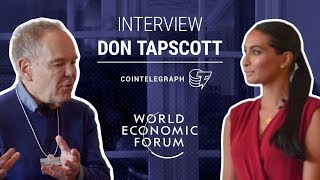
Don Tapscott on blockchain's moment at Davos and Canada's emergence as a hub, with government pilots on Ethereum and Bank of Canada involvement. He covers Walmart's supply chain experiments, crypto's remittance potential, and his plan to launch 75 Blockchain Research Institute projects for enterprise strategy.
Chapters
I'm sitting here with Don Tapscott, CEO of Tapscott Group, co founder of the Blockchain Research Institute, and one of the most influential voices on blockchain and the digital economy. So thank you for being with us today.
Happy to be here.
You are a senior advisor for the World Economic Forum. So what are your thoughts on how big a role blockchain and the digital economy are playing in Davos?
Well, it's interesting. First of all, I don't speak for the forum, I speak for myself. But I was interviewed by the Wall Street Journal television here, and the guy said to me, you know, this is the third year that we've interviewed you about blockchain, and this year everybody's talking about it at Davos. Describe how it's changed over the three years. And I thought about it for a second. I said, well, three years ago, the main person talking about it was me, and I was sort of talking to myself and there may be a few other people. Last year we had the big financial institutions that were talking about it, and also some entrepreneurs around the Congress, and also central bankers, ministers of finance, and I spent some time with them this year. This is the blockchain Davos, and apparently blockchain on the formal program, as a word, appears more than the United States and Europe combined. And someone did an analysis of language, and they found that blockchain was the number two word at Davos, number one being Trump. Anyway, be it as it may, but it's an extraordinary thing. It's not just that it's integrated into the formal program and that powerful people are talking about it. I estimate there are about a thousand entrepreneurs, investors, social activists, social entrepreneurs, academics and so on that have come to Davos. And they're not inside the Congress center, they're outside doing all kinds of things. So you got the Global Business Blockchain Council holding up whole days of programming and having a dinner with 200 people and hundreds of people lined up, hoping to get in. There's the crypto hq. I wonder what that was. For days I couldn't get in there because there were lineups all the time and everywhere there are activities. So I'm walking along the street, someone recognizes me, says, we're having a big blockchain meeting upstairs. Would you come and speak to us? And I go upstairs, and There are like 100 people in a room, and I do a panel discussion and answer a bunch of questions. So this is a very. It's very reflective of what's happening more broadly in the world that finally this Technology has not just come of age, it's really becoming part of the vernacular, and everyone's trying to figure it out.
So how do we feel the Canadian government piloting Ethereum blockchain to create more transparency?
Well, Canada is a pretty interesting story. And when you think about where is this whole thing going to be centered in the world, there are a few candidates. Switzerland is obviously one. I don't think it's going to be Silicon Valley, basically because leaders of old paradigms have difficulty embracing the new. But Canada's got a government that's very interested, including the Prime Minister who was here, who's totally into blockchain, of all things. And as part of our blockchain Research institute, we have the bank of Canada that's doing this work. It's the federal government, the provincial government, and this, the city of Toronto. But there's also five, not 95, big banks, and they're working to reinvent the payment system. We do have a theory, and that was created by a, you know, a university dropout from the University of Waterloo. We've got thought leadership with our research institute. The two biggest incubators in North America are in Toronto. Mars alone has 1.9 million square feet. And we used to have a brain drain in Canada where entrepreneurs would leave the country and move to the U.S. but now, thanks to two things that's been reversed. One of them is Donald Trump, where a lot of people want to, especially Canadians, want to move back to Canada. But the second one is there was a funding problem that you would get to a certain point with your company, May20, maybe 20 million in revenue, and you need to do a Series A. And some big venture capitalists in Silicon Valley would say, great, we'll fund you, but you got to move to the valley. So there was a company drain as well that's been turned around now because of ICOs, and that people don't have to go the venture route to fund their company. The other thing is that we have a pretty good regulatory environment in Canada, too. We sure don't have crazy stuff going on like in some countries in the world. And I'm very hopeful the bank of Canada is going to be a real leader in this space because ultimately every country needs to embrace blockchain for their fiat currency. So we need the digital dollar, digital pound, digital yen, and so on. And that would give central bankers powerful tools to manage the money supply. You change inflation rate, you can see what's happening instantly. You have a crisis, you want to, rather than giving money to the Banks, you could helicopter it onto the mobile devices of say the poorest people or something. So there's a lot going on in Canada right now.
Do you think other governments will be as open to this technology as Canada?
Well, all around the world, world, it's very uneven in terms of government comprehension of this whole second era of the Internet, because that's what we're talking about here. Fed an Internet of information for 40 years. Now we're getting an Internet of value or anything of value can be moved, stored, transacted in a secure and private way. And trust is achieved by cryptography and collaboration and code rather than by intermediaries. So that's a very, very powerful thing. And it'll be at the center of any innovate building an innovation economy. But governments, many don't understand it. You know, I was recently in Korea. Here's a country that, you know, created a miracle around the whole first era. And they created this amazing manufacturing facility. They call it the miracle on the Hun. And now the Korean government is trying to figure out what to do. And they've done some wrong things. They banned ICOs and they're looking at restricting or even banning cryptocurrency exchanges. And I was there, I'm meeting with government leaders and doing a lot of press conferences and stuff saying this is going to hurt you. You don't want to do that. There is a public interest here. It's not like the Internet of information where I always said just leave it alone. You know, if you're doing an ICO and the token represents a share in a company, that's called a security and it should fall under securities legislation. But we need, you know, micro surgery on this new economy. We don't need a chainsaw. And this is will be one of the three most important rate determining factors in terms of what countries emerge not just with a blockchain industry, but with a whole new innovation economy. Is the governments do the right thing or do they and have sensible legislation or do they mess it up?
What other ways you have seen blockchain and the digital economy mature throughout 2017?
Well, it's been an extraordinary year. And of course the biggest thing that's got everybody's attention is the crypto craze. Right. And just a word on that. You know, this is a tulip bubble like in Holland. I don't think those kinds of analogies are quite right actually. Yeah, there will be all kinds of volatility and there will be bubbles. But, but think about it. The first era of the Internet information was placed in the Commons by Tim Berners Lee. The second era will the actual protocols are going to be owned by investors and people. So what's the first era worth? How many tens of trillions of dollars? The second error is probably bigger. So the alternative way of looking at this is this is the biggest investment opportunity maybe in human history. Now, are a lot of these ICOs garbage? Yeah, well, this is 1995. A lot of the dot coms were garbage too. Are a lot of people going to lose money? You bet. Will there be all kinds of speculation? For sure. Is there hype? Yeah, there's hype. There's that much hype and. But there was that much hype about the Internet in 1995, and we talk more about the Internet today than we did in 95. So the hype's not going to go up and then burst. It's just going to continue probably for decades as we understand that this is the new operating platform for the firm and for the economy. So the other big things that have. But what we have here is the sort of crypto asset class tail wagging the blockchain dog. You see, because the real pony here is not all this asset stuff, although it may be a big opportunity. The pony in this pile is that we have a new platform emerging that's going to change the deep architecture structure of the firm that's going to fundamentally transform every industry in our economy. And over the last year, we've seen some really big developments like, yeah, I could talk all day about this, but I'll just give you one example. The supply chain industry globally is a $64 trillion industry and supply chains are going to move to blockchain. You can see that with Foxconn doing this now. We've done a big case on that, on the Walmart use of blockchain for food safety. And the biggest supply chain in the world ever is the One Belt One Road project linking Hong Kong and Rotterdam. All the trade, finance and a lot of the supply apps on that are being done on a blockchain. And it's perfect for that kind of situation where you have a buyer and a seller, an escrow agent and governments and various shippers and tax authorities and so on. And rather than passing off pieces of paper and fax and emails and so on, they have a single shared network state where they can all instantly see what's going on. So it turns that supply chain into something we call an asset chain. And ultimately, as this thing becomes cognitive, it really becomes an issue. Cognitive computer. That's what a supply chain will be.
So in what ways do you think cryptocurrencies will impact the way we understand and use money?
Well, that's a good question. I don't think that non fiat currencies will replace fiat currencies. Lots of people may disagree with me. I'd be surprised If Bitcoin got to 1% of transactions in a major country five years from now. There is a role for these currencies, but more as a tool for creating new apps. So, for example, the global diaspora, people have left their ancestral lands and they send money back home. It's called remittances. It's a trillion dollar market. Well, if you're a Filipino nanny in Toronto, you don't have to pay Western Union 15% to send money to your mom in Manila. You can use a platform for remittances, but that platform actually uses Bitcoin as the underlying tool to enable that to occur. So that's not the actual currency. The currency is sort of a transition between two fiat currencies. And as I said before, the biggest opportunity is to turn a fiat currency into a cryptocurrency.
Like national or.
Yeah, yeah. I think that every country should have its cryptocurrency for the next period of human history. Ultimately, I'm with John Lennon. Imagine there's no countries. It's easy if you try. You know. You know, the whole. The whole idea of all these nation states is sort of an interesting idea that came out of a certain period in human history. You know, we had these areas and they were a bunch of cities and they consolidated together and they had a common currency and borders, and they created institutions and the rule of law and bureaucracies and so on. It was nation states for national economies. But increasingly the economy is not national. You know, it's. Notwithstanding Donald Trump and America first, no country can succeed in a world that's failing. And increasingly we have regional economies like North America and Europe, and increasingly we're going to need some kind of global economy. So it's fun to speculate about stuff like that in the future, but I think it's. It's probably not in my lifetime.
You know, you can hear it from. All right, so could you tell us about what you personally will be focusing on in 2018?
Well, in the Blockchain Research Institute, we're doing 75 projects right now. And these are all looking at the strategic implications of blockchain to transform the corporation. 10 different industries we're looking at. And also we're looking at seven C suite functions of management. So what does triple entry accounting mean for the cfo? You know, what is, what is smart contracts mean for the chief legal officer? What does blockchain mean for enterprise architecture? It's fine to have a bunch of pilots, but nobody slot through, you know, companies. Not a bunch of, of divisions. It's, it's an enterprise ultimately. And we do need enterprise architectures. And we've got a great group of about 6, 60 of the world's leading thinkers that are leading these projects. And over the next year, we're going to complete the projects and then the management will be out in all of these companies doing executive briefings. And these are typically the CEO and the executive committee of some of the biggest companies in the world. So we're pretty excited that that's going to bring about some big changes. The other thing is both my son Alex and I are spending a lot of time out on the road, sort of speaking to big conferences and also to smaller and more important events. In three weeks, I'm speaking to, I won't mention the name, but it's 150 CEOs of the 160 largest corporations in America. And they're very curious about this. Most of them haven't quite figured it out. So we're sort of in the business of, of breaking logjams and of bringing clarity to the market. And we partner with Hyperledger and Enterprise, Etherium, Koala and the Chamber of Digital Commerce and these other organizations there are affiliates. And we're not duplicating what they're doing. We're trying to address the strategic issues. So that's going to keep me busy for the next year.
Thank you so much, Maria Johns. Don Tapster, Popcorn Telegram.
Thanks, Maria.
Thank you.










