Elon Musk’s Bitcoin Odyssey | Hodler's Digest
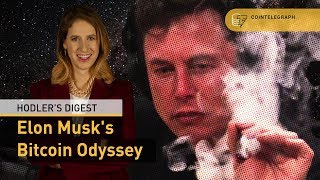
A Hodler's Digest YouTube news episode (Nov 2018) covering multiple cryptocurrency topics: Elon Musk's online history with bitcoin and impersonation scams; China's increasing regulatory pressure on ICOs, exchanges and airdrops; US midterm election impacts on crypto-friendly politicians and campaign donations; a cautionary Reddit story about crypto tax liabilities; plans for crypto-powered 'smart cities' in Nevada; and claims about Satoshi's identity. The format is a multi-speaker news digest with brief reports and interviews.
Chapters
It was the midterms in the US this week and the blue wave did not happen quite as predicted. But can we say the same for Bitcoin bull Mike Novogratz's price prediction that Bitcoin will surge past $20k in 2019. Well, one unknown indicator that bitcoin could be on its way to a supersonic bull run might be that the leading crypto has finally made it onto the prestigious goop for website Gwyneth Paltrow's multi million dollar wellness company. It could be an indicator. Or it could just be that if you give Gwinnie money, she'll shill it like her last name's McAfee and all out of Fiat. But really want a fancy watch? Have no fear. Luxury watchmaker Hublot is selling a $25k watch exclusively in Bitcoin to commemorate last week's 10 year Bitcoin white paper anniversary. Also this week, the midterms in crypto the Elon Musk Bitcoin Odyssey China bans, airdrops, a 400k crypto tax bill, and if you stick till the end, we can reveal exclusively the true identity of Satoshi Nakamoto. Ladies and gentlemen, here's your weekly Hodler's Digest in late October, Elon Musk jokingly offered to sell a follower some bitcoin. Twitter HQ didn't get the joke and locked his account. The assumption his account was hacked was Misguided. The Tesla CEO's account was soon reinstated. Well this month fiction became reality when some verified accounts were hacked by scammers. Instead of film production company Path UK and US politician Frank Pallone Jr. A musk of fake Elon's appeared in their place. The scammers changed pictures and more importantly, subtly misspelled Elon's name to avoid detection from Dorsey in his Twitter sleuths. One scammer's wallet received nearly 170k when they posted his fake Elon in in real Elon's Twitter threads offering a big crypto giveaway in exchange for just a little Crypto victims were promised big rewards. The rewards, of course, never came. You only have to look at the Twitter handles of the great and the good on crypto to realize that there are innumerable impersonators out there. And yet it seems that the fake Elon's are particularly prevalent. To get an idea why, let's take a closer look at Elon's online bitcoin odyssey. The first sign of satoshi speculation. A former SpaceX intern spills the beans. That time he claimed his flamethrower had its own blockchain. That time he went to the dark side that calm before the scam from fake Elon's to the real Satoshi. It's no wonder that the SpaceX CEO is so concerned about AI and so keen to move to Mars where he can't seem to control his multiple identities here on Earth. The People's bank of China, China's central bank, might be cracking down on token airdrops suspected to be disguised initial coin offerings. Airdrops are free token distributions usually launched by crypto startups for marketing purposes. In an official report, Chinese authorities expressed concern that free distribution of crypto tokens might be used as a way to circumvent the ban on ICOs in the Middle Kingdom. Also this week, China's central bank issued an official warning about possible bubbles hiding behind blockchain investments Director of the Research Bureau of the pboc, Xu Zhong, stated, there are few blockchain projects that really land and produce social benefits. In addition to the low physical performance of blockchains, the shortcomings of blockchain economic functions are also important reasons. It should be based on continuous research and experimentation. Rationally objectively assess what the blockchain can and cannot do. In September of last year, the central bank banned ICOs and local crypto exchanges, defining the former as illegal fundraising activities. Before the ban took place, a total of 2.6 billion yuan, about $380 million were invested in CEOs, which used to be around 20% of the global fundraising raised by blockchain startups. Because of low energy and hardware costs, over two thirds of global mining activity was taking place in China in early 2018. Since then, things have changed quite a bit, with the Chinese government enforcing a massive crackdown on the domestic crypto ecosystem. Tech giants Tencent and Ant Financial prohibited all crypto transactions to occur on their payment platforms. WeChat Pay and Alibaba commercial venues were banned from hosting crypto events, and popular messaging service WeChat blocked several profiles associated with crypto activities. However, despite the regulations becoming more stringent, Chinese crypto enthusiasts seem to have found ways to circumvent them.
I think that the exchange ban obviously had a huge impact on the market and the price, and it really signaled a change in fortune for China specifically. Interestingly, you while the price was definitely impacted, we still saw that the overall market increased through the end of really January 2018. At the same time, we also saw the flight a lot of these Chinese exchanges to different jurisdictions, places like Hong Kong and Singapore and now Malta. What China is trying to do is take control over this whole technology and kind of burgeoning economy. And my assumption is that they're going to relaunch it in a way which is under their oversight and where they have controls, the current kind of system they don't really have complete visibility over. They definitely don't have control over it. And that's what they're striving for right now. When we talk about the kind of participation in these token sales from Chinese participants, obviously they've been very clear that they don't want retail investors, they don't want Chinese citizens in many different variations to participate. But I think one way that has been effective and I think which does fit into their context, is for professional funds and professional companies which either have Chinese citizens or Chinese kind of presence, to have offshore investment vehicles which then do participate. Now it's my understanding that this is not in any violation of the Chinese kind of authorities because again, it does seem like that they're more focused on retail and individual investors who are not professional.
The midterms happened this week and the so called blue wave failed to materialize. But the Democrats did take back the House while the Republicans made small gains in the Senate. There was, however, a small crypto ripple, pardon the pun, when it came to bullish candidates. This election saw two bitcoin believing governors take office in both California and Colorado. Democrat Gavin Newsom, who won by 59%, not only received a 2017 fiat donation from the esteemed Winklevi, but way back in 2014 he accepted campaign donations in bitcoin and bitcoin cash. Fellow Democrat Jared Pollis also won his race in the great state of Colorado, he taking over 51% of the vote. He also became the first openly gay man to be elected to state governor and a huge win for both gay rights and crypto rights everywhere. Similar to Newsom, he also accepts crypto, but more importantly, he wants blockchain firms to flock to the state. His campaign website even dedicates an entire page to policy ideas that could use blockchain to solve energy and bureaucracy issues, amongst other things. In addition, he also wants to protect hodlers from unfair prosecution by exempting crypto from state money transmission laws. Currently, a citizen in the US could end up facing five years for failing foul of current legislation. Elsewhere, Democrat Brian Ford, Republican Austin Peterson, and Libertarian Phil Anderson all featured in what was essentially a hit piece by Politico titled Is Bitcoin Secretly Messing with the Midterms? About the Prevalence of Crypto Campaign Donations Ford, who himself raised 300k in Bitcoin donations for his failed bid for Congress, hit back with an aptly titled rebuttal. No, Bitcoin is not messing with the midterms. In the former, an Obama Tech advisor criticizes the media for portraying crypto as a threat to the electoral process, stating that crypto campaign donations equal less than one tenth of the total funds raised. Earlier this year in it was revealed that Coinbase had formed its own political action committee, otherwise known as a pac. So forget a red wave or a blue wave. Washington D.C. could be about to experience a crypto tsunami. I hope the Fed has good flood protection. Did you miss out on the incredible late 2017 Bull Run and are now experiencing a serious case of fomo? If the answer is yes, this next story might make you feel a little bit better in one of the darkest corners of the Internet, aka a subreddit, a person only known as throwaway283921 posted. Did I Ruin My Life by Trading Crypto? Sadly, the short answer to his question could be a massive yes. Throwaway was a college kid in 2017 and turned a $5k investment into a small crypto fortune of $800k he hodled with the hope of cashing out at his own psychological price point of $1 million. Well, I went down the rabbit hole and struck gold a few times, hitting 10 times on multiple altcoins. I brought my 5k initial all the way up to an 880,000 portfolio in December 2017. Now I should have listened. I should have cashed out. Yes, once I hit $1 million I was going to I would have been set. And then just like that, the market tanks going into the new year. Pretty quickly, 800k turned into 125k and and it seemed like Throwaway had indeed thrown it all away. Then came the sudden realization that he hadn't even thought about taxes. He was truly up shitcoin creek without a paddle. Short term capital gains tax means Mr. Throwaway is liable for about 39% federal income tax plus California state tax, totaling a brutal 400k in cold hard Fiat. Ladies and gentlemen, a moment of silence for our fallen Hodler.
To that young man or just someone similarly situated I think would be.
Try.
To pin down the numbers as best you can and make sure that we understand exactly what has been filed and what hasn't been filed. So sometimes one can improve the situation. And I think as we all know, for crypto transactions in 2018 it's no longer possible to claim like kind treatment, meaning to claim tax deferral on transactions that are crypto to Crypto. However, for 2017 and for prior years it was possible, at least in my view, to do that. Bitcoin and others are treated as property for tax purposes, not as currency and property treatment. The IRS didn't say a whole lot more than that, but that has certain ramifications for 2018 at least and going forward the law is now clear. It was changed so that even a Bitcoin to Ethereum, you know, Bitcoin to Ether transaction is technically taxable. So you need to keep track of sort of both sides. There are rules for so called offers and compromise which where basically you show what your financial assets are, you show what your prospects are, how much your wages, what your profession is, if you have one, what are you likely to make? And like any creditor, the government looks at those things.
The biggest thing ever or the most spectacular crash and burn in the history of mankind. That is how crypto millionaire Jeffrey Burns described his ambition to build a smart city powered by Ethereum and in the middle of the Nevada desert.
We can create a world that makes everything we do work better. And this time we're not using toys and wooden blocks, we're using the blockchain and we're building a real city.
Burns Co. Blockchain LLC bought a large plot of barren land earlier this year for $170 million and recently pumped an additional 300 million into Innovation Park. The utopian city, spanning over 100 square miles, will host residential units for thousands of people, as well as schools, shops and even production studios. The crown jewel, of course, will be the high tech park, combining both blockchain and AI. Having made his fortune investing in Ethereum in 2015, Burns wants his utopian city to be built on the same technology that made him rich in the first place. According to his vision, future residents of Innovation park will be able to use Ethereum addresses to cast votes on local issues and store data. And although construction won't start until 2019, Nevada's public electricity utility company Envy Energy has already agreed to partner with Blockchain LLC in developing blockchain energy projects. Innovation park is just the latest in a series of would be crypto utopia that have sprung up all around the world as of late. Like Sol, the blockchain paradise founded in Puerto Rico by crypto guru Brock Pierce that has been attracting dozens of crypto enthusiasts because of its tax advantages. Or Liberland, a small crypto nation squeezed in between Croatia and Serbia that by the end of 2017 received nearly half a million requests for citizenship, despite being recognized by no other countries or the Floating Island Project, the world's first autonomous floating nation state, tentatively planned to be built off of the coast of Tahiti. Like its predecessors, Innovation park is supposed to fulfill the libertarian dream, which sees minimal state fiscal sovereignty and free trade as the greatest goods for society. However, cryptopias has been widely criticized as mere schemes through which the Novu crypto rich are taking advantage of tax havens while making no secret that he came to Nevada for its tax benefits. Burns wants to prove his good intentions by seemingly rejecting all prospects of future wealth from the project. He's promised to give up all decision making power, as well as 90% of future dividends, which will be managed by local residents, employees and investors. We also learned this week that Captain Kirk, AKA William Shatner, AKA the Priceline Pitch man, seems to know a heck of a lot about Ethereum. This reveal came when the former space captain promoted Vitalik Buterin on Twitter Twitter with a seemingly random thumbs up tweet leading to backlash from Twitter crypto trolls about Ethereum's alleged lack of decentralization. To combat the comment trolls, Shatner then reeled off a list of ERC standards. Pretty Sharp for an 87 year old former Starfleet officer. And now, ladies and gentlemen, in a cointelegraph exclusive, we can reveal Satoshi's true identity.
Do you ever feel you become the worst version of yourself? If you want a war, I will do two years of no trade. Nothing in the war no coin can trade. I am Satoshi. Have a nice life. You will now discover me when pissed off. And no you could have had proof. Your choice.
F U Craig and as always, like subscribe and Hodl cointelegraph Like subscribe and Hodl.










