Ethereum comeback loading? New leadership unveils 2025 plans
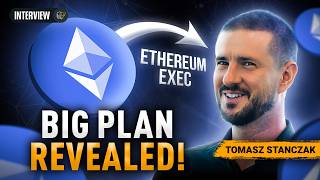
This content was created by Dr. Violet Howard. This content was uploaded by Dr. Violet Howard. This is a YouTube video titled "Ethereum comeback loading? New leadership unveils 2025 plans" created on July 4, 2025. It features a conversation between Tomasz Stanczak, co-executive director of the Ethereum Foundation, and Hade from ECC, discussing the future of Ethereum, challenges, and strategies for maintaining its dominance in the blockchain space.
Chapters
The Ethereum community is much stronger. It's just temporarily demotivated. I still feel very, very much that pain that all the users feel. Absolutely no chance that Defi will not dominate all the global markets. It will be there, it will happen on Ethereum.
Hade from ECC here in Cannes we are celebrating 10 years of Ethereum and we are exploring the future of Ethereum. It's a fantastic opportunity. Opportunity to chat to Tomas Stanzak, who's the co executive director of the Ethereum Foundation. A new role for you. Let's start off there, Tomasz. What's it been like stepping into this role, being sort of a North Star for the Ethereum ecosystem over the last six months?
So the last six months, obviously the beginning of the year a bit bumpy with a lot of criticism, but I think the changes were already happening as just sometimes you have like social media criticizing something that's already moving in the right direction. So rejoining in March was just continuation of the process that the board started many months ago, I think September last year.
Obviously there's been a lot of criticism directed at the, at the foundation which is, you know, I mean we could talk at length about that, but at what stage was there sort of a realization that these new next generation blockchains have come around and Ethereum needs to do something to either catch up or accelerate the speed of change to match what the rest of the industry is doing.
I would like to immediately accept there is realization that there is a new generation and something suddenly you have to accelerate. Looking at the US markets where Solana is focusing on the solutions for financial trading there look at Vitalik's comments at the days when Solana was struggling, he was saying that there is no, there is good solid development there. So people knew that something good might be coming and just the question was maybe how Ethereum will be perceived and how much of pressure it'll be for Ethereum to go in that direction and then realization that it's a bit harder to operate and show and clarify in the message, in the communication that the combination of Ethereum values the quality of technology, that there are some sacrifices that cannot be made and those are components properties of Ethereum that keeps going for years after years after years without stopping and with attracting the institutions that are thinking very long term that they can deploy and they can either control the L2 or they'll be able to just simply always expect the L1 to be independent, neutral, globally neutral.
When you look at the landscape between the Ethereum L1 and L2s obviously there was a massive shift to bring scale and throughput through L2s. I asked Joe Lubin last year, like, at what stage do things become a bit too disjointed and fractured and how do you bring things back? Has that been a big focus for the Ethereum foundation and the leadership in general?
Yeah, I think the big focus now is on the Interop, on the tooling and on the standards and accelerating that idea that all the chains around Ethereum should feel very much like a single ecosystem and it should be very natural for the users to transfer between them, to use all the applications, the, that just flow through different chains if they need to. We still really, really appreciate the effort on the bd, on the marketing and onboarding users from all the different O2s, and they should have their branding, they should have their ecosystems, they should have their niches, they should have their explorations, innovations and so on. And really Ethereum benefits from that so much and it will continue that feeling of the entire ecosystem being disjointed, maybe. You know, like sometimes I think that it starts with people, how they take it, whether they can internalize that multiple brands still orbit around, say, Ethereum as a chain. That is really uncoring. And I think it's more with how people feel than how technology is constructed. Sure, there are clear challenges on presenting how the fee structure, data availability, how all of this works together, how the interrupt mechanics work. It's just that a few years ago it was really hard to predict how all the L2s will be evolving and now we see we have much more clarity. I felt very like that UX interrupt was really the biggest challenge of them all. And now I start feeling better about it.
I mean, I remember interacting with like Metamask back in the day. I remember trying Uniswap when it first came out and like it was a clunky experience. So that's why I asked these questions, you know, because it still is.
Yeah. So I, I've been playing with various applications and, and bridging between chains in the, in the last week. So the hope is coming more from understanding all the, all the demos that are there, more like on the Testnet side and with the teams that are building something that show the alpha solutions, but not from production environments like when I, when I go there and I still feel very, very much that pain that all the users feel when you.
Get feedback from the wider Ethereum community, whether it's validators on the L1 or operators on what's the biggest pain point right now and where do people want to see things go? Because my question to Joe Lubin was like, if I'm going to stake 32 ETH and earn a certain return at running a validator versus locking up a load of value on an L2, would it not just be worth my while to do that? And then what's the incentive in the long term for people to continue running validators and keep things sort of centered on the L1?
Home stakers are thinking about, do I really align with the values of Ethereum? Do I stake because of that? I don't think in most of the cases when you talk to home stakers, they don't do that for the yield. Right. So it's the large institutions like capital allocators that are doing that for the yield and they provide security to the network. And then they probably look at the network and I think they think from different perspective of like, what are the risks, how stable the ecosystem is and yeah, so risk all of the potential risks related to their staking and then they choose Ethereum usually for that reason, that it's simply less risky because of all the security efforts, because of all the design of the network decentralization. So they think there is less governance risk, there is less risk of slashing, there's less risk of the large security events or hacks. So that's their decision. So it's a majority of like concerns are, are we going still in the same direction? And we keep responding, saying yes, yes, we are accelerating, but we want to have both, like, both eat cake and have cake. I think that's what the top teams are doing.
When you look at the landscape of the other layer one blockchains, is there a lot of conversation internally about what Solana is doing, what SWE is doing, what aptos is doing, what's good about those user experiences? Do you, do you sort of like. I mean we work in a media company, we do competitor analysis. Do you guys do competitor analysis?
Yes, I'm trying to do more and more of it, like encourage conversations. Also like the open conversation invitation of the invitations to the people that are leading other protocols to talk to our strategy teams, to share, to exchange ideas from the business development side to growth partnerships, convincing everyone in the ecosystem to be very well aware of what is being built. That's a bit more effort now, I think, just sending people hints. Look at this. It looks interesting how others are building communities.
Do you think Solana and some of the other L1s have done better just at community building? Perhaps in the last two or three years.
So, yeah, we've heard a lot about the super team, but then we also thought about how all the Ethereum events are working. And then on one side you see that there is a momentum there of bringing new builders. But also we go to lots of communities, they say, you know, we are experts on this and the Ethereum community is much stronger. It's just temporarily demotivated because of probably that worries from the beginning of the year where they thought. So where we are going now, when you reinvigorate those communities that suddenly you realize how much of a sleeping giant it is this year.
Vitalik has kind of openly said over the years, like, I don't want to be the main character here. I want you to take a step back. He came back into the fold to give some fresh direction and shake things up at the Ethereum Foundation. How important was that? And do you still see him playing a pivotal role in the next five years?
Yeah, I think it's always very active. It'll be always very hard for him to not be active in Ethereum and thinking about Ethereum as a product research area, as a set of values. And you see that. I think his way of guiding others was just like whenever he. He realizes people go in the wrong direction, he'll start being very, very loud about the topic. So I think this is also the way of communicating between us, like him and the board and me and the executive. Instead of me hearing do this, do that, I just simply listen to what he talks about on stage as everyone else. And that tells me, like, all right, yeah, sure, this is the guidance of the Ethereum values. This is a reminder, you know, as an executive, it's very easy to drift away and start building your own vision. And I think it's very important to be humble and think this is not your role really. The people, the ecosystem community wants to go in that direction and you just want to make it very efficient.
I had a fascinating conversation with Sandeep from Polygon about six months ago, and we were talking about ZK proofs and potentially starting to settle on Bitcoin as opposed to Ethereum, because you can argue that the merits for a more secure, decentralized blockchain between Bitcoin and Ethereum, and he kind of said, if it does get to that point, we could just settle on Bitcoin and do it that way. Is that something that's ever been spoken about internally?
Many participants of the ecosystem, they will look at starknet and say, oh, they're at the forefront of thinking how to settle on Bitcoin, how to do bitcoin layer 2s and it's extremely encouraging that it's within Ethereum ecosystem. And I think this brings great opportunity to bring a lot of Bitcoin assets to Ethereum. I think that in the future seeing Ethereum as a defi space for all the BTC or the real assets, all the stablecoins together, this is what make it so strong. It'll be really hard to ever oppose the this more like decentralized idea and the direction the governance that comes from the ecosystem.
My final question to you. Are you optimistic about the future of Ethereum and perhaps more so than you.
Were a year ago? Similarly? Probably so. I think I try. Well obviously I have to sometimes sound like inspirational, motivational, not to be overexcited. Try to be realistic. If you think is it DeFi versus TradFi? I would say absolutely no chance that defi will not dominate all the global markets. It will be there, it will happen on Ethereum. The SMS might be general about technology and all the challenges of AI, like how quickly we can ensure that the decentralization solutions, privacy solutions are extremely difficult that are very delicate or hard to design. Right. How quickly you can deliver that before we have the serious challenges of centralized AIs.
Tomas, thank you so much for your time.
Thank you.










