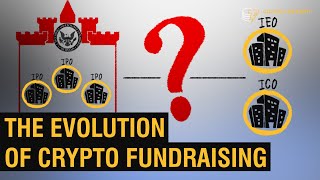
A panel traces crypto fundraising from the 2017 ICO boom, when $14 billion was raised, through its 2019 collapse to under $370 million. They discuss why ICOs and IEOs failed on trust and regulation, and whether STOs and tokenization offer a more legitimate path forward.
Chapters
In the past two years, we have seen the rise and fall of one of the most lucrative fundraising bubbles in history. From 2017 to 2018, over $14 billion were raised from what became known as initial coin offerings, or ICOs. But since then, the ICO boom has come to a screeching halt.
ICOs are no longer in favor anyways. They're down 95%.
Is this the bottom?
The ICO market is going to be in a lot of trouble actually, and a lot of those ICOs will never make it back to where they were eight months ago.
In 2019, ICOs raised less than $370 million. Why the sudden drop off? Well, let's just call it a trust issue.
The vast majority of them are either.
Scams or underdeveloped and people just seeking.
To raise money really easily.
Without your bank knowing it. You've been using its reputation to burnish these ICO scams and selling them to customers when you know damn well the coins are worthless, if they even exist in the first place. You know, I guess I do understand after all. Because for all the ICO mumbo jumbo, what we have here is an old fashioned pig in a poke.
Lack of regulation. This was the main reason behind the spectacular rise and fall of ICOs. Companies were raising millions by selling cryptocurrency tokens without having to comply with the time consuming and expensive procedures required in traditional IPOs. With no regulatory framework to protect investors, it's not surprising that many of these companies just took the money and ran. What is the next big step in the evolution of crypto fundraising?
I thought ICOs when they first came about were revolutionary because the whole network effect and the ability to then grow networks, and with them, the branch effect of network, of network effects was pretty amazing. But they were very much misused and the whole trust went out of the market. And we've been looking at how we can take that kind of decentralized construct and unregulated exchanges on one hand, and then the traditional market infrastructure on the other hand. Then combine the two so that you bridge the gap between them, because the two have to, for the foreseeable future, coexist.
After people lost faith in ICOs, a new fundraising method appeared in the crypto space. IEOS, or initial exchange offerings, are token sales conducted on the platform of a cryptocurrency exchange. The exchange backs a project with the credibility of its name by listing the token sale on its website. This is supposed to give investors a greater sense of security and give the project an established platform of exposure.
The exchange has the existing network of investors. They can handle the process, they can handle the marketing, they can handle the money coming in. That in itself is a very, very interesting concept because it can be much more effective to get to market much quicker. For those project developers, the launch of.
BitTorrent on Binance in January this year seemed to promise a bright future for this new fundraising model. The token sale was a success. It ended in only 15 minutes with over $17 million worth of tokens sold. Sounds great, right? Well, maybe not.
The figures are misleading on IEOs, because everyone talks about, you know, if you look at the data out there, that there's been a phenomenal amount of activity, but that's really been concentrated to a small number of large IEOs.
The enthusiasm for IEOs fizzled out pretty quickly. In 2019, IEOs raised only $1.6 billion, still far from the $7.8 billion raised by ICOs a year earlier. This is because IEOs do not actually resolve the credibility issues of cryptocurrency projects.
Because a lot of these exchanges in their own right are unregulated. And they say they're offering IEOs as a matter of trust. But by virtue of being unregulated or having questionable balance sheets or processes, you may think you're doing something trustworthy, but in reality you're not. Therefore, the very investors that got burnt by ICOs see no different a construct in terms of that investor protection mechanism.
In other words, IEOs are just old wine in a new bottle. To earn back people's trust, companies need to offer the security that only regulatory compliance can provide. But most startups lack the resources to go through the path of a traditional IPO.
When you look at IPOs, I mean, the process is quite expensive. And that's not only in terms of legal fees, but also corporate advisor fees, kind of all the intermediaries involved. It's very lengthy, it's very detailed. It also requires a lot of overhead and capacity within the firm. And that's why a lot of companies also differ from going private to listed, because the whole governance structure becomes completely different.
So if ICOs and IEOs aren't credible enough and IPOs aren't accessible enough, where does that leave us? It seems the ideal solution needs to be a middle ground between security and accessibility. Perhaps STOs or security token offerings are that middle ground. Tokens sold in STOs are securities in tokenized form. This means the issuing company needs to fully comply with regulations before launching an STO. However, STOs have an advantage over IPOs. Blockchain technology. By using blockchain, SEOs can save companies roughly 40% of their expenses in regulatory processing fees.
The whole idea of tokenization was to become more efficient and not be beholden to the existing establishment. Having an instrument identify and having a tokenized security that isn't in a national central securities depository or an international one is where we should really be going.
But the groundbreaking novelty introduced by stos is fractional ownership. Each security token corresponds to a fraction of a larger asset like a stock, bond or commodity. This allows small investors to participate in sales traditionally accessible only by large investors.
This is what's game changing. So the average person in the street can now have access, if done in the right way, to these asset classes. It won't be long before you then see listed blue chip companies also saying, well, actually I may list and do an ipo, but I may also offer a proportion of my securities in tokenized form as well.
Blue chip companies think companies like Walmart, Coca Cola or Apple. Imagine if they tokenized shares of their company. How would that affect standard business fundraising practices? What would that do for cryptocurrencies? Are we headed toward a world of tokens where everything and anything of value is translated into a digital tokenized security.