How AI Can Prevent a Global Food Crisis | Cointelegraph Documentary
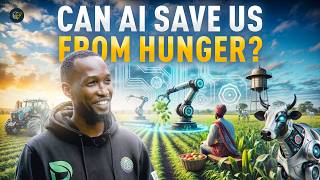
AI and blockchain are helping smallholder farmers in Kenya boost yields and access markets. One project funded trees with crypto to increase farmer income. As climate change and population growth threaten food supplies, startups like Dimitra are connecting farmers directly to buyers.
Chapters
Are you sure you'll have enough food in the coming years? Will your neighbors have doubts?
Well, you're not alone. By 2050, the world's population will surge to 10 billion.
But here's the catch.
80% of the food we rely on is grown by farmers working on small plots of land smaller than a football field.
We have been living very poorly life.
These farmers feed billions. But the stark reality is that they are battling against the clock to increase their yields and feed more people with with fewer resources.
We have the twin challenges of both population growth and climate change that's pushing down the productivity that we have on those farms today. And so this is quite alarming. The projection just for 2030 is 32 million more hungry people.
Today, the world has almost 600 million smallholder farmers. If we double the output of smallholder farmers, a lot of these problems just go away.
But the question remains, how do we feed a growing population? If those who grow the food are already struggling to increase their yields and make ends meet? Well, the answer might surprise you. Artificial intelligence. For centuries, farming has remained rooted in tradition, hands in the soil, age old.
Methods passed down from generation to generation.
But now those traditions are being empowered and elevated by AI, an innovation that is considerably transforming agriculture. In this documentary, we'll take you on an incredible journey into the future of agriculture, where artificial intelligence is not just improving farms, but reshaping the entire system. We'll explore how AI is revolutionizing everything from crop management to resource optimization.
This is the story of how technology.
Is not just transforming agriculture, but changing the future.
Artificial intelligence is by far one of the most transformative technology that the human race ever created. Alongside the invention of the wheel and fire, the integration between humans and artificial intelligence is the key to the growth and the prosperity of our civilization. Currently, the AI industry is valued around $640 million. In just 10 years time, the industry is set to grow tenfold to over $5 trillion.
So.
So our job is not to oppose the growth of AI, but is to facilitate the growth of AI and work together alongside, however, always putting the human at the center.
Today's smallholder farmers face a myriad of challenges, from climate change to soil degradation, water scarcity, pests and diseases, and rising input costs. These challenges are complex and interconnected, and they require innovative solutions.
In.
It's no secret that artificial intelligence is transforming the tech industry. But now AI is poised to redefine agriculture and how we grow our food on farms.
Today, AI is predicting the weather, detecting pests before they spread, and helping farmers maximize every Drop of water. This isn't a futuristic vision. It's happening right now in the heart of East Africa.
Avocado farmers in Kenya are leveraging AI and blockchain technology to revolutionize their growing practices, increase yield and drive financial growth.
At 1 million avocados, we provide four main AI tools that we use. The first one device that we use is called a real time kinematic machine. It's a precise measuring tool where we have each and every single avocado tree precisely measured up to 2 centimeter accuracy so that you're able to, when using Dimitra's satellite technology, we're able to have an understanding of where these particular trees are. And using the refractive light, we are able to generate vegetative indices that we're able to lear from this particular and say this is a healthy tree, this is not a healthy tree, this is what happened on this particular tree.
Before, AI farmers assessed crop health mainly through manual field surveys. Now through satellite imagery combined with AI, farmers can monitor the health of every tree or crop patch with centimeter level precision, predict yields and plan harvest effectively, all from the palm of their hand.
So we do fly drones so that we're able to get even closer estimation of the farm. That's one. And then secondly have an aerial monitoring view for, for the farms themselves.
Prior to AI monitoring required basic imaging tools that lack the intelligence to identify specific issues. But now drones equipped with AI powered cameras and sensors can identify problems like pest infestations, diseases or water stress early on, allowing for targeted interventions. AI powered systems direct drones to apply pesticides precisely to infected areas, reducing costs and environmental impact. This kind of AI driven resource management enables farmers to use only what's needed, minimizing waste while maximizing yields.
We are using soil sensors, we use them, we bring them to the ground, we are able to understand what is the nutrient level of the soil and what mitigations we can do in case there are any problems with the soil.
In the old days, farmers gauge soil.
Conditions through visual inspections or occasional lab tests, which were time consuming and lacked precision. Now, soil sensors integrated with AI are.
Allow farmers to analyze soil conditions in.
Real time, including moisture levels, ph, temperature and nutrient content. AI algorithms recommend optimal watering schedules and precise fertilizer application, ensuring their crops receive exactly what they need for the highest yield. AI powered image recognition also enables farmers to detect early signs of diseases, pests and nutrient deficiencies.
Dimitris connected farmer this is the platform that aggregates all the information from beyond just the farm, but also a database.
Of global crops Agtech company Dmytra's Connected Farmer platform accumulates real time data on soil health, weather, crop growth and pest activity. Previously, farmers relied on personal experience and manual observation to make decisions about planting, watering and pest control, often leading to inefficiencies and unpredictable outcomes. The Connected Farmer app provides farmers with actionable insights and recommendations, optimizing efficiency and boosting productivity by leveraging data driven decision making. Currently, only about 2% of farmers use AI technology. Limited access to tools and information remains a significant challenge. Many smallholder farmers in rural areas are unaware of how these technologies can help them overcome challenges and thrive. Bridging this gap is essential for transforming agriculture and helping farmers thrive in a rapidly changing world.
And we need to educate a new generation of workers, workers that know how to use artificial intelligence. We know how in Africa, the population people are leapfrogging technology. So they're jumping from old technology to new technology. And artificial intelligence is a new technological frontier that enables workers all over the world to become more productive, to become smarter, to become more knowledgeable.
So the first thing we have to do is to train these farmers and educate these farm farmers. Secondly, we'll have to try and push the younger generation that are a bit more tech savvy compared to the older generation to get into agriculture. And one of the ways of doing this is by implementing tools that can entice and pull this young generation into the whole agricultural industry as a whole.
The first time I had this training, it was community training which was brought by the 1 million avocados. And I learned more about it. At that time I found it easy for myself because how they were training, it's understandable. I do learn about the seasons, the weather, the plants, the soil, how things happening and what to solve the problem. We have been living very poorly life because we have the land, but we didn't know how to manage it. But now through this, I'm sure we'll make more product than before. This technology will change a lot at the community and the generation to come. And even for us.
Dmytra is not only helping farmers revolutionize their approach to farming through AI technology, they're also bridging the financial gap that prevents farmers from transitioning to high value crops like avocados. John Trask, CEO of Demetria, explains Kenya.
We're funding trees with crypto in order to allow farmers to move into avocados. And that is game changing from a financial perspective to the farmer, they, you know, move from growing whatever their core crop is, onions, where they're making A thousand or two thousand dollars a year. When they plant avocado trees and move to mature avocado trees, that same acre of land can produce $50,000. And that's, you know, mind blowing numbers for a small holder farmer who's used to making a couple thousand dollars a year. It changes the poverty cycle, it changes the hunger cycle. And so project by project, we try to replicate that. Different crops, different regions, different farmers. We're running probably 30 projects like that around the world now, and we're continuing to add projects as we go.
Blockchain technology is also playing a crucial role in the future of farming. It can provide smallholder farmers with direct access to markets, eliminating intermediaries and ensuring that farmers receive better prices for their product. By recording every step of the supply chain, from planting to harvest to sale, blockchain ensures that every transaction is verified, creating trust and accountability between growers, buyers and consumers. Using tokenized funding, smallholder farmers in Kenya have been able to access financing not available through traditional credit systems. By attracting global investors, tokens directly connect farmers to resources, markets and technologies. It simplifies transactions, enhances traceability and fosters collaboration, making sustainable farming not just an ideal, but a tangible, rewarding reality.
So now guys, you've seen exactly how AI technology helps farmers and how we implement blockchain technology to be able to increase the production and the transparency of farmers and beyond just that, have a more sustainable agricultural industry and a more better planet. So right now I'm going to demonstrate exactly how we do by minting an avocado tree into a non fungible token. We begin by having the connected Farmer platform which you're able to download from the Play Store right here. We have a very healthy looking avocado tree in this farm. So once we load up the application and we go to mint Dimitra nft, there are some instructions available. You take a close picture of newly planted avocado tree and the camera should be at least 1 meter. So let's do that. As it's initializing, it's taking the GPS location of this tree and we take an image. The image of the tree has been uploaded.
If you have a tree as a farmer now you have an asset. We basically transform the asset into an NFT the community can actually purchase so that we can give back to the farmer the investment that the farmer made. Now at the beginning, Dimitra financed the project so that we could actually help farmers to plant the avocado trees. But this was also done and backed by AI because with the satellite imagery we told the farmers via the app how to actually plant the trees and where. So to make sure that it would be profitable in the long run and sustainable from an ecological perspective.
Well, Holder farmers are the future of global food production. AI and blockchain solutions are two of the resources helping farmers optimize crop yields and reach new markets.
By having a system that you are able to have an understanding of, where did this produce come from? How do you ensure that this produce gets to the market that's fast. And then beyond just that, being able to understand yield farming, being able to adopt the AI tools, machine learning, being able to get an understanding of the intangibles of, for example, avocado trees or even whatever sort of planting that is, you're able to increase the production of the farm. So it becomes a call for us to be able to relook at our farming methods.
Remember, to keep humans at the center of the equation, we will create the best and most transformative technology that humanity ever witnessed. I think AI can greatly transform the way that we farm, the way that we produce food, the way that we harvest crops for the better and for a better future.
The question isn't if AI can help shape the future of agriculture. The real question is how far will it take us?










