How Blockchain Is Improving Gaming | Is Adam Back Satoshi Nakamoto? | Samson Mow Explains
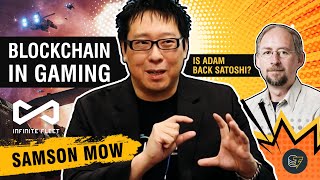
Samson Mow, who built Infinite Fleet, explains how blockchain games work: players earn INF tokens on the Liquid sidechain and can withdraw them to trade peer-to-peer. He argues blockchain should support gameplay, not be the main draw. On Satoshi, he doubts Adam Back is the creator, citing different cryptographic errors and writing style.
Questions this video answers
INF
Liquid (a Bitcoin sidechain)
Around 2013
Director of production at Ubisoft for around two years
Title: 'How Blockchain Is Improving Gaming | Is Adam Back Satoshi Nakamoto? | Samson Mow Explains' — created on June 22, 2020
Chapters
And then they can keep their own currency, withdraw it from the game, trade peer to peer, or do whatever they want with that.
So essentially what you're saying is that the currency you get from playing the game can actually be used outside of the game. Is that the idea?
Potentially. So it's an experiment to see what happens.
Do you think he is Satoshi Nakamoto?
The reason why Adam is not Satoshi is because Adam is actually a very skilled cryptographer, applied cryptographer. And Satoshi actually made a lot of rookie cryptography mistakes.
Hello, hello, hello. What's up YouTube? My name is Jackson. I am your host and journalist at cointelegraph. Today I'm going to be talking to Samson Mao. He is the chief strategy officer at Blockstream and he founded a gaming company called Pixelmatic. We're going to be talking a bit about how blockchain fits into the gaming industry. And we'll also touch upon some more or less recent community drama that in which Adam Back was named as potentially being Satoshi Nakamoto. So Samson, how are you doing today?
I'm doing great. Thanks Jackson, for having me on.
So first I'd like to hear a little bit about how you first got into bitcoin and how that interest in bitcoin coincided with your interest in gaming.
Right. So I think it was back in 2013 I first read about Bitcoin. I believe it was TechCrunch. It was an article about mining basically, and that kind of got me down the rabbit hole. So I started reading more and more about bitcoin, reading the white paper and trying to understand what it was. At the time I was actually working on games and I've been working on games for quite a while. And you know, for games you build these online economies and you have to create sinks when there's too much currency. So bitcoin was really interesting for me because it kind of existed outside the purview of any company or entity and it just kind of produced itself and self sustained. Whereas in a game, typically someone is managing that economy just like governments manage the fiat economy.
Cool. So I'm interested to hear what drove your interest towards gaming economies. You know, most people when they're into games, they're looking at the flashy graphics, the intense storyline, or the deep mechanics of the game. So it seems a little different that you were drawn more towards the economy side of game development.
Well, it probably came from also playing games. So I was a very hardcore MMO gamer back in the day. So I played Lineage 2. That's actually where I got my handle Excellion from, we were playing Lineage two on the Leona server and I actually worked with a friend to create a gold farming operation back then. So we're farming gold and he was selling it and I was helping him to purchase and maintain the accounts. But yeah, like after that I think I joined the game industry and that was when I actually started having to build online economies for online games.
And you actually have quite a bit of experience developing games. You were a director of production at Ubisoft for around two years and you are now creating a game called Infinite Fleet, which is a massive multiplayer online game which according to your website is leveraging blockchain technology to create a new token based economy. So could you just explain a bit how blockchain is fitting into the game you're currently currently developing and how blockchain fits into the broader gaming industry as a whole.
Right, so there are a lot of different companies doing a lot of different things. With Infinite Fleet, we're really focused on using a crypto asset for the game, currency. So, so imagine World of Warcraft if you had a crypto asset instead of. Wow, gold. So, you know, secondary economies will always build up in MMO games. People are going to buy, sell, trade currencies or items if they can. And I think they'll work away, they'll find a way to work around the systems of the game. So in World of Warcraft, you know, you come into the game, meet the guy that's selling you the gold and you do a trade in game or they sell you the whole empty account with some gold on it. But even though it's against the terms of service, people will still do that. And you have these secondary economies. What we want to do with Infinite Fleet is kind of just be okay with it because it will evolve anyways and we want to make it a safer, smoother experience. So instead of having a game currency that is in the database and bound to accounts, we want it to be separate from the game itself. So we're using the liquid network, which is a bitcoin sidechain, to issue this currency. It's going to be called INF and players will be able to earn that by doing social activities in the game. And then they can keep their own currency, withdraw it from the game, trade peer to peer, or do whatever they want with that.
Interesting. So essentially what you're saying is that the currency you get from playing the game can actually be used outside of the game. Is that the idea?
Potentially. So it's an experiment to see what happens. They could possibly use it for doing other things too. Like they could buy and trade with other games if they have crypto assets as well. But the sky's the limit. And you asked earlier what other games are doing this game called Light Knight. They're actually doing NFTs, which is interesting too. They're tokenizing different game assets, and they're also on the liquid network. So because INF will be on liquid and lightning assets are also on liquid, you could technically trade INF currency for a lightning asset with someone too.
Yeah, I think that's some really interesting ways to use blockchain. And, you know, I've been to some events and conferences and I see these booths that are advertising games on blockchain. And it seems like people are just there to kind of take advantage of the hype of blockchain games. And they make blockchain the defining feature of their game. So I'm curious to hear, you know, how. How you see games avoiding this and what your game specifically is doing to differentiate yourself and not fall into this trap of making blockchain the only valuable aspect of that game.
Well, I would like to think that we're doing it in a smarter way. So, as you mentioned, a lot of games are trying to incorporate blockchain technology at a very low level. And I've seen some card games, they want to create their card using a smart contract, and that card is quote unquote, immutable. It can't be changed anymore. That has its own set of issues. But if you kind of like use the blockchain for computation and you try to embed a lot of game logic into that chain, one, it'll bog down the chain. We've seen that with things like cryptokitties where, you know, they just killed Ethereum because people were trading digital cats and now they're migrating off into their own blockchain. For those games that are trying to imbue assets so that they can't be changed, well, you come up with a new set of problems. So if it's a card game, typically these card games, they will rebalance every so often and change the values. So if you cannot change a value, then how can you rebalance or even tune the game? If you have some card that's op or overpowered, then you're kind of stuck. And then you maybe issue a new card to replace it. But then at that point, what's the point of owning the card or the asset? So what we're doing is just using the crypto asset for trade. So it's to make things easy for players so they have their game currency. Because liquid is a bitcoin side chain, we have the benefits of all, all bitcoin supporting ecosystem aspects. So you can create a multisig wallet with INF and store that with your guild members. You could use a hardware wallet with it too to secure it. But it opens up a lot of avenues to kind of let players do different things with their assets. If you take Eve Online as an example, people have infiltrated guilds to earn trust and then stolen money from the guild too. And that kind of would be avoidable if you had a multi sig wallet storing your game currency.
Yeah, those are some really interesting ideas. So do you think that blockchain is going to begin spreading out more into the mainstream, becoming a part of bigger titles or do you think it will still remain sort of on the fringes as like a niche part, a niche sector of gaming?
So I think ultimately the technology has to support the game. There are a lot of games that are trying to build on top of a blockchain but you come with a lot of barriers when you do that. So you have to download this plugin or download some wallet and you have to buy some cryptocurrency to make your transactions. Those are all big barriers for players. So the approach we're taking in Infinite Fleet is the game currency is secondary. What we're building is in a AAA MMOR game or strategy game and that is the first and foremost thing. And we've put together a team of AAA developers that worked on Age of Empires, Homeworld, Company of Heroes, like big blockbuster type games. So the game is the most important thing, the currency is secondary and we don't want to force it down players throats from the get go. So you know if you, you earn inf but it's going to be in your in game account unless you choose to withdraw. So you could say we're operating on kind of an exchange type model where you withdraw the crypto asset and you deposit it but you're not forced to use it if you don't want to use it.
Yeah, thanks for all those insights. I really think that blockchain gaming has a lot of potential and I'm really curious to see how things evolve over the next couple of years. Now I'd like to switch topics. I mentioned before that you are the chief strategy officer at Blockstream and a little over a month ago a YouTuber named BarelySociable came out with a video that Essentially pinned the name of Satoshi Nakamoto onto the CEO of Blockstream, Adam Back. And Adam Back quickly responded on Twitter to deny it, of course, saying that he is not Satoshi Nakamoto. But since you work very closely with Adam, I'm curious to hear what your thoughts are on this finger pointing and answer the question, you know, do you think he is Satoshi Nakamoto?
The reason why Adam is not Satoshi is because Adam is actually a very. A very skilled cryptographer, applied cryptographer, and Satoshi actually made a lot of rookie cryptography mistakes. So basically, Adam is overqualified to be satoshi. And if you talk to his peers in cryptography, they would go, yeah, you wouldn't have made that mistake. It's like cryptography 101. But if you just look at the early cypherpunks, you could easily argue any of them is satoshi because they have the same interests. Right? They're interested in ecash. Um, they're interested in privacy. They're interested in, you know, ways to let people opt out of the system and create systems that are not prone to manipulation. So if you look at them and you look at what they're writing at the time, their thoughts, their philosophies, you could pick any of them. You could pick Nick, you could pick Wei Dai. How Finney, Adam Back. They're all candidates because they all share that common background and common interest. So it's really. If you're choosing to look for satoshi, you can find satoshi. It's very easy. But I think judging from satoshi's writings, like you said, I think it is one person because he's very, very coherent. If anything, Satoshi's got a very. How can I say it? He's got a very directed and coherent voice in everything he's talking about. It would be very hard for a group of people to maintain that kind level of solidarity or coherence, I think. And also looking at Satoshi's offset, you know, he did a really good job obscuring his tracks, and I don't think that he would do that and come back one day and basically throw all of his work away, masking his identity.
Gotcha. So given that Satoshi Nakamoto's identity is still unconfirmed, do you think it's better that his identity remains a mystery or. Or do you think it would actually be more beneficial at some point in the future for satoshi to come out and reveal himself?
I think it's definitely better he remains unknown. Because if you have A known figurehead for cryptocurrency that is kind of an attack vector. They can be lobbied. You know, people can go after them or threaten them, and it just makes it much less of a decentralized project. Whereas Bitcoin had this virgin birth, it was just created by Satoshi and it kind of grew on its own without any interference. And now it's maintained by hundreds of Bitcoin core developers. So there's no leader. If you have Satoshi coming back, then suddenly you have this person who you can ask questions or they might direct the project in a certain way. I think right now the way we have it is much better with Satoshi being anonymous and the project actually being really decentralized.
Awesome. So thanks so much for taking the time to talk to me today. I thought we covered really some really interesting topics there. I'm especially excited to see if there will be a point where an in game currency can be translatable into the real world. So I'm really keeping my eye on where things go in the gaming industry over the next few years. So thanks again for coming on and I really appreciate it and I learned a lot.
Yeah, it's great. Let's do it again sometime.
And guys, thank you everyone for tuning in to watch the show. That was Samson Mao, who is the chief strategy officer at blockstream and he founded a gaming company called Pixelmatic. My name is Jackson. I'm your host and journalist at cointelegraph. And if you enjoyed the show, please hit that like button and subscribe to our channel.
Subscribe.
You can watch more great crypto content cointelegraph.
Like subscribe and hodl.










