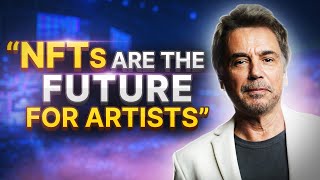
Jean Michel Jarre is building immersive VR worlds with Sensorium and creating digital twins of himself for virtual shows. He sees NFTs as a way for artists to monetize directly and connect with fans, though he worries about the environmental cost of the technology.
Chapters
What's up everyone? I'm Giovanni, here from Web Summit 2021. I have the pleasure to be joined by electronic music legend Jean Michel Jarre. How are you doing today?
Fine, and yourself?
Great. Let's start with your impression of the conference. What is your first impression about it?
I mean, I love the Web Summit. It's a very interesting part hub for exploring the future, in a sense. And I'm here to talk about Metaverse and the partnership I have with this very interesting VR platform called Sensorium. And to explore the partnership we have on different levels to develop basically the relationship with the audience tomorrow with new modes of expression such as VR experiences, shows, VR shows. I think the Pandemic played a very important role as an accelerator for the digital world. I was in the Web Summit three years ago. It's a different Web Summit, totally different. Because now suddenly the Metaverse is a buzzword, but the VR, the digital, all the digital aspects of our day to day life has changed. And this is of course for an artist and for a musician, a game changer.
Yeah. And you always have been interested in technology, so your music show has been always integrated with high tech. We saw last year when you did this performance in a VR space representing Notre Dame, the Cathedral of Notre Dame. That was very impressive. So now you also did an NFT exhibition. So I wanted to talk about that. How did you get involved with cryptocurrency? Was it with nft or you were involved even prior to that?
No, I think I've always been interested in the idea of nft, even before nft. I would say that a long time ago I did a project, I released an album, one copy called Music for Supermarkets. It was in the early 80s and with the idea that the notion of original, which is the philosophy nft, should be also applied to music. And I did this album as one copy sold in an auction, exactly like nft, except it was in the analog world, but it was exactly the. So I think I created the first NFT concept back in time. So what I see in nft, and it's also linked with VR, it's linked with Metaverse, is a different way of considering the production of an artist. The fact that you can be closer to your fans, closer to your audience, you have a direct link on a financial point of view, on an economical point of view. It's also a real game changer. And also it's part of the Metaverse philosophy, the old blockchain system. And I think you have dark areas, but also you have real positive Aspect for artists to be able to control their lives, to control their creations in a more direct way, in a simpler way.
Okay, and can you tell us a bit more about this partnership that you announced today regarding this perspective of developing into the metaverse?
Yes, I'm very happy to announce my partnership with the VR platform called Sensorium. I mean, I would say the title says it all. It's not just another VR platform. Everybody's talking about VR and talking about different things. What I like with the idea of working with VR, with Sensorium is the fact that I'm going to be able to create my own world, my own planet, my own ecosystem, as a musician, but beyond also as a stage designer, as an architect, because music and architecture are quite close to each other. And also the fact that Sensorium is taking as a priority integrating AI, what is a real game changer as well, to actually think about a work in progress in terms of constant evolution for my concerts and for my work. The fact that my avatar would evolve with myself. And it's not just like the avatar I used, for instance, even last year, where it was just a representation, an instant representation of myself, which is great, actually. I'm going to have a partner which is going to be my doppelganger, my double, my double, my digital twin. And this is very exciting. And beyond that is also the idea of creating worlds which could touch a lot of different things, like creating a show, like a music festival, but in cyberspace, but also being able to explore other things, like meditation, for instance, creating. It's also something we have in mind to create a whole world where you could be immersed, like going into a world for meditate or for sharing some total different aspect of yourself. And so it's quite exciting project.
Regarding this project you were talking about, what is the role of NFTs in it?
You know, NFTs playing a major role in the concept of democratization. The fact that until now social media has been considered in a very passive way for all of us. We were like products or spectators of what was going on through Instagram or through Facebook and all that. And this is already obsolete because of course, the next stage is what we are hoping is to be part, to have an active part of what's going on with the artists we like and all that. And the major game changer for considering NFT is the fact that anybody can take his or her own avatar and making an NFT with it to monetize this avatar in the virtual world and becoming part of the whole global system. And then becoming part of the overall creative process and generates some and to be able to monetize what they've done. And this is quite a total different way of approaching not only the economy, but the philosophy of collective creation.
That is fascinating. So one last question is I read an interview with you for the Financial Times where you were expressing concerns about the potential this topic future that some technologies can generate. So you said that we need to find a balance in between ecology, but also our relationship with technology. And so what is the risk that blockchain technology and cryptocurrency and NFTs can pose if not used correctly? What kind of dystopian future we should be aware? What kind of dystopian future we should try not to create, not to generate.
Okay, There is a. It's in the DNA of human beings to have necessarily a dystopian vision of the future. Generation after generation, people are saying, yesterday was better, tomorrow will be worse. It's not that true, because otherwise we won't be here talking to each other. So for the blockchain, of course, blockchain is an issue in terms of environment, but you know, we are still in the dark age of even of Internet of the Web, all this. We are still in the Wild West. We need regulations, we need to think about, we need to make progress, you know, in the blockchain, from the first crypto, crypto money to the, to the cryptocurrency to the new ones, there is a big change about the fact that now the new ones are consuming or polluting much, much, much less than before. So I think that in terms of nft, we have lots of progress to make to actually getting a safe ecological approach. And I'm actually convinced that we can only survive in the 21st century if we can create a fair harmony between technology and ecology. And of course, blockchain is an issue at the moment. Blockchain is consuming and polluting a lot, but it's polluting less and less. And this is the reason why, you know, people like us have the responsibility to create a kind of, to think about the ethics or the ethical part of, of all what we're talking about on one side, like any technological progress, you have lots of advantages, but we have to be aware of what the negative backlash it could create. So it's our responsibility to make it positive. And I think more than ever, we should be optimistic by subversion and being conscious of the risk, but at the same time playing the game. Because actually, of course, NFT and blockchain is necessarily a future for artists and creators because we can have a direct link with artists, with our fans and with the audience.