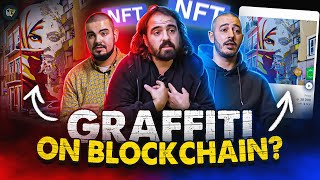
A Cointelegraph Reports YouTube piece (Jan 8, 2022) documenting how Portuguese street artists like Alexander Farto (Vils) and Mr. Deo are using NFTs to preserve, monetize, and extend ephemeral street art. The video explains NFTs and their ability to prove digital ownership and enable royalties, presents market figures (e.g., Q3 2021 sales surge), and profiles artists who convert physical actions (explosions, graffiti) into video NFTs, discussing benefits (new revenue, interactivity, community) and criticisms (speculation, accessibility).
Chapters
This work of street art was destroyed in Lisbon, Portugal. The footage of the explosion is now being sold for thousands of dollars as an NFT. When you hear NFTs, you probably think of cryptopunks or bored apes. But what happens when something physical like street art is turned into an nft? What value does that add to the original, especially when the physical piece is removed or destroyed? To find out, we traveled to Portugal, a bustling seaside country with a dynamic street art scene. Here, local artists are exploring how NFT technology can serve as a bridge between the physical and digital worlds.
I started as a graffiti writer, so it was a lot of the work that I was doing was always I never knew what would happen to it. So my work is ephemeral by nature.
Alexander Farto, also known as Vils, is one of Portugal's most prominent artists. He carves portraits into city walls using hammers, chisels, and even explosives. Vil started experimenting with NFTs by putting videos of his explosions on the blockchain.
The artwork is actually what you film, you know, it's not what happens in reality. So in that sense, I needed a technology that I could not just documented, which is with cameras and digital format, but then putting it on a blockchain, it kind of creates a second life to the works that I do. I think NFTs was the first example of how this can be disrupting an industry. And I think art industry will be disrupted by this technology.
It sounds crazy blowing something up, videotaping it, posting the video online, and then expecting someone to buy it. How does turning a video into an NFT suddenly make it valuable enough to purch purchase? To answer that, we first need to understand how NFTs work. To put a physical asset on a blockchain, you need to create a non fungible token, or NFT. NFTs are unique pieces of code registered on an immutable digital database known as a blockchain. Think of it as an unchangeable sequence of digital signatures that shows who the creator was and who the current owner is. This means that the NFT cannot be replicated and its movements through cyber squarespace can be tracked. This is a groundbreaking innovation because prior to NFTs, proving the ownership of digital art was impossible. Anyone could copy a photo or video an infinite number of times, and each copy would be exactly the same as the original. But now we can know for certain who made it and who owns it. These two facts are opening up a whole new market for digital art.
Because before, I was not able to sell A video work or a video installation with a certificate in a gallery, it was difficult. It's a very niche market of collectors that collect video art. What NFTs brings you is value to digital work. Because before I was not able to sell a video work or a video installation with the certificates in a gallery, it was difficult.
Because digital ownership can now be proven. Digital artists can take advantage of one of the longest lasting and most lucrative revenue streams in the art world, royalties.
The royalties. That really solves the problem with artists getting paid in the long term with their career. That was solved with music, with royalties, with science, was with patents. But with artists, visual artists, you never were able to get paid throughout your life by the work that is being sold.
However, the NFT market is often criticized for being highly speculative. Sales surged to nearly $10.7 billion in the third quarter of 2021. That's over eight times more than the previous quarter. It sometimes seems like people are willing to buy any NFT regardless of artistic quality. Fabio Colosso, a young contemporary artist from Lisbon, believes the technology may actually be undermining the art.
Every person can create an NFT and turn something into art. I can go to your Instagram, do a print screen of a photo of you and do an nft, and that is a single unique piece of art. And that is art. Tell me, is that art? For me, it's not about art, it's about money.
In the traditional art world, artists have to rely on galleries and auction houses to showcase and sell their work. With NFTs, anyone can upload and sell theirs online. That feature makes this technology curiously similar to street art, which is also mainly exhibited in public spaces.
Graffiti brought me that the power to paint on the streets and the power to. I don't need to go to art galleries or to have, you know, one expert or two experts saying that it's good for me to be considered a good artist.
Mr. Deo is one of the pioneers of graffiti art Portugal. His artwork can be found on the walls of over 40 cities around the world. In 2021, he started creating digital versions of his graffiti using NFTs.
So I think graffiti, like street art or graffiti in specific, kind of changed the whole way we saw art until a certain point. And I think NFTs are exactly the same, and that's why I'm so interested about it.
But not everyone believes in the democratizing power of NFTs. Just because anyone can make an NFT doesn't mean they will be able to sell it at a profit. It Is still hard for artists to sustain themselves without an already established fan base.
If you are a big artist with a big name in the markets, you can sell NFTs. If you don't have name, or if you are very young as me, you cannot sell NFTs. It's very difficult.
Despite the criticisms, it's undeniable that NFTs are changing the very perception of physical and digital art. In 2021, a group of crypto enthusiasts bought a print by renowned graffiti artist Banksy and burned it in a livestream video. The video was then sold as an NFT for $380,000. They wanted to show that digital art can outlast its physical counterpart, while also preserving and even increasing its value. That same idea is behind one of Ville's first NFT experiments.
We did the explosion, and then we demolished the whole building so that work doesn't exist anymore. Then putting it on a blockchain, it makes it something that is ephemeral in a way that I cannot do it when I do work in a public space, then gets destroyed and disappears.
NFT technology opens the doors for creativity beyond the limits of traditional art. There is only so much that artists can achieve in the physical world with materials, colors, and services. These boundaries don't exist in the virtual world.
On the street, I have limits, you know. I cannot work with sound, I cannot work with animation. I cannot work with more than still images. The thing with NFT is I can take everything further. What I can add to what I've done before, it's absolutely crazy. So let's say I have a 2D image of a content that I did with the movement, with the sound effects, with the music. I can bring senses to a whole different level.
The digital medium also fosters interactivity between artists and collectors. Thanks to smart contracts, NFTs can be burned. Burning is when tokens are sent to an inaccessible address. By burning NFTs, a collector could be rewarded with new or rare collectibles, or even influence the artist's creative process.
I do an edition of 10 NFTs, and if you give the opportunity to five of them to burn those five NFTs, and then each NFT will activate an explosive on a wall, or it will activate a brushstroke in my painting. That interaction that you make your community participating in your process of creation, it will change everything.
This level of participation is unprecedented. The modern art community is more and more inhabiting the digital space.
I really see it as a completely different community. And I think it's actually all about the community, like Twitter is the main social media for the NFT market. I never used Twitter before, so being in the NFT world meant for me started, you know, building a new community from people who didn't know my work before.
NFTs, without the communities that they build around, they are not much. And I think that's the connection between an artist and the people that follow them and that respect their work and that like their work. It's, it's. The connection is made in a very way, in a very transparent, easier way than the traditional art market, let's say.
From social media to virtual reality to cryptocurrency, our lives are increasingly moving from physical to digital spaces. It's only natural that NFTs are allowing art to go in the same direction. We are just at the beginning of this transition, but new communities are already emerging with a completely new way to create, experience and value art.