How Pudgy Penguins CEO turned a $2.5M NFT brand into a $200M business
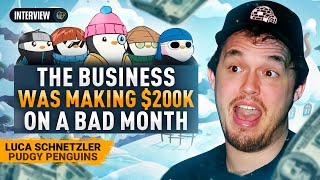
Luca Netz explains how he grew Pudgy Penguins from a $2.5M NFT brand to a $200M business. He covers brand building, IP development, and why he thinks consumer crypto has a real future beyond speculation.
Chapters
I'm scrolling through Twitter and I see these cute penguins. And so me being a brand builder for the last seven or eight years, I thought, and always look at NFTs, even today, as a supply and demand model. And I thought penguins were the most universal pfp. And why I think that matters is because I think being the most universal, I think has the highest or the widest net for demand because they're finite tokens, you know, they have small token supplies. I thought, well, the one that probably yields the most demand with the smallest token supply probably is going to have the most opportunity for a run. And, and naturally, I just believed in the brand and I believed in the penguin. So I started collecting a bunch. Unfortunately, it didn't go the same way as kind of punks and apes early on, as you know, Punchy Penguins was one of those first early projects that kind of kicked off the big NFT bull run. And, you know, six months later, the opportunity came around to buy it. And here we are today. I didn't really know what I was getting into. I think the math of the business made sense. So at the time, all you had to do is just calculate the royalties and he, like, you know, the business was making $200,000 on a bad month. So technically I didn't really think there was that much risk. But in hindsight, kind of understanding everything that I know now, it was a really risky move. And I kind of did it a little unconsciously, but thankfully it worked out the way that it did. Naturally, I believe in myself. So I'm not buying like two, I'm not rolling in money. So $2 million, two and a half million dollars in this case is not a small amount of money for me. And so I believed, and I knew instinctually, whether I logically understood it or not, I knew instinctually that this would be, that this was something that I needed to do. And so we joke about it all the time. I mean, we're super grateful and thankful for being in the situation that we're in today. It could have ended up a lot worse, and we're thankful that it didn't. And we still have a long ways to go, so no victory lapse yet. Still have a lot of, a lot of the business to build. But, you know, two and a half million dollars to the valuation we are today, it's a pretty, pretty awesome ride I did. And so the anchor that inspired me was the Bored Ape race. So Bored Ape had the highest, the highest valuation seed round of all time, basically 0 to 12 months, $4 billion company, give or take. And what I saw and the reason why I bought Pudgy is because I saw what they did and I said, look, like, you know, that stuff is not easy, especially now that I've built this thing. And, but, but I saw what they did and said there's nothing that they are doing that I can do or that I can do better. And so I was like, well, if they were able to pull it off, you know, this, this universal ip, I thought Pudgy penguins had so many different places they could go that I think Bored Ape couldn't. And then understanding my skill set, understanding the people that I knew I was going to bring on board, I kind of looked at the landscape and I looked at and I thought, I said, look, if they could do it, I know I can do it and I can do it better. Obviously, different market conditions, different times, but I'm very sure that when NFTs come back and are at the spotlight once again, we will take NFTs further than they've ever been in the past. So this was part of the plan, but exactly how it transpired, I can't tell you that. I knew it would go down the way that it did, but thankful it did nonetheless. I think it just comes down to the ip. Like what makes sense with the ip. Like naturally you close your eyes and you think pudgy penguins. I know I did two and a half years ago and I'm like, this is a billion dollar ip. And I think a lot of people try to reinvent the wheel, whether making NFTs about metaverses or this and that. I think at its core they are status symbols, they're Vibland goods and they're collectibles. And so when I look at what makes a collectible valuable, I'm a huge collector in the real world. It's nostalgia, it's brand affinity. And how do you create that? You create that with product, you create that through content. And that just seemed like the obvious next step at the time. If you kind of look at it now, hindsight is 20 20. Every project is looking to build IP. Every project is looking to build affinity and love. But when I came around, it almost felt like nobody was doing it. And so we subsequently kind of pioneered though there was the thesis and it was the hot topic. You know, these guys had hundreds of millions of dollars and they never did it. And you know, I'm going to take credit for pioneering ip, you know, on the blockchain that obviously I think was a, you know, decentralized effort, but ultimately, like, what does it mean to brand build? What does it mean to build a real company leveraging these digital collectibles, leveraging these first editions? I will take credit for Pionee because I think nobody was doing it the way that we're doing it today. I see the same opportunity that I see in the L2 space that I saw in the NFT space. I look at the L2 space and there's nothing that anybody's doing that is super impressive to me or that I think I can't go do better. Furthermore, we have a ton of products within the Igloo and within the Pudgy Penguin ecosystem that is powered by L2S. And so I'm thinking to myself, I'm looking at the other L2s. I'm looking at, you know, their thesis is, and what they're doing. And I think there's, you know, I'm not impressed, right. And they're not fulfilling the needs that I need. As a consumer crypto builder. I'm looking at the future of crypto me. The future of crypto is glaringly consumer. We've been the face of consumer crypto for the last two and a half years, and it's like nobody knows the pain points, nobody knows the struggle, nobody knows the things that need to be solved for consumer crypto the way that we do, because we've just been building it longer than pretty much everyone else. And so when looking at the opportunity, I just think there's a fundamental error in the mindset and in the ethos and how all these L2s are building. And, you know, I'm very confident that we're going to do the same thing in the L2 space that we did in the NFT space, which is, you know, basically win and be the top dog. I. I have every intention in doing that. And I think we're also going to capture the entire consumer narrative. I think when you think consumer blockchain, who do you think of? Maybe Solana, but on evm, it's a ghost town. I think nobody's owning that consumer and we're going to be the people to do it. A PSP is a great representation of understanding who somebody is without really knowing who somebody is. I mean, naturally I can tell the difference, or I instinctually know the difference between, like a bored ape PFP and a Pudgy Penguin psp. There are different personality types, right? They're optimizing for, I think, two things. In Pudgy Penguin's case, I think it's like a really philanthropic evangelist, you know, kind of, kind of PFP where like, if you're rocking it, I know you're probably a good person. I know you're probably funny, I know you're probably lighthearted. You know, if you're specifically in crypto, I know you care about pushing crypto boundaries, I know you care about the underdog and you know what it means to take something from zero to hero. So there's like a lot of things that I think penguin embodies that I think makes it easily identifiable. And if you're a bored ape, then I know you're in the cool and you're trying to be like, you know, hip and in the street streetwear scene. So it's like I can kind of assign interest. So for that reason, I think this is why these things are so powerful and so much more powerful than I think a lot of people give them credit for. I find myself being able to message somebody or in the past, you know, before I was the CEO of Penguins, like, I would be able to message one of the top crypto traders because he was a penguin and he would respond to me because I was a penguin pfp. And I think this just gives, like a huge edge that, you know, especially in an industry like crypto. You know, most people don't know this, but this is an alpha driven industry. You either know what's going on or you're playing a 99% losing game. And alpha is really given by tribes, right, and by community members, and those are most easily identified by profile pictures. I think it just opens up the ecosystem and obviously I want them to participate. I want them to bring that culture in an abstract. I mean, that's a huge thing. A lot of people wanted to name us Pudgy Chain, but ultimately I thought that was like a huge handicap. Like, I can't. The number one L2 in the world, naturally, from a branding perspective, can't be Pudgy Chain. Like, I don't think that's, you know, that doesn't, that doesn't incite people to go and build something bigger than Pudgy, which is like, I want somebody to give me a run for my money, especially on the abstract rail. So I think from our perspective, and, and I'm in the business of rewarding my early believers, right? So, like, how can I create an ecosystem that benefits them, but they also have to reciprocate that value? I'm also not in the, in the business of just like, hey, you buy something and you don't do anything for years and just reap all the rewards. I don't really like that, that type of cadence, but nonetheless, it doesn't change anything for them outside of, I think just add tons of new opportunity to the ecosystem and just more and more benefits to, you know, their assets and what they're collecting. Not at all. So my situation specific is specifically I have zero worry because I issued no NFTs, right? So I bought into something. So I think a lot of the problem is around the issuance, but anything other than that, I think it's a nothing burger. But for the, for the space in general, I also don't really care. I mean, if you're going to go after opensea, you got to go after Sotheby's, you got to go after Nike, there's that. You got to go after Pokemon, you got to go after everyone. Cgc, I mean, this is just, this is nonsense at this point, right? Ultimately, there has to be some sort of level of accountability in the space, right? Which is this idea that it's like if you buy something, right, whether you buy it at $100,000 or $1,000, like you are making that purchase, that is your conscious decision. And at the end of the day, you know, people are selling this stuff. They're JPEGs, right? Like, you can misinterpret them 100 different ways or you can try to know, have somebody sell you a bunch of different ways. But OpenSea specifically, I think it's in its own unique SE where it's like not selling people on a, on a false promise or a dream. And so for that reason, I'm not worried.










