How Solana could reach 1 billion users in the next five years | Interview with Solana Labs CEO
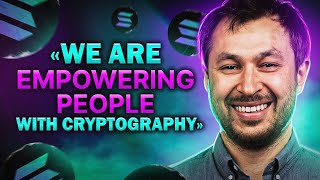
Anatoly Yakovienko, CEO of Solana Labs, discusses how the blockchain could reach a billion users in five years. Solana processes transactions in roughly 400 milliseconds and costs far less than competitors. The main obstacles aren't technical: they're user experience, key management, and phishing attacks.
Chapters
What's up, everyone? It's Giovanni here from Breakpoint in Lisbon. I have the pleasure to be joined by Anatoly Yakovienko, the CEO of Solana Labs. How are you doing, Anatoly?
Great.
Awesome. So let's start with a very basic question. So we know that now everyone is focusing on web 3. Like in terms of new buzzword that is going around in the space. What do you think is the role of Solana? What do you think is the role that Solana will play in Web3?
Well, I think it's kind of interesting that we see like the defi primitives and all these kind of more complicated financial things now become part of a standard developer's web stack. Just another tool. And I think Solana is the cheapest, fastest place to run those tools. And where I see the pioneers of that that have proven that out, folks like audius already have 6 million users. I think they do about half a million transactions per day. The reason they can do that store likes and follows and plays on a network like Solana is because it's cheap.
And I wanted to ask you about the concept of censorship resistance. So you are very much focused on this concept. You think that it's central in the way you developed Solana. So what does censorship resistance mean to you?
Yeah, this is like a very financial term. What this means is that I can send and receive information within a very short amount of time. And I'm guaranteed that nobody can interfere with that, whether ordering of information or withhold it or make a decision before I receive it. And to us, that's a very kind of engineering problem. How do we get that process globally? A global state machine to synchronize within 400 milliseconds. So Solana is designed almost specifically just for that.
And as far as I understand, it has to do with cryptography. So with the possibility to send a message and be sure that that message will get to the receiver in the same way as you sent it in the first place.
Right? Yeah. Except the interesting part here is that the receiver is the entire globe. It's everybody in the world all at once. So how do you guarantee that? Go look at our GitHub. It's a bunch of code.
If you had to point out what are the limitations that still face Solana from a technical standpoint, what would those limitations be?
As an operating system, it's very young, so it takes 10 years to build an OS for real. I had the pleasure of doing that at Qualcomm when working on the first Mobile operating systems. And a lot of the work is now in the tooling and the application development and building better frameworks, libraries. It should be easy for somebody to port a new virtual machine. It took neon folks about a year. What if the next set of developers need Java running or Net? How long is that going to take to port? We want to. What I want to see in the next five years is for Solano to be a full featured operating system. The developers have the, you know, the kind of ease of use that today they have with Linux or Windows.
And it's curious. So you were talking about a time frame of five years. What do you think about in terms of users? How many users we are talking about in a time frame of five years, what do you think?
A billion users? I think it's possible. Like the difference with Web three and Web two and Web one is that those cycles are getting shorter and shorter. You know, we now have the Internet to really scale and grow. The challenges of course are people, right? How long is it going to take for normal people to understand what cryptography is, what it means to store a seed word, how to deal with that, how to deal with signature verification when somebody displays a request to sign, what that means to a person that's never done that before. So implications of all of that are going to take a bit of time to work out. But I'm super excited to work on that with folks like Brave where we can iterate on the entire stack vertically integrated from a mobile browser down to the URL bar that, you know, start doing some anti phishing heuristics there. Plus the trusted display that displays that to the user. It's a lot of work. Right. But you know, I'm excited for the challenge.
Yeah. And I think that another challenge maybe is also the challenge of security. So we know that in September Solana was faced by some technical issues. It was down, the network was down for a few hours.
17 hour bug.
Yeah, 17 hour bugs. And a lot of people have been talking about it, they've been asking you question about it. So what do you think? You said that those kind of bugs are some sort of inevitable in the sense that the network is run by volunteers that need different incentives. And so how are we supposed to entrust the Solana network with billion of dollars if those things could still happen in the future?
So the core of what decentralization provides is that as long as there's one, a single honest party out of all of them, that the network can continue soundly. So no matter what Happens, right? Government decides to censor all of the data centers that Solana validators operate in. The Internet has a massive outage in a BGP router that shuts down down two thirds of it. Those things may sometimes require human intervention to unblock, but that process of unblocking it is cryptographically secure. And as long as there's one honest copy available of the ledger, the network will continue. So you can actually think of it as a 17 hour block.
You mean like that? Okay, we can face these problems, we can fix them. We with not much, no risk to.
The safety or funds or anything like that, but it is effectively as if application developers or users experienced a block that took 17 hours to complete.
We are seeing a lot of talks about the competition between Solana and Ethereum. Do you see it as a competition?
I don't know. Right. Like is Linux competing with BSD or Windows? Sort of, yes. Sort of no. You know, there's feature overlap, obviously. I think the core thing that I've always realized is that myself as somebody that grew up with Linux and being like part of that community, you know, just as a teenager, that's where I really learned what it means to code. Like, how did what open source projects look like? It's impossible to kill an open source project because as long as there's people that want to work on this stuff for fun over the weekend, there's nothing anybody can do to stop them. That's really that kind of idea of community driven open source development and it's kind of the media loves that narrative, the Eth killer narrative. But it's just a bunch of people writing code, you know, like some people like Rust, some people like solidity. You know, we'll see what happens whether the applications built on Solana will have more users or the ones built on an Ethereum L2. But I designed Solana with the architecture in mind to be the fastest, cheapest global state machine. And I think that's the one that humans want the most.
Yeah, and actually I was talking to one of the co founders of Polygon, which is a layer two solution built on top of Ethereum. And, and he was saying that according to his vision, in the long term there is space just for one layer one solution. And of course he says that that layer one is going to be Ethereum. How could you comment on that kind of statement?
I think the core of what we're building is actually empowering people with cryptography. The real layer one is the elliptical curve. Imagine a billion people that can actually Sign, they know how to sign. They know what they're doing when they're signing things. At least at the level that people know how to click a link in a browser, what a URL is. They understand the web. They have a mental model for it, even though they don't know how HTTP works or how browser technology works. But they've already built that mental model. If we get to that stage where there's a billion people that can do that with cryptography, it doesn't really matter what layer one they're going to use. A bunch of smart engineers will figure out some fast way to coordinate them. But it's the fact that they can sign, right, that they now have that power. That's the real thing that we're building.
Okay, and one last question. You said yesterday during one of your panels that one of the main challenges that Solana is facing is not technological, but it's of a social nature. So can you explain what you mean by that?
Yeah, you know, like, if you look at our testnet, it is the most censorship resistant network in the world because it's very easy to coordinate stake weight across 2,000 nodes in a test net. Because you control all of it. You have the incentive to demonstrate that, for that to propagate to mainnet. That requires everybody that's participating in mainnet to understand what that means, what censorship resistance means, why they care about it, and what are the benefits to them, both individually in that action and globally for the network itself. And that's just kind of, again, a process of teaching people why are they in the space? What is this all about? It's slowly happening, but it's happening. So excited to see what this looks like a year from now.










