How Thailand went from a tourist paradise to a crypto tech-giant | Cointelegraph documentary
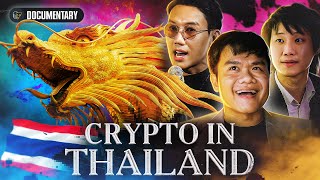
Documentary tracing Thailand’s rapid shift from anti-crypto posture to an active, regulated crypto market. Key points: May 2018 Royal Decree brought digital assets under Thai SEC supervision; an estimated 3.6 million Thais (≈5.2% of the population) own crypto; domestic trading volume rose ~600% since November 2020; major influencers (e.g., Be the Sky with ~13M subscribers) and projects (BitCub, Fans Token, NFT marketplace) accelerated adoption. The film covers regulatory moves (2013 warning/ban → 2014 lift → 2018 regulation → recent bans on meme coins/NFTs and in-person KYC requirement by AML office), corporate entry (SCB/SCB10X investments, stock exchange initiatives), rules for real-asset token offerings (projects must be 80% complete or ≥500 million baht ~ $15M), and CBDC/Cross‑border CBDC Bridge pilots (pilot launched June 2020).
Questions this video answers
May 2018
About 3.6 million (≈5.2% of the population)
Almost 600%
Over 13 million subscribers (≈18% of Thailand's population)
Declared illegal in 2013; ban removed in 2014
Chapters
What comes to mind when you hear Thailand perhaps a tourist paradise of endless sandy beaches, a refreshing swim in the sea or the bustling streets of Bangkok. But have you ever thought of Thailand as one of the most dynamically developing cryptocurrency markets? In May 2018, the Royal Decree on Digital Asset Business officially authorized the use of crypto in Thailand. Today it's estimated that more than 3.6 million Thais currently own digital currencies. That's about 5.2% of the total population. Since November 2020, domestic crypto trading volume has increased by almost 600%. One of Thailand's most popular YouTubers, Be the Sky, is a supporter of cryptocurrency and he has over 13 million subscribers. That's roughly 18% of the entire population. With such a huge platform spreading the word about cryptocurrency, it's not surprising that crypto adoption in Thailand is bo. We're going to bet that your perception of crypto in Thailand will have changed by the end of this film almost as much as the Thai government has over the past few years. Thailand was among the first countries in the world to regulate cryptocurrencies at the national level. The authority's stance has not always been welcoming though. Back in 2013, Thailand Central bank declared crypto trading illegal. However, a year later this ban was removed. Since 2018, cryptocurrencies have been considered as digital assets that can be issued and traded on exchanges under the supervision of the Thai Security and Exchange Commission. Just a few months ago, the Thai SEC banned meme coins and NFTs as part of a crypto crackdown. According to the regulators, the new rules are aimed at protecting traders from tokens that have no clear objective or substance and whose prices are easily manipulated. Also in May, the Thai Anti Money Laundering Office required digital exchanges to verify users accounts through an in person checking procedure. Meanwhile, blockchain and crypto supporters have been working hard to help this Southeast Asian nation change its perception and push for better regulation and greater adoption. We went to Thailand to meet some of these people who are working hard to develop and grow the crypto industry. They are everyday heroes who are moving the Thai cryptocurrency market forward. On the trip we were joined by Vadim Krakotin, the head of cointelegraph China who helped us get the full picture.
Let's dig more deeply inside of the Thailand crypto landscape and see what we can get here.
What makes the Thai crypto industry so interesting? First, the regulators are often changing their views on this Asset class trying to keep up with the changing market conditions. What's more, many companies from traditional finance are jumping onto the crypto bandwagon and creating crypto related businesses. They all want to be at the forefront of this technological disruption that includes large players such as the stock market of Thailand, Siam Commercial bank and Kessakorn Bank. Interestingly, the bank of Thailand is now developing a central bank digital currency. Overall, Thailand is a fertile ground for crypto business. But that's certainly not how it was a few years ago. Jiryu Sripsi Sopatap was among the entrepreneurs affected by the rapid change of crypto regulation in Thailand. He started his business back in 2013 in a small room in the back of his parents clothing store. Now he is one of Thailand's leading open blockchain experts and the founder and CEO of Thailand's largest crypto exchange, BitCub. However, six years ago he was close to being thrown behind bars.
It was really tough. I was being investigated by the anti money laundering officers. They wrote a letter with my name investigated. The company invited me in for an interview. The bank of Thailand also called me in in the past, even the revenue department. We had to go and explain to different regulators. I tried to call my friend that graduated from Oxford University. They were working at a very big law firm. No one wanted to help out. They were like top, good luck. Even though I had the money to pay. Because imagine Bitcoin like seven, eight years ago, it was really great. No right or wrong, no one wanted to risk their reputation to help.
Back then the bank of Thailand issued an official statement warning citizens against the risks of using Bitcoin. Topp had to spend months explaining to officials how Bitcoin worked while also dealing with tax compliance issues. Six years later, the situation has changed dramatically. As of January 2021, Bitcoin claims to host over 90% of Thailand's crypto trading activity.
So this is our main Bitcap office that houses 500 people here. And this is the support function area. This is our marketing PR communication team. They are sitting here. And this is our finance team. And if you notice the CFO desk is with the team and that is the CMO desk. They are sitting with the team. It's an open space.
In addition to the crypto exchange TOPS groups of companies is engaged in implementing blockchain applications in publicly listed private companies and even in government agencies. In November 2021, Thailand's largest bank bought a majority stake in BitCub that increased the valuation of its parent company to over $1 billion making it one of the first Thai unicorns.
Cryptocurrency adoptions in Thailand right now is growing really fast. We are one of the very first countries to issue out a license by the Thai acc. So Thai ACC right now has a good understanding about blockchain, about cryptocurrency. They are one of the first regulators in the world to create a digital asset exchange license. And we are one of the very first company to be a fully regulated, you know, licensed cryptocurrency exchange.
Recently Bitcub launched Fans Token, a project that converts celebrities reputation into digital assets through blockchain technology and NFTs. The goal of the project is to boost the popularity of blockchain technology in Thailand. To achieve this, Bitcub partnered up with the country's most popular YouTube influencers. Meet Krit Bunyarong aka Be the Ska. One of the most popular YouTubers in Thailand. He has more than 13 million subscribers.
I've been doing it for a while. I created my team and we started to generate more content which allowed me to get more than 10 million subscribers. Only two people in Thailand who have received Diamond YouTube button and I'm the second one who got it. Yeah, I'm the second person. In 2009 I heard of the name Bitcoin with the founder's name of Satoshi Nakamoto and then I just forgot about it. Five years later I went to a friend's house who is a programmer and then I saw a four sided machine with all these cables and I asked them what is it? And he said this is a gold digger machine. And I asked him how does it work exactly? And he explained to me that this machine is used to mine bitcoin. And so I was interested in it and studied more about the technology. Blockchain is a very good technology which will change a lot in the world and improved development in many industries. And then I started investing in bitcoin.
Be studied computer engineering and participated in a few programming competitions. He then started trading and after that he joined the mining business.
I used to sleep here. In the past it was my office. Now I moved out so we just use it as a storage room and we keep our machines in here. Please come have a look. So here it is.
Wow.
Video cards.
I have two but I don't use them anymore. In the past I used it a lot just to have feelings that I was getting money. But actually I made more money from trading than I did mining.
Be and his fellow YouTubers joined the fans Token project as a way to reward their followers, Token holders can exchange them for content such as exclusive video clips or an experience, a one on one video call, an exclusive dinner or meeting their favorite celebrity. For example. To give you an idea of the scale of this project, the five YouTube influencers have a combined total of over 40 million subscribers.
Blockchain is a very good technology which can be used in daily life. I cooperated with Bitcub for their project. I think it helps support creators and influencers. Their income mainly comes from the YouTube platform which they generate the content for. But some creators might not have enough sponsors so they just lose motivation. But now NFTs could encourage and support creators in the new generation.
Another Thai influencer involved in the Fans Token project is Surabath Likbai or Plume, my girlfriend.
He is named B the Sky, Be the Sky. He is a top influencer in Thailand and he has and knowledge about crypto and blockchain.
I heard about Bitcoin for the first time in Australia. I went to participate in the influencer event with Buy the Sky. It was around five years ago. Back then bitcoin was very new.
Plume is a founder of VRZO, one of the first Thai channels on YouTube which has accumulated roughly 6.5.8 million subscribers.
This is me when I was six, six years old.
Yeah.
And MJ was in Thailand. I was so lucky to meet him. He was very nice. He didn't look like a human.
He.
Was like an angel or something.
Look like an angel or something like that.
Not a human for sure.
Not human for sure.
Right now, Plume is a well known influencer advocating for cryptocurrency.
This is my favorite one. Influencer Asia 2017. I was awarded as the influencer of the year. I was shocked and never thought I would get it. And yeah, I was so proud of it. Cryptocurrency was introduced in Thailand a while ago to a specific group of people. But these days cryptocurrency or blockchain has become something that catches people's interest. My followers DM me and ask advice about crypto, blockchain and all the differences.
But since this interview was recorded, the situation has changed. Back in June, Thailand's securities and Exchange Commission banned local exchanges from handling meme based tokens, fanbase tokens, NFTs and exchange issued tokens. However, the ban didn't prevent Bitcub from launching its own NFT marketplace. Top's business partner Sako Korn Sakoi AKA Ton is among the central figures promoting the use of blockchain technology to convert influencers popularity into digital assets. Thanh came to crypto after working in the gaming industry for about 10 years. That is why he is a big supporter of NFTs.
It's related to gaming and is the same concept that the hero skin or game items have value. And I see that NFTs are something new and that can allow people to truly own something. It's digital ownership. I could tell NFTs will change the world. People can even acquire fame with it. Regulation is the most exciting part. How to make everything comply with the regulators. I think it might be the most important part for us to get right.
Now the odds of NFTs returning to the legal realm seem pretty good. In February 2018, the central bank of Thailand directed all banks in the country to stay away from cryptocurrencies until a regulatory framework was implemented a few months later in May 2018, a legal framework for cryptocurrencies came into effect. About two months after that, in August 2018, the bank of Thailand allowed banks to set up branches that could issue tokens and invest in crypto. Little by little, enthusiasts who believe in the potential of cryptocurrencies and blockchain are shaping the future of this technology in Thailand. These enthusiasts consulted the Thai government and had their voices heard and made real changes.
I think the NFT is just start and it needs the time to educate the people.
But.
A lot of emerging technology starts from speculation. That's right, the NFT has the value in terms of. In the holder mind. In the holder mind. What does it call? It's called like sentimental value. NBA top shot I think NBA top shot Very famous right now.
This is Superuk Bunsukt or bit President of the Thai Digital Asset Association. Since its establishment, the association has had a significant impact driving the Thai digital asset industry forward on both the institutional and retail level. Besides reaching out on social media, the Digital Asset association relies on offline gatherings like the Blockchain Thailand Genesis 2018, 2019 and 2020 events.
I think in Thailand it has a lot of active community. They have, they help each other, they create the community and share the knowledge. But the level of the access to the defi I think is still limited to the people that have the skill like it has a financial background or IT background to understand, to learn it. And another thing I think it has limitations for Thai people is about language. A lot of people that are not familiar with foreign language such as English and a lot of information is in English. So this one is a barrier for the mass adoption in Thailand. If you need to create the mass adoption. You need to like translate to localized in Thai language. It would be better if in in terms of Thai market.
Sanjay Papli understood the importance of the Thai language when promoting crypto in the country. In 2018, he organized one of the biggest offline crypto events focused on Thai speakers. The gathering attracted over 3,000 people, which is quite a significant number given the context.
All right, yeah, great Sanjay, nice to. Nice to see you.
Nice to see you as well.
Sanjay is another crypto enthusiast trying to change the course of history.
So I think from our experience and hosting that event, right we see a lot of foreign event coming here and there's no opportunity Thai people to learn because all the content is usually in English. And then we also want to educate the mass adoption for the cryptocurrency.
Right.
So I think a lot of people people are asking us when are you guys going to do an event? Is there some way I can learn about this? And plus there's no like a big blockchain conference where all the Thai community pull together.
Seven years ago, Sanjay's parents were shocked when their son decided to quit his family's textile business. Sanjay believed more in bitcoin than in textiles.
But I think definitely this is at least in Thailand you know what you're doing is right. Right. So at least there's a clear regulation you can follow and clear set of rules what you can do and what you cannot do. Whereas in a lot country is still in a murky gray area. So on I would say but in Thailand is either you are fully compliant, you're non compliant. So at least it's a good thing for like I think a bigger company or even global company to have a look at Thailand as a serious market and as a way to establish themselves.
Ordinary people in Thailand are changing the government's view of cryptocurrencies and now big corporations are joining them, including large banks. In 2019, the stock exchange of Thailand announced that it was planning to build a new digital asset system. Earlier this year, the venture arm of Scion Commercial Bank, Thailand's oldest bank, set up a $50 million fund to invest in blockchain. This venture arm known as SCB10X previously partnered with Ripple on a blockchain powered mobile app. The company has also worked with Asimo to use Ripplenet for cross border payments.
The goal is to build and invest in a new business and crypto and other ecosystem. So that's a mandate. So we get funding around US$800 million as a starting point. Investing and also incubating projects. But the goal is to build a new S curve for semicommercial banks.
This is Kaliwut Templewapa. He is responsible for many of the innovative ideas springing from SCB 10X. Kawiru was educated in Thailand as an engineer and worked in the oil and gas industry for a while. Then he went to Stanford University where he learned a lot about entrepreneurship. When he came back to Thailand he started working in the corporate sector focusing on innovation.
I think it's quite interesting because we've been working closely with the regulators on how because I think under the law a bank cannot hold tokens but in terms of the we have a subsidiaries called SCB Securities, SCB Security actually can working on under another regulators so we're working with them on investing in tokens right. So now we can have a vehicle to own a token staff or safe and all those. I think we figured it out so definitely can do and then we just start sorting out a project right. You know it's CEFI and Defi as well but you know we invest in blockfi and we haven't announced but we invest in a fund defi fund like Polychain and also there are a number of funds that we haven't announced.
SCP10X aims at decentralizing entire sectors such as healthcare, commerce or finance. Its team comprises a total of 35 developers in house designers and product owners. They incubate five or six products simultaneously and can spin out the promising ones as subsidiaries of SCB 10X.
So basically I think we split into two parts. The first thing we call it a SAFI right regulated one. At the end of the day it's a crypto business as well. But as a bank we need to get into a regulated industry for sure. There's a license coming out a lot if you look at the SEC now even though it's exchange broker and dealer custodian, you know, investment, you know, investment recommendation there are a number of things that we are definitely going towards that at the end of the day we believe that the banking will be changed and one of the medium that we think it's going to be very important is through the, I would say not the cryptocurrencies but like the way you use a blockchain technologies to do that. So that's one thing called safi. So we, I think we all in on that. Right. So now there's a license coming up. We apply for the license and try to get it up and running as fast as possible. Recruiting Talent, that's one thing. Another thing is defi decentralized finance as unregulated. We've been talking with, you know, regulators around how can we work in this? So it's going to be pretty much investment right now. So we have a $50 million funds investing in tokens and then we start investing in a number of projects. So there are two parts. We are doing a cefi, building it and also investing in defi and also incubating a number of some of the small projects internally in my team on the defi as well. If you're talking about Thai people, we have to step back on how it can improve people's lives. Because Thai people, I think just only a fraction of them can have a bank account. I mean for Thai people who already learned how to use crypto, how to use defi projects, for them it looks very, very attractive. Because in bank depositing, in just a traditional bank you can get maybe less than 1% per year and in DeFi you can get 20%, 30%, 50%. I'm not talking about some crazy like you know, APIs like yeah, yeah.
In a recent development, the Thai SEC approved the trading of real asset backed digital tokens. Now Thai property owners are allowed to raise funds by issuing tokens backed by real estate. Among the requirements for conducting an initial coin offering, real estate projects should be 80% completed or valued at at least 500 million baht, around $15 million. To find out all the details, we visited Kuleradpungsadapuram, a lawyer and cryptocurrency lobbyist for the Thai government.
In Thailand we call it investment tokens. And investment tokens are regulated as digital tokens under digital asset law. And because it is regulated, the whole offering process must comply with the requirements of the sec. It must be done through an approved ICO portal and the issuer must do the filing with the sec. And the project must have approval from the SEC as well.
Holders of investment tokens are rewarded with profit sharing or dividends. These benefits will be written and enforced by a smart contract. However, holders will have no equity or voting rights on the company board. Since investment tokens don't represent the company's security or assets.
And because this is going to be the first ever regulated digital token offering project in Thailand. The first is always the hardest, I would say so it how long it took, it took quite some time. But that relates to how we need to really be in discussion with the regulators. Talk about the benefits, benefits that the project can do for the economy. Talk about the risks that are involved and how to address those risks for the investors, for example, and look at the regulations and see whether the regulations already support the project or there needs to be further amendment for the projects.
The next big step for Thailand could be the creation of its own state owned stablecoin. In June 2020, the bank of Thailand launched a project to pilot test its CBDC payment system. The plan was to develop a prototype and test real life business use cases for its central bank digital currency. Earlier this year, the bank of Thailand and other major banks across Asia have joined forces to build a cross border cbdc. The project is called the Multiple Central Bank Digital Currency Bridge and aims to address the pain points of cross border transfers. These include cost inefficiencies and the complex range regulations that accompany moving money from one country to another.
I think they're. I think that they did a good job on trying to catch up on this. And when regulators always catch up, to be honest, because innovators move ahead, they catch up, right? I think they catch up very fast and they work closely with us.
Five, six or even seven years is an imperceptible time frame in the span of global human history. But in that relatively short period, ordinary Thais went from sitting in tiny rooms behind their parents stores to creating communities that positively impact national policies. Could one have imagined this seven years ago when reading the news about the Bitcoin ban in this paradise kingdom? So I'll ask you again, what comes to mind when you hear Thailand? Could you achieve the same?
It.










