How to pick the next explosive altcoin | Interview with Ran Neuner
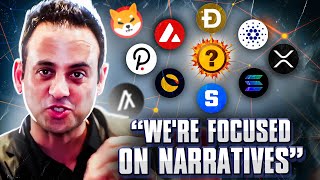
Ran Neuner discusses how to identify altcoins poised for explosive growth, covering Ethereum, Solana, and the market cycles that drive blockchain investments.
Chapters
All right, folks, we have Rand Nooner here. He is one of the most recognizable names in the world of financial technology. He's made his name as a co founder and global CEO for On Chain, a blockchain investment fund advisory service. In 2017, Rand launched crypto Trader, the world's first televised cryptocurrency show. Featured on cnbc, he has been voted one of the most influential people in Africa by Time magazine. He is also the host of popular YouTube channel Crypto Banter, which has over 4,500,000 subscribers. Ran. How are we doing today, man? What's going on?
I'm doing fantastic. I'm doing fantastic. Just excuse my green background. My software is not working, so you're gonna have to suffer the green background.
All good, man. Thanks for jumping on the show today.
Yeah.
Foreign.
So, Ren, you've talked about Ethereum, and my question is, do you think that Ethereum over the next couple of years could lose the number two spot container? And which are the best alternatives in your opinion? And why do I think Ethereum loses the number two spot? Very difficult to say. And I'll tell you why. I think that Ethereum becomes a settlement layer for multiple Ethereum layer 2s. And we're seeing it now with Zksync, with Polygon, with ZK rollups become a game changer in terms of scaling technologies. And if these layer twos get significant adoption. And I think today is a big day because of the Polygon zk, they're having a Polygon ZK day to day. They've already made one announcement where they've made an acquisition at $400 million of a company called Mirror. Now, if Ethereum can successfully become a settlement layer for multiple layer twos using things like rollups, then maybe, maybe, maybe Ethereum maintains the number two spot. If not, then I actually think it becomes Solana. And I'll tell you why. From a pure technological point of view, Solana is way better technology than Ethereum. It's faster. It's time to finality. It's time to finality is much quicker than Ethereum. It can handle the scale. And of course, critics are going to say, well, it's not decentralized enough and it's not evm and you need to learn how to use Rust to code on Solana. And those things are all true. But I think with enough time, Solana does look like it's gaining that kind of network effect. Yeah.
So I, I know on your show you've talked about, you've sold off part of your ETH for Solana. When it comes to, to like measuring the metrics behind a lot of these new blockchains is transaction speed and finality. Are those the two most important metrics?
No, they absolutely. So in terms of a blockchain performance. Yes. How much load can it handle and what are the fees when you get to that load? I guess that that becomes the measuring factors, but that's not how I make my investment decision. So you referenced that I sold a whole lot of my ETH into Solana. I then further sold some of my ETH and put it into other layer ones, things like Avax and some of the other ones. The reason is what I'm doing there is I think that the way the market works is it depends where you want to invest. So typical retail investors will come in at the end of the market and they'll invest following price. So price goes up, price goes down, they'll make their decisions based on price. Slightly more sophisticated investors will look at metrics like transactions or maybe TVL or maybe active addresses, and then they'll say, look, if the TVL increases or the active addresses increase, then that should bring the price to increase. Great. More sophisticated investors will take one step back and they'll say, where is the venture capital money going? And they'll follow the venture capital money, which ultimately leads to more dapps being developed, which ultimately leads to more tps, which ultimately leads to more tvl, which ultimately leads to more active addresses, which ultimately leads to price. The smartest investors will actually just follow the developers. So the idea is to try and follow the developers. And the metrics that I'm looking at are metrics such as GitHub, deposits and any type of metric, which shows me that developers are moving to blockchains. And we're seeing a lot of developers move to blockchains, like Luna, for example. There's a very, very, very strong developer ecosystem moving to chains like Luna. The smartest developers in the world are moving to arweave. Not a lot, but they're moving to arweave. The mass of smart developers are developing on Solana. And so I'm starting to follow the developers because the developers will lead to VC money, the VC money will lead to more DApps being developed, more DApps being developed will lead to more active addresses, more TVL, and then ultimately price. So I'm just following the, the food chain, but I'm going backwards.
And you kind of showed and explained how the, the market stayed, gotten some momentum, still building. Do you think that we're headed into a longer market cycle than the four year cycle or are we starting a new cycle over? What do you think?
So I think that crypto people have a bull and bear market mentality, right? Like crypto people know this. Hey, if it's not a bull market, then we're going into a bear market and it's got to be a bull or a bear market. Now let me ask you a question. When was the last time that there was a bear market on the stock market? Never.
I was thinking about this earlier.
Hold on. So the only reason, the only reason why we are conditioned as crypto people to think about a bull market or a bear market is because we've been through three cycles. We went through 2013 and 2013 was a bull market and a bear market. Then we went through 2017 and 2017 was a bull market and a bear market. And so we're making this assumption that we're going to get a bull market and a bear market in 2021. And we're also making this assumption around cycles. Now the difference between 2013 and 2017 is it was the beginning of a technology cycle, right? So you think about 2013 and 2017. 2013 was all about bitcoin and it was about the first decentralized blockchain and the higher expectations of what it could achieve in a shorter period of time that it could never achieve. And it was bound to disappoint and it crashed. 2017 was the same cycle, but it was for altcoins. So bitcoin started coming to its own. But the explosion of 2017 was actually altcoins. And then the disappointment was that they couldn't achieve the disruption in that period of time in a short period of time. But let me take you back to the NASDAQ and let's talk about the Internet bubble of the 1990s. When the Internet bubble collapsed in 2001, we didn't have bull and bear markets. We just had a gradual bull market, which was a function of a few things. Technology and disruption is one of the things. And the second part of it was just money printing and inflation. And so I think that this mentality that we have of. Because we always have a bear market and this PTSD that most of us have because we were here in 2017. So we have, I mean, you know, we all have PTSD that says when the bear market comes, it's going to be bad and it's going to be long, because that is what happened in the previous ones. But in other asset classes, for many Many, many years. We haven't had a bad long bear market. I think that we may see a very different market now. I think that this market is slightly overheated, but I think that we'll have multiple corrections. But we'll just continue to grow. I think we'll just continue to grow. Like the stock market. If you take the stock market chart, chart and I'll actually show it to you, if you allow me to share my screen again, definitely I'll show it to you. There we go. So like that's the stock market chart since. Since COVID And you know, if you kind of zoom out and you remove Covid and you just keep, you kind of keep zooming out, what you realize is that you just have, you know, just a bull market with multiple small, quick corrections. You look at the COVID correction, it started in March and by November we were at higher highs. That's not a one year or a two year or a three year bear cycle. It's just multiple corrections that shake out leverage, shake out overheated environments. But ultimately we continue to grow. I think that that's what happens now with Blockchain because I think that the technology is really getting adoption and disruption. And when that happens, it's kind of illogical for you to have adoption and disruption and then still to have a one and a half year bear market like we had in 2017.
So what are some of the. I think, and I also appreciate anybody from the banter fam that is tuning in today for the market report. But like, what are some of the maybe top three projects that you are keeping a very, very close eye on right now.
So we don't look at projects, I mean, you know, to talk about specific projects. I think there's a hundred great projects out there doing great things. I think we're focused on narratives. So the first narrative that we are focused on right now and we started, we've been focused on this narrative for a long time, but specifically in the last 30 days is Luna. And there's a reason for it. We've been calling Luna as a buy since last year, this time when Luna was trading at 35 cents. Today, Luna is trading, I think $75 and it keeps breaking new highs. And the reason for that is because there are multiple narratives that are playing into Luna's hands all, all at once. And I'll walk you through them. The first thing is the whole metaverse narrative and the fact that the US is clamping down on stable coins and dollar back stable coins. And there's regulation. And so we think that in the Metaverse there'll be a new type of money and the money won't be backed by by USDT or usdc. Just my view on USDC and USDT is that without doubt those are securities. And I'll explain to you why. You know, if, if an item derives its value from a basket of other items that fluctuate in value, then that item is a security. Now USDT openly claim that they invest in multiple assets, including corporate bonds, debt, etc, etc. If that debt collapses, theoretically the value of the USDT coin should be less than a dollar. Okay, so with that in mind, there's no doubt in my mind that USDT and USDC are actually securities. And maybe they will be and maybe they won't be over time. But what I think is going to happen is that there's going to be for Metaverse, there's going to be a magic metaverse money. And that magic metaverse money is not going to be backed by US Dollars because we don't want it to be backed by US Dol. So I think that who wins at that point is ust and I think maybe, maybe magic Internet money do too. But I think UST wins that battle. We saw it now with a correction. When the correction happened, all the stable coins lost their peg except US T, which is actually not backed by US dollars, which is. It's unfathomable that algorithmic money would have held us a peg better than stablecoin money. It's unfathomable, but it did. And it just shows that we're moving to a world where astute investors are saying the US dollar is worth shit anyway. I'd rather just buy this magic Internet money. And it is what it is. And so ust, there's the UST narrative, this decentralized money narrative that is not based backed by USD. And then you've also got a Dex which is launching on Luna. So on Terra. So you've got Astroport, which is a new dex like a uni swap which is launching this next week. I think they're launching it. And you know when you introduce a Dex to a ecosystem which is based on a which is based on a non dollar backed money and is made for defi. I mean at the center of, of Luna, of Terra sits anchor protocol which offers people 20% for depositing these USD. So you get this whole narrative and you say obviously Luna is going to explode in value. So that's one narrative that we're really, really, really following at the moment. And we're investing in multiple projects on that narrative. So we invested in Kujira, we investing in the Launchpad, which is, I think a starterra. We investing in Orion Money. And Orion Money effectively allows people to invest their USDC and USDT and earn 20% using anchor protocol. So we invest in multiple investments within a narrative. So that's the first narrative that we're really investing in. The second narrative is ETH layer 2 scaling and particularly roll ups and preferably ZK roll ups over optimistic roll ups. But we have made some investments in optimistic roll ups. Things like Boba was a good investment of ours in optimistic roll ups. And we're constantly looking for places to invest in ZK rollups and I think there's going to be multiple of those coming out pretty soon. So that's the next narrative. Another narrative is we're expecting a Cardano explosion early next year. Why? Because the first Dex is out on testnet and you know, Cardano struggled to get smart contracts and everyone thought, hey, Karan has got smart contracts now everything will just explode. And that was in August or September. But that's not how it works. Because when you have smart contracts, you can build a Dex. Once you build the Dex, you can build a whole defi ecosystem around it, which you can't really build unless there's a Dex. And the first Cardano Dex went on to testnet on Monday, which was Sunday Swap, and now we call it Monday Swap because they launched one day late. So Monday Swap, Monday Swap is now live on Cardano and multiple other Dexes will start to form. There's going to be ADA Swap and a whole lot of others that are going to come online. And in January you're probably going to see a whole lot of these functioning Dexes on Cardano and, and that's going to be the uni swap moment for Cardano. And when that happens, then you're going to get multiple Defi projects and you're going to see the lending protocols come out and you're going to see a whole lot of these and you're going to see TVL start to be locked in Cardano and then that will start a Cardano narrative. And that I would say will probably happen around January or February.
Excellent. No, this has been super insightful and I'm sure our audience has enjoyed hearing from you. This is Rand Nooner, folks. It's been a pleasure having you on. Hopefully we can have you on again. Thanks for joining us today.
Anytime, guys. Thanks so much.
Thanks, Rand.
Awesome.










