How to solve the blockchain trilemma? | Interview with Silvio Micali
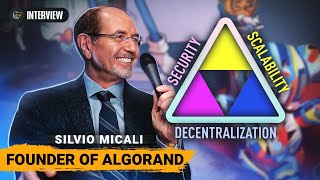
Silvio Micali, founder of Algorand, explains how a cryptographic lottery that randomly selects small committees solves the blockchain trilemma of security, decentralization, and scalability. Algorand produces a block every 4.4 seconds, uses pure proof-of-stake, and requires minimal energy.
Questions this video answers
April 14, 2022.
Approximately one block every 4.4 seconds.
A randomly selected 1,000-token committee (example).
A "pure proof of stake" (cryptographically fair lottery-based) proof-of-stake design.
Chapters
Hi, my name is Joe. I'm here today with Silvo Micali, the founder of Algorand. Silvio, how are you doing today?
I'm doing great, Joe. How about you?
Yeah, very well, thank you. How's your, how's your conference going? I presume you've been to Paris many times.
I've been in Paris many times and it's a special conference and lots of energy. And I'm very delighted to see how many people participate and care about blockchain is a pleasure to see.
Fantastic. Of course. And Algorand, you know, is the blockchain that's known to solve the trilemma. Would you be able to explain to viewers the importance of firstly the trilemma and what it means to solve it?
Okay. The trilemma famously stated that no blockchain could be at the same time secure, decentralized and scalable. Now why is this important? It's important that the trilemma is false, because were it to be true, do you want to sacrifice security? Do you want to sacrifice scalability? No. Unless you want to have a blockchain for friends and family only, or do you want to sacrifice decentralization? If you want to sacrifice decentralization, why to have a blockchain at all? So I think that it's very important to solve it. It required some more mathematics and the idea that we had to have a cryptographically fair lottery. But somehow everybody which has a one algo has a chance, equal chance, to be selected for, say, 1,000 token committee who is in charge of one block, and the next block is a different randomly selected 1000 token committee. And so this is scalable because of a selection takes a microsecond. And if you are selected, you propagate a proof of being selected. Mathematical, very strong, easy and easily checkable and very short proof. And together with your opinion about the block. And why is this secure? Because nobody knows in advance who is going to be selected, okay? And therefore nobody can corrupt in advance anybody. And after. And by the way, everybody is also secretly selected. And only you know that you've been selected when you propagate your winning ticket, your proof that you are part of the committee of this bloc, and your opinion about the bloc. So once it becomes publicly known who you are, it's too late to corrupt you, because whatever you have to say, your winning ticket and your opinion about the block is virally propagated through the network. And nobody can put this into the bottle, no more than the US government or any other government can put Back in the bottle. A message virally propagated by, say, WikiLeaks.
Very good. Wow, okay, Quite an education for us. Silvio, thank you very much. And of course one of the other key things about Algorand is that it's a proof of stake blockchain. Now this year is the year when the world's second biggest blockchain, Ethereum, is supposedly moving from proof of work to proof of stake. Now, Algorand was built specifically on proof of stake. Firstly, why did you build on proof of stake? And secondly, what does it mean now that Ethereum is moving from PO to pos?
All right, a lot to unpack Joe, but let's do it one by one.
Sure.
First of all, proof of stake is a portfolio of approaches. There is delegated proof of stake, there is a bonded proof of stake, blah blah, blah, blah. The Algorand version is a pure proof of stake, which is really is very different. Why did we choose pure proof of stake? Because of two things. First of all, it's green. In fact, Algorand is the most powerful and sustainable blockchain there is and I think this is very important in the world. And actually our version of proof of stake, pure proof of stake is really decentralized because if you ask me, delegated proof of stake. You select a bunch of people, an elite club, and you hope that they will remain honest for the foreseeable future. I don't want to put, you know, the chances of having an ecosystem as important and as big as a blockchain to be in the hands of the chosen few. Frankly, delegated proof of stake is not good. But we are. The particular brand of pure proof of stake is 0.1 of your questions,.2 of of your equation. You say we can sell your.
It's very logical.
So you said this is the year that Ethereum should launch it. I thought it was last year. Actually, if I think better, it was the year before. Actually it was the year before, but it's very factual. And by the way, you know, I. We don't know what version this is going to be up for for stake, but let's remember that Buterin who made the trailer says security, decentralization and scalability cannot live together currently. Perhaps it's fair to say that somehow scalability has been sacrificed in favor of security. What is going to be sacrificed later, I don't know, but certainly if they want to use Algorand protocol then they can have all three without problem. So it's hard for me to comment. What are they going to Do.
Yeah, okay. No, it's really interesting. I mean, what would you say is the sentiment or the overall feeling among Algorand and other proof of stake blockchains with regards to Ethereum's shift over? Is it something that you're concerned about or you know, is it just another day?
I'll tell you, competition is always good.
Okay.
You don't like competition, don't get into blockchain. Because I really believe in democratization and meritocracy. I really, that is what is going to enable us, the best of us to win. The world does not need 6,000 blockchains, but it's not going to be a winner takes it all. There is room to collaborate in competition with a few blockchain and by the way, when things become a monopoly is never good for the world. So we welcome competition makes us better and hopefully will make our competitors better too by pushing them to improve themselves all the time.
Fantastic. So you mentioned a keyword that collaboration here today at Paris Blockchain Week and Algorand is one of the key partners. What does it mean for Algorand to have these to be in such a place as the former stock exchange to be in communication with institutional partners? You know, what is the importance of this collaboration now with institutions?
Well, I believe that institution the world over and national institutions only big financial institutions will benefit tremendously for coming on the blockchain, on the public blockchain. Let's remember people were afraid of Internet which was public says who maintains it? Everybody uses it. So I think that you know, the institution we are ready for institution and Algorand, we have a scale and we by the way, we have a technology. We never fail to produce a block. We never outage and think we have, we are green. We produce block after block of a block every 4.4 seconds. We are ready and we welcome our institution to bring in and in investor environment like the stock exchange. I think we welcome regulation too, by the way. I think, you know, good regulations make a better market. But the important thing is for regulation to be good and not just a premature or wrong. This can actually create damage.
But fantastic. Yeah. I mean, what would you say are the common pain points or the hurdles that you come across in conversation with these institutions? Is there something that keeps coming up that you're like, ah, why don't they understand this yet? Or why is it they keep getting stuck on this point?
Well, you know, it is, look, big institutions are by definition have a lot of inertia.
Yep.
And so that is in my Opinion is not that they don't understand, but they do understand. But they think they take more time to bring over the entire institution. Institution don't want to break into whoever goes on the blockchain who doesn't they would like to move together. This will take a bit of time, but I think that they understand now that there's a much more secure way to transact. You can actually we are geared in Algorand to have all the technology to be compliant with good regulations when they come. I believe clarity is always welcome. But I think the security, the cost of the transaction going down and really the ability to, to have settlements in seconds with finality rather than in two days should be appreciated by everybody.
Yeah, yeah, absolutely. Okay, so let's look forward, let's. Let's consider your vision for the sector. I mean we're sat here next to a bear. I mean the cointelegraph teddy bear. It's no sign that we're in a bear market. Okay. It's just an assemble. Yes, exactly. What are you most looking forward to in 2022? 2023?
Well, what is going to happen in 2023? First of all, we are going to deploy even more and better technology and we are going to even increase our scalability in expectation what is going to come. I think this is going to be the year in which speculation will disappear and real world use of a blockchain will start. Big institutions, nations and even new institutions that really the blockchain and this technology brings into existence.
Okay.
So we are going to be not anymore the speculation, but actually real use cases. And in my opinion for this is important, the technology ought to be stellar because you know, when you hear about how to 12 hours a month, if the blockchain is down today and my blockchain is for speculation only, say who cares? I speculate tomorrow. But if real application, healthcare application, financial application, it better be. That service is always up 24 by 7. In fact every few seconds new block. And life continues with prosperity and opportunity for all.
Yeah, it feels like we're on that cusp of speculation becoming real, real life. Right? Yes. You mentioned institutions there, nations. Is there anything that you'd like to, you know, let slip today?
No, no. Not sleep. No, I'm a cryptographer.
Okay, okay, very good. Fantastic.
But I love the future.
Okay, very good. I mean, is there anything that gets you really excited in this space? You know, if we take an even longer term, you know, 10 years out from now, is there something that you're really excited to see come to fruition.
So I believe ultimately what makes me excited about this entire field, Joe, is really the democratization of finance.
Okay.
So I really think that I'm here, we are here, but I certainly am here with Algorand to make sure that the person on the street, the common person on the street, has the same as access to the same extremely sophisticated financial tool at a fraction of the actual cost. But right now, only they lead us. That for me, is what is going to unlock really opportunities for everybody and the growth of everybody else. Because I think we all get sick and tired of the concentration of wealth. And I think the blockchain can actually level the playing field by creating a platform where everybody's welcome is very low cost, very secure. I think that is the real excitement for this field. There are all kinds of uses. I'm save the planet. We certainly want to help the planet. But this to me is the human centric version of it. Is the democratization of finance is really a big win for us.
Yeah. It cannot be overstated, can it? It's that important. World concentration and the climate. Yes, of course. Is there anything else you'd like to comment today or. I'd like to shine a light, blockchain.
To everyone and we are working for you very hard and we are making a better world. Join us.
Fantastic. Great note to finish on. Thank you so much, Silvia. And enjoy the rest of the conference. Cheers. I.










