I built this AI Agent in 2 hours (and got paid $1200)
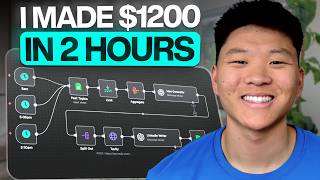
Someone built an N8N workflow that generates LinkedIn posts in two hours and sold it for $1,200. The workflow runs three times daily, pulling ideas from AI and publishing automatically. They explain how consistent YouTube tutorials attracted the client, why value-based pricing works, and what guardrails matter.
Chapters
So I built this agent in 2 hours and someone actually paid me $1,200 for it. And it wasn't anything too complex or advanced. In fact, I actually built this back when I had just first started messing around with N8N. And honestly, if I was to rebuild this system today, it would probably take me 30 minutes max. What's crazy about that is I'm pretty sure all of you guys could build something just like this. So in this video, I'm going to walk through what the agent does, why someone paid me for it, what this means for anyone trying to get started, and how I'd sell my first agent if I was starting from zero today. So what was the agent that I ended up selling? Well, it's funny because it's actually not an agent at all. It's more of an AI workflow, AI system. At this point, AI agent was kind of a buzzword and everyone was calling everything agents, myself included. But more realistically, this was an AI workflow that I sold. So what did this workflow do? Every single day it would go off 3 times in the morning and it would go through an idea generator AI, which was prompted to think of topics that would appeal to this client's target audience. The end goal was that everything was speaking through his company's branding and his tone of voice to ultimately help nurture and convert the target avatar that his LinkedIn profile is trying to speak to. And you can see here, it's a very, very simple system. You guys may even think it's funny how simple this thing looks right now, but at the time there were some pretty advanced things going on here with like data aggregation, splitting out different items, stuff like that, making an HTTP request and then creating content, which was a really hot topic and still is when it came to AI-powered systems. And at this point in my life, you know, I was still working full-time and I was just building a lot of stuff with NN for fun and really just trying to learn what was possible. And that's how I got good at automating so quick because I was just talking to ChatGPT, trying to figure out some cool use cases to build. And then I would go ahead and try to build it as best as I could just for myself and to make a YouTube video about it where I build it live, explain what I'm doing. Because for me, explaining something really helps it stick in my brain. So you guys see that workflow, you know it's nothing too complex if you've been building with N8N for a while. But how did I actually get someone to pay me for it? Well, like I said, I was just posting random things on YouTube, little tutorials, stuff like that. And at this point it was primarily for learning. I had no call to actions in my YouTube videos, but in all of them I just had my email right there in the description. And at this point, my videos were getting like 200 views a week. But what I knew were people that were super interested, like genuinely interested in what I was building. And after a while of this, people started reaching out and this client ended up reaching out because he just wanted to hop on a call and wanted to talk about what was possible. It almost seemed like he was just reaching out to make a friend because I was not an expert. I wasn't positioning myself online as an expert or someone that would sell a service. We ended up just kind of hopping on a phone call and talking and he ended up asking if I wanted to collaborate with him. At this point, I was really excited at the opportunity just to be meeting people that are interested in what I'm interested in, but more so at the opportunity to build something for free for someone and just get some experience working with people and not taking on something that was a whole lot of pressure. But he seemed so excited about it, and we were talking a lot about the value that this system would add to him. So I decided I might as well throw out a price tag and just see that, you know, what his reaction is. And he pretty much agreed almost immediately. I guess the takeaway here is putting yourself out there and making content on whatever platform it is is extremely powerful, especially if the goal is not to get tons and tons of views and go viral, but the goal is to connect with people who are genuinely interested in exactly what you are genuinely interested in, even if you're not positioning yourself as an expert, because that raw genuineness builds trust, that authenticity, and that's what you need to get people to actually want to work with you. Of course, I wasn't the only one building at the time and posting about end-to-end workflows. So why did this business owner pay me $1,200 for a 2-hour job? So it took me 2 hours, which is $600 an hour, which is an insane rate. But the client wasn't paying for the workflow or wasn't paying for me on an hourly basis. He was paying for the outcome. I get so many questions about pricing and really it's about the value add. In order to accurately and fairly price something in a way where it's a good deal for you and also a no-brainer for the client is to understand exactly the value that you're adding to this specific client. And in order to understand that value, you need to figure out how do they do this process manually? How much time does it currently take them or their employees? How does that client value an hour of his or her time or an hour of his or her employee's time? And then there's also tons of other intangible benefits of AI automation as well. Of course, at the time I was insanely happy about making a quick $1,200, but if I really started to think about it, the value of this system in my mind was way more than $1,200. The way that the client was manually doing this process was spending hours each week creating and posting this content, which wasn't something he was genuinely passionate about, but it was more so something he knew he needed to do to grow the business. And rather than paying a VA or some employee to do this, which would be an ongoing expense at the time, he was able to get this one-time build with a one-time fee. And now all he has to do is pay for his API credits, which are pretty minimal. So this is over a 10x return for the business owner. And I think the main thing to understand here is that if you know how to solve a real problem, even with off-the-shelf AI tools, people will pay. At this point, I've really positioned myself in the N8N market. So people come to me now and are looking for N8N solutions because that's what they're familiar with. But ultimately, people don't care how you fix it. They just care about what you did to fix it and if it actually provides value to them as a business owner. Now, the reason I'm telling you guys about this is I know a lot of you are building but find it hard to believe someone will pay you good money for your agents? Well, this is proof that a lot of people will. What this means for you is that you don't need to be a coder genius, an expert. You just need to be accessible to anyone who likes building agents and has a business that they want to grow without increasing headcount. Like in the example I just showed, the business owner reached out to me just to have a casual conversation, and then because I was so passionate about it, he just wanted to work on something with me. Now I'm aware that it's a completely different space today than what it was 8, 9 months ago, but you'd be shocked just how early we still are to this whole AI automation wave. There are people who are still just now starting to even use ChatGPT and understand the value of it. And if you can understand pain points and start stitching together different tools, you are going to become in extremely high demand. There are so many high leverage automations that you can build for small business owners who don't even know that this technology exists. Stuff like building some automations for personalized outreach, automations for customer support, automations for personal productivity. The list goes on and on. If you're in this space now, you've probably been aware of the whole website chatbot thing for a while, and it may seem like old news to you, but almost every day I'll be talking to people who are just mind blown by the fact that you can have a little widget on a website and no longer have to manually answer FAQs or customer support related issues. And if you can help people save time, save money, save their focus so that they can use that time, money, focus to grow their business, you will get paid. Now, I know it might sound like it's super easy because I've already built up a channel, but here's exactly what I'd do if I had to start over from scratch. I would start sharing my journey, whether that's on Medium, LinkedIn, school communities, whatever it is, to start talking about what I'm learning and people will find it interesting. Then I'd get really good at not just building automations, but being able to identify people's problems. Like I've said before, you want to make yourself a doctor, not a pharmacist, someone who can not only fix the problem, but someone who can help you identify what's wrong. A lot of people that I've talked to in this space know that they need to start using AI and they know that they need automations, but they don't know exactly where in their business to look to start implementing it. And that's where you can come in and help them out. Next, I would understand the different tools that I have available to use in order to solve those problems. Obviously I use N8N for most things, but I think you'd be shocked at how easy it would be to leverage other tools that are out there and prove your expertise in this space. I think just the other week I told someone about Perplexity and how I use it to help me research and find a bunch of good sources, and they were absolutely mind-blown that they could pay a $20 a month subscription and basically get a software that would replace an intern that would be doing research all day. But of course, the more custom you want to get, and especially when you want to build backend automations at scale, learning something like N8N is a great, great place to start. But I know for a fact that there are people out there right now making money just going into businesses and teaching them how to use ChatGPT. The next thing to think about is get to a prototype fast. You don't need to go from discovery call with client immediately to a perfect production-ready system. In fact, the quicker you get to a prototype that fails, you're actually on your way to getting a system that you'd be ready to sell much quicker. Most builders overthink this and get super caught up in that aspect. But typically when I am working with a client, I tell them straight up at the beginning, hey, I'm really going to need to lean on your subject matter expertise here because ultimately I'm building this system for you. So I'm going to need a lot of your input to make sure that it fits your needs and that you're happy with it. Not only does that make sense from the business owner's perspective, but they're really going to appreciate that you are thinking through that with them. And that's how they can tell that you're really on their team. And when you're building high-quality automations, predictability and patterns are going to be your best friend. And you don't know what you don't know. So when things start to break, which they will and which they should, what you can do is you can start to collect those edge cases and identify patterns, and then you can build in certain guardrails to protect against those patterns. So that's really the best way to make your system actually robust is to put it out there, test it a ton, let it receive some live inputs, and basically just make sure you're watching it and tracking it. You need to see when it breaks, why it broke, so that you can actually fix it. And at this point, you should feel very confident doing things and selling some of your solutions for money, but you need to be able to put an accurate price tag on it in a way that the client feels justified handing you over that check. And like I kind of alluded to earlier, this all comes down to proving the ROI, the return on investment. Business owners typically don't think in terms of how many nodes are on your workflow or how many API calls you're making. They're going to be thinking in terms of, if I pay this person X amount of money, how much time are they going to save me? How much money in the long run am I going to make or save because of this person? Will the results be more consistent or higher quality than what I'm currently doing manually? So every system that you are pitching to build should very clearly show improvement in at least two of those three categories. Ultimately, you want all three to be improvements, which makes it a no-brainer. And just like I talked about earlier with value-based pricing, let's say you get to the conclusion this system is going to save the business owner $15,000 a month. It's going to get them back personally over 20 hours a month that they can use to focus on higher leverage tasks. It then becomes almost a no-brainer to say, hey, upfront cost of $3,000 a month and then $1,000 a month ongoing, just to throw out an example. But that is basically an offer that would make the business owner feel dumb for saying no. And that's how you show ROI. So I don't want this video to go too long, and I hope you guys have gotten a lot out of it. I've thrown all of this together in a doc for you guys so you can save this as a resource. And if you want to access that for free, All you have to do is join my free school community and you'll find it in there. And if you guys want to see more in-depth content on selling AI services without having to start up a full agency or a full AI company or anything like that, let me know. I'd love to bring some more of this type of content to you all because I'm aware that we're all kind of looking to monetize our skills, but not all of us are looking to start up an entire business. So if you enjoyed the video or you learned something new, please give it a like. It definitely helps me out a ton. And as always, I appreciate you guys making it to the end of the video. I'll see you on the next one. Thanks everyone.










