Interview with Binance's Changpeng Zhao (CZ)
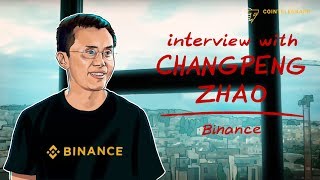
Changpeng Zhao, founder of Binance, discusses his path from China to crypto and why he built an exchange instead of trading himself. He explains how crypto exchanges differ from traditional ones, requiring wallet integration and stronger security, and outlines Binance's strategy across centralized trading, fiat gateways, and a decentralized exchange.
Chapters
Can you tell us your story? So who is Suzy? Where do you come from?
So I was born in China and then I moved to Canada when I was 12 and then I went spent six years in Vancouver, four years in Montreal. After university I went to Tokyo to work. I worked in Tokyo for four years and then went to New York for four years to work for Bloomberg. And. And then in 2005 I returned to Shanghai to do a startup together with five other founders. So there's six partners in the startup, that company's still there. And in 2013 I decided to leave that company after eight years and I decided to jump full into crypto. Back then it was called the Bitcoin industry. And then in mid-2017 I decided to do Binance and we got very lucky. It grew very quickly. So for me it's like a 20 year journey.
So how did you go into the trading in the first place?
So myself I was never really involved in trading even today. So I'm actually a very bad trader. I don't know how to trade, but I know how to do trading systems. So I think of myself more like the blacksmith that's making the sword for people to with kung fu masters to use. So I was always making those trading tools. So systems. I come from a programming background, so I've been doing that for 20 years but never really trading myself. So every time I try to trade myself, it never worked.
You mean you lose all the money or you just can't transfer it?
No, I usually lose money.
But how did you first heard about the bitcoin industry?
Yeah, so I first learned about bitcoin from Bobby Lee and Ron Cao. Bob Li was the CEO of BTC China before they disbanded that exchange. And Ron, Ron Cao was his institutional investor at the time. Ron Cao was with Lightspeed Ventures. Right now he runs Sky9 Capital. Both of them are very good friend of mine. I've known them for like three or four years before 2013. So I know like from 2008, 2009 ish. So when they asked me to look into it and Ron's investing in Bobby BTC China and the whole thing looks really good and I looked into it. But the thing that turned for me was the Vegas conference in December 2013. So I went there, I went to Vegas to learn about bitcoin and met a bunch of people. Vitalik was there, Charlie Lee was there, Matt Rozak was there, Brock Pierce was there and the same crew. It was really a group of nice people. They're not money driven, they're Very nice. So after that conference, I said, okay, if this is the group of people in this community. And I know the technology worked, the encryption, asymmetric encryption, private key, et cetera. So I understood those quite easily. But it was the community that said that made me decide, okay, if this is the community that's around, I'm very happy to join this industry and I know that it will be the future. So I know basically it's like discovering the Internet in 1989.
So this is the community that got you into the space in the first place?
Yes.
Is it still the same community?
It's still pretty much the same community. It's much bigger now. So those same group of guys are now KOLs or knowledge leaders in our space that people look up to. The industry definitely have grown a lot back then. I think that conference was maybe like 100 people. So the conference today is like 3500 on this little island. So the industry has gotten much, much bigger.
Now there are a lot of opinions that the crypto and blockchain community has become more toxic or more greedy. Do you agree with that?
Because the community is much larger. So there are some bad players, there are some money driven people who are more pure profit driven and some of them even go to the worst extent of being scams or lying, stuff like that. So there are those players. But I think by and large the community is healthy. I think there are definitely more good players than there are bad players. And also we should not have any delusions that even in any industry, even in a very mature banking industry, there are bad players. Very recently a bank was fined for laundering like $235 billion. That's bigger than the entire crypto market cap. So you could say they're worst players in the traditional industries, right? By far.
Can you explain me what is the difference between building trading system for traditional financial markets and building a system for crypto exchange? 1?
I think the biggest difference is the wallet or the funds management. So historically you would interface with a bank API. So you will do reconciliation with a bank and you have to go with the bank's API and bank schedule. Today we interface almost exclusively with blockchains. When you're dealing with banks, you depend a lot on the business negotiations or the business side of it. Whereas in blockchain now, there's no business to discuss. The blockchain cannot reject us. But we do have a lot of new blockchains now, especially with people switching to mainnet. So some of them are less stable, some of them are Technically they're technical issues. So there's two different sets of issues. And with traditional exchanges, the money is at the bank. So as a technology system, there's not a whole lot. The security requirements actually lower. Basically you can fake somebody's order, but the impact is quite minimal. And if you try to wire money out of the bank, the bank can reverse the transaction. Come to blockchain crypto, you got to be really, really secure. So the security requirements much, much tougher.
You've mentioned that your team is quite distributed.
Yes.
So different cities, different time zones. How do you cope with that?
So it is a challenge. But now I think we found like a medium or distributed teams are definitely less efficient than, than a centralized team in one place. And this is the same for blockchain networks or teams. It's all the same. But we now use chats a lot. We have tons and tons of chat groups. We use almost every chatting tool out there, we use every video conferencing tool out there. So we have a way that it works.
Now do you think it's the future for businesses?
So I think there's definitely going to be more and more decentralization even in the team structure of businesses. But a centralized team is always, especially when you're small, it's much easier to organize and much more efficient. So there are trade offs. So I'm not exactly sure you'll be fully. Fully decentralized is the way to go.
So what are your plans for the future in terms of binance as an exchange and as a company?
Sure, sure. So basically we just want to provide a few infrastructure services in the blockchain space. Right now our core business is the exchange. So right now we run a crypto to crypto centralized exchange and we are working on a number of fiat to crypto exchanges so that we can bring the fiat, we can open the fiat gateway into crypto. On the flip side, we are working on our decentralized exchange. Those two are not in conflict. So we're giving users options, we're giving our community options. With a decentralized exchange, we're taking a very different approach. Now we don't manage customer assets. So you hold your own private key. We don't know about it, we don't want to know about it. And then it's a decentralized, you can run a node yourself. So we don't fully control the network, which is the crypto sort of way. So we're doing both. So that's our core business, which we know well, which is or at least I personally know well, other than that. Binance Labs, their mission is to invest in projects we don't know too well. So for example, wallets for our payment systems, gaming, anything else. So I believe that we want to manage businesses that we know well, closely, but the business that we don't know well, we should let experts do their own work. So labs will typically take a minority stake in projects. So they will invest, will become a minority shareholder, or not even a shareholder owner. And we just try do whatever we can to help the project succeed. But we're not the drivers, the project team are the drivers. So we want to help and we want to invest in infrastructure projects. So projects that will help build basically roads, buildings in this industry. So anything that's infrastructure related. So I think we're still in the early stages of this industry, so that's kind of what we want to do. We also have a few other initiatives, like Info is a portal for different information about coins. We have a charity which is a very important social impact program for us. So the Binance Charity foundation has partnered with President Malta's Charity initiative and a bunch of other initiatives.
You are famous for being a very open and honest person, like in a good way, a rock star of the industry. Do you know how did you get to that point?
Actually it just happened so quickly that actually, to be honest, I didn't really know. I don't even if I recall, I think it was only during the last two conferences that started to get mobbed by people trying to take selfies. I don't know why people want to take selfies with me.
I'm going to take a picture after this as well.
Sure, sure, sure. But I'm always happy to take selfies. I think all of those guys are our strong supporters and so I think we got to thank people who support us. And I think this whole thing just happened so quickly that I actually don't know how exactly it happened at every step. We certainly did not plan it. If you asked me like a year ago when we first started, I would say I would give you maybe three, three years, five years will become number one. But it happened in six months. So we got very lucky in a lot of places. But we worked really hard. We had the right values, I think we had the right ethics that the community appreciated. In an industry where there's less regulation, it's actually more important for you to do the right thing. So sometimes regulation is very tricky because there's 200 different countries, each one slightly different, but the right Thing people would have applied the common sense and it's quite easy to figure out. So we always protect the user's interest. We never participate in trading. We try our best not to list bad coins. We go through a very rigorous process to list, we think only good coins, but again, it's subjective to some extent. But we do all of those things trying to, we work really hard to try to do those things. And I think our supporters and users are very smart now. They figure it out and that's why they, so that's why they like us. And I think there was a need, there was a very strong need for exchange that wanted to operate everything properly. So I think the value system is a key ingredient that drove us to the success very quickly. But there's a lot of external factors that we got lucky on how to.
Build a brand in the crypto industry, whether for a company or for a person.
So I think basically it's exactly what you just said, which is you want to be transparent to the maximum extent possible. You want to be available, so you want to be available to your community to the maximum extent possible. You don't want to hide, you don't want to say, hey, I'm above you guys and now you can't reach me even after you're successful. And most importantly, you want to establish strong trust. And this is not something you just say, so people are smart. I mean, you can say trust us, but people don't. But people trust you through stuff you do. So you really want to put the user's interest ahead of yours. So I think it's quite easy to make short term gains in this industry, especially like last year when ICO was going crazy. And there will be opportunities like that in the future as well. But I think if you're honestly shooting for the long term growth and building value and being doing everything properly, people will know. I think there's no shortcuts to it. So I don't think there's any shortcuts to trust. You just got to earn it, you got to build it. So I think every decision you make, you got to think about it. So we never take shortcuts on that. We never do anything dodgy. We always said, okay, we have certain values that when we make decisions, we ask ourselves, even as a group, say, okay, this decision, does it fit with our values of protecting users or doing the right thing? And is it ethical? Is it a fair thing to do? Sometimes it's kind of hard to tell if it's the most. Sometimes you have to argue from different angles to consider it, but we always choose the most ethical, most fair, most right thing to do. And over the long run, I think, especially because there are a lot of scammers. There's some scammers in this industry that's actually good for anybody who wants to do a proper business, because then you can differentiate yourself quite quickly, quite easily. So it's actually, it's actually not that hard in this industry.
Cointelegraph like subscribe and Hodl.










