Kevin O’Leary "Mr. Wonderful" discloses his crypto holdings | Interview
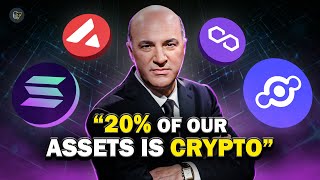
A Cointelegraph interview (recorded April 11, 2022) with Kevin O'Leary covering Bitcoin mining, crypto proxy stocks, regulatory barriers to direct institutional crypto ownership, other crypto infrastructure opportunities (exchanges, wallets, NFT platforms), and O'Leary's personal crypto positions. Key points: O'Leary criticizes carbon offsets, promotes a "Norway model" of green hydro-powered mining (he's an investor in Bitzero), explains that regulatory/compliance/ESG rules prevent many institutions from holding crypto directly, and discloses his operating company's crypto allocation is 20% (up from 7 last year) with 32 positions including HBAR, Polygon, Helium, Avalanche, and Solana; he is a shareholder and paid spokesperson for FTX.
Questions this video answers
April 11, 2022.
20%.
7%.
32 positions.
HBAR, Polygon, Helium, Avalanche, Solana.
Chapters
Welcome. The man I'm sitting with today needs no introduction. You probably know him as Mr. Wonderful. Maybe you've seen him on Shark Tank. He's a fellow Canadian businessman, entrepreneur. Kevin o'. Leary. Kevin, it's wonderful to have you today.
Great to be here. But I also want to make sure we cover my other nationalities because I don't want to diss anybody. I'm also Irish and recently became an Emirati.
Emirati, wow.
So much happening in the Middle east, in the uae. Great for business. Big crypto. Big.
That's excellent. So, Kevin, yesterday I heard you speaking about bitcoin mining and potentially its role in creating a greener future. A lot of people might not understand that because of all the fud surrounding bitcoin mining. Can you explain maybe the role of bitcoin mining in creating green technology or actually paving the way for more green technology?
Yeah. And it's a good observation you're making. Let's start with fund flows. Okay. Because what. Bitcoin mining is a capex. It's an infrastructure play. It's a data center play. So when the first companies started to build up hash here, hash rates here in the United States, they basically linked into the existing electricity lines, not knowing what the source of that power was. It might have been flared gas, it might have been coal. It could have been. Whatever it was, it's blended now. That was fine two years ago. And why it mattered was that many large institutions like sovereign pension plans, they are not allowed to own bitcoin, but they want exposure to the assets. So what they did. And I know this because I'm in the indexing business. So let's say you're a sovereign wealth fund in a Middle east country and most of your wealth came from oil, but you don't want to invest more in oil. You already have that. So you go to an indexer and you say, okay, index me the S&P 500 ex oil, ex airlines. We don't want to own those. And so indexers like me do that. So we're exposed to fund flows by the trillions, you know, 24, 7. We're servicing these giant entities and they are majority of wealth, US Pension plans, sovereign funds. This is where most of the money is in investors. So the reason I'm walking you through this cycle is you'll understand this massive switch that's going on in bitcoin mining. So we indexed all these companies, companies like Marathon Hive, Hut8Riot and others. And that's how these large sovereign plans own Bitcoin. Because the price of these public stocks goes up and down as a proxy against bitcoin pricing. So if bitcoin pricing gets cut in half, they get cut in half. If it doubles, they double. So it was a great way to own bitcoin until the ESG mandate came out from. It started with BlackRock, then you saw it in the POTUS executive order. Then the SEC just announced they were in a memo that they're contemplating carbon audits on public companies. Doesn't matter. What if you're a bitcoin miner or any company that's in the s and P500. And here's the problem, everybody knows and all of the bitcoin miners were using carbon offsets. So they would say we're carbon neutral because you bought all these offsets. The offset market is such a wide range of, call it target error that it's impossible to audit it. And here's the problem. The SEC order is contemplating getting your audit firm to sign off on your carbon neutrality in the same way they're signing off on your financials. You can't get an auditorium to sign that right now. They're never going to do it because everybody knows that tracking error is so wide on carbon offsets. In another term, carbon offsets are bullshit. That's the only way to put it. Okay, so all of a sudden we had to sell all those shares because we know they're going to get into a lot of trouble when they try and prove their neutrality. So the new mining is emerging. It's being funded primarily by sovereign wealth. And here's how it works. You find a country like Norway, or you find a province like Quebec or upstate New York or Montana or North Dakota where there's excess hydroelectricity. You build a facility right by the turbines. It's a brand new build and you get an agreement with the miner. And this is happening right now in Northern Norway with a company called Bitzero. It's a private company. I'm an investor in it. So its largest investors are the United Arab Emirates. Every coin that they're awarded is staying on the balance sheet. So that becomes our proxy to Bitcoin. Now we own our coin. Now we've mined it ethically. Now we've mined it all green. We do not have to be audited for carbon because there is no carbon. It's 100% hydro. And so in doing so we are not only capturing unused hydroelectricity, we've got the latest state mining equipment which uses 40% less energy. We're taking the heat from the Stacks and creating a hydroponic facility that grows tomatoes and a canning plant beside it. Because in northern Norway there's not that much sun for tomatoes. We're integrated into the community. We are creating a new power source for all the citizens in that 3,000 person village that is the new mining. So the best way to look at this is we should applaud the early miners that built up capacity here in the United States. But they are essentially the pioneers with the arrows in their back because the capital is going to move away from them and it's going to go to the new generation of miner, which is the Norway model, as I call it. We're building these in almost every state here in America that has hydro. We're very fortunate because we have access to the latest technology. A lot of people don't realize this, but it's the sovereign wealth plans in the Middle east that were nascent early on, 25 years ago to buy capacity of chip manufacturing in many, you know, the global foundries and many of the other Taiwan semiconductors, et cetera. So we have access to those mining chips that we need and we're going to build these new miners all over the world. Brazil has Hydro, Georgia has Hydro, all of these, Quebec has Hydro. That's the new model. And I'm not against what's happening with the existing public companies us. And I'm getting a lot of people aren't happy for me telling the truth, but it is the truth. They're screwed. They're going to face carbon audit. What can you do? And everybody knows that it's going to be very hard for them to pass that. And whatever happens, their stocks are going to be one alternative for an institution to buy. Or all these other companies will go public in the next 18 months. It's obvious which ones they're going to pick. They're going to go with the green miners, the real green miners that don't have to deal with carbon offsets. Bottom line is, and I think policy is showing it and the SEC is driving it, POTUS order has it carbon offsets are bullshit. That's the story.
Absolutely. Absolutely. That's interesting. You talked about, you know, for me, crypto proxy stocks are a way for these legacy financial institutions to actually participate in the market. What's the limiting factor for outright ownership of Bitcoin? Is it still the regulatory side? Is it uncertainty on which way it's going to go? From a, you know, from a policy perspective, what's preventing so many legacy finance institutions from actually investing outright in crypto or are they waiting for spot ETF for example?
Well, you're 100% right. It's completely regulatory. So here's how a sovereign pension fund would work. And this is pretty well the mandate. Stateside and globally. Let's say you're running a $100 billion mandate. You have certain parameters you're allowed to work with and indexers like me, we work with these people every day. Generally speaking, there's 11 sectors in the S and P. You're allowed to hold up to 20% in any one sector and up to 5% in any one stock. So those are sort of the diversification mandates. And it's been that way for, you know, some derivative of that for forever. So you get diversification within the broad 100 billion dollar mandate you have on top of you as the money manager, a compliance department. They mark to market your positions. By the second they know exactly what you hold, whether you've breached the mandate, whether you're in an area that you're not allowed to invest in or whatever, how much leverage you have on. If you have leverage. All of these things are in this infrastructure build out that's been around for decades. On top of the compliance department is now an ESG compliant department and an ethics department. And so the reason none of these funds, you know, people are so excited about Bitcoin and say, oh this is amazing. And we're sitting at forty plus thousand dollars. The truth is the majority of the world's managed money, trillions and trillions of dollars, has this much bitcoin zero. And they are never going to put it on their balance sheets until they get the regulatory environment to give them the rules. Then the compliance department to say okay. Then the ESG committee to say okay and the ethics committee to say okay. So they don't want coin that's mined in China, for example, because it burned coal. That's the ESG guys coming in and weighing in. So this is forcing a change. It's not changing the nature of a coin that's awarded, but people want to know the provenance of the coin, which is why these new age miners, the Norway project, the Bitzeros, all of these other companies that are going with 100% green hydro, they're very coveted. Their shares are going to be very coveted as they come onto the public market because now these sovereign plants can buy the shares of these companies. They pass ESG mandates, they pass compliance mandates on ethics and they are an equity. So they're going to be able to be held within one of the broader mandates. So there's a tremendous amount of capital funding these new miners and that will be the proxy for exposure until the SEC and the other regulators in the US which pretty well most regulators around the world abide by. That ETF you talked about is actually was an issue, an order from the OSC in Canada, which is one of the most advanced. They were the first to bring an ETF that had the underlying being Bitcoin, but they also brought an ETF that had the underlying Ethereum. And the policy up in Canada is they also issued the very first crypto exchange with a broker dealer attached. They're very advanced. But my thesis, this is a personal opinion, is that the SEC has a very close relationship with the OSC in Canada. Their policies are almost identical. They're probably using Ontario and Canada as a guinea pig to try these policies. Right. And if they work, they'll use some of these maybe in the United States, which we hope. But I'm very bullish that policy's coming because you've seen bills coming from Senator Lummis and you've also got the same from Hagerty. You know, there's all kinds. Toomey was on CNBC this morning talking about stablecoin. The Hagerty bill is a two page bill that contemplates stablecoin. So there's a lot of momentum on the regulatory side that I'm very excited about.
Well, as a resident of Ontario, I can tell you the sky is not falling because we have a Bitcoin etf. So there's really not much to be afraid of. Everyone, right? So we talked about bitcoin and the bitcoin mining. Are there any other sectors within crypto that you're really excited about? Is it the defi space? Any other investments that you're really looking into? Maybe a thematic investment potential that you look at within crypto?
Yeah, I'm very, very interested in as an investment thesis. And this is not only in Canada, but globally. Show me the jurisdictions that are issuing crypto exchange licenses because that's the infrastructure of crypto forever. And so uae, United Arab Emirates, particularly Abu Dhabi, Brazil, Argentina, Switzerland, the uk. I'm using a vehicle called Wonderfi, a company that's a Canadian company. They own the largest crypto exchange in Canada. They bought bitbuy. They're looking at other opportunities all over the world. I assume that's what the management has said to the market. And I'm very interested in investing in that because I'm hoping what they're going to do is a roll up exchanges globally and what better place in Canada because Canada has been so accommodative on issuing the very first crypto license. The other area that really intrigues me and what I like about WonderFi is they have both centralized wallets and decentralized. So where they're allowed to provide a decentralized wallet which that means when you acquire a customer they can keep both wallets active. Maybe your NFTs are in a decentralized and you're keeping your coin in a centralized wallet for security reasons. But the point is they have both. I love infrastructure so I also have a position in bit zero which is also private but building the Norway model. That's infrastructure data centers and bitcoin mining. They're looking at many opportunities around Hydro stateside. And then of course there's immutable holdings. They're the infrastructure for NFTs. They own NFT.com I'm a shareholder. Jordan Fried is the CEO there. These are all infrastructure plays. That company again went public in Canada. Hold is the stock. So there you have it. I mean there's lots of opportunity. And within our operating company's portfolio now 20% is in crypto. That's the most I can hold.
I was going to ask you, have you reached your 20%? I know you mentioned it last year. Have you reached the 20% threshold?
Last year I was at 7.
7.
Yeah. So now I'm at 20 and we have 32 positions on. It's the most exciting part of my portfolio, the most volatile. I mean it's all over the map every day.
Care to disclose what kind of assets you're holding?
I will, I'll disclose some of them. You know part of this came through my relationship with ftx. I'm a shareholder in FTX as well as a paid spokesperson. I have to disclose that I love what Sam is building there, you know and I use my FTX wallet obviously. But I also own hbar. I own Polygon. I just put a position on in Polygon after you know, meeting Sandeep. I love his vision of reducing gas fees, particularly you know, for people that can't afford to spend that much on eth. But he's, you know, he's aggregating transactions and passing them through in one. Saving a ton of money. I love that idea. Just got into Helium also Avalanche Solana. I'm a big believer in that. I've got, I've got 32 aggregate positions. Those are some of the larger positions. And so I don't know which one's going to win, nobody knows. But certainly, you know, Ethereum's too slow for me as a financial services guy, so I'm looking, I'm hoping that Solana ends up being something much faster. It's got the backing of Sam Bankman Fried, which is always a good thing. But there's a lot of new ideas and I'll back any entrepreneur that has something of value. I'm not so much onto the, you know, for lack of a better word, the shitcoins. I want something to show economic potential, to create value somewhere. But it doesn't mean you can't have fun with crypto. You know, if you want to trade.
Some dogecoin, great Doge along Mars and.
Stuff like that, that's all fun. It's like going to Las Vegas.
Yeah, some healthy speculation isn't too bad, right?
Yeah. And I'm also very, very interested in seeing policy come through on stablecoins because in many of my operating companies we have large cash positions. We're making 22 basis points if I can lend out a contract for 30 days at 4% on, you know, USD or whatever. There's many ways to go on stablecoins, but we really need policy there because my auditors and my compliance departments will not let me put on a significant position on stable.
You've got to think that market is really ripe for growth given the yields that you can earn just by holding stables.
Compared to the yields have come down over the last three months because we're past 100 billion, but it's still better. And I think why it should be standardized as policy is it allows the US dollar to remain the default currency globally, and you want that. And I'd like to do a lot of the work I do in Europe on USDC and just not have to go through FX transactions all the time. But we need regulators to approve that. But we're in nascent days, we're early days, but I'm extremely optimistic.
Excellent, Kevin, Appreciate your time. Sam, with Cointelegraph. It was great to talk to Kevin o' Leary and we'll continue the conversation.










