Learn How to Develop Your Own Trading Style | Peter Brandt & Joe Saz
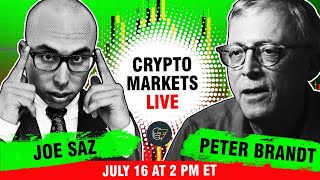
Peter Brandt and Joe Saz discuss how to build your own trading style, from risk management and position sizing to choosing between classical charting and order-book analysis. They cover bitcoin price action, a recent Twitter scam, and what separates professional traders from amateurs.
Chapters
Tune in now for the latest market update.
Market falls like a knife.
The weak hands are out, the strong hands own it. If you think trading is easy, that's the fastest way you will actually get.
Wrecked with your hosts, Jackson and Giovanni. This is Cointelegraph's Crypto Markets Live. Of Cointelegraph's Crypto Markets Live is sponsored by Tokenbox. Tokenbox is a convenient, state of the art platform for managing your digital assets. It has advanced security infrastructure, deposit options for both cryptocurrencies and bank cards, a designated wallet for converting currencies on site, and multiple portfolios that can be managed under one account. All this makes the platform a one stop shop for professional managers and digital funds. Check out Tokenbox IO using the link in the description below. What's up everyone? Welcome back to another Crypto Markets Live. I'm your host Jackson and I've got a couple of very special guests with me today. So I have Peter Brandt, who is a trader of classical charting principles, has 45 years of trading experience, is an author and publishes the Factor Report. How are you doing today, Peter?
Hey. Hey. Good to be with you, Jackson. I'm doing great.
Awesome. Great to have you. And our other guest today is Joe Saz, who is a YouTuber, order book trader, corn farmer and self proclaimed bitcoin maximalist. Welcome to the show, Joe.
Pleasure to be here. Thank you for having me.
Awesome. So today we've got a few interesting topics to cover. We're going to get some reactions to yesterday's Twitter hack which was a really interesting event that was really interesting to see go down. And then we're going to take a look at bitcoin and potentially some other cryptocurrencies. And the theme of this week's show is to learn how to develop your own style of trading. You know, how do you go from being an amateur trader who doesn't really have an idea of what they're doing to having a cohesive strategy and being able to follow your own kind of initiative. So that's what the agenda is looking like today. If you guys have chat, if you have any questions throughout the course of the show, don't be afraid to just write them in the chat and I can ask them directly to our guests here. I'll be checking out the chat along the way, so holler at me and we'll get to it. And if you enjoy these kinds of shows and you want to stay up to date on them, make sure you hit that like button. Subscribe to our channel. We have these Shows every week and occasionally like yesterday, we bring you breaking news, so. So make sure you stay tuned for that. So let's get to it guys. We're gonna start with yesterday's extreme events. Twitter yesterday suffered the largest scam hack in its history of existence. Coincidentally, yesterday was also Twitter's anniversary of going public. So little interesting fact there essentially. I'll just break down quickly what happened. We were covering it live yesterday, so if you wanna go check out that Bob, it's up on our YouTube channel. But pretty much what happened was that there was a website called Crypto for Health that was saying that it was going to give a 5,000 BTC giveaway. And then later on Twitter accounts started getting hacked. First it was crypto people. CZ Binance, Bitfinex, Justin Tron, all these accounts got hacked and then it moved on. It spread out. The hack spread out to other celebrities, including presidential candidate Joe Biden, Kanye God, Wendy's, Kim Kardashian, Bill Gates, Apple, Jeff Bezos, Elon Musk, and pretty much everyone who was a big name in tech got hit with these scams. And essentially all the scams were doing was asking for people to send them, asking the people to send bitcoin to a specific address and they would promise to send back double that bitcoin. And I think they accrued around $120,000 worth of Bitcoin to that address. And then Twitter decided to take some pretty significant action. They locked out all verified users from tweeting on their accounts. So anyone who had a blue check to their name was not able to tweet for a few hours, I believe. So this is essentially what went down yesterday. It was a huge deal and everyone was all in a tizzy over it. So I'd like to get your guys reactions to it. Obviously Twitter is like the hub for crypto. Ta opinions, memes, all things. Crypto is always on Twitter all the time. So Peter, I'd like to start with you. What were you experiencing as you witnessed this scam? And, and what was your initial reaction to it?
Well, I wasn't even aware of it at first because I was up shopping with my wife and only when I got back was I where I wanted to send something out. I'm verified, I'm blue check marked. And so I was going to send a message out on something, wasn't even aware of the hack and the message didn't go out. I was notified that no outgoing tweets were going to take place from, from my account. And then of course I Looked on Twitter and realized the news. And, you know, it's my first reaction. My reaction is really two things. First, how what a meager amount was given. I mean, relative to the magnitude of the Mac, of the hack. Excuse me, $120,000. I mean, that's a pretty weak showing, I think. You know, the other thing was just how unsafe we are. I mean, obviously we're all hoping that Bitcoin itself can't be hacked. People's accounts can be hacked. People's bitcoin trading hack can be hacked. All kinds of things can be hacked. But, you know, you're not safe out there. Whether you're Twitter, whether the U.S. defense Department, whether you're Sony, whatever the case is, hackers are very, very sophisticated. We may have double encryption, triple encryption, as I have, but wow, we're exposed at all times. And so, you know, the Internet's a dangerous place.
Yeah. Before I throw it over to you, Joe, I just want to give a little bit more information about the hack. So yesterday during our livestream, our news team was investigating what was going on, and we got a tip from an anonymous source that essentially laid out how the hackers got into these people's Twitter accounts. And essentially Twitter called it a social engineering attack. So what happened was that an outside, a third party entity was able to gain access to high level employees in Twitter who had admin access to a lot of accounts. And then the high level employees at Twitter went around changing accounts, email addresses to their own email address. And then through that, they were able to change the password on the account and then get access to the account. So there was someone inside Twitter who was working with someone outside Twitter in order to gain access to all these accounts. So technically speaking, this wasn't a hack because there was no bypass security breach. I mean, the security breach was human. It wasn't like computer program. So that's why they call it a socially engineered attack. But the end result was the same. So, Joe, what is your reaction to all this?
I think it's the first thing that I think is a really important point is we don't know how much Bitcoin actually came from the pockets of, let's say, deer in the headlights. Let's assume that some of that was the hackers themselves or whatever you want to call it. I do think that it shows that bitcoiners are pretty trustless people. I look at something like that and I'm like, scam immediately. And to know that this scam that must have cost a lot of money to Operate from an inside job perspective to run through two factor authentication settings and such. This was obviously an expensive move from a hacker's perspective and they made relatively little. Assuming everything they made was profit, that's still relatively little. So I'm happy to know that the bitcoin community is skeptical. I'm happy to know that if there were some noobs drawn into this trap, there weren't too many. And my reaction is, certainly is one hell of a move. That was a big, big play. Never seen anything like it.
Yeah, I mean, the world's never seen anything like it. So that was really crazy to witness in real time. So I like to turn our attention now to bitcoin's price, because bitcoin's price has pretty much not reacted whatsoever to these events. And I'd like you guys to now take a look at what's going on because we've had this sideways chop for like, what is it now? Months, and it seems like the range just keeps decreasing and decreasing and decreasing. So the real question is, you know, how much longer are we going to keep, is this going to hold up? So, Peter, let's, let's start with you. You know, what's, what's your read on the current bitcoin price action?
Well, yeah, I mean, it's like watching paint drive, really. We've been up in this area for an extended period of time. We're tightening up our trading ranges. We're, we're tightening up our atr, a key, a key indicator that I look at. I'm not an indicator guy, but Israeli ADX, whenever you get ADX, under 12, under 10 especially, be prepared for some sort of move out of the trading range that we've had. We're not down there yet. We'll probably get there. But this is a market that's not very fast to go anywhere. I just look and say, wow, the government, with all governments printing money the way they're printing, you know, the narrative right now is such that it seems like it would be an easy play to say, wow, I'm buying bitcoin. We've got a global virus going on. We've got fiat expansion like never before. And you know, that's the narrative that people would use to say that they're constructive to bitcoin, that that's a reason to own Bitcoin. But yet bitcoin is just kind of lulling people to sleep there. And personally I think that's not going to change here in the near term. We're not going to see Bitcoin really move to the upside, I don't think until maybe mid September. I think between now and then, we either chop sideways or we have a sharp shakeout. I, you know, I'm always trying to think to myself, what's the easiest play? What's the easiest thing to believe? I think the easiest thing to believe by the noobs is I'm just going to own bitcoin here, and this is great to buy, and we're going to the moon and there's no risk to own it here, and I'll buy it here and we'll be at a million dollars before you know it. Markets don't make it that easy. Markets always show some curve balls in there. And I think it's too easy to think that bitcoin, it just needs to be owned here, and it's just a matter of days or weeks before we have an upside price explosion. So I'm trying to figure out where's the surprise coming from. And I think personally, the surprise is that we see a shakeout in bitcoin. This is not a prediction, but I'm trying to think through the market psychology is we have a sharp break in bitcoin, maybe back to 7,000, 7,500, and really stir the pot. I mean, what a perfect thing to happen. You know, everybody, you know, people are really excited about the alts now. There's some big alts making move, thinking, okay, bitcoin's next. We've got great plays going into the alts and all of a sudden, in light of that, we get a shake out. Bitcoin, you know, that that's going to try people's patience. You know, we're 31 months away from the high now. It's been 31 months since Bitcoin topped. That's enough to wear people out. You know, we get a shakeout here and I think we shake the tree and we probably get rid of all of the folks that we're talking about going to the moon in December of 2017, finally going to give up the ship. And so in the back of my mind, that's kind of what I'm thinking, what's the surprise going to be? And I'm thinking the surprise would be a big shakeout, 7,000, 7,500, turn on a dime, just like we did in March, and then run the market straight up to 12,000 and leave everybody waiting behind with a bushel basket wanting to buy the first break, which won't happen.
That's an interesting take on that. I'LL be curious to see how it turns out. And I just want to remind everyone who's watching and chat if you have a question for either of these guys about bitcoin price action, trader psychology, you have it. Make sure you write in the chat and I can ask it directly to them. So Joe, I mean you look at order books and so naturally trader psychology is a big deal for you. How does this sort of analysis of trader psychology right now line up with what you're thinking about?
I'm actually with Peter for a number of reasons here. I can explain it or I can share screen at a later time whenever you want to do this. But I have a service here called Trader TRDR and it provides a lot of volume data that's really interesting to me. One of the most important things is that over the past couple months the total amount of bids and asks has increased to 15,000 Bitcoin approximately on Binance USDT Bitcoin USDT pair. So we're talking from 0 to 10% up, 0 to 10% down. There's 15,000 orders roughly right now. 6,000 bids, 6.2 thousand bids, 8.4 thousand asks. So there's a very, very liquid book right now. And that's why we've been ranging. It's just been really hard. It's going to cost a lot of money fiat to break the price to the upside or it's going to cause cost, an accumulator, a lot of bitcoin to dump the price. And what's been happening is we keep hitting this nine thousand dollar range, eight thousand nine hundred, whatever and then the sellers pull the liquidity, they stop chasing the book, they let the buyers run it right back up with no volume and then they let it sit, move its way back to 9300 and crush the price again. I think bears are in control of the market. I think they're doing, you know, as far as psychology is concerned they're repeatedly pulling the rug out from underneath the bulls feet and the bulls just keep showing up. And I think Peter really mentioned a great point that there's a lot of people that buy bitcoin with the intent to hold probably forever. So we have that, that constant, you know, upward, you know, I don't care if bitcoin goes to zero mentality, just constant upward pressure from DCA toddlers to the last resort.
Right.
So I think it's important to note bitcoin is very stubborn on the way down. I think it's due for a breakdown. I actually have, I think 7,000 is probably my optimistic target. I think a more natural price discovery in my eyes is between 4 and $6,000. That was the April 2, 2019. We had an individual buy about 20,000 Bitcoin on three different exchanges, cumulatively on three different exchanges. And that made me think this is where big money wants to buy bitcoin. So I believe that we're probably headed down to that range and it's probably going to be an elevator down. It's probably going to be externally driven by some sort of news event. The market seems very kind of common and organic right now. So I have a feeling it's going to be an external variable that causes this. And I do also believe that it's going to happen fast and we could go lower. But I think a lot of traders should be having bags under their eyes over the next few weeks.
Thanks for that. And you were speaking about volume there and crypto days. Any has a question about it. He says any thoughts on the declining volume on the daily btc? Is it relevant and when do you consider this trend as broken? Peter, do you have any thoughts about this?
Yeah, I mean, we've got a lot of. There's a lot of liquidity. I think even though volume is down, Joey Joe pointed out we've got massive liquidity on both sides of the market. It reminds me of some things I've seen in the gray markets over the years where you really have no actual volume going down. But if you move price, you've got volume like crazy because you have liquidity that's bracketing the market. And that's really what we have. And so I think the low volume to some degree just shows that the market is coming to a point of equilibrium. I mean, that's what's happening. It's balance. You have a balanced market. You have a balanced market with no volume at the current price but a lot of liquidity on both sides of the market. And so when you get sharp days up and sharp days down, then you get volume that come in the market because you have ordered sitting there. Markets tend to either sit still and do nothing or else move to where the liquidity is. Markets are attracted to liquidity and eventually we work into that liquidity. But for now, it's a market that's balanced. There's just no interest in the market to move volume at these current prices. And as a result, we just are drifting sideways.
So what you're saying essentially is that there needs to be some sort of price move shock in order for the volume trend. To have any significant change.
Yeah, I think that's exactly right. Great.
Do you have anything you'd like to add to that, Joe?
No, I think we're in agreement. I actually really think that's an interesting statement. You just said markets. Markets are attracted to liquidity. You know, I'm kind of thinking on that. I don't know if it's the same ballpark you're in, but it would lead me bearish. I'm leaning bearish. We have 2,000 more bids in the same space, 0 to 10% from price. I think it's going to be very difficult to grind our way up. I think bulls have been exhausted and I could present my case. I think bulls have been exhausted in the 9000 range for a while now. I think the 10k move to the upside was a bit of a hiccup. There's a lot of liquidity pulled, stop loss areas that were triggering right into the next stop loss area as a result of a lot of liquidity getting pulled. So I think that was a bit of an anomaly in my eyes and obviously the breakdown wasn't in my eyes. So I just think that this market is supported somehow. Right now we're really rejecting 8,900 9,000, but I really think that the next move is going to be most likely a violent move and it's probably going to be to the downside.
So when bitcoin's kind of maneuvering in this very tight range. Are you guys actively trading on this? Have you made any trades today, for example, with these small movements? Peter.
There'S an altcoin that I've been buying the last couple days. I haven't been involved in bitcoin at all. I bought Live Cattle today, but that's not a coin, so your viewers should not go out and look for a coin called Live Cattle.
And what about you, Joe? I mean, I saw that you're actually involved in a trading competition lately. So what were you doing with that?
Yeah, so over the past week, I've been trading violently. Obviously, this has been very risky. And I created a set of indicators to specifically handle this much liquidity and to manage the ratio that I am going to use to make a trade. A ratio of bids to asks or ask to bids, essentially an overextension point from one or the other side. And currently in this competition, I'm in first place at 108% P&L.
That. That's. That's awesome.
Good work. Good work.
Thank you.
Yeah, yeah, we love to see success like that. So I Think I. I heard you say earlier, Peter, that you don't really use indicators much, which I thought was an interesting statement, because I think Joe has his own, you know, SAS signal, which is his indicator. And I think a lot of traders, you know, like to use these indicators in order to inform their trading. And I'd like to use this as kind of a segue into one of the main themes of today's show, which is developing your own trading style. Like, how do you develop your own trading style? And for those of you who don't know, there are four main trading styles. You got day trading, position trading, scalping, and swing trading. These are all differentiated by time, more or less. But it seems like no two traders follow the same methodology, that even though there are these broad categories, each trader has their own method. So my question to you is, how do you develop this method of trading? Is it something you just kind of work into? Do you have some sort of instinct that pushes you in a certain direction? How did you personally find your groove, so to speak, in trading? Peter, let's start with you.
Well, I mean, do we have a couple hours? Because it may take that long for me to explain. Explain it. I'll try to give you the condensed version. I blew out a number of accounts trying to figure out how this thing is, how this thing works, this thing called market speculation. And there's no easy way. You just have to pay the tuition, and the tuition is paid by making mistakes and making them over and over again and making the same mistakes, sometimes multiple times. And you just try to go through trial and error. And everybody's. Everybody's root there is different. Everybody's path is different. For me, I tried a lot of ways. I knew I wanted to trade. I mean, I knew that's what I wanted to do. I'm driven by the desire to trade. I look back now and realize my motives were not right. I had the wrong motives for wanting to trade. And eventually I figured out the right motives. But, you know, it's just, you're finding your path. And for me, it was finding a path that really the area I call classical charting. I became a classical chartist. And, you know, and so you just. You build a trading approach based on certain presuppositions, and you develop these presuppositions and you develop these assumptions on how you trade, and you find out whether they're right or wrong. And you just work out the process over time and you get to something that you're comfortable with. And for everybody, that's a Different thing. I mean, my basic presupposition is I don't think anyone really knows where the markets are going. They may think they know, they may have a strong feeling, they may convince themselves they know, they may even convince other people that they know, but they're not going to convince the market of that. And so my default assumption is I'm going to be wrong on the next trade. And I go with that assumption. And that assumption drives everything else I do in the markets. And so I'm a classical chartist. I look for chart patterns, I look for head and shoulders and rectangles, ascending triangles, and I look for patterns such as that and believe that, you know, and all an indicator is, is a derivative of price. You know, every indicator that you have is a derivative of the price of the underlying commodity or coin or whatever. And so why should I study a derivative when I can directly study price? And so that's really the focus of my attention and is trying to study price to find those spots on the chart where I have an asymmetrical reward to risk ratio. It's not about being right in a market call. It's a matter of money management. And where can I find spots on the chart to take, to take a long or a short position. In the case of cryptos, I'm only long, but to take a position that gives me the ability to control the risk under the circumstances. And so, you know, I really have no desire ever to be a bull or a bear. And I really don't want an opinion on where market's going, although I do have opinions from time to time. But I'm just keyed in on how I can manage risk. I'm a risk manager, I'm not a trader, I'm an order enterer. All I do is order, is enter orders and I try to enter orders that makes sense in relationship to protecting my capital. And so that's kind of where I have, that's the path I've gone. That's what I've evolved myself in, I think as a trader.
Thank you for that. That was incredibly interesting. So essentially what I got from that is, you know, you kind of, you found your focus, which was on charting through a series of trial and error processes. And it just, it just took time and money in order to get there. So now I'd like to kind of see how that compares with your experience, Joe, because you focus a bit more on order books rather than simple charting. Well, not simple, but rather than charting. So how did you find your way into this Area of focus. Was it through the same, like, trial and error process, or did something carry you in that direction?
Initially, yeah, I came in as a complete noob. I didn't even know what an indicator was. It wasn't until I became a student of tone vase attending one of his seminars in January 2018 that I learned about indicators and I learned about various other things. Ignoring other people, a lot of stuff, basically. To get onto the general topic here, I think passion is really what drives you into distinction, discovering your identity as a trader. I started and I did. When I started trading, it was. I hated my life as it was, and I really wanted to get passionate about something. I've been lacking that for many years. And so as I became a trader, I was regularly staying up three days straight. I forgot to eat, I forgot to sleep because I was so passionate about what I was learning. Ultimately, I stared at G. Dax and I said, I'm a smart dude. I don't know what any of this is, but I can figure it out. And the thing that spoke to me was the order book. So after learning from tone about some indicators and some general trading principles, of course money management came a bit later to me from ugly old goat, which I'm glad you pointed out, Peter, because I think that should be number one. Don't lose money more than try to make money is kind of a first goal in my eyes. But I developed my identity as a result of passion in this analytics space and a lot of trial and error. Of course, none of us would be here telling you, sharing wisdom had we not learned the hard way. So, yeah, I think it's a combination of when you get consumed with your work and passion, I got ultimately consumed with my observations of the order book. And from there I started creating definitions, observing notes. I took months and months of screenshots. I analyzed everything that I possibly could as it relates to the order book and particularly the psychology. The way I break it down is the order book is like the fighters as they look at their eyes, at each other's eyes in the ring, and the stats as to what guy's arm length is longer and who weighs more. Those are all indicators and they're all shit to me, I don't care about. So I built my identity with help. I stood on the shoulders of giants. Peter Brandt. I remember learning a bit from you, some of your very wise sayings that you throw out sometimes. Tyler Jenks. A good handful of people have really brought me to where I am. And of course, my passion has brought me the rest of the way.
That's a really good point, Joe. I really appreciate what you had to say because, you know, if somebody comes in and they don't. They don't love trading. I mean, you gotta love trading. You gotta love the markets. You have to have a passion for the markets. If someone comes in and their just goal is to make money, they just want to make money, but they don't have a deep driving passion in the markets. Good luck with that one. I mean, you gotta love the markets for what they are, not necessarily from any dollars they're gonna put in your pocket. Because the reality is I, you know, people who make a lot of money right out of the gate look out because they're usually going to lose it all. I mean, the best traders I know are the traders that lost money on their first trade, and they lost money on their first five trades, and they gave them respect for the market, respect for risk. So, hey, I really appreciate what you had to say there, Joe.
Thank you.
Yeah, thanks for that. Thanks for that, guys. That was, that was a really interesting comparison with, With a number of great analogies in there. I really enjoy hearing about how you guys actually approach trading. It's really interesting to see, not only that your passion is driving you, but everyone sees things a little bit differently. Your analogy with the fighters was really interesting because it's a very psychological thing, but also Peter's approach of just breaking things down to their most simple form, you know, like, this is the price and this is what I'm going to look at. So I like those two very distinct approaches, and it was really great to hear about them. And we actually have a question from chat, Jim Vasilo, who asks, how did you reach where you are as a trader? And I think the main question is, what made the biggest difference in your journey as a trading? What was it that made the biggest difference? You know, when you look back, is there a specific moment that you remember? An experience that you had that really, like, that made you realize something? The cliche, like, epiphany moment, anything like that you can talk about, Peter?
Well, you know, I had an advantage I think guys don't have today. And I was at the Chicago Board of Trade, and it's a building that was filled with very successful traders. You rode the elevator with them, you ate lunch with them, you rode the train home with them. And good traders usually are people who are willing to share things. They're willing to tell you what they think. They're very generous with their ideas. And I was in the Pits with them. And I just remember the best wisdom I had was from a guy who kind of took me under his wing. He was an outstanding grain trader. And his lesson to me is, if you have a loss at the end of the second day, you're in a trade, get out of it. If you have a loss on a Friday afternoon, don't take it home during the weekend. You know, your job is to deal with your losses, let your winners take care of themselves. Your job is to manage your losses, and things will turn out in the end okay. That was a real good learning lesson for me. A lot of people learn that. They learn that the hard way, and they learn that the expensive way. And I heard it and took it under my wing. I think the next thing was that, you know, you flounder around, you try things, and eventually, in the case of Joe, it was the ladder. It was the price ladder. But you stumble upon something and it becomes a. I understand this. I get this. I resonate with this. And for me, that was a book by Richard W. Schabacher. He wrote it in 1933, and it was dealing with classical charting principles. I tried all kinds of different approaches, and when I read that book, it was like, okay, I get this. I can do this. This I understand. This is the lens that I can put on, and it's the lens that I can use to look at markets and make sense and then accomplish. What I was given in terms of good wisdom by people who really, really mentored me is given now the charts. I can combine that with the fact that my job is really to manage my losses and let the winners take care of myself. But that took years. I mean, it really took me four years to get to that point where I could see the fruits of what I was doing. And I think people come in and think they're going to get it the first year, the second year, they're going to figure it all out. That just doesn't happen. I mean, sure, it does happen among some people, but I think for most people, it takes three, four years to really get a scent, pick up a scent that says, okay, I'm, you know, I'm a sniffer dog, and I finally picked up a smell. And, you know, you got to keep your capital together during that time, because if you blow your capital out, you never reach the point where you have a clue as to what to do.
Yeah, a lot of good points right there. Expertise takes time and practice and, you know, just a lot of failure. And. Yeah, so I'd like to Also compare that with your experience, Joe. I mean, what was like the biggest moment for you when you were going about trading? What really defined your experience?
Yeah, there's two things that come to mind and I'm also going to give you what I learned from that. One of the biggest things that I learned was losing my money. I was so sure of this one trade and I remember losing my first bitcoin in one trade and I was devastated. It was like, you know, there was a convergence of indicators that were suggesting I was, you know, my ducks lined up and I was going to make a great trade. I got blown right through, I got liquidated and I got hurt. It was a painful trade. And that was the moment where I realized, like Peter says, I'm not the one in control here. I am at the mercy of the market and it is a, you know, I spend most of my time in short term timeframes and that's where I prefer to spend my time. Because it really isn't, you know, an easy task to fire it at a target in the dark, which is, you know, a long term call in bitcoin. Right. But the next thing I would say, the most important lesson that I learned that has had the single greatest impact on me was making a bad call and losing someone else's money. That was the most devastating emotional experience I went through as a trader. I had to re evaluate everything about who I am. Is this my life? Is this what I want to do? Everything was up and up for grabs. And the way I made it through was to build a comprehensive strategy that required little to no discretion. I decided then after days not to quit and I decided to enhance my understanding and build a, you know, I needed a stop loss strategy. I needed entries. Exits, take profits, double downs, stop losses. I did not have all that. I didn't, I wasn't managing my money. I was a fucking cowboy just, you know, firing my guns, you know, just, you know, acting like I was a trader, you know, and I, I was aimless and I learned a lot from this experience. And that was the single most valuable lesson that I learned. And from then I fortunately was able to grow and become much better to the point where I'm first place in a competition. It's been a long road, but yeah, that's it.
It's amazing how often the most forming experiences are the ones that are the most emotionally impactful, that really leave you with something that you feel for a long time afterwards. So if I was just starting out trading amateur trader, and I was trying to figure out where I'm going to put my focus, how I'm going to start building a strategy, what I'm going to be doing. What are some of the factors I would be looking at? Obviously, trading. You have limited resources. You're trading essentially your livelihood, right? Your ability to put food on the table most of the time. So what kind of factors would I consider? Should I consider if I was first getting into the game? Peter?
Wow. I would think, yeah. I mean, my observation, and it could be wrong, is, is a lot of the amateurs that come into this have way too short a term. It's how much money am I going to make today, this week, this hour, Where I think the question has to be, this is not a sprint, it's a marathon. Given that's a marathon, what might I do differently? I think that that's one thing. I think the other big thing is whatever you can afford to lose, you have to decide what you can afford to lose to learn. Because that's the reality when you're starting out. You're not going to end up where you start out. No matter where you think you're starting out, it's not going to be your destination. It's going to take time. And you don't really know what that's going to look like. You don't know at the end of five years what you're going to be as a trader. That's a process of discovery. And it's discovery. The process is different for everybody. And so I would say you take all that you can afford to lose and you divide it into 100 buckets and you pretend, okay. And then when you go in, only risk one bucket for every trade. You do no more than one bucket. If you lose a bucket's worth of your money, that trade is over. And I think in the process, perhaps it'll cost you 30 buckets to start getting an idea where you need to be headed. You may end up wasting 50 buckets to finally have a feeling for what you need to do differently. And then you build it from there. But be prepared to lose. But be prepared to protect how much you lose. That would be my advice to you.
Thank you for that. I just want to make a quick reminder to everyone watching, if you have a question for these guys about, you know, how to develop your trading methodology, be sure to write in the chat and I'll be reading it and take a look at it and I can ask it straight to them. So now I'd like to throw it back over to you, Joe. What kind of factors should I be considering if I'm first getting into trading? You know, what should I be looking at? You have that experience of, you know, essentially learning it all on your own. So what can you take from that experience and impart on me?
I would even take what Peter said a step further. And I like, test that, you know, test nets, they do allow you to trade with paper money. And I feel like even though the liquidity is not the same, it's not. You don't have the same skin in the game. The emotion isn't the same. The most important thing you need to do is have a strategy, and then you need to practice that strategy, find its strengths and weaknesses, develop a relationship to not only your strategy, in my opinion, also the asset you're trading. And so I think that those are some of the things that just take time. So if you spend six months, you know, hating your job but keeping a paycheck coming in and slowly trickling into this whole speculative market, you know, analysis, then you're going to build yourself a foundation for success. If you come in with all the money you have and you. Your first account you create is Bitmex, chances are it's going to be gone in less than two months. You create, you use a hundred bucks out of a hundred thousand to make some, you know, pennies or, you know, a couple thousand sats per trade, but positive P L nonetheless, not to mention a strategy behind it that includes, and this is something Peter said that I just can't shake. There's actually, like, probably five things you've said, Peter, that I can't shake. But it's better to get stopped out of your trade and analyze the stock then to not have a stop in place and to get blown through. And that's happened to me about three times of significance where I've been blown through. And I didn't have a stop because I don't like trading with stocks because there are slap hunters out there. But the truth is I could analyze that stop hunting, and I can put my stop, you know, maybe use a little less leverage, create a more of a pain threshold, and then I can, you know, there's the analysis of how I want to assess my stops if my stop isn't hit. And maybe I want to add some leverage closer to my stop up there. I could, but, you know, absolutely, you need to build. You need a strategy. You can't walk in blind. You need to know something, you know, you need to know what it, you know, the various orders are and how they're going to affect you, especially if you're using leverage market orders, multiply your leverage times the fee, you know, so there's, there's a lot of exchange literacy that's required. But also I think a strategy, whether it's borrowed or original, is important and minimal capital, I don't care if you turn $100 into 110, that means that maybe one day you can turn 10,000 into 10,000. 110,000, 11,000. Right. So I think small capital, always start with small capital. Don't think like I'm going to put, you know, 100k in the market and I'm going to turn this to 200k because, you know, this guy, you know, link pumped because the tick tock fuckers, you know, talking about dogecoin and getting people all interested in alts, you know, So I think it is the long run that wins the game in the end and it's the small steps in that lead you to big steps out.
Yeah, thanks for building that up. You mentioned about how having a strategy is so important. So for anyone who's just tuning in, go back about 20 minutes and we were talking about how to sort of find the right way to approach these trades and you'll get some great insights into how to develop your own strategy and then you can come back to this with a little bit more of an enlightened attitude. And I'd like to go back a bit to what you were saying before Peter, with splitting things up into 100 buckets and tie this into with a question from one of our chat members, Tesla. Mr. Who says what kind of position size do you use for a trade now? I mean, are you still splitting it up a lot as you're, your experience has developed over your 45 years of training. How has your position size in trades changed?
Well, my position size is based on the risk I'm willing to, what I'm willing to lose in a trade. And so for me, I'm a chartist and so it's not difficult for me to determine based on the charts where I'm likely to get into a trade and then where I am likely to say this is where I throw in the towel. And so I know what that risk is. Maybe that risk is in bitcoin where I'm willing to risk $300 on a Bitcoin trade. And so for me it's just then a matter of mathematics to get to my size because on my trading I'm willing to risk about 1/2 of 1% of my total nominal capital on any given trading event. And so in other words, I think in terms of a million, or let's say I think in terms of $100,000 of nominal capital, you know, I'm willing to lose 50 basis points or 1/2 of 1% of that on a trade. And so I know what that dollar amount is. I know that my risk in bitcoin on a Trade might be $300 and just simple, simply a matter of division and figuring out on $100,000, I'm willing to risk $500. And it's a $300 risk in a bitcoin. So somewhere in the area of 1 1/2 bitcoins on the trade, but I do that ratio relative to my total nominal capital.
Do you follow a similar procedure, Joe, when you're figuring out what kind of position sides you want to have going into a trade?
Yeah, and I'm curious to hear what Peter thinks about this, because being certain in a market is very rare. But I like to judge my position size on my certainty level. If I am completely uncertain that this thing can pop or this thing can just fall through the floor, I'm not going to be exposing myself to too much risk. If really anything significant. I just, I really boil it down. I'm Never above an 8 out of 10 certainty of a trade and I can get down as low as zero. So if I'm, you know, somewhere at a 5, you know, feeling really good, 6, 7, 8, I feel like I'm in control of the market. I feel like I'm really tuned in. What I mean by in control of the market is I feel like I'm tuned in. I'm, I've been analyzing it for days and days and days and obviously, you know, something can happen seven times in a row and the eighth place it can flip on you. But you know, there's going to be times where you're just really connected your relationship that you built to this asset over time. Whatever you trade, you just really have this certainty level that's greater than zero. And therefore I will expose a bit more capital to that position and maybe even a bit more risk than I typically would. But you know, of course that also comes down to the SaaS signals that I've built on trader. It's been a long time that I've been, you know, working on creating extremes of the order book where price is likely to have overextended on one side or the other. And you know, that makes me more confident, you know, knowing that I have Built a system that now I can see visually as opposed to something that I was doing discretionary, you know, on a discretionary base. Because I'm sure Peter can say order book analysis isn't, you know, something people were doing all this time for decades. I think, especially with platforms that have the data readily available and even visibly available. It's a completely different analysis has evolved as a result of this. There's a lot that goes into my certainty level analysis and if I'm not too certain, even with indicators, they can be saying go long and I could say I'm not certain. I just don't feel good about this position. I'm going to drop my capital and I'm going to drop my risk. It's to going. So, you know, rule number one, money management. Rule number two, money management. Rule number three, as ugly old goat says money management. So, you know, that's the most important thing to me.
Yeah. Joe asked before, I mean, Peter, what are your thoughts on his approach?
Well, it's interesting. I don't understand it because, you know, I came into the market, time went where you never see the ladder. The ladder didn't exist because the ladder sat and in paper piles that were being held by floor brokers. I mean, it was not computerized. We didn't know. All we knew is what was bidden offered at the next tick away from the price you were at. Unless you happen to know a broker in the pit who was handling a large block order for Merrill lynch or Credit Suisse or somebody like that and he happened to tell you, I've got, you know, I've got a million bushels of corn to buy 2 cents lower. But that wasn't public knowledge. It wasn't on. It wasn't on. So you take little tips for me, I don't really look at the order deck the way that Joe does. I think is a very legitimate way. I mean, I'm intrigued by it, old enough to know that I'll never get his knowledge. But there are still little tips that that'll you just have to be constantly aware of little messages the market's gonna send you. I'll give you an example. Just the other day I had an order in a forex trade and it was a stop order. It was a buy stop order. My buy stop order, it was for euro yen and I had a buy stop order in euro yen for €400,000 yen and my stop was hit and the fill came back and it was at a better price than my stop. It was at a lower price than my stop order. I saw that and immediately knew I'm in trouble. This is a loser trade. There is no way that a buy stop should be filled at a lower price than the buy stop. I turned around and immediately liquidated the trade because I knew there's forces here at work that were willing to let me buy at a price lower than my buy stop. I'm in big trouble. And so I just want out, and I want out immediately. And so, you know, whatever it is that a person develops or style, they'll figure out little things that will give them the ability to maybe size up or size down in a trade, to press a trade, or to, you know, to scramble out of a trade.
Yeah, it helps you build perspective on the market, which is really important for analyzing it. And we've got another question from the chat. Pock Poc, originally directed at Peter, but I think it applies pretty well to both of you. As a bitcoin trader, what is the percent you suggest to keep in BTC and the percent that you convert to fiat? Joe, I know you mostly trade bitcoin, so do you have any thoughts on this?
Yeah, most important, I'm in bitcoin for the revolt. Flat fucking out. I am here because the world is a dark place and they've done terrible things because influence through money has created some terrible financial architectures and even political architectures and so on. So I'm in bitcoin for the revolt. You need to decide how much of this revolt am I willing to lose influence of in my trade. And I strongly encourage people to have a hodl till death stack if you are going to choose to take on the risk of trading. And every single trade is a risk. No matter if I feel like I'm at an 8 level of confidence or a 0 level of confidence, it doesn't matter. Every single trade has an equal risk. That is, the trade can easily go against me.
Right.
So I recommend you make that decision. It is your own. But keep in mind, bitcoin is here to change the world. And if you're going to risk what you have already, you better have a damn good reason to do so.
Peter, do you have a similarly impassioned position on bitcoin?
No, I don't. You know, and I think part of it is generational. Right now, about 7% of my net worth, I think, in terms of bitcoin. Right. I mean, it's kind of the currency of measurement is bitcoin. With the rest, I measure net worth in fiat. I think I know some people that for the most part, they return always to a measure that's bitcoin based. Now that may differ if they own a home or if they own a car, they own some jewelry or that sort of thing, you know, that they're not going to, they're going to express that in their local currency, in the currency of their country. But I know people, for the most part, they're thinking always in terms of their net worth in terms of bitcoin. That's an admirable position. It's not my position and I think that's generational. I think If I, instead of 73, if I'm 33, that may be the case. And so in my mind I know that about 7% of my net worth is bitcoin based. It's expressed in bitcoin.
Thank you for that. And even another question from the audience from jpar. Sorry, from Giuseppe Poggio, who's asking, did you ever enter a period of your trading career where you lost the passion about the markets and started thinking about abandoning? You guys were talking a bit before thing like 20, 20 or 30 minutes ago about how passion was such an integral part of you becoming so involved in trading and what's driven you. Has there any been a point where you just totally doubted that passion, Joe?
Yeah, I burnt out. I'll take that one. I burnt out 20 years in. You know, I just, my passion wasn't there. I quit trading. I completely quit trading for a period of 10 years from 1995 to 2006. I was not involved. I didn't do a trade. And then I became interested again. And when I became interested, the passion was greater than it ever been. And I think I needed that time. I wasn't intended to leave the markets for 10 years. I was thinking I need a year or a two year break. And I got involved in some other things and things I got involved with kind of became my new passion. Eventually I returned to trading, but I. Yeah, so for me, absolutely there was a time when I just completely lost interest in the markets.
What about you, Joe? Have you, have you hit that point yet?
No, I've never lost interest in the market. I have lost faith in myself. And in that time I stopped being a trader and I focused on being an analyst, which is something that I really never wanted to do. I always felt like, you know, I wanted to be a trader. If you're going to be one, you kind of need to be the other. But if you take a step back, it's good to analyze. And so I remember Those, some of those significant losses I was telling you about. And the reason, you know, anyways, point is I ended up smoking a cigar on my deck after getting wrecked one day. Not, not completely. Of course. I have an insurance fund that, that insulates my trade account from my, you know, my. So when I, if I get hit on my trade fund, like Peter said, I have buckets and I, my bucket got emptied and I went upstairs, smoked a cigar on my deck and I realized this is the first time that I've enjoyed something other than like real life, other than trading for the first time in years. And, and it was that kind of, you know, serenity that, that I needed to really come back and find my itch to trade again. And fortunately I, it came back, you know, it came back sooner than 10 years. It was maybe about a three week break, but I really analyzed, I focused on just, just the basics and focused on analysis. And then, you know, came back in with, I think I came back in with $60. I came back into the market with 60 bucks. I didn't care about making money. I cared about being right and making sure that my head. Because psychoanalysis is probably one of the most important elements of being a trader, the analysis of the self. And I came in with very small capital and all I needed to prove was that I could be right a handful of times. And then I felt comfortable exposing myself to the market again over the course of weeks. So no, I haven't completely been out of the market for an extended period of time, years. But certainly my failures have made me question myself as an analyst, question myself as, you know, a lot. It really hurts to be wrong. You know, it's not just about losing money. You were wrong and you got, you know, the cherry on top is you were wrong and you lost money. You know, it really is a kind of, you get hit twice. So that's kind of one of the things that you're gonna have to get past if you're gonna be a trader. You're not going to be wrong twice and live to trade the rest of your life profitably. So have to be resilient.
Yeah, a few things are standing out to me from what you guys said. One, just the mental fortitude required to be a trader to just be able to kind of take it in stride or at least deal with your losses and failures as you go along. And the other, I think it's really important is distance. Distance is so key in anything that you do. Sometimes you just burn out and that's it. And you need to take a step back, take some space, you know, and that space gives you a new perspective on what things look like and how things are. So, yeah, I think those are some really good points that you guys brought up. And, you know, throughout the course of the show, we've been tracking how you get from having zero experience trading to becoming an expert. And so we've hit on a number of points so far about this. But what do you guys think is the defining characteristic that differentiates, you know, professional traders from amateur traders? Is it this mental fortitude we were talking about? Was it risk management? You know, what is like that thing where you can see, you can hear someone talk about trading? You can be like, they got it, they got it. You know, what for you is that Peter?
Yeah. That's an interesting question. Thanks for asking it. Jackson. Let me just hop in on a couple of things you were talking about. You know, everyone talks about drawdowns, right? I mean, it's a term that you hear a lot. I'm in a drawdown. I've lost 30% of my capital, 50% of my capital. And drawdown is always a reference point to capital. And there's a whole other aspect of drawdowns that, that. That Joe touched on, too. And it's an emotional drawdown or psychological drawdown. You know, we have to protect our capital, our financial assets in the market. We also need to protect our emotions. You know, in many ways, an emotional drawdown is worse than the capital drawdown. And when you get them both, of course that's a double whammy. But I'm always. I'm always trying to protect where my emotions are. You know, I really want to be diligent now in terms of professionals, and I know a lot of them. I've been lucky enough to be in some coalitions of some really outstanding traders. And I would say there's a point in which a trader no longer focuses on profits. They start focusing on process. And I'm really not that upset when I have a losing trade. I'm extremely upset when I screw up what my process should have been. That's what really makes me upset. I mean, losing trades, they come, they go. I don't take them personally. I don't feel like, well, I'm a bad trader because I lost 10 times in a row. I look and say there's a difference between a good trade and a profitable trade. I can have a bad trade and make money. I can have a good trade and lose money. And so my emphasis and my focus needs to be on being excellent in every aspect of my trading. Excellence in analysis, excellence in process, excellence in order entry, excellence in trade management, excellent in doing metrics at the end of the day. And so I think when I'm together with really career traders, you seldom hear them talk about their good trades. You're more often than not likely to hear them talk about things that deal with, with process, things that deal with, you know, things that they think are real measures of what happens in a trader's life. You know, how they, you know, how they measure personal aspects, how they release steam, how do they do all kinds of things. So that really needs to be the focus. You need to turn the corner. Stop thinking about profits, start thinking about profit process, start thinking about an obsession with diligence. And I think you go a long way if you become obsessed with diligence.
That really nicely echoes what Joe was saying earlier where he was experiencing that strive to just be right. It doesn't matter the profit, but just the fact that the process was there and that you were able to achieve that goal. More so than the fact that, oh, you made some money off it. So for Joe, I'd like to hand this question over to you as well. What is that characteristic that differentiates amateur traders from professional traders?
I think money management was one of the first things that comes to mind. I had a much less generic answer and I kind of lost a bit of it, but oh, yeah, this is it. I think the best traders know how not to turn one mistake into two. I think that is going to be the most important thing because in this market particularly, one mistake can take you out. Two mistakes, because you're revenge trading or whatever the case is, you're. You let it get to you. Letting one mistake turn into two is the worst thing that you can do. And I noticed that the people, people that succeed are able to walk away from one mistake that hasn't destroyed them and reevaluate, rebuild, restructure, whatever it takes. I don't know, everyone has a different process, but then to come back and make sure that what you're doing is, you know, again, just, you're coming back with a level head, you're coming back with a sound strategy and you're not turning one mistake into two mistakes because it only takes one to wreck you and it takes two to annihilate you. So I would say that's probably the most important thing to me to note in a successful trader.
Yeah, thank you guys for all of that. I think this has been like a journey so far, this show, I mean, we've really broken down both of your experiences from start to present in terms of the humps you've gone over and how you've worked through all of the different aspects of trading. So for anyone who's just joining right now, make sure you go back probably about 40 minutes ago and check out this entire journey that we've taken through here. And, you know, it's gotten pretty philosophical about trading, which is great. But as we start to wrap up the show, I'd like to bring it back to cryptocurrencies and the crypto markets. Peter, you noted in a breakout in ethereum. In a July 8 Twitter post, you said that alts will gain on BTC in the near future. That was like, I think, you know, over a week ago now. But why do you think that alts are gaining on bitcoin?
I have no clue. More buyers and sellers. I mean, I think that it's just kind of cyclical. I compare it to kind of pet rocks or Beanie Babies. All of a sudden one coin becomes kind of everybody's pet rock and they want to own it. And I really don't understand the fundamentals of anything other than bitcoin, I think. And that not very well. So, yeah, I mean, it's just money chasing markets. And when you get into a market that's not a bitcoin that's got, you know, hundreds of millions of dollars on the bid and offer side, and you get into some of these altcoins that are a lot thinner, you know, it's easy to see a market double in price over two, three weeks or so because it just doesn't have the liquidity. Illiquid markets can move faster than liquid markets. And I think that's what we're seeing is some no ether. That's a thick market. But, you know, I don't really even consider that an altcoin. But yeah, and it hasn't broken out yet. But I was looking at the strength on ether as kind of an indication, the canary in the mine, that there was a sign that, you know, we kind of go through a cycle where altcoins could take a run. And of course, we've kind of seen that in a few of the altcoins anyway.
Yeah, I'd be curious to hear your thoughts on this, Joe, as well. I mean, you're a bitcoin maximalist. Do you expect alts to gain some ground on bitcoin as bitcoin continues to chop sideways?
I think that alts are going to still play a role. I think if bitcoin goes down to some terribly low numbers out of nowhere, it's very possible we might see some altcoin deaths. But I think that there's a lot of. 2017 wasn't the bubble that was going to end altcoins? I think that we have another one ahead of us. So, you know, I'm kind of. I know it's a little vague here, but I do think altcoins are going. Some are going to be able to make their way back up. There's going to be some corner of the market, altcoins that, you know, pump rapidly, that no one's even heard of except the founders. The next thing you know, it becomes the, the, the, the most seen article on, on Twitter or something. And you know, we saw what happened with tick tockers and dogecoin. You know, dogecoin was kind of. It's a meme, it's a joke tiktokers, you know, which is an app or whatever, Peter. That a bunch of kids use started getting into dogecoin and next thing you know, dogecoin is pumping like crazy. You know, it's really hard to, like you said, address the fundamentals of altcoins just with, with low liquidity. You know, it could be anything. It could be a complete manipulation. It could be organic, I don't know. But for the most part, yeah, I deal in bitcoin because I do trust the liquidity that's there, being mostly organic and, and there isn't like a pre mine where Link, for example, the founders dumped 500 million USD worth. Right.
So.
I might have trailed off that a little bit, but your question. But I think alts still have a life. I don't think they have a purpose, but I think they have a life in the cryptocurrency space, at least through the next bubble.
No, I think it's a great tangent you went on. I think a lot of people often have trouble evaluating alts because of the points that you mentioned. So it's good to take care of those. And speaking of alts, Peter, are there any alts that you currently have your eye on that you're keeping a close watch on?
Yeah, stellar lumens. And I don't understand the fundamentals of it other than it was a chart that I, you know, I don't. There's too many. There's too many cryptos and alts for me to scroll through the charts. And so every once in a while I see a chart and attracts my attention I go, that's interesting. And so I kind of follow it for some reason. That's been a coin that I've followed over time. And there's three or four of them that I follow. That's one. But I've liked it. I've liked it for a number of months here. And so that's a coin that I own. In addition to bitcoin, I own some ether, primarily bitcoin, but I'm playing around a little bit with XLM and own it. And that's about as daring, I guess, as I get.
Joe, I know you mostly trade bitcoin. Do you play around at all with any alts?
I actually only trade bitcoin and that's enough of a risk to me. But yeah, I just remember I know tons of people that have an altcoin has, you know, gone down 97% in one day. You know, I know way too many examples of people getting annihilated in the alt space. Peter would probably agree with me when I say this. You never want to let Emotion get to a trade. I am a passionate bitcoin maximalist and Emotion is going to get into every single altcoin trade that I take. The only altcoin trade I'm willing to do is short a dumbass all time high for whatever reason that is, you know, and that's Emotion me saying it's a dumbass trade. Right. So, you know, I let Emotion get to my trades when it comes to alts because I hate them and so I just don't dabble.
Fair enough. Yeah. And I think as a final question, I'm gonna take. I'm gonna take one from our chat. I think it's an interesting one to end on. And it kind of loops back around to our whole original theme of how to develop your trading style and what it takes to overcome some of the hurdles there. So Giuseppe Paggio asks, which trait of your character gave you the most problems in trading? I'll give you certainty.
Yeah, Certainty overconfidence. I'll let Peter expand on that while I. Or if you want to say anything first.
Yeah. Peter, do you have anything?
You know, I think one of the things that Trader has Trader, if they don't know themselves, they're not going to make it. You've got to really know who you are. And there's nothing that'll teach you who you are better than being involved in trading. You'll find out who you are and you'll find out the good, the bad and the ugly, because there will be ugly there. And part of the job a trader has to do is build picket fences to keep him away from his ugliness. You know, you want to know your worst enemy as a trader? Just look in the mirror because you're it. And I know the aspects of my personality that make me. That contribute to me being a good trader. And I know the aspects of my personality that keep me from being a bad trader. And one of the aspects is if I let myself, I could become real impulsive. And so I have trading rules that, for the most part, I obey 99% of the time. But every once in a while, the ugliness will escape. But that's, for instance, why I have a rule that I will not do a trade that I did not plan to do the day before. I'm not going to decide on a trade the day of because there's a chance that that's not. That impulsiveness drove that decision and that urge. And so I try to stay away from computer screens during the day. I try not to watch price action because I know that that can get me into trouble. So traders need to know themselves well enough to know what personality characteristics they need to push to the forefront and which ones they need to manage, because you'll never defeat them. Your personality ugliness, you're never going to get rid of. You're never going to purge it. The best you can do is know it's there and manage it.
That's really interesting, kind of building. Building yourself the right path, in a sense, you know, making sure you have those rules in place that are going to let you succeed and keep you from doing the things that will hurt you. And following those rules, that was, that was an important one you mentioned. Yeah, follow those rules. So, Joe, what's it for you?
I think that again, it boils down. This is all psychological, and I firmly believe pride cometh before the fall and it'll. The market will humble you very fast. Very fast. Some of my, you know, biggest losses were pride cometh before the fall, and it's as simple as that. You have to remember that the market will humble you and count your blessings, you know, if you make a number of good trades, you know, if I make a number of good trades in a row, that alone might cause me to drop my capital and my risk exposure because I just need to, you know, if I'm playing blackjack and I have a couple hands where I decide to go, you know, a hundred dollars instead of the table minimum or something, 15 or $5 a week. Whatever it is, then I win a couple big hands. I'm not going to assume that I'm going to keep winning every hand and I'm not going to be playing every hand for a blackjack, you know, so at every once in a while you got to drop it back down to the table, minimum, make sure that your head's still on tight, make sure that you haven't lost your identity as a trader. And through confidence, overconfidence, through cockiness, arrogance. And I think those are some of the things that really separate me from my worst trades. Like Peter mentioned, I'm very well aware of my demons as a trader, as a human. And you know, I have to squash those. You know, I have to, I have to take profit on trades that I feel like are clearly going to go down much further. Let's say I'm short and I'm exposed, you know, moderately exposed. I still might take profit because I need to keep my head clean so that I manage my risk exposure and maintain a positive analysis, you know, that isn't cluttered by fear or greed or any of these negative opposite of virtues. Right. As opposed to patience and sound analysis.
Thank you so much, guys for all of those insights. I think we're going to have a number of inspired traders going into their bathrooms tonight and just staring at themselves in the mirror for about 45 minutes after all of this. But I want to give a huge thank you to everyone in the chat. Chat has been awesome throughout this entire show. Some really great questions, saw some familiar faces as well. Tone, vase, Big Jonas, some people have been on the show already. So it was great to see you guys coming out and to support this. If you enjoyed it, please hit that subscribe button. We do these shows every week and you if. And we love to bring you this kind of an analytical, philosophical at times and trading oriented content. So make sure you hit that subscribe button. We really appreciate it and thank you, Peter and Joe for coming on the show, guys.
Yeah, thanks Jackson. Thanks Joe for being on with me.
Yeah, thanks Jackson. It's a pleasure to be here. And Peter, it was a pleasure to work with you as well here. Great.
Yeah, I saw you almost finish that cigar, Joe, so that's a good sign that we kept the conversation burning long enough. So thank you guys again for coming out and taking part of the show. I'm your host Jackson at Cointelegraph and see you guys next week.










