NFTs to push crypto to 200M users? | Interview with Kris Marszalek
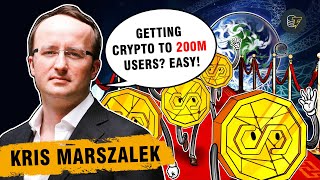
Kris Marszalek, CEO of Crypto.com, talks about growing from 106M users in January 2021 toward 200M through NFTs. The company launched a $200M venture fund for early-stage projects and planned a major CRO token burn with the Crypto.org chain.
Chapters
You know, people tend to operate with analogies like, oh, hey, this is just another CryptoKitties from 2017, right? The world has moved on.
Chris Marzalek is the CEO of Crypto.com, an exchange payments and lending platform dedicated to bringing crypto to the masses. Crypto.com released a study in February 2021 which showed the total number of crypto users had increased by 60% since May 2020, finally breaking the 100 million user mark. Chris believes the stage is set for another explosion of crypto adoption.
So it's really slowly, slowly, slowly, but then it's all at once. And we are at this all at once phase, and there is a certain type of gold rush here.
But with crypto users sitting at just 1% of the global population, can we realistically expect mass adoption to come anytime soon? This is another exclusive Cointelegraph interview with Crypto.com CEO Chris Marsalek. In a recent article on the Financial Times titled Bitcoin cannot replace the banks, Brandon Greeley criticized the crypto lending business. Despite their promise to revolutionize the financial system, he said, what these companies do is just earn fees and interest on loans and manufacture fiat credit money, which makes them just another group of banks. As the CEO of a company that offers crypto borrowing and lending services, how would you respond to that? How is crypto.com fundamentally different from just another bank?
Yeah, I think that the whole premise is quite wrong. I mean, the person obviously doesn't have deep understanding of bitcoin. Bitcoin does not compete with banks. It competes with central banks. So this is the best money we've ever had. This is hard money and it can't be debased. And this narrative, bitcoin becoming digital gold, has gained so much traction in the last 12 months because governments around the world do massive quantitative easing of us leading the way. So I think this is just not the right question to be asking.
That's interesting because this author in the article, he makes the point that actually in not just the central banks that manufacture money, as the crypto people are used to say, but also the commercial banks are creating manufacturing fiat credit money, which is apparently what you are also doing@crypto.com. so would you disagree with that?
No. So everybody who is a lender essentially creates money, Right? In essence, you're increasing the money supply in the system. But this is completely different from central banks unilaterally debasing everybody we're talking about. You can't compare a commercial transaction when there is a Borrower and a lender and the person who borrows money is repaid eventually versus somebody just increasing the overall supply arbitrarily and essentially debasing everybody to the tune of like 20% a year. I think those two scenarios are not comparable at all.
Okay, so in the same article, the author mentioned some of the flaws of the legacy financial system. He said that the supply of credit money can be unstable as banks stop making loans in a downturn. Rather right when people need them the most. There is little incentive to extend cheap credit to people who needs small loans. He concludes, saying that there isn't much so far that Bitcoin seems to have done to fix these things. And it's not at all clear how it will. How can Bitcoin and crypto lending fix those problems?
Yeah, yeah. I don't think that Bitcoin is attempting to fix these things. That's not what it set out to do. And that's not the major use case. The major use case, digital gold is store of value is money that can be debased. And yes, there is a growing lending industry in crypto space, but that's just simply a part of a growing industry where people see an opportunity to generate yield and they view Bitcoin as a fantastic collateral. So this is a growing segment of the market, but that's not what Bitcoin is all about.
The core mission of crypto.com is accelerating the adoption of cryptocurrency. According to a recent study published by Crypto.com, the total amount of crypto users in January 2021 globally reached 106 million from 66 million last May last year. What are the main factors that, according to you, led to such a growth? How do you expect this growth to continue in the following months, and how do you plan to contribute to it?
Sure. So obviously there are two trends that are converging here. One is with increased institutional adoption of cryptocurrencies. So you've got very large players coming out there in support of bitcoin and crypto, like our yesterday announcement of global partnership with Visa. But there's plenty of other institutions that got into the space. PayPal allows people to buy and sell crypto. Facebook has been working for a long time on their crypto initiative. There is just a whole slew of financial institutions that now are putting a certain portion of their assets into Bitcoin. So that drives quite a lot of action. And on the other hand, you've got tremendous innovation crypto space with things like DeFi and recently NFTs, which get people excited and obviously it's a cyclical market, so we're now in a very strong bull run. So this also generates a lot of media attention and that drives people in. But it's a convergence of a few trends and I would say that the 2017 Bull Run was much more fluffy, if you will. There were no institutions at the time because the infrastructure didn't exist. The projects that were launching at that time, well, they didn't have real products or real tech. But this time around is different. You've got tens of billions of dollars locked in in defi. You've got some of world's biggest names launching their NFTs. So this is a much, much more solid run this time around. And the increasing participation of institutional money increases the size of the market and also gives it more strength. So I think this time around is going to be more lasting.
Okay, now let's talk about the most, the hottest topic of the moment, which is NFTs. You recently said that NFTs are going to play a big role in bringing the overall number of crypto users in the world to 200 million. So that's a pretty strong statement if you compare it to people in the traditional media world that say that NFTs are just like a hype, a bubble that will actually just burst very soon while you say that it will actually get the whole crypto space to increase to 200 million users. So why do you think so?
Yeah, I think people tend to operate with analogies like, all right, this is just another CryptoKitties from 2017, right? The world has moved on. In 2017, there was no strong creator economy. You know, today culture is led by influencers who are just operating online. And this is the perfect time for NFTs to actually go mainstream. And I think if you look at some of the top celebrities who have 100, 200 million followers, 250 million followers, if they come in and then they feel comfortable expressing themselves creatively with NFTs and they bring their fan bases over. Going from 100 million to 200 million is going to be much, much faster than going from, you know, 50 to 100. I'm super bullish on the NFTs. We actually just announced earlier this week that we are appointing a senior music industry executive executive, Joe Conyers, as our head of nft. And you know, he brings a wealth of these relationships and his tasks with bringing the biggest names in music, entertainment, sports onto our platform. And we're just putting final touches on it. We will announce the launch of it soon, but there's so much excitement around it. And I think that this is the general trend in which the world is going. People do want to express themselves with, with virtual goods, digital collectibles. People want to own it to show the support and engagement. I don't think this is going away. These things, they typically take a while. So it's really slowly, slowly, slowly, but then it's all at once. And we are at this all at once phase and there is a certain type of gold rush here and I'm sure that there's going to be plenty of things that don't work out. But out of all this creativity and innovation and investment that goes into this space, there will be a few very large platforms that are going to drive the adoption of crypto further.
But now I would like to know more like your personal evaluation of what NFT means to you personally, because I know that this is a very profitable sphere to be in right now. But let's see if you have like a deep conviction in what NFTs mean. So a lot of critics say that art is something that you can touch, something that you can look at, and that's the pleasure that we derive from art. Well, NFTs are just like a bunch of numbers on a blockchain and that's why they cannot be considered like as a piece of art. What's your opinion about it?
Yeah, no, I think that couldn't be more far from the truth. I think it's a new medium. You know, you've got visual artists, people who put in new functionality into it. I mean, just anybody who is a critic of this, I encourage them to go to any of these marketplaces that are popping up every day and just spend 15 to 20 minutes just browsing. Some of this stuff has extremely high cool factor and I would love to own a lot of them. Fortunately, most of the time they're all sold out. And this the fact that if you have already a strong relationship with an artist or an athlete or an entertainment personality, whatever it may be, or a brand, if you have a strong emotional connection with them, your willingness to own a piece of it is only going to increase. So I just think that people don't appreciate the creativity that the artists are putting into it. And this is just a new way for people to express themselves. I definitely think the media attention around this is going to pass, but NFTs are going to stay.
So, switching topic, you recently launched a 200 million venture fund that will be investing in Crypto startups. So what kind of projects will you be looking at for this fund?
Sure. So obviously NFT is one large area of focus. We've made several investments already that are not public yet, but they will be announced over the next couple of weeks, months. And you know, other areas that are very interesting are, for example, you know, L2 and how this, you know, how projects tackle the issues of scaling. There's plenty of interesting innovations still in defi space. I mean these projects have been super hot, you know, mid last year, but there's still new stuff coming out and this is not the area that we are looking at. Our approach is to focus on seed stage and series A. So we go in early and we want to lead these rounds. So we are not waiting for other guys to show up and say, okay, I'm gonna lead and we just tag along and follow. We want to lead these rounds. And typically when you lead a round, when you have a lead for the round, it's very easy to line up all the other guys, especially if your lead is a well known name. So that's kind of how we think about it. I think the areas of interest are going to change over time. As long as this fits within our broader mission of building out our ecosystem and driving the adoption of crypto, we'll continue to invest.
On March 25th you are planning to launch a public blockchain called crypto.org chain which will have the CRO token as its native token. So ahead of the launch of the mainnet, you burned $10 million worth of CRO tokens in what you define as the largest token burn in history. What are the motives behind this token burn?
Yes, so the total supply of CRO was at 100 billion and we've announced the burn of 70 billion, which is about $10 billion worth at the time of the burn being announced. And, and again, we believe in decentralization. I think we wouldn't be able to credibly claim that this is the decentralized network if we control majority of the supply. So we just decided to burn it and now we've got circulating supply at about 84% and the remaining supply is simply going to be awarded to, to people who produce blocks on the neon chain and people who delegate their stake to the block to the validators on the network to keep it secure. So I think this is just in line with what we believe in and in line with how we view the future of our chain and this industry.
Okay, I think that was pretty much it. Chris, thanks a lot for joining our show.
Awesome. Fantastic questions, Giovanni. I really enjoyed it.
That was Chris Marzalek, CEO@Crypto.com. i'm Giovanni, your host. If you enjoyed the interview, don't forget to like the video and subscribe to our channel.










