NYIAX co-founder, eToro’s CEO and a TechCrunch editor on crypto trading | Web Summit 2021
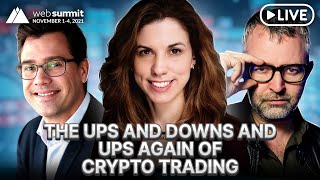
Panel from Web Summit (Nov 4, 2021) in which Mike Butcher (TechCrunch) moderates a conversation with Yoni Assia (eToro) and Carolina Abenante (NYIAX/Nayax) about the current crypto market, blockchain use-cases, and implications for traditional finance and advertising. Key themes: bitcoin and crypto market strength (price cited ~$62,000; discussion of all-time highs), eToro’s social trading model and crossover between retail equity and crypto traders, NYIAX’s use of permissioned blockchains (Hyperledger, Interstellar) to add transparency to digital ad supply chains while prioritizing privacy (GDPR compliance, cookieless future), debates over transparency vs privacy in trading (front-running, dark pools), the long-term view that crypto/DeFi may displace many traditional finance functions (speaker cites current crypto market cap ~2.5 trillion and projects much larger growth), fractional ownership of bitcoin, and brief discussion of NFTs and eToro’s interest in them. The session closes with mention of eToro’s move toward a public listing.
Questions this video answers
Web Summit, Nov 4, 2021 (YouTube upload of the session).
"$62,000" (speaker cites ~62,000 for one bitcoin).
"two and a half trillion dollars" (≈ $2.5 trillion).
"21 million bitcoins" (total supply cap).
Hyperledger and Interstellar (Stellar lineage/Chain → Interstellar).
Chapters
Trading has never been hotter. And while talks of regulation continue, this talk considers what's next for the industry. So here to discuss, let's welcome to the Stake Mike Stage rather Mike Butcher of TechCrunch, Carolina Abenante of Niacs and from Etoro Yoni Asia.
Hello everybody. From TechCrunch, it's just me. Yeah.
Almost.
Let's switch it on. Right, we're back. Hi everybody. Mike Butcher from TechCrunch and I'm delighted to be joined by some fantastic panelists. As you. As you heard earlier, we got Niacs and Etoro both working in the blockchain space, but obviously crypto is the word of the moment. $62,000 now for one bitcoin. I didn't check the ETH price just now, but I'm sure it's doing okay. Usually when bitcoin does well, all the other cryptos do well as well.
All time high.
All time high. And in fact, actually speaking of eth, you actually authored a paper with Vitalik Buterin, didn't you? Not.
Yeah. At one point in 2012, after being bitten by the bitcoin bug, we developed colored coins. So we thought about the tokenization of assets like Euros, dollars, gold, etc. We thought of building this on top of the bitcoin protocol and wrote the paper with Vitalik. Obviously Vitalik decided to go his own route and build a new blockchain.
Right. Do you feel like you missed out a little bit there?
I think all in all, we did well. So never regret.
Regret, Royan, that's always the issue with Crypt. And please don't tell me how. Yes. You told me to buy bitcoin many years ago. I didn't. Yeah. Anyway, we're done with that. I like my job. Let's get into it. Carolina Nayax is. Now, you're not strictly crypto or anything.
No, we're not.
You're using the underlying technology of.
We are using Hyperledger and Inter Seller as our blockchains.
Right? Yeah. But what I think is interesting about your company is that you're trying to basically flip a very traditional, let's face it, slightly old fashioned online advertising and digital advertising market into a new paradigm of transparency, of immutability. Being able to track ad buys, ad sales and the media business into blockchain. You're not doing a token or are you?
No, we're not doing a token. We were thinking about doing a token 2018, but when there was a changeover for the ICO market, there was a lot of regulation that was coming in, especially from Jay Clayton at the time, from the sec. We decided not to do something like that. But the importance of blockchain for anybody that is dealing with any kind of supply chain technology like contract management, it creates one of the most transparent, multi sided methodology for every participant to see how the contract is being performed, transacted, reconciled and the cash being distributed.
Yeah, and I think that's what partly what everyone got so excited about with crypto was the sort of the public nature of it, the transparency, potential for transparency. But Etoro, you chose not to go through a traditional, well, not traditional, but a, shall we say, normal crypto exchange. You've come out of stocks and shares buying and then reversed into crypto. You're kind of at the intersection between these two industries. What's the sort of flip between your existing stocks and shares market and the crypto side of things? I guess you said the crypto side rocketing, right?
Yeah, so. So the majority of our customers do both. They trade both equities, buy stocks and crypto. We actually think there's a very interesting intersection happening right now with the rise of retail investors all around the world, the use of social media, our social network, where people actually are collaborating and communicating about these trends. Whether the similarities between meme stocks and meme crypto is, is amazing. But definitely people are waking up all around the world to investing both in crypto as well as in the stock markets.
I mean, I think that was the interesting thing when you built Etoro. I remember when you started, it was a very social network oriented platform. You know, you can follow other traders, you kind of built a social network inside the platform, which is quite unusual at the time. But we've all seen how social networks can be manipulated. You could see how crypto is manipulated by, you know, sometimes orchestrated campaigns on Twitter and things like that. And we've also seen the rise of disinformation on platforms like Facebook and the Capital Riots and really sort of strange crazy things. Anti vaxxers, et cetera, who frankly, you know, are just bananas. How do you keep your algorithm from kind of going crazy and inflating things and taking you down that difficult rabbit hole?
So we provide basically a very transparent platform where you can actually see other people's performance. So when you talk to someone, you actually know they're a real person and you can see their track record, their performance and their actual portfolio location. We believe that level of transparency enables a much higher level of trust because you don't talk to somebody anonymous who's just talking his book or against his book, you can actually seize trading activity. You can automatically copy him. So I think that level of transparency provides trust for users so they can basically be more transparent with each other.
And I guess you're trying to bring more transparency to the media industry with Nayax.
Well, we were built for privacy. Privacy. I've been a privacy officer for 20 years. I started with the IAPP for the international association of Privacy Professionals since it started with Trevor. So we had privacy as a design. So what's happening now with Google and the demise of the third party cookie by 2023 and the people that we're working with and the US has a lot more problems than Europe because you have decided on gdpr. We've decided on a hodgepodge of different laws that we're going to be working on and hopefully in the next year or two we're going to have a federal law, but we're working with all publishers, ad agencies and advertisers that are all compliant with gdpr, with the individual states that they're working in or trying to reach the customer with. And other jurisdictions like Canada has their new law, Brazil has another one and we are working globally with them.
But don't you think, I mean, you mentioned the death of the cookie that's coming through. Apple has also introduced lots of privacy now. So in a way you're really at an almost at an inflection point. Thank you. In a very traditional industry between transparency of blockchain and also moving eventually to sort of a NASDAQ style approach crypto platform perhaps for media buys and then. But you're still kind of stuck in the old world, aren't you?
We are. It's like this. No one knows what they want to be. Are they looking more of this is how we're going to look at audience driven data. How do you do this in this new world? Are you looking more contextually at how you're going to drive advertising? And also in another methodology is what's going to happen with, as you know, in our industry there's now the idea of data with the rise of the clean rooms, which also can be utilized very well with blockchain technology as a method.
Yeah. So yes, you're using a technical term that clean rooms, which is sort of data where you don't know the identity of the user, but you can actually use that data for other platforms perhaps. And this isn't a privacy panel, but we'd best not kind of go down there. But going back to the crypto World to some extent also. This speaks to the subject of defiled decentralized finance. You're trying to do decentralized advertising. You have entered the world of decentralized finance to some extent. Well, certainly trading, but that's part of where you're going and part of the industry you're in to some extent. There's regulation up to the eyeballs about all of this stuff. Stuff, obviously bitcoin and the bitcoin ETF which recently got announced means that the traditional finance world is hankering for all of this stuff. Apparently London is now awash with traders looking for crypto kids who know what they're doing. But how are you, how do you see the traditional finance world now being able to mesh with that crypto world?
I think eventually the crypto world, blockchain world is going to eat traditional finance. It's just a matter of time. Traditional finance is 9 hours a day, 5 days a week. Crypto world blockchain is 24, 7. Traditional finance is hyper. Local industry, local language, local currency, local people, where blockchain crypto is global. And we're going to see that transition. In my view, what we're looking at today, which is total market cap of two and a half trillion dollars, which already sounds big 10 years from today, is probably $200 trillion. Because we're going to gradually see defi and blockchain eating every piece of finance today and doing it better. And it's beyond finance, it's art, it's all assets. So in that process, gradually, what we call today traditional finance will disappear.
Is that your opinion as well?
We're built on the NASDAQ technology, so we're built on the financial framework of Nasdaq. And NASDAQ is much more dynamic than what people think. Over 130 different exchanges globally trade on an OMX, NASDAQ based exchange, 40% of all trades, our NASDAQ based exchange anywhere in the world. And that's in commodities, that's in options, that's also in equities.
Yeah, I didn't say all banks and financial institutions are going to die, only some of them. But they need to adapt to new technology and some of them are doing that very nicely.
Exactly. And the reason we got into blockchain was through NASDAQ and nasdaq's investment in Chain, which eventually was sold to Stellar and became Interstellar. So Adina Friedman, the CEO of Nasdaq, has always been looking forward at a much more dynamic and open idea of how exchanges work.
But one of the issues that I often find when I'm covering that blockchain and crypto is the concept of front running because so much trades are public. So for those of you who don't know front running, stop me if I'm going to get this wrong and please correct me. But it's when you can see that a trade is about to be made and then somebody else can quickly benefit from that public information. Now, in the traditional finance world, you can stop front running because there are private trans. The transaction is private until it's, until it's made public, shall we say. And, and that's a big problem in the crypto world. So is the crypto world actually going to start becoming less public and more private and introducing more privacy? What would you say?
I think a lot of the information is public, but once something is already public, that's not an issue of front running. So again, more information that's out there is generally very good, and more public information is very good because it creates more opportunities for people to understand what's happening. So I'm not a big fan of trying to move trading back into private, dark places. I think opening the light and people being able to see price formation of all of these assets and the trading activity is actually a very good thing and more progressive than traditional finance.
Can I ask one question? I mean, alive in all of trading, especially for institutions, is dark pools, iceberg orders, other things where you're not seeing the full order flow, because if it was too transparent in a world, people are not going to move, they're not going to do the big buys. Because if you're going to show your full book of how many orders you're going to attack at that point in time, you're going to get it. You're never going to get a move, which is fine.
You'll have all. Everything that's happening today in traditional finance is going to get replicated first. You're going to get all the order types, you're going to get everything basically just translated into 24, seven new layers of technology, global marketplace.
But do you remember a few years ago when the big discussion was wasn't really trading is about hodling. Hold on for dear life. And now, of course, it's become vastly more complex with people trading in meme stocks and Bitcoin, Ethereum. Let's do a little bit of audience test. Who's a Hodler? Put your hand up. Oh, not that many. Okay. Who trades crypto?
We all trigger.
It's actually a little bit similar. Wow, interesting.
I thought I Was expecting much.
How many people?
More people raising their hands.
I do.
Put your hands up.
Go buy crypto.
Who, Who, Who. Put your hand up if you got an Ethereum or a bitcoin wallet. Guys, I think we need. I think. What do you think?
Do you think I'm coming here every year on stage explaining to people that they need to go into crypto?
But, okay, listen.
You're not listening. You're not listening.
You obviously took the red pill. Your mother is trading in my dogecoin crypt.
Etherium, litecoin. She has. And she's 86.
Yeah. Rock and roll. But I think we've only got a couple of minutes now. This is annoying because I could go on forever. But the. But I think the big point that we kind of want to make here is that is. So is the. Is the. Is it the case that crypto, Bitcoin, Ethereum, and perhaps other kinds of, well, shall we say, harder and, you know, quality cryptos or coins and tokens, are they a hedge against traditional inflation? We've just had a pandemic. Governments have printed money like the Second World War, bigger than the Second World War. So what's going to happen? What are your predictions?
I think bitcoin as a digital store of value, as digital gold, holds that promise of a hedge against inflation. We're seeing now the widest discussion in human history about the value of money. Right. We used to think cash is king. Now everybody's talking about inflation and the fact that if you have cash in, the bank actually loses its value over time. And the scarcity model of bitcoin basically protects against that. If you think about the next four years or 10 years or 20 years, there's still going to be just 21 million bitcoins.
But isn't it kind of becoming too expensive for the average person to get into Bitcoin?
You can buy $1 of Bitcoin, so you don't need to buy 62,000 the same as you can buy fractional shares.
And would you advising people do that?
Well, I won't use this stage as an investment advice, but I do think from a generational point of view, Bitcoin is. And crypto is a generational asset class. And I think it makes sense for people to have exposure into crypto assets and specifically bitcoin.
I totally agree with him. And there's also going to be fractional shares that you're going to be able to get to it so you don't have to hold a whole Bitcoin. You can own a Fractional piece of it. But I think there's even a greater model that's happening. You're talking about inflation risk, there's hedging risk. Everybody thinks about NASDAQ and the New York Stock Exchange as being where everything, everything exists. Or any of the other exchanges around the world. More than 80% is off exchange transactions. And with swaps and other derivatives and bitcoin and other cryptocurrencies could be a fantastic hedge for that through insurance hedging with swaps and options.
We've only got a minute left. But we, and we didn't even get into NFTs. What's the point of buying bitcoin and crypto when you could buy NFTs?
Oh, listen, NFTs, we were talking about this before is with smart contracts, what you can do with NFTs, especially if you're making a movie or anything else, the ability to do licensing agreements with that through the contract to pay all the parties that are part of it. It just makes it a very, very interesting piece.
Oh, I see. But that's a very structural thing. I mean, we're talking about like apes and things and punks. What about.
I think it's a super fascinating space where we see a lot of innovation and a lot of new product. Simply a digital product. It's buying digital products.
Are you doing NFTs on eToro?
We are looking at it, definitely.
You are looking at NFTs. Breaking news. Oh, I smell a story for TechCrunch. Finally. Remiss of me to not ask. You're going public. Are you?
Are you going public or very excited. The transition from a private company to a public company. Is a big fan of capital markets. I'm excited about that next stage of growth for Etoro.
So that's on the rails, is it? As we speak, definitely. Okay, great. Well, thank you so much to NAX and to Etoro, the founders and mine is Mike Butcher from TechCrunch. I'm covering climate tech and impact now. Guys, reach out to me on mikeechcrunch.com or reach out to me on the app. Say hi and let's get you on TechCrunch and make the next generation of founders public for the public markets. Thank you very much to Web Summit. Thanks everybody.
Well, climate change has been in the news all week. Can we reverse global warming? Our next guest believes it's not impossible. Patrick Brown is here to argue that plant based meat is humanity's science. Single most powerful way to put the brakes on climate change. He believes it's the best way to restore native ecosystems, recover biomass, and to reverse the effects of global.










