'SEC's standard seems made up just for Bitcoin' | SEC Commissioner Hester "CryptoMom" Peirce
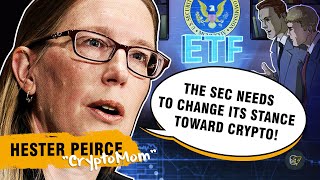
SEC Commissioner Hester Peirce discusses her reappointment and pro-innovation approach to crypto regulation. She proposes a three-year safe harbor for token projects to decentralize before securities laws apply, and questions why the SEC applies a standard to Bitcoin that seems made up just for it. Peirce calls for more industry and Congressional engagement on DeFi.
Chapters
I really do think the capital markets are powerful at transforming people's lives. I think people should expect that there will be enforcement activity. It's really hard for me to predict what will happen because of the fact that we're using this kind of standard that seems to be made up just for bitcoin.
What's up, everyone? My name is Jackson. I am your head of video at Cointelegraph. Today I have the pleasure of talking to Hester Purse, who has just been appointed as an SEC commissioner for the next five years. How are you doing today, Hester Jackson?
It's great to be here. And I want to start by just giving my standard disclaimer, which is that everything that I say represents my own views and not necessarily those of the securities and Exchange Commission or my fellow commissioners. But I probably don't have to tell your audience that.
Yeah, and in fact, our audience actually likes you a lot. They affectionately call you Cryptomom. So I know that you're already aware of this name, but when did you first become aware of the nickname and how do you feel about it?
Well, I first became aware of it, I think, right after I issued a bitcoin exchange traded product dissent. I think that's when I first got that nickname. And I thought it was kind of funny because I'm actually not a mom. So I always wanted to be a mom. And I figured this is not a bad way to become a mom because these are some really interesting people in this community. So I like the name. Although I will say my one reason for not liking it is I don't think the government should be maternalistic or paternalistic to people. You know, part of my philosophy is that people can make really good decisions for their own lives, and it's really detrimental to society when people start looking to government to make decisions for them. People start being less careful on their own, and they become more dependent on the government to do things for them. And I don't think that's really healthy for us as individuals.
So given that attitude, what do you hope to accomplish over the next five years as an SEC commissioner?
One big reason that I did want to come back for a full term at the SEC was that I really do think the capital markets are powerful at transforming people's lives. And I wanted to be able to work more on making sure that the capital markets work for every segment of our society and for businesses all across the country, not just on the coasts. And I also wanted to work on the SEC's attitude toward innovation, which has traditionally been A quite conservative attitude. And I wanted us to open up a little bit more so that we could be friendlier to innovators, easier to work with, and ultimately we could get people the answers they need to move forward with innovation and entrepreneurship.
So are you the only one in the SEC who feels this way, or are there other commissioners who also have a similar attitude and want to push forward more change and innovation?
I think there really are a lot of people at the SEC who want to make us a better innovation agency. Institutionally though, it's really difficult. You end up with a situation where there's so many different layers of bureaucracy, things have to get through and people tend to be very hesitant to make decisions because when they do, the ramifications come back on them if something goes wrong. And so it's easier just to kind of kick the can down the road road or try to maybe have someone else make the decision or just not make a decision at all. And so that really is a function of the institution rather than the people. We have a lot of people here who are very interested in innovation and technology. We have people who are specifically quite interested in crypto. And I think that the number of people who are, who really are interested in and learning about that area is growing at the sec.
So do you think that there's a chance that the SEC's stance towards crypto will change significantly over the next five years?
I think it will have to, in some sense, because the landscape is changing so quickly. And so while we've been very slow on giving guidance, there's more and more interest from a wide spectrum of people, both inside the crypto space as well as inside traditional financial institutions who are asking us for guidance. So I think we're going to be forced to really confront that more and more in the coming years.
And you're currently designing a safe harbor proposal, which you've been working on since early this year. What exactly are the goals of this proposal that you're working on?
Well, the goals are to give people some guardrails within which they can develop token projects and feel confident that even if they can't really figure out at the get go whether or not it should be classified as a security or not. They'll have this three year period within which to develop the project, get it out there into people's hands, have it be functional and decentralized, and at that point then the securities laws really aren't applicable. So it's giving them kind of the growing room. I am hopeful that even if it, you know, I don't care whether it's my safe harbor or some other solution, if there's another solution that people think is better. But I am hopeful that having it out there, I hope to be able to, you know, now that I've gotten a lot of feedback, I hope to be able to revamp it and have a 2.0 version at some point here. I do hope that something will get the conversation spurred in a way that's so my proposal was my proposal. But I'm hoping to get the conversation spurred to a degree that we can get a commission proposal out there so that people can really formally comment on it. And while I don't know that that's going to happen immediately, it's something I'm still working on.
So what do you think is the possibility that this proposal will actually end up becoming reality?
Well, I think as with other things in Washington, it's usually, you know, it's unlikely that something just gets taken and it gets finalized the way it is. I mean, that's the whole point of the administrative processes we have. It's to take an idea and then get people's input into that idea and then build that idea into something that works well based on all of that input. So I think usually things change in the making and I would expect that would be the same with something like this. But again, I need for people who care about this kind of thing to keep talking about why something like that is important so that it can be on other people's priority lists as well.
And you were saying before that the SEC is going to necessarily have to come around and change their stance towards crypto. So my question is, why do you think the SEC has been so slow to date to provide guidance on crypto and what do you think it will take to really get those gears moving so that the SEC is paying more attention and offering more guidance on crypto regulation?
Well, I think there are a couple of things. One, I think we're seeing some positive developments from other regulators. So international regulators have, have been a bit more quick to get to providing guidance and to providing frameworks that work for crypto. And that's helpful for us to see because then we know that it's possible to do that kind of thing. And then second, you see some regulators here in the US taking a more forward looking approach. I think of the CFTC and the occasional, both of which have been really quite upfront about the fact that they think that there's a role for them to play in making it possible for crypto innovation to happen here in the US and for people to use crypto here in the US So I think those things serve as a good example for us, too. And then again, the more we hear from people in our space that this is something that's important to them, the more we're likely to do something about it. And so, you know, I can't predict the future, obviously, and I certainly can't predict technology, but my anticipation is that we'll see continued interest in this space from a growing percentage of the population.
And do you guys have any idea about how you're going to approach DeFi? I mean, DeFi is, like, incredibly complicated and can be a real regulatory challenge. So do you have a plan on how you want to begin addressing decentralized finance?
Well, I'm certainly glad that you admit it's complicated, too. So I don't feel alone in that. From my outsider perspective, it looks like these things are being designed so that the smart contract itself acts as something in something of a regulatory role because it enables you to know what will happen. Right? You don't. It's the code is out there. People can see the code, and they know what happens under different circumstances. And so that serves a regulatory function. So I think we need to be thinking about how does our. What can we bring to that as a regulator? Where is it important for us to play a role? And. And that's a conversation that not only we at the SEC need to be having, but as DEFI develops, society needs to be thinking about those kinds of questions, too, and Congress needs to be thinking about those kinds of questions so that we can get from them, you know, directives on how they want us to handle some of these things, because I think there are enough new things in DEFI that don't kind of naturally and easily fit into the regulatory structure as it is now. So I do think it will be a challenge for us.
So those questions aren't being asked. Is that what you're implying by saying that the questions need to be asked?
I mean, again, there are a lot of people at the SEC who are quite knowledgeable in this space, and so they're certainly following the DEFI developments as well. And to the extent that things are happening that are not consistent with our securities regulations, I think people should expect that there will be enforcement activity. So I don't want to. I don't want people to think that simply because you call something defi that you can do things that you wouldn't otherwise be able to do under the securities Laws and you know, people are looking at those kinds of things. But I think there are some more fundamental and interesting regulatory questions that are ones that it really does take, not just us asking those questions, but the broader community. Because you know, our regulatory system was set up at a time when this kind of thing wasn't possible. And if you're trying to set up an exchange that is truly decentralized and is run by the people who use it and runs according to to open source code, then what does that mean for regulation? I think those kinds of questions are ones that we need to be talking to lots of people about. Cool.
And switching topics slightly. There's been the possibility for a Bitcoin ETF to become reality over the past few years, but it's never seemed to materialize. So do you think that we will ever see a Bitcoin etf?
Well, there have been many people have been interested in having an exchange traded product offered based on Bitcoin. And I think that the interest in that will continue. And so as the bitcoin spot markets and futures markets continue to develop and become more mature, I suspect that there'll be people who continue to try to make the case that there should be exchange traded products based on them. I mean, as I've made clear in my dissents, I don't really understand the reasoning that we used to deny the applications that we got. So I'm hoping that eventually as the markets mature, there'll be a willingness to revisit some of the thinking underlying those, the previous disapprovals. But I think there will be a need to go back and kind of rethink the reasoning because the standards being applied to those were just different than the standards that have been applied to similar products in the past. And so it's really hard for me to predict what will happen because of the fact that we're using this kind of standard that's seems to be made up just for bitcoin.
And I also wanted to ask you about the digital dollar. This was something that came up in response to the early stages of the coronavirus quarantine. The creation of the digital dollar was suggested as a way to easily provide stimulus checks to a lot of Americans. So what are your thoughts on the possibility of a digital dollar as a securities regulator?
The digital dollar is pretty far outside of my purview. I think it's pretty likely that something like that will happen, frankly, because I think you see a lot of other countries experimenting with digital currency. And so I expect that something like that will happen here. But I think a lot of the really interesting innovation is happening outside of the sort of central bank digital currency space. So I'm of course I'm partial because that stuff falls more within my purview, but I've found it fun to watch some of the developments outside of the CBDC space. That said, I think we've heard from people at the Fed and from folks like Cryptodad who is working on trying to get us to think about a central bank digital currency here in the us so there is definitely a lot of work happening on that front.
Awesome. Well, thank you for your time and all of your answers. Do you have any parting words you like to say to your followers or crypto kids, if you will?
Just like to say, you know, keep thinking creatively, keep innovating, keep remembering that the real power of change comes from people cooperating with one another voluntarily and working together to build things that are mutually beneficial. And so keep up the good work and do come talk to me when you think that regulation is not helping us to achieve the ends we're trying to achieve, which is protecting people, but at the same time making sure that people have an opportunity to build things that make our society a better place.
Great. Thanks again for your time. Hester.
Thanks for having me. Jackson. Take care.
Thank you everyone for watching. That was Hester Purse, who is affectionately known in the crypto community as Cryptomom. My name is Jackson and if you enjoyed the video, please hit that like button and subscribe to our channel cointelegraph.
Like subscribe and Hodl. Sam.










