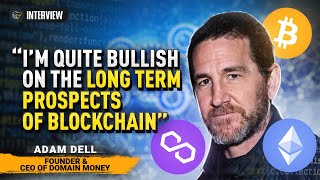
Adam Dell, founder of Domain Money, argues institutional crypto adoption is already happening. He points to engineering activity as the real source of value and says Domain's engineered portfolios make crypto investing accessible. The company launched in January 2022 and plans thematic funds including one for the Metaverse.
Questions this video answers
July 6, 2022
About 24 million people
About 7 million developers
About 25,000 developers
Up to two days and about $2 per transaction
Chapters
Foreign. Hey, everyone, it's Rachel Wolfson here at consensus 2022 and I'm here with a very special guest. Adam Dell is an American venture capitalist. His brother, Michael Dell is the founder of computer manufacturing company dell incorporated. In 2021, Adam founded a stock and crypto investment platform called Domain Money. What is the goal behind Domain?
Well, our goal is to make investing in assets like crypto accessible to everyone. You know, the average consumer can use Amazon or drive a Tesla, but for the average person to really understand what Ethereum is or Polygon, it's quite removed from their day to day experience. And while they might want access to the asset class, they might be less comfortable understanding the underlying technologies that make up the crypto ecosystem. And so rather than relying on Twitter or guessing, we offer portfolios that are constructed by an investment team deeply knowledgeable in the crypto space.
Now, you said that Domain has the team behind it came from Goldman and maybe some other traditional finance institutions. In terms of the knowledge with crypto there, how does that look?
Well, we put together a team that has pretty deep experience in solidity in blockchains. We have Chris Giancarlo on our advisory board, Michael Arrington, folks who are pretty close to the crypto community. And so we stay very close to the engineering world within blockchains. It's our view that if you think about all of the noise in crypto meme coins, things that are sort of momentum driven, it's really the engineering community that defines where the value is being created. The entirety of the software development community in the whole of the world is about 24 million people. And just to give you an example, a subset of that group is the Java developer community, which has about 7 million developers. The entirety of the blockchain developer community is about 25,000 developers. It's a very small ecosystem with a very nascent set of technologies. And so this innovation cycle of blockchains to me really looks a lot like the Internet. In 1999, when there were thousands of Internet companies all trying to become Amazon or Google, but only a few rose to prominence, the same thing will happen in crypto. And if you pay close attention to the engineers who are building projects that have real economic value, that serve a real economic function in our economy, those are the ones that are likely to do well, and those are the ones that make up our portfolios.
Can you maybe name a few of those?
Sure, yeah. We have large positions in Bitcoin, Ethereum, Polygon. Those are some of the assets we are big believers in.
Right and now you said domain caters to retail investors. But what are your thoughts on institutions getting involved with digital assets and how important is that for the space?
Well, the ship has sailed there. I mean, the large institutional firms, MasterCard, Visa, J.P. morgan, Goldman Sachs, they've all moved very robustly into the blockchain space. They have significant resources behind studying how to implement these technologies into their core businesses. And there's no doubt about why that's the case. If you look at the legacy systems that make up our financial markets, they're proprietary, they're slow, they're expensive, and in 2022, that ought not to be the case. One of the questions that we talked about before we started was how I got into this market and I'll just address it. So for the last few years, I was head of product at Marcus by Goldman Sachs, which is their consumer facing bank and investment platform. And I was shocked by how inefficient the ACH networks are. In our financial system, the average transaction can take up to two days and cost $2. But a blockchain technology, a layer, one that's, you know, a little bit further along than Bitcoin, can do it in a few seconds for a fraction of a penny. And so as I looked deeper into that ecosystem, it became clear to me that that was the future of money and it's why we moved into this space.
So crypto and digital assets, in your opinion, are the future of money?
Well, I think that it's inevitable that blockchain technologies become the standard for how money moves around. In the same way that HTTP is the standard for how information moves around the world, blockchain technologies will become the standard for how money moves around the world.
In terms of use cases, with moving money around the world, are you talking about blockchain being great for moving like cross borders?
Any transaction where you have two parties on either side and they need a digital ledger or a mechanism to consummate and settle that transaction. Blockchain is an ideal technology for. If you look at the most robust use cases today, it's defi exchanges where people are arbitraging across assets. That's where the most robust activity's been. But anything where you have a digital ledger and you want to contain a digital asset and have that asset be a medium of exchange and transfer, blockchains are a great solution for.
I also want to get your thoughts on the regulatory landscape in the US Right now. Do you have any thoughts on the bipartisan crypto bill that's recently been in discussion or just any other regulatory aspects that we're seeing now.
Yeah, the bill put forth is a great first effort. It recognizes the importance of an exemption for smaller transactions below $200. It wants to explore the utilization of a dollar backed stablecoin, which is a very intelligent thing for the federal government to engage in, particularly because there are large places, large markets in the world that don't have easy access to US dollars and would absolutely like to have that access. So, you know, I'm hopeful that this broad bipartisan bill will gain traction and start to make clear lines of delineation around where regulations should live. The CFTC owning the commodities side of it, the SEC owning the security side of it. It's really the first time Congress has put forth anything meaningful to address this large burgeoning market. And it's critically important that the United States take a leadership role here because other countries have like the UK and if we don't, we'll lose the position we have of being the financial center of the world.
Adam, I want to get your thoughts on the market today. Right now we're in crypto winter, we're in a bear market. Are you still, I'm assuming you're still optimistic about things.
Yeah, I mean I take a very long term view of this market. If you look at the volatility over the last five or six years in this market, you know, kind of does this, but the long term trajectory is up and to the right. And more importantly, you need to look at the commercial use cases of blockchains and those are only increasing in importance and in mainstream adoption among the institutional community that makes up the large players in our financial system. So I'm quite bullish on the long term prospects of the blockchain technology ecosystem. But it's really clear to me that it's very early in this world and that were a long way away from these technologies becoming mature and to the point where they're ready for the mainstream.
Got it. What can we expect next from Domain? I know it was launched in January this year, right?
That's correct. Yeah. We're working on a number of different fund options that we have available. So we have some thematic funds we offer. One is the Metaverse Fund which has both stocks and crypto in it. And so we're working on some additional thematic strategies that our investors have been asking for. And so you'll see some of those emerge in the coming months.
Great. Adam, any final thoughts that you want to add before we say goodbye? Thoughts on Consensys the market your portfolio? Maybe.
Well, I think that it's important for people to appreciate the long term nature of this market.
Thank you so much, Adam. It's been a real pleasure. It's been great speaking with you and we hope to see you soon.