The 4-Year Bitcoin Cycle Is Broken. Here’s What Comes Next
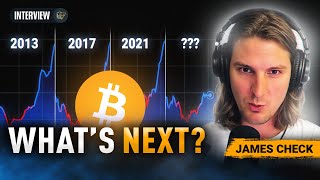
On-chain analyst James Cech argues Bitcoin's traditional four-year cycle is broken, now driven by macro and institutional flows instead. He identifies $70-75k as a confidence zone, says altcoins are structurally weaker, and cites recent flows: $8B into Bitcoin, $28B out of Ethereum, $3B into stablecoins.
Questions this video answers
April 23, 2025.
Realized cap; MVRV (short‑term holder variant preferred); SOPR.
Approximately $70,000–$75,000 (he referenced tests near $74k–$75k).
~$8 billion/month into Bitcoin; ~ $3 billion/month into stablecoins; ~ $28 billion outflow from Ethereum.
Mantra — the native token lost about 90% of its value in a matter of hours.
Chapters
The old rules are breaking down. For years, crypto followed a predictable pattern. The four year cycle repeated waves of boom and bust driven by bitcoin halving events. But not anymore. Institutional investors have disrupted the rhythm. Macro forces are stronger than ever. And now it's unclear if we are in a bear market, a correction or something entirely new.
The world doesn't really operate on four year cycles. The next headline could send all risk assets into a pretty nasty decline.
To make sense of it all, we turn to the data that doesn't lie on chain metrics. In this episode, we sit down with James Cech, one of the world's leading on chain analysts, to find out what's really going on beneath the surface. I'm Giovanni. Let's get started. I would like to start with a very simple question that you maybe have a much more complicated answer to that. But are we in a bull or in a bear market?
We're in between both. It's a very interesting dynamic at the moment. So if you think about where the world is, bitcoin is, I mean, it's a reaction to liquidity. People buy and hold bitcoin. They sell it, they buy it when they see something wrong with the existing system, they buy it as a hedge against a basement. They buy it because they believe that it's a better store of value. And in many ways, the years up until I would say around 20, 23, people would buy this thing because they were like, oh, what is this new interesting bitcoin thing? Right. It's a new kind of asset that's on the market now that we have ETFs, it's got a little bit less of this adoption angle and it's a lot more of a it's reacting to the world angle. People are buying and selling it based on what's happening around us, rather than buy it because it's this new funny money. So if we think about it from that perspective, we're in a very interesting dynamic where you can imagine a headline tomorrow where suddenly all these tariffs get pulled back, suddenly they come to some kind of a deal and markets start to move. I can just as easily construct a case where the next headline could send all risk assets into a pretty nasty decline. So I'm actually in the camp where I think we should probably let go of is it in a bull or is it in a bear? I think people, as humans, we like to simplify the problem. I actually think we should leave those concepts a little bit behind at the moment because bitcoin is very much Responding to the macro world. And the macro world is going through a very, very strange dynamic at the moment.
You also were saying that there is no cycle anymore. Maybe you can expand a little bit on that. Maybe going into also the classic four year cycle. That's also something that we should reconsider.
Yes, absolutely. So I think that the right way to frame is that we are still going to have bull markets, we're still going to have bear markets and everything, no matter what it is, will have a cycle. And I would say that 99% of the time when you see people disagreeing on Twitter or anywhere about assets and performance and these things, the common denominator, that is why they don't agree, is almost always timeframes. So over what timeframe? So if I think about it, we are in a bear market since February, Right. And how do you want to define that? Well, the equity market is down 20%, so therefore Bitcoin is in a bare market based on that metric alone. But we also know that bitcoin goes through 20% corrections all the time. So we can't really use the same measuring sticks. Now in terms of the four year cycle, similar to the concept of bull and bear, I think we should also probably just let go of the four year cycle. And I, I, as I've studied data and kind of looked at how Bitcoin's traded, I actually paint a slightly different story to what most people would say. And I think we're in the third cycle at a much more macro scale. The first cycle I think ended in 2017 at the bull market peak. And that was very much adoption retail. Right. We barely had a price chart for this thing. Most people heard about bitcoin for the first time in the 2017 bull. If you look at the way that it's traded since 2017, right through to FTX. So that's not your typical four year cycle. That's 2017 all the way through to 2023. That zone, high amplitude moves, the way it moved away from the 200 day moving average or MV RV ratio, any metric you wanna plot, very high amplitude booms and busts. It went straight up in 2019 and it crashed down in Covid. It went straight up in 2021 and then it collapsed in 2022. We had these high amplitude moves and they kind of went in one direction without a pause. In 2023 it's actually trading much, very closely to what 2016 and 17 did. Despite the fact that we're literally 100 times bigger. We're a multi trillion dollar asset now, whereas back then we were 10 billion right in 2016. So we're talking about just, you know, orders of magnitude difference in scale and yet it's trading almost the same as it did back then, which is quite remarkable in its own right. Much more spot driven. You know, even though we have derivatives, they're not playing as much of a role as what the spot market is, but the amplitude is much smaller and we're oscillating around a lot of these metrics in a, in a slightly different way. So I think that we're in a more institutional cycle. There's a lot more volatility capture strategies and that's where derivatives come into the picture. We're in a more mature market cycle and I personally believe it started when FTX blew up that kind of recovery process. So, you know, I think leaving the four year cycle behind is probably a good idea. The world doesn't really operate on four year cycles. And if bitcoin's responding to the world more than people are responding to bitcoin, that would suggest that we're going to move more into a macro cycle rather than an intrinsic bitcoin cycle.
You were mentioning the fact that you are looking at 70, 75k as a key level that we should look at. And if bitcoin breaks to the downside, that sort of threshold, then your vision would sort of change. Can you explain why you see 70, 75k as such a key level for bitcoin?
Sure. So I mean markets generally speaking are a confidence machine. So when you go into price discovery, which is when you break above the new all time high, no one knows where we are. It's, it's, you know, we're trying to find what the new price of bitcoin is. And I started talking about this 80k to 70k region. I called it the air pocket because on the way up in November last year, we just had no coins transact in that zone and they just form magnets for the price. So now that we're down there, right, we've touched 75. I think maybe 74 is the lowest that we've been. Each of those times the market has come in and bid it, right. And we've been chopping around about 85 is kind of the average price for the last couple of weeks. So the market's trying to work out do we belong here? Right. If you love the price at 100k, do you like it at 85? And it's trying to see do the bulls come back in so the reason that I highlight that 70 to 75, it's not so much a target, it's more. So that is the last time that the market had very, very high conviction and confidence, that we belong there. So therefore, I would expect that if the market goes down to 70, if the market goes down to 75, we will see support come in and people will buy it. And so far that's been the case. The more that we test that level, the more the bulls have to really kind of prove their mettle. But so far that has held. And, you know, that's just how I think about these things. Right. We're trying to find where the next level of confidence is. And so far, that zone has been an area where investors are like, you know what? I quite like buying bitcoin down at these prices.
You said in a recent podcast that while bitcoin is doing fine, altcoins are in trouble. So why do you think. So why do you think the altcoin market has been so depressed lately? And do you expect it to continue in the foreseeable future?
Yeah, it's a good question. So first things first is I have no, no edge when it comes to alts, because I just don't. I don't care too much for them. The reason why I don't care too much for them. And I've. I've traded alts, I've held alts, I've used most defi projects, I've tested all the chains in all of my time in this industry. Today I look back at what I was using crypto for all those years ago, and I realized that the only thing I really used it for was getting cheap leverage to go levered long some other shitcoin. So when I really reflect on it in the modern day, right, with far more experience behind me, I just realized that I actually don't need any of the products. I don't desire any of the products. I don't demand any of the products. Now, when we then take that view, and I think more investors are coming to this agreement, we're more than a decade into the altcoin experiment, and quite frankly, there's just not a lot you can point to and say that's really cool. That works and the market demands it. We just don't see this dynamic. So the challenge with all these altcoins is the market's just going. There's kind of no value capture for this stuff. The size of the market just isn't big enough to justify the prices. You know, if you look at Ethereum. Ethereum was, you know, generating enormous fees back in the day and they're just, they, they gone. So they're just struggling to find reasons to buy this stuff. And I think when I really peel, peel back, I think there's a clear trend. In 2017, there's no question Bitcoin received a huge bid because you had to buy vtc. I did this. You had to buy BTC to go on binance and speculate on other stuff. It was the casino chip. In 2021 you had to buy ETH to yield farm and defi and speculate on NFTs. It was the casino chip this cycle. Solana was the casino chip. And we saw the implosion of meme coins when Trump and Malay launched their coins. And I think the market just evaporated. So once you lose that demand, that speculative demand for the casino chip, it just becomes very, very hard to justify holding this stuff.
I saw you were commenting on what happened with Mantra, which is this protocol that deals with the real world asset tokenization that experienced a massive collapse. The token, the native token, lost about 90% of its value in a matter of hours. You were saying that tokenized real world assets are a joke. Can you explain what you mean by that?
Yeah, sure. I mean, look, there's this whole push to say real world assets on chain and there's just a lot of problems with this use case because if you're going to do real world assets on chain, there's a few issues. The first one is the Oracle problem. You own a token of a house or a fraction of a token of a house and then you realize that there's a bunch of squatters living in the house or the house burns down. How does the token know what's happening in the real world? The only way this works is what's called the Oracle problem. The only way this works that somebody has to feed external data in to say, well the insurance claim is now in play and therefore you get this and you get this and here's your fire insurance payout and blah blah, blah. Why did you need a blockchain for this? Why? Like at the end of the day, if, if we're dealing with centrally managed assets that really like let's just use tether because tether is a real world asset. Tether can be frozen in your wallet by tether. If they froze Tether and Circle tomorrow, literally two companies, if they froze, froze the assets on Ethereum, the defi economy would collapse because they run borrow stablecoins. So now let's just bring this across to other real world assets. If you've got these centrally planned, centrally managed databases, why do we need the blockchain, right? And some folks will say because some guy on the other side of the world wants to buy a share in a piece of real estate in San Francisco. And you just look at this whole thing and you go, guys, just use an etf, just buy a reit. We already have these tools. At the end of the day, no one's going to want to buy a share of one property somewhere in the, in the world. Maybe they'll buy a share of like a basket of things, you know, a basket of real estate somewhere in a city. Just buy, just go to a reit, guys. Like, you know, like we're kind of creating a solution that doesn't actually have a problem.
So now I want to talk about stable coins. Because stablecoins are tokenized real world assets. Dollar backed stablecoins are tokenized dollars and arguably they are an incredibly successful use case. How can you say that tokenized real world assets are a joke when tokenized dollars are arguably the most successful use case in crypto?
That's a fantastic question and truly that is the best counter to it. And at the end of the day, why does it work for tether? Because the dollar is the most traded asset in the world. Full stop. Full stop. Let's take like the dollar is special the same way that bitcoin is special because it has network effect. I don't see anybody demanding the Australian dollar on chain. I don't see anyone demanding the euro on chain. I don't see anyone who wants the Japanese yen on chain. That's the thing, that's the difference. You could argue the same perhaps for the S&P 500 and the NASDAQ and maybe some of the top traded stocks. But if you actually then take another step back and say, okay, let's imagine we tokenize Nvidia is other powers that be where I mean if anybody who's listening, I'm sure you've all opened a crypto account. You've either opened an exchange account or you've got a brokerage back home. Imagine the amount of KYC that's required to allow someone to buy these assets. They're just not going to allow it because you suddenly open up. You know what happens if Nvidia stock starts getting traded in countries that are on sanction list? How do they deal with that? They have to go and freeze it, which means they've got to go And KYC everyone to make sure that this doesn't happen. The things that blockchains are designed for. In order to make this all work, they're going to have to introduce KYC for all of it. It just breaks down the moment that you think about regulators and money laundering and all that stuff. And that's not the world I want to see. I would love to see a full libertarian world where people can trade whatever they want anywhere. But I just don't believe that's a realistic world. The dollar. The dollar is a very interesting case because the dollar is simultaneously one of the most visual, surveilled, monitored, centrally planned, centrally managed asset in the world. It's also the preferred currency for buying drugs off the street and for shady deals and envelopes under the table. The dollar still has that special place because it's the global reserve currency. So it's a long winded answer. But that kind of is why I think the dollar specifically is very different because it has the liquidity, it has the demand. Everyone wants the dollar. Not everybody wants a random token of a random stock in a random country.
Yeah, that's a solid argument. And now just to wrap up the discussion, James, I just want to ask you if you can point at specific on chain metrics or on chain parameters that people that are watching could look at in order to understand better where they are in the bitcoin market.
Absolutely. So really there's three metrics that people need to get your head around. The first one is the realized cap. It's the on chain market cap. Rather than valuing every coin at the current price, which is not realistic, it values every coin at the price when it last moved. And where this is useful, if the realized cap is increasing, it means that people are bringing capital into the system. It's a capital inflow. So if you have an uptrend and that thing keeps hitting all time highs, which it is, albeit slower at the moment, then we're seeing money coming into bitcoin. As an example, over recent, like last three, four weeks, Bitcoin's been seeing about $8 billion of inflows per month. Stablecoins are getting about 3 billion per month. Ethereum's had about a 28 billion outflow. Kind of gives you a bit of a sense of scale. Then you look at the price, you're like yep, makes sense. The second metric is called MVRV and I personally prefer the short term holder variant, but that's a different kettle of fish. The idea here is we're looking at the how in profit? Unrealized profit, Paper gains, paper losses. Now, what's really useful about this tool? There are certain levels where people look at their portfolio and look at the green number and they go, I have to, I have to sell some. This number is just too big. I'm feeling really good. I'm gonna take some profit. And it may not be you who's looking at your portfolio, but someone out there. And that's what MVRV tells you. Where is everybody else in terms of their profitability? So it allows you to disconnect your own feelings of your portfolio and then look at what everyone else is doing. So that's why MVRV is very useful and it has a system metric. So MVRV is all about the coins that are not moving. How in paper gains are they? But then there's another one called sopa, S O P R. And it looks at the paper, the paper gains that are getting locked in. Show me the coins that are actually being spent, sent to exchanges, taking profit, taking loss. And this is really useful in all parts of the cycle for me. When I'm writing, I use two Personas. Check the analyst and check the Hodler. Check the Hodler has a handful of very simple rules. If MVRV and SOPA are high, I do not buy because that means that too many people are looking at their portfolio and saying it's a big number and then they're actually selling at the same time. So I don't want to be there when they're selling and putting volume into the market. What I do want to do is wait for the people who didn't listen to that step and do buy at the top. They always hold and they hold and they hold and then they fall. Finally sell everything in a loss all at the same time. And SOPA can then tell me, right now we've got people who are panic selling and selling their coins that they bought at a high price, at a low price. That's when check the Hodler steps in and goes, I will stack sats now. So the idea is just helping. Think like a contrarian. Don't buy when everyone else is buying. Flip it around and look for when those people panic. Sell at the bottom and then you can step in. So they're the three metrics realize cap, MVRV and sopa. They're fantastic tools and they're invaluable.
Awesome. James, that was a very interesting conversation. Thanks a lot for joining our show.
Thanks, mate. Been a pleasure.










