'The definition of institutional money has evolved' during the Bitcoin era | CME managing director
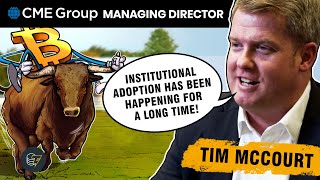
An interview (released Oct 24, 2020) with Tim McCourt, Global Head of Equity Products at CME Group, about CME’s Bitcoin futures and options. McCourt defines open interest and explains its use as a signal of market participation and longer-term positioning; attributes CME “gaps” to weekend maintenance windows versus 24/7 crypto spot trading; argues that institutional participation has evolved to include crypto-native funds and trading shops; and contrasts CME’s regulated, index-settled futures (settling to a Bitcoin Reference Rate) with crypto-native perpetuals and derivatives. He cites that CME’s flows were equivalent to ~55,000 BTC/day in September (a sign of price-discovery importance).
Questions this video answers
Approximately 55,000 bitcoins per day (equivalent flows in the month of September).
Bitstamp, itBit, Coinbase, Gemini, and Kraken.
October 24, 2020.
Chapters
When we look at CME Group doing the equivalent of 55,000 bitcoins per day in the month of September, that certainly puts Bitcoin as one of the leading centers of price discovery in the US and globally.
This is Tim McCourt. He is the global Head of Equity Products at the Chicago Mercantile Exchange. That means he is directly responsible for the development of Bitcoin futures and options products listed by cme. In this video we discuss the importance of open interest, the cause and effect of CME price gaps and and how CME competes with crypto native exchanges. My name is Jackson and welcome to another exclusive cointelegraph interview. Changelly is a suite of products and services that enables customers to have a one stop shop experience when engaging with crypto. Changelly acts as an intermediary between exchanges and retail users, offering over 160 cryptocurrencies that can be effortlessly swapped within 10 minutes on mobile or desktop. In 2020, Changelly branched out to accommodate the needs of traders with Changelly Pro. Pro is an easy to use platform that enables retail buying and selling of digital tokens and coins Piggybacking. The great support system found within Changelly, Changelly Pro will provide simplicity, effective pricing, fast execution and 24. 7 live support. How are you doing today Tim?
Great, thanks for having me. Looking forward to catching up today.
Could you just describe what open interest is and why it's important for people to pay attention to?
Open interest is the total number of futures contracts held by market participants at the end of each trading day. It's often used as an indicator to determine market sentiment and the strength behind price trends. So that's something that we watch at the exchange because it does show a sign of growth of the contract. But also it's interesting to notice what is the relationship between something like trading volume and open interest growth. So if you have an uptick in trading volume but no change in open interest, that's really a function of people that may be just intraday trading or taking advantage of price movements intraday, but there's no net gain of open interest. But when you see an increase in volume that is followed or met with a corresponding increase in open interest, they know people are trading and deploying strategies with longer term time horizon. They may be buying the future as an investment, they may be selling the future as a hedge to maybe mining operations. So it's really when looking at the two of how many contracts are held at the end of every day overnight that also when looking at volume provides a little bit more, I think perspective about what may be going on in the market. You also then look at something like the CFTC website where they monitor large open interest holders and large traders. You can also see the commitment of traders reports which show you by type of client, what are the trends of those that are holding long positions or short positions. So open interest is really an informative piece of information in the market with respect to trends and how the growth of the contract is coming along.
Yeah. And speaking of like things to pay attention to for traders, one of the things that a lot of people pay attention to is the CME futures gaps. The gaps in the charts on the CME's futures chart, why do people pay attention to this? And as a follow up to that also, why do most of these gaps eventually get filled? Do you have any thoughts on that?
Yeah, so I think it's interesting when we look at the CME gap, which personally I kind of love, that is a trend, it's a topic on Twitter, people love to talk about it and it's really a technical aspect of the market. When we look at CME Group futures, we offer nearly 24 hour trading, but from Sunday night through Friday afternoon, from a US east coast perspective, we have maintenance windows and maintenance that needs to be performed over the weekend. So that's where we do product launches for all of our asset classes and our thousands of futures and options products. That's where we deploy technological changes or as we deploy enhancements around our match engine. So we have weekend downtime as a function of exchange. What's different about crypto? When we look at something, let's say like the equity index market, which is the other thing my team looks after, futures are open when the primary markets are closed. Futures are providing price discovery in overnight trading hours from a US perspective and we're open when the underlying market is closed. Crypto and Bitcoin is a market where the opposite is true. Crypto is traded 24 7. The underlying market never closes with the exception of the occasional platform downtime for upgrades, releases, et cetera. So because of that you just have price discovery happening over the weekends on crypto spot exchanges or some of the crypto native derivatives exchanges when CME is not open as a result, that just will as a de facto present gaps in price information being presented to the marketplace. So I think that's just kind of what it is. We're closed, the underlying is open. So there's going to be divergence in price. So I think just watching the basis, watch how these things perform and if people are so inclined to devise trading signals from them, then so be it. But to me, it's just more interesting from a technical perspective. It's largely explained because of operational aspects of each of the markets. But it's certainly a lot of fun to read about on Twitter, for sure.
Do you have any personal theories about why they get filled?
I don't. I mean, to be honest, I think, you know, like going back to some of our other conversations, when you look at the markets, it's really a function of supply and demand. So not every gap is filled. Right? I mean, I think that, you know, people like to talk about filling the gap. I feel like the gaps that don't get filled don't maybe get quite the. Quite the attention or, you know, sometimes it's a function of time. And Bitcoin itself is a pretty volatile underlying. So at some point just gaps will be filled months later because of natural supply and demand. So I think it's just interesting. But I do think what I personally find fascinating is when we look at the bitcoin, how the bitcoin futures market has grown over time, the open interest, the adv. When we look at CME Group doing the equivalent of 55,000 bitcoins per day in the month of September, that certainly puts Bitcoin as one of the leading centers of price discovery in the US and globally.
So I'm curious to hear your opinion on the narrative of institutional smart money moving into Bitcoin but not crypto. What are your thoughts on that?
When we look at that, it's certainly something that you've seen in the marketplace. But from our perspective at CME Group, we offer futures and options on futures on Bitcoin. So that's certainly what we're seeing. But you also need to consider that I think the definition of institutional accounts or institutional money has also evolved during the crypto era. And what I mean by that is when we say institutions, it's not necessarily the standard or the traditional definition of institutions that you would have seen more than 10 years ago. You now have the advent of crypto only hedge funds, crypto focused trading shops, crypto focused CTAs that are offering services and products to their own customers. So that's also something that people need to be mindful of is when labeling things or attempting to label things as institutional smart money or institutional accounts, everyone really just needs to understand, like what does that mean from your vantage point in the ecosystem. So certainly at CME Group, we've seen that institutional onboarding and that institutional adoption happen. But in terms of some of that narrative, I can't really comment outside of Bitcoin because frankly, we don't have products really around that from a tradable or an investment perspective. So we don't have transparency into that. But what I can certainly confirm is that the institutional adoption of Bitcoin has been happening at CME Group for a long time now, and it's going to be interesting to see where it goes from here.
In addition to the options product that you brought to us in 2020, we've also just kind of seen an exposure explosion of derivatives products across crypto native exchanges. I mean, you got perp swaps, you got options futures, just everyone's doubling down on the derivatives market. So what do you think about the growth of this derivatives market on crypto native exchanges?
So personally, from a philosophical standpoint, I believe in the interrelatedness of the underlying spot, or in this case digital market with derivatives market. I believe in the convergence between spot and futures in terms of discovering price and making sure that these markets are interrelated in the fact that they keep each other aligned from arbitrage or basis opportunities. So it's really important for the ecosystem in general to develop with respect to the ability to transfer risk access markets. It's been interesting to watch some of the innovations in product development in the crypto native space. But what's interesting is we need to remind ourselves and keep focused on what makes Senior Group different. And I think one of the largest things is that we are a regulated venue operating here in the us, but we do have global distribution. And there are a few things that make our contract a little bit differently. One, unlike things like perpetual swaps or some of the other leveraged type products out there that may use the colloquial term future more as a marketing angle or just a description that the marketplace is using. At CME Group, these are regulated futures by the cftc. We're a regulated venue, which increases the burden that we have in operating with respect to the marketplace of providing to our market participants the trusted, tried, transparent, regulated experience that they have on all other products. At CME Group, we have to approach cryptocurrency and Bitcoin the same way. And that's something that I think has been great for the marketplace. We think regulation is a feature and not a bug with respect to cryptocurrency trading, especially when we look at some of the institutional accounts and adoption, because the fact that we've been able to bring this in a regulated fashion to the marketplace and meet those expectations placed on us by both the regulator as well as the marketplace. That is what is bringing institutions to the marketplace at cme because they know how the contract works, they know what the rules of the road are. And we have a near 180 year history of, of operating a marketplace and an exchange venue for futures. And that all is something that differentiates cme. So we're certainly intrigued and we're always watching and supportive of competition and the interrelated aspects between the crypto native market and regulated venues like CME in the US There are clear differences that just participants need to be aware of that Seeme can provide that some of those crypto natives, despite the interesting and innovative work they're doing, it's not necessarily the same experience trading there as it is at sea.
So do you see yourself as a direct competitor to these crypto native exchanges or do you, do you see yourself as just more of like a separate entity?
I think we're separate. I think that's my opinion is something that we also hear from feedback because we operate slightly differently. We have different rules, our product is different. Right. So we have the five bitcoin multiplier. We settle to the bitcoin reference rate, which is a index based on five constituent exchanges, bitstamp, itbit, Coinbase, Gemini and Kraken. We are representing a large swath of the underlying spot market. We're not tied to the potential idiosyncratic performance or trading on any one exchange. We have a diversified robust reference rate that is a regulated benchmark, the first regulated benchmark in the crypto space under the BMR rules in Europe. So I think that is something that differentiates us from others. So I don't necessarily think we're competitors. I don't necessarily think it's an either or choice. A lot of customers are trading on both. It's just different. The regulated venues, particularly here in the us we have different rules and standards that we must adhere to. So I think it's different.
So you've already begun to elaborate on the differences in your futures product versus some of the products on crypto native exchanges. I'm curious, what are the factors that really affect the CME futures price.
So when we look at futures contracts in general, I think it's important to remember that CME Group as the exchange operator, we are agnostic to price. We are the venue that facilitates where buyers and sellers can meet and exchange risk and trade with each other. And as a result of that, it's really like other futures Contracts, whether it be equity indices or something like corn or soybeans, these are all functions of supply and demand. The market will have one clearing price that's equivalent to where the last trade was. Where did the last buyer want to pay a certain price such that the last seller agreed to sell it to them? So I don't necessarily think bitcoin is different in that regard in terms of the fundamental drivers. What is different are the nuances of those fundamentals when you look at the underlying asset itself. Certainly bitcoin has its own supply curve, its own demand function, but it's really just where is the market going to clear at CME Group? And that's, you know, that's a function of who wants to buy and who wants to sell at what price and what their personal or kind of corporate motivations are at that time.
Would you be able to describe some of those nuanced, differently nuanced differences a bit more deeply?
I think when we look at something like Bitcoin, you know, when we certainly, I wouldn't necessarily say it's different, but it is a little bit more nuanced when we look at something like the supply side and the mining aspect of Bitcoin. There's just different risk parameters in the underlying market that are not necessarily unique at the, you know, let's call the 10,000 foot. Most futures contracts on underlying assets that can be transferred have cost of goods sold, they have cost of raw materials, they have input costs, they have output costs, they have term structure. So even though some of those nuances, whether it's the demand for hedging purposes because it might be a slightly more volatile asset, or if you're a miner, which may be akin to a commercial grower, you need to know where can you offlay or sell or liquidate that inventory that you're looking to mine at a future date in time such that you can manage the cost expense of what it's going to take to extract that asset, in this case, mining the bitcoin. So these are all things that I think are common in futures. But that's where bitcoin is a little bit differently. One is it's a fixed supply. There's varying and often increasing degree of difficulty around accessing that or mining that finite supply, and a very evolving demand profile as more and more folks and institutions get into this space. People have different risk management needs, different hedging needs, and it's evolving very quickly. To think back, Bitcoin itself is only a little over 10 years old. So we're still early days in the grand scheme of things of this asset class and figuring out what those institutional as well as individual needs are and how they'll manifest. But at the end of the day, it's really a supply and demand function of where people need to manage or transfer that risk. Great.
Thank you so much for joining me today. Tim.
My pleasure. Thanks for having me. Cointelegraph like subscribe and Hodl.










