Trezor AMA: Security. Privacy. Usability. The hardware wallet that upholds Bitcoin’s original values
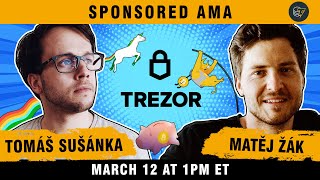
Recorded AMA (YouTube) with Trezor representatives Thomas Soussonk (Head of Development) and Matei Zak (Head of Product). They explain hardware-wallet basics, highlight Model T features (color touchscreen, Shamir backup, SD card functions), discuss Trezor Suite (desktop/web app, Tor support, planned full-node support, coin and feature roadmap), and address security, open-source, and usability questions from the audience.
Chapters
Thank you for joining us today for this very special AMA with Trezor. Today we have Thomas Soussonk, he's the head of development at Trezor. And Matei Zak, who is the head of product at Trezor. Hey, guys, how are you?
Hello, everyone.
Thanks for having us.
Yeah, thanks for coming on. This is a really great ama. I'm excited to host it with you guys. It's all about hardware wallets, obviously. So Trezor is one of the best companies for hardware wallets, if you guys didn't know. And today we're going to be talking about the Model T, which is one of the latest hardware wallets from Trezor. But before we get into that, could you guys explain what a hardware wallet is?
Sure.
So let me start on that. So hardware wallet is simply just a single purpose device. That means it does one thing and it does it well, and that's cryptocurrencies. So just so all of you get an idea, like this is what it looks like. I hope you can get an idea of that. What I'm showing, it's two devices, let's say in the size of a half of a credit card, something like that. And we have model one and then we have Model T, which we're going to talk about a little bit more today. I guess what is important about hardware wallets is that they have a trusted display. They have a trusted display. What that means is that you see all the information on the dedicated display and that's how you know that you can confirm everything that you are supposed to confirm on the device directly. Because, for example, if your computer is hacked, if you have some malicious malware and so on, the information that your computer is showing might not be accurate. While the information that are displayed on the device should always be correct and are always the ones that you are then signing and broadcasting into the blockchain, into the network.
Got it?
Cool.
Before we get into the Model T, I just want to remind the audience, please ask questions during this ama. It's so important to engage with us. We, we've got the experts here, they know all about hardware wallets. So please send your questions in the chat. And if you like what you see so far, remember, be sure to subscribe to the channel. Okay, next question. Let's get into the Model T. So are you guys able to just chat a little bit about the features there and what makes the Model T unique from other hardware wallets?
Yeah, so maybe I can jump in here now. So the, one of the key differences of the other hardware wallets on the market is that this model actually has a color display and touch display, so you can navigate through the user interface very easily. And that's one of the sort of one of the pillars that we want to build the products on is the usability. We are bringing the Model T to the masses and the whole sort of Trezor ecosystem. And so the ability to, for example, type in your pin or passphrase that we will talk about in a moment directly on the device in an easy way is kind of key and crucial to the whole user experience.
Got it. So the touchscreen feature is obviously very important. Are there any other features that you want to talk about that kind of make this a unique hardware wallet from others?
Yeah. So if we talked about the hardware wallet and also the computer side or the side of the client where you actually use your computer and you work with the interface. So we are building this ecosystem where you have desktop app and browser app, and in a future, some mobile apps. So the goal here is to connect all these features together and make it extremely usable for the user. So that means that you can input the information on your computer, and then the app will basically ask you certain questions or, you know, ask you to verify certain information on the device, and the device will light up and, you know, it will give you the option to either, you know, accept the information or reject it. So that's basically, in a nutshell, what we are trying to achieve and get the hardware features into the, you know, like the computer interface in a. Like, a very easy manner.
Got it. And. Oh, go ahead.
Yeah, I just wanted to add.
A.
Feature of Model T that is probably my favorite since you've asked about some particular features that Model T has. So I first have to explain how backups work, because I think that may be interesting also for all beginners that are joining us. Before joining the company, I've actually been thinking about how the backup is done, because I was always, you know, how do you back it up? What happens if you lose the device? What happens if somebody, you know, what happens if a car runs over it and so on. And this is actually very well thought out because during the onboarding process, we give you 12 or 24 words, English words, simply English, nothing crazy, and you write down those words. You write it on a piece of paper, you hide it somewhere. You can choose your own hidden spots. And these words are actually the backup. I mean, that's it. These words actually represent all your keys and therefore all your cryptocurrencies. What is new regarding Model T is so called Shamir backup. And this Shamir backup is one step further regarding the security, because you actually can have a number of sets. You can have three sets of 20 words, you can have five sets of 20 words, and you basically can define the threshold and the number of such shares. So, for example, the default that we give is three out of five. That means we give you five shares of 20 words. You give one set to your mom, you give one set to your girlfriend, you give one set to anyone and you keep those remaining two for yourself, for example. And then you need three, and it doesn't matter which ones, you need three of those sets to combine it all together and get back to your cryptocurrencies. And this is great because obviously if you do not have this feature, if you have just, you know, one set, as mentioned previously, then anyone who finds that, that's it, that's the game over. If somebody finds the backup, the coins are theirs and that's it. But in this case, if somebody finds just one share, then you still have four more and you need actually two more if the threshold is free. This is a neat feature that brings the security set up even one step further.
Right? Yeah, and obviously that's so important because we hear so many horror stories about, you know, coins getting hacked or people losing their password and they just can't find it. Before we go into more features, I'm going to take a question from the audience because I think this is kind of relates to what we were just talking about. So Pillsbury Dopboy, he is asking, is Trezor more secure than ledger? So what do you guys think?
So we obviously will say yes, right? We believe that, but you know, it's a complicated topic. We truly believe Trezor is better. But you know, when it comes to the fact both are hardware wallets, and I think the most important is that people use hardware wallets because as we will probably talk about later on, the important thing is that you have a wallet, that you do not keep your currencies on exchanges and so on. And why I think Trezor is actually superior is that we are now building the whole ecosystem. We have a Trezor, which is a brand new wallet. And Matthew will, I think talk about that in just a second. And we're just trying to really push the usability even more to lure in all beginners and have it really friendly for anyone. So, yeah, Matei maybe wants to add something on that.
Yeah, maybe one extra since you're talking about security. One extra feature that we have on top of the backup that Dimash mentioned. So you created follow it. We give you the words, and then on top of it, we give you something that we call passphrase, which is, you know, which is. Which basically add an additional phrase. You know, it can be word, can be the whole sentence through the, you know, as sort of as your kind of password. But we don't want to call it passphrase. It's actually a passphrase which you add in the interface. And that's great. You know, that creates another wallet inside the. Inside the ecosystem. And this phrase, you gotta remember, that's something only, you know, it's not safe anywhere. It's not on our servers, on anywhere. You are the only person that uses it. And that's great. The keys that you then access your funds. And that's a neat security feature because it's. Technically, it creates a virtual device that's not hackable in any way. So it's an extra step in the security.
Yeah. And I just want to add one last thought. Not that it just isn't stored anywhere. There's also no such thing as incorrect passphrase. Normally when you log in into an account, it tells you this password is incorrect. You know, it's not the correct one. But how passphrase works, since it's not stored anywhere, it's only in your head and nobody can know if you have 2 or 4 or 5 or 20. It's completely up to you and it's not really discoverable because it's not stored anywhere else than in your head.
Right. Yeah, I mean, obviously these are all really important features. I did want to take a question from Kevin Pauly. So he says, what about the claim that Trezor can be hacked in 15 minutes by Kraken Labs? So what do you guys have to say regarding that, Just out of curiosity?
Yeah, sure. So we have a detailed article on our blog post about that, about that claim. So I encourage everyone into reading that. But also what I would like to stress out is that the main attack vendor, the main thing that we are trying to protect our users is like against the risk remote attacks, that means against the online attacks and so on. So what that means is that if your device is connected into your computer, then that's the main use case that we are trying to protect against. And of course, I don't want to, you know, of course the physical security is important as well. And we took some steps to take it even further and to protect Trezor against such. But what I want to stress out that the most important aspect is the remote security and the remote attacks protection. And it actually nicely corresponds with the feature that we've been discussing just a few minutes ago. And that's the passphrase, because as I mentioned, passphrase is not stored anywhere. So if you use passphrase, even if you would hack Trezor, even if you would hack Ledger, even if I don't know what would happen, the passphrase is not stored anywhere and therefore you cannot really hack it. If you use passphrase, there's no such hack that would take anything from you. That's just fact.
Got it. Can we talk a little bit about the Trezor suite? Because I know that's a new feature. It sounds pretty cool. So I'm sure the audience wants to know a little bit more about that.
Yeah, for sure. So that's, that's a product we've been working on for the good past two years, maybe even longer. We just, we are right now in a, in a, in a beta. So it's an actual, you know, desktop app. It also runs on web as, you know, as a web browser and we are building also, also mobile app. So. So in the near future you will be able to use Trezor with your mobile phone. So the app is basically piecing all the sides and corners of the whole ecosystem together. It's an app that is well fitted for even the beginner users because you can actually buy crypto, you can exchange crypto directly in the app and of course you can send, receive and make basically the basic sort of financial operation that you would like to with your funds on the sort of more hardcore users, let's put it this way, side of things. We also implemented Tor as a privacy feature and in any near future we will introduce full node support as well. We are also on the roadmap, there's a coinjoint function as well, which is basically anonymizing the transactions. So we like to put it that it's like a360 sort of ecosystem where it really should solve for all your needs and, and attract a wide range of use cases and users.
Got it. I'm curious because I was reading an article like a hardware wallet review article and it mentioned that the Model T can be complicated for beginners to use. So what are your thoughts on that? I mean, it seems like the suite is intended to make it easier for beginners to use a hardware wallet.
So.
So what are your thoughts on that?
Well, first thought Is it's breaking our heart probably. But we really want to make it as easy as possible. We are actually in a process of redesigning the Trezor firmware as well and bringing some design improvements in the whole application and not only for the Model T, but also the previous one for Model one. So for example, the users will be able to, in an easy manner to input their PIN codes and passphrases and recover the wallets directly from the device. So they will not even need the actual interface of the computer for that. So that's security improvement as well, by the way. But back to usability. So right now we like to think about it. It's sort of like make a mobile for home navigation. So you know, if the new designs and everything, they really improve the usability. I mean there are even, you know, swipe gestures and stuff like that. So yeah. So I believe then that already now, but also in the near future with all the, you know, ideas that we have into roadmap, it will be pretty, you know, usable or it is pretty usable device.
Yeah. And I believe if like as Matthia mentioned, we started doing Trezor Suite also. Exactly. For the reasons to, you know, bring it even closer to our users and to simplify a lot of design, simplify a lot of workflows and so on. So it's more beginners friendly. I basically believe if you are able to use an Internet banking, I'm pretty sure you can use a Trezor suite. Of course, you know, there are specifics since you have the device and we are actually just redesigning the whole onboarding process so it's even a little bit easier. So we really believe that in a few months we will get there when it's just like an Internet banking with a nice device in your.
Yeah, yeah, definitely. I love the concept. Can you just hold up the device again real quick just so everyone can. It's really cool. Awesome. Okay, I'm going to take another question from the audience. So Seb Sarori is asking, are there any bugs?
That's a nice question.
Thank you.
Seb, I think was it. So, you know, in every development process you find bugs. I mean that's natural thing. But we have a number of steps to prevent these things from happening. So for example, we of course have automated tasks. So we have tests that, you know, check the firmware in the device. We have tests that test resource suite. We have automated tests that actually test both of those together. So we make sure that they actually fit together. And then we have our beloved QA for knights that, you know, that take care of the product and they actually test it manually and make sure that everything is in the top quality before the actual release.
Cool, Great. I'm going to do one more question before we move on. So this is a question from X. Bumski. It's obviously very relatable right now with the whole NFT boom. He's asking, is it possible to make an NFT download to Trezor and use as a wallpaper on the wallet face?
Not yet. I mean, we do not support that yet. I'm not saying we will support it in the upcoming future, but these trends come and go and we always wait a while to evaluate that and then consider implementing it. So it's nothing that you can do at the moment, but who knows, maybe in the foreseen future we could support that.
Got it.
Cool.
Okay, moving on to the next question. Open source is a common theme in the blockchain community. So how does open source relate to Bitcoin and how does it apply to Trezor specifically?
Okay, so open source, as the name suggests, is the concept of having all source code publicly available. And that is the case for our company. Both Trezor firmwares, both Trezor One firmware and Trezor T firmwares are publicly available on GitHub.
So.
If you feel up to it, you can go ahead and read it, read the code from start till the end. And open source is definitely in our heart because it's something that the company basically start upon. Everything was open source from the very beginning. Trezor suite is open source as well. So it's something that is in our hearts for quite some time already. What is great about that is that it brings great audibility. That means anyone can read it, everybody can check what the code is doing, you can have a look what what we've been working on actually directly, because we do everything out in the open and this is actually indeed happening. We have a program where hackers are trying to find things that would be exploited. We have researchers trying to study our code and so on. And it's really something that works, I would say, because it's already open source for ages. It also brings an interesting situations because our Trezor was cloned many times. There are devices that just took our code and used it. But at the end it always comes that you want the best. So you go and buy, buy Trezor directly because you want to buy it from the people that actually built it.
And support the continuous development as well. On the firmware side. And also brings me to another topic. Maybe I would say the open source is actually inherited in the company's DNA as well. So it attracts a specific talent that likes the idea and likes the philosophy. And as a company as well, I think all the processes are built in this sense of basically in the philosophy of open source, Right?
Definitely. Also, Tomas, you made a really good point. You mentioned that typically users want to buy the device from the company that actually produces it. I think that's also a really good security thing to note. Just because so many hardware wallets, for instance, there are giveaways, there are conferences where people are giving out hardware wallets or auctioning them off, or contests. But I think that it's important for people to know that in order to ensure that this hardware wallet is secure, to get it directly from the source. Like, do you guys agree? I think that's really important for people to know.
Definitely. It's the best way to buy hardware wallet is directly from the source. I guess if you buy it from a company that you know for ages, for example, Amazon or some like really big established company, then I guess it's okay as well. But why risk it if you can buy it directly from the authors and from developers? That is being asked.
Yeah. And also again, from the software perspective, Tomas mentioned at the beginning that we are building this new onboarding experience for basically onboarding the device and getting the firmware update into the device and all that. So actually the new onboarding has a few authenticity checks built in. So the user is actually based on. Basically the user connects the device to the computer and then the program ask him or ask her certain questions and then they are verified against the state of the device. And then we can judge whether the the device has been tampered with or not. And there are even some offline checks that just see on the device and stuff like that on the packaging as well, which should prevent the unauthorized tampering.
Yeah, that's awesome. So let's talk a little bit about coins and which coins are supported on Trezor. I know we've got a question here from one of the audience members from pk. He says, when will Monero be supported in the suite?
Thank you for that. So actually we would love to support Monero directly in Trezor Suite. It's just that Monero is not one of the easiest coins to support, to put it that way, because the cryptography is cutting edge. And although we do support Monero in Model T, we actually do. It's just not yet. In Trezor Suite, it works only with the official Monero wallet. So we would like to. It just takes some effort. So, you know, it's not going to be tomorrow, but we would like to have Monero in Trezor Suite. What do you think, Matthew?
Yeah, I mean, maybe I can add on in general sort of strategy of, you know, supporting different coins as, you know, the NFT moment, you know, before we are kind of reluctant to work with all these kind of frenzies and jump on the next new thing that's out there. Because of course that's risky, not only from the product perspective, but from the business perspective as well, because it needs to have an audience and user base and stuff like that. So we actually think about this in terms of the supporting different coins more in a quality than necessarily the quantity. So, so we, you know, like, when it comes to prioritization, we would always probably give a, you know, priority, something to develop more, you know, like rich features around a certain coin when jumping to the next thing. That just came up.
Yeah, definitely. Actually, that is. That's a good transition into the next question from pk, an audience member. He's asking, when can we expect a Coin Control feature?
That's a good question. It's actually on the roadmap already. Speaking of the open source, the roadmap is public on our GitHub and you can find a link on our Trezor Suite landing page as well. So Coin Control is there. I'm expecting to have it released by either June or July. It should be there. Cool.
Okay. And I just want to remind the audience, please continue sending your questions. I'm getting them. We're getting a ton of good questions. And also be sure to subscribe to the YouTube channel because it's awesome and we do really great AMAs like this all the time. Okay, so next question. Not from the audience, just from me, a general question. So KYC and AML regulations are becoming a common theme with the rise of Bitcoin. So how does Trezor and the Model T in particular address these concerns?
Yes, so privacy is definitely one of the topics that we are trying to address in addressing that we are addressing very thoroughly. We've actually introduced a very nice feature in Trezor Suite about a few months ago. I don't remember exactly. And that is store. So Tor software is a piece of software that's very popular among privacy advocates. And what Tor is doing, that it actually routes all your traffic through a number of hops or through a number of servers. So instead of communicating from A to B, Tor actually takes the traffic and puts it through a number of different hops. So the end server actually doesn't see your original IP address, it sees address of one of the hops before, you know, before that was there before. And those hops change all the time. Each few minutes, you know, it all mixes all together. So this way, if you're using Tor and the destination, the server does not know your original IP address. And that is something that we have implemented in suite on a single click. So you have in Settings, you have a Tor enabled checkbox, you just hit it and there it goes. Trezor Suite start Tor directly. You do not have to install anything else. It's directly bundled in, it spins up Tor and it routes all traffic through Tor. So basically this obfuscates you and anonymizes you pretty well. And this is a feature that we all already have in Trezor Suite. It's really one click, one click thing. So that's Thor. And also I might elaborate on the fact that Trezor and actually also Trezor Suite, they work also without our company. What I mean by that is that if our whole company is canceled tomorrow, if we decided to, I don't know, go home, everyone, and just stop working on everything, it will all work. It will still keep on working because everything is open source. Trezor devices are actually supported by Electrum. So you can actually use third party software as well, not our software. And what we also plan to bring is a support of the actual Bitcoin node. That means because currently you do join, you do connect to our servers that give you info about addresses and how much bitcoins or other cryptocurrencies you have. And you can obfuscate yourself through the Thor feature that I've mentioned previously. But what I want to point out is that we are also considering, or we've actually decided it's on the road roadmap already, that we would like to bring a complete Bitcoin Bitcoin node support into Trezor Suite. So similarly to Tor, you will just have a one click button and you will download the whole blockchain and you can actually have the whole Bitcoin thing inside, inside Trezor Suite. It will take a time. So please, you know, give us a few, don't, you know, just give us a few months or give us a little bit of time for that, but we will definitely deliver. Deliver this.
Cool.
Sounds good. Okay, I'm going to take another question from the audience from Michal Stano. He says, hi Tomas and Matei. The first question is he wonders when Polkadot Dot will be a supported coin on Trezor devices. And his second question is Passphrase wallets do not work with Daedalus and he plans on fixing it or is it a problem in Daedalus?
So as far as I know, that's the problem in Daedalus. As far as I know I can be mistaken. But we're more than happy, you know, to have to have a look at that. We've done some changes like a year ago about how Passphrase are handled. So you know, we can, we can discuss with them to fix that. And on the first question, we do not plan to support Polkadot just yet. We actually, as Matei mentioned a little bit, that we want to focus on the quality, not directly quantity. We actually would like to first support everything that is supported by the Model T to have a support in Trezor Suite. What that means that we currently support Cardano for example, we support some other coins in Model T, but we do not support them in Trezor Suite. And users have to use some third party wallets that we do not control the UX there. So we are kind of limited about the whole user experience there. So we would like to actually first merge those two worlds. Meaning that we would first like to have everything that is in firmware. We would like to have that in Trezor Suite. And after that is done one cryptocurrency at a time, then we would like to reevaluate what is the next coin that we would like to implement in both firmware and Trezor Suite. Great.
I'm going to take another question from the audience real quick. It's from Sunny Sign. He's saying exactly what metadata is collected and leaked using Trezor Suite or simply Trezor.
Okay, so as I've mentioned, if you're using Tor, you are all good because the IP address is different. We are logging some information about who's connecting, who's connecting and so on. But those are only in the blog book, which is like a piece of software that tells us which addresses how many bitcoins and so on. So there are some logs, but they are rotated daily or something. Or I think it's daily, I'm not 100% sure. Maybe it's once in a two days or something like that. But we definitely do not store them. So it's just like have some basic to have a look if something goes wrong. And so on. So that's one part of the, of the, of the question. And second part, we also, in Trezor Suite, you have the ability to, you know, to, to send us data about how you're using the app. But that's 100% voluntary. We ask you during the onboarding, so you can turn it off if you wish not to. Not to send us, of course, anonymized usage data. But even those that are obviously we do not send information such as how much cryptocurrencies you have or how much Bitcoin you have and so on. That's forbidden. So that's definitely not what we are collecting. Even if you voluntarily say that you are okay with that. And yet again, I would like to sell the Tor feature because if you enable Tor, then all logs or any data that even can be collected by us are anonymized and the IP address is not yours. So there is definitely not anything that can be leaked or abused, Right?
Definitely. So next question is mass adoption around cryptocurrencies and Bitcoin is happening now and it's obviously going to keep happening moving forward. So how does this influence Trezor and what is Trezor doing to ensure adoption of cryptocurrency moving forward?
Yeah, so maybe I can take that one again. So I mentioned that we are incorporating other features that are not just the hardcore features. Maybe Thomas mentioned Tor and Full Node and the Conjoint has been mentioned as well. So one way to look at it is the usual story would be, I mean, if people start researching how to start with Bitcoin or how to get started with crypto in general, they would be proudly advised to go on some exchange and buy the first coins and do that. Luckily, you can do that already in Trezor Speed as well, because you can buy your first crypto there with a credit card. It's a very simple process through a partner company, actually our sort of company, it's called Inviti. You can check it out on NVT IO. It's a company that, it's in the Satoshi Labs group and they're providing these features by sell, exchange, even spend, where you can actually exchange crypto for services, basically by vouch for different service, Amazon, et cetera. So these, you know, if you think about it, it's basically these features that, you know, give the general public and the mainstream users the option to get started. Like basically the barrier of entry into this whole world that may, you know, feel technical to some or to most, maybe it's actually, you know, this feature is supposed to help you with that and navigate the users through the. Yeah, through this, you know, quite technical world. Also, we are building our new knowledge base that, you know, supposed to be super user friendly. It will be, you know, it'll be accessible directly in the app. So basically whenever there's some, you know, Bitcoin or some, any coin basically specific feature, it will be explained directly to the user within the, you know, within the interface. So they should be able to, you know, get onboarded on the feature very easily and sort of seamlessly within the same space.
Yeah.
Any other ideas, Tomashi? I don't know.
Yeah, I just wanted to add that also what we would like to make happen this year is localization into native languages because obviously that's one of the main usability aspects as well. Of course, we currently support only English, which is the majority of our market, but still we believe that localizing brings great potential because that way we can really increase the mass adoption and then we can ease up the onboarding process for all the people around the world. Our idea is that we will translate also the devices, not just the Trezor suite, but we really want to make the one step further and actually translate the devices. And actually, if I may to elaborate on the exchanges, because what I believe is important to realize is that if you have your coins on an exchange, the coins are actually owned by the exchange because they just have a database and they say, Matei has 100 bitcoins. I have 1,000 bitcoins. Well, I wish, but I mean, it's just a database that says how many each user has. But that's very different to how hardware works for it, because hardware, we do not actually store your coins. We store the keys. We store the private keys that you need for accessing your coins on the blockchain. So I'm not sure if it makes sense for beginners. I hope so. But there is a fundamental change in that because we are just protecting the keys and the keys are directly connected into the blockchain. There is no middleman. There's nothing in between. It's just your keys and therefore your coins.
Right. I mean, I think another important element for beginners because the online exchanges, they make things easy. And for instance, if you want to sell or, you know, take your Bitcoin and put it in your bank account. How does that work with Trezor?
Yeah, you can actually, you know, within the. Within the app, you can, as you know, Tomas mentioned as well, you can. If you buy Trezor tomorrow or today and you download Trezor Suite. I bet that within three to four minutes you will be able to buy your first bitcoin. Even if you have zero experience of crypto. Maybe I can add a few more minutes with the onboarding because you actually need to set up the device properly and we will help you with that. Make all the authenticity checks that I mentioned before. But let's say within five minutes, I think you'll be able to buy your first bitcoin and you can make sure that it's yours. It's not, it's not any other entities, it's actually yours. For example, on the other side, if I, let's say Revolut app is very popular I think these days in Czech Republic, for example, where we are based, if you purchase the bitcoin there within few tabs, you actually bought it technically. But if the company goes bust tomorrow, then you lost the funds for sure. There's no way to, you know, to recover them. Whereas in this, in our ecosystem, basically you own the funds and you are the only owner of the keys that, you know, that basically make you. That provides the access to the blockchain where your funds are stored.
Got it. I'm going to take a question from the audience. It's actually a really great question from Rahul Manakyari. He's asking when do you plan to launch the staking feature?
So.
Yeah, so for staking feature, we first need a coin, you know, that has proof of stake in the blockchain ecosystem. I believe Cardano could be the first because as mentioned, that's definitely on the roadmap. I believe in. I don't want to make any promises, but I believe in two to three months we could have Cardano in Sweden and then staking is almost there. So I believe soon.
Cool.
Okay, I'm going to do another question from the audience. So from Humpty Dumpty, he's asking, is it safe to use the Trezor on a compromised PC or PC infected with malware or viruses?
Great, thank you. Great question. Thank you. So the important thing that everybody needs to know is that you always need to check the device. I mean, what the device says, that's the truth. That's what is actually happening. So if your computer is compromised, if you have malware and it says sending bitcoins to address A, but then your device shows that you are actually sending bitcoins to an address B, so you know, it does not match, then something is really, you know, something is going on wrong and you should be very careful about what you're going to do and you should basically abort the transaction. But what is important is that the device has the display. As mentioned, Model T has the touchscreen. So it tells you the information that the device is doing. You know, actually. So if your malware says I'm sending coins to address A and then the device says I'm actually sending it to somewhere else, then you know, the malware cannot touch the address that is shown on the device, you know, because that's, that's, that's the accurate thing. That's what's, what's actually being done. So thanks to the displays on both of devices, you can actually verify what is going on.
Cool.
Awesome. Just a reminder to the audience, please keep sending your questions. We're getting some really good ones coming in. So obviously these guys are here to answer all of the questions that you may have. I'm going to take another question from the audience. Let's see here. There was a good one that I saw. Okay, so this is from Rahul Manakari. Why is there a micro SD card slot in the Trezor T? What are you guys planning to do with, with that? And can you show that again what he's referring to?
Sure.
I'm not sure if you can actually see it. Maybe a little bit.
Right.
So yeah, there is a little place for SD card just right there in the Model T. So yeah, so this is a feature that like our ability to provide a feature to Model T via SD card. So there are a number of ideas that we have or some of them already implemented. For example, we have really, really hardcore feature which we called SD Protect. What that is doing is that it sets, it actually apologies, uploads some random piece of data onto your SD card and then you actually need the SD cards to unlock your Trezor. So normally you have pin like a normal PIN number that you need to enter to access your Trezor. But with this feature you actually need the PIN and SD card. So it's yet another layer of protection. If you are really worried about physical attack, then you take the SD card out and you can hide it where this is as mentioned, a little bit hardcore feature. I would say it's really for the advanced features. So that's one of the features of. And then Matei, if you want to elaborate on the labeling, that's what we are considering as well.
For sure, on the transfer suite side we have a feature that we call labeling, but basically that's an option to rename transaction addresses Accounts, et cetera. It basically makes the whole interface more usable or more customizable sort of, because you can basically rename pretty much everything, all the blockchain related transactions. And so there are a number of options how to store the labels. One of them is locally in the memory of the app being on the desktop app. The other options are basically cloud services. Right now we support Google Drive and Dropbox and actually the feature that we have planned on the Roadmap is that you could store the labels on the SD card as well. Character in the device.
Yeah. And just a small side note to that, the data that are stored either locally or in Dropbox or Google Cloud or whatever, they are actually encrypted by Trezor. So we do not share your data in a plain text. We encrypt it using the keys that are stored in the device. And neither Dropbox or any other company can touch them because all they have is the cipher tags that they actually cannot get into because they do not know the, the PIN and so on to encrypt those.
Yeah. What I think is really cool about the Model T is that it's designed for beginners and also for advanced users. And you don't see that a lot with hardware wallets. I feel like a lot of beginners are just scared of hardware wallets, naturally, but this gives them the option to really feel more comfortable with using a hardware wallet. That being said, I'm interested in knowing from both of you, what do you think? What are your favorite features about the Model T? Like what's the most unique feature in your opinion that makes this hardware wallet? Just above and beyond.
So maybe I can start. I love some features that we have on the roadmap and I mean they are small improvements, not necessarily on the security or privacy side, but like a nice, nice, easy, nice sort of touches to the interface. So soon you will be able to actually lock the device by touching it, sort of. That's not an option as of now, but you will be able to lock the device by interacting with it. As of now, you just have to sort of reconnect it or wait for the timeout because you can set up how fast or like basically when the device auto locks itself. So that's one of the features I like. We also redesigning something what we call bootloader because in the process of the firmware update, which it's maybe interesting to say that we actually send firmware base, I would say on average every two, three months, if I'm not wrong, Tomas, but Basically on average in this time period and during the firmware update you always have to go through this bootloader which is basically like a low level system in the device that you need to get to. And right now we are redesigning it so you will be able to access it directly from the Trezor speed interface. So you will just click button and it will help you to get into that mode. Because before you sort of as of now actually you still have to keep touching the display and then connect the cable and it's sort of cumbersome to get in the mode. So it is all because also with different variability, it's security feature as well because the firmware updates always bring some new security improvements into the whole ecosystem. So again we are thinking of what are next steps, how can we even make it even more easier for the users to do those? So that was just few examples from my side.
Yeah, and I totally agree. So I've already mentioned the Shamir backup at the beginning so. So that's definitely one of my favorite features. And then also the display because it's nice, it's colorful, it's touchscreen so you can use it very easily. I can show it again how it looks like. I mean my camera is not very good, so I'm not sure if you're getting any of that. But it's very nice and you can type directly on that. So that's really neat. And yeah, as Matei mentioned, it's not just a design thing, it's a usability feature. Because one of my favorite mottos is that security at the cost of usability comes at the cost of security. I'm sorry, I don't remember the author. I apologize in advance. But what that basically means is that the usability has to be top notch. It has to be great because otherwise users do not follow the best practices and so on and they can make an easy mistake, they can do something that could endanger them or they their funds. So we are really trying to improve, we actually try to improve all those main three aspects that we have talked about that it's usability, security and privacy. It's, you know, all those three aspects is something that we are trying to improve every day.
Cool. Great. And audience members, just keep sending your questions. We've got about eight minutes left in the ama, so we're still taking questions. This question is from an audience member from Rahul Manikari. He's asking Grace Singapore selling customized Treasure Tea with a shiny metal body. How secure is that? Do you guys officially support that level of customization as those need to be removed from plastic housing.
Yeah, so yes, that's like an official cooperation or to put it actually, the firmware that is running there is exactly the same as it's running in our devices. So the chips are the same, the electronics inside are the same. It's just that they are making their own plastic case which is a little bit more shiny. And also what might be interesting to our viewers is that you can actually build Trezor yourself. I mean if you are into DIY kind of project. We actually on our GitHub you can find a tutorial how to build both Model TA and Model 1 because everything is publicly available. You can buy all the components on, you know, ebay and so on. You can put it all together and then you download our firmware and it will run on your DIY Trezor the very same way as it runs runs on the official devices. Yet again, it's more of a. I mean it's for those interested, obviously. Otherwise the more straightforward approach is to buy it directly from us. But it's something that we have in mind and we don't want to do any vendor lock in or something like that. We really want to give the ability to build it if you want.
Yeah, that's so important I think in the blockchain space just to have that flexibility, that openness. I think that's what the whole space is really about. So that's awesome. Next question from the audience member Kaltoro. He's asking will Binance Smart chain be supported by Trezor?
So we currently support Binance Coin. That's what we support in the firmware. We do not support it in Trezor Suite as of now. And yet again it's something that we are evaluating. We don't want to spend 100% of our resources to keep doing one cryptocurrency after another. It's just something that we want to think about and do it a little bit slowly and you have to think about it a little bit. So no ETA yet. Something on the roadmap? It is, but so yeah, I don't think that's going to happen anytime soon.
Okay, so we have about five minutes. I think we have time for just a few more questions from the audience. If you guys have any, just keep them coming. I'll try to get to them. This question is from Learn Simple. He's asking is it technologically theoretically possible for a compromised PC to steal keys from a device?
So, you know, theoretically. So theoretically everything is Possible. I mean, I would be lying if I would tell you no, but from the reasonable point of view or from everything that we know from, like everything that human knowledge, you know, as we know it, it's not possible because the keys never leave the device. The keys always stay in Trezor, and Trezor is actually only doing some operations that you specific tell the device to do. So a typical example is that you want to sign a transaction, you want to send some coins from one address to another, and the Trezor actually asks you if you really want to do that, and you have to confirm it with your actual fingers. So there is no way to get the keys out of the device. We do not send them from the device into the computer. That's what the whole architecture is about, that we only do the cryptographic operations. We only do them inside the device, but the keys never leave the device.
Cool. We've got a few minutes left. So I'm just curious before we do any more questions, Matei and Tomas, do you have any. Just additional comments that you want to throw out there for the audience to know that we didn't cover yet?
Yeah, so maybe one general thought, I mean, depending of course, on the maturity of the audience in the crypto world. But. But I mean, if you are scared of Bitcoin or crypto, don't be, you know, try to experience with it. It's a lot of fun. I myself went through the process not that far ago. You know, I'm not like, in a crypto, as you say, like, yeah, like a very, you know, but basically I'm not in the world for like past 10 years or something. And still it's. Yeah, provides great experiences in terms of. Yeah, basically all these, like, philosophical, you know, topics that we talked about. It's something that, you know, crypto, you know, brings to the world and Trezor helps to, you know, to grasp it and to use it in a nice way. So, yeah, I would say I just like, encourage everyone to. To do that and ideally, you know, give a try to Trezor and the whole ecosystem that we are building.
Yeah, mate, put it quite nicely. Also, if anybody is interested, we are hiring. We have some interesting positions we can check out online. And yeah, I would like to thank everyone in the Trezor company because, you know, we are here as an ambassador, but obviously they've done all of the great work. So, you know, sending hi to our company.
Cool. It's good to know that you guys are hiring. I mean, right now it's women's International Month. And so we're trying to get more ladies involved in Blockchain. I think it would be great to see, you know, more women in the space. So ladies, they are hiring awesome company. Also, before we end, if our audience wants to get in touch with either of you or with the team, if there are support issues, where do they go for that?
I think they can also they can definitely find us on GitHubs because GitHub, as was mentioned, everything's public there, so you can do that. We also have company most. You can probably share them. I think we are both on LinkedIn as well. So if you google our names, you will definitely find us and get in touch if you wish.
Yes. And like our website is Trezor IO as you will definitely find the link somewhere quite easily. And in case of some questions, problems and so on, you can definitely hit our great support team, which is supportresor IO and they will definitely help you with any problems that you might have.
Very cool. Well, Matei, Tomas, it's been a pleasure. Thank you so much. Thank you to the audience for joining and engaging with us. And remember to subscribe to the YouTube channel because we will continue doing very fun, engaging AMAs like this moving forward. So thanks again, guys.
Thanks.
Thank you very much.
Thank you.
Bye everyone.










