Vabble AMA: The Future of Streaming Entertainment
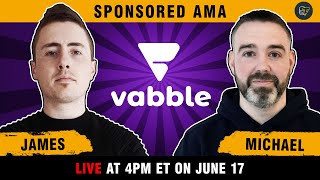
James and Michael, founders of Vabble, a blockchain-based streaming platform, explain how it pays users up to 60% rebates in VAB tokens and charges per 15 minutes watched instead of monthly fees. The platform launches a token sale June 21-24, 2021, targeting independent films from France and Canada for viewers aged 16-24.
Questions this video answers
IDO sales run from June 21 to June 24, 2021; Uniswap listing on June 24, 2021.
KickSwap, ZeroSwap, Axion, and Cyberfi (speaker also mentioned QuickSwap/QuickSwap variants).
Up to 60% of the subscription (rebated in VAB).
Users pay per 15 minutes of content consumed (billing granularity = 15‑minute increments).
France and Canada (with plans to expand to England, Ireland, the U.S., and others).
Chapters
Hey everyone, what's up? It's your girl Rachel here. And today I have a very great AMA for you guys. We are joined by Vabble.
We have.
We have here today with us James. He is the CEO and founder of Babel & Michael, he's the COO and co founder. Hey guys, how's it.
Going? Good.
Yeah. And.
You? Doing well. Thank.
You. Thank you for having us. This is going to be a lot of fun.
Today. Yeah, thank you. And you guys are joining us from Ireland.
Right? Yeah, yeah. Sunny Ireland for the first time in a long time.
Yeah. Awesome. Glad to hear it's sunny there. And I just want to remind the audience to please send your questions our way once we get started and to subscribe to the YouTube channel. Okay, great. So first question I have for you guys is what is Babel and what makes it unique and different from other streaming video platforms? And either one of you can.
Start. So Babel is just like any other SVOD service in a sense that we're quality over quantity in terms of content. But where we differentiate from the others is that we're creating, instead of having this single window where you just watch a video or watch a film on your own, we're creating a social experience and a co watching experience, an interactive experience. So what we're trying to do is actually replicate the cinema experience that we all know and love in a digital environment. We're focusing on things like co watching, where you'll be able to watch films, documentary series with your friends and your family, where you have independent chats, where you'll be able to talk directly with people all around the world who are watching the exact same piece of content you are at the exact moment that you're watching it. And then we have other social features as well that we're working on. But the main thing that differentiates Babbel is that it's not just your single view into a film. We're creating an interactive experience, a social experience. I think we're merging the social and the current svod. We're mixing the traditional XVOD and the social that we all know, especially younger generations. They're more now on video when they're talking to friends, they're often on social media. So we're merging the two of those worlds, are bringing together two to have a more modern day SBOD type.
Service. Got it. And can we talk a little bit about the role of blockchain here? Because obviously it sounds like an amazing streaming video platform with a lot of interaction, but I want to know how Blockchain is involved here in the use of cryptocurrency as.
Well. So crypto and blockchain come in, it'll come in in a lot of ways over time, but there's a lot of work to do and I'll expand on that in a moment. But the main reason crypto and blockchain comes in here is to support the economy that we're building within Babel. So to start off, we're kind of, we're merging two types of VOD services. We're merging svod, which is subscription based services, and tvod which is pay per view services. So users just come onto Babel, they pay their monthly subscription, they don't part with any more money. And when they pay their monthly subscription, they get a reward or a rebate of up to 60% of the money that they pay to us. That is rebated in the fab denominations. That VAD then is delivered to their wallet on Babel. So when they consume content on Babel, they pay for every 15 minutes of a piece of content they watch. So if they only watch 15 minutes of a movie, that's 90 minutes, they'll only pay for that 15 minutes. If they watch 30 minutes to pay for 30 minutes, an hour, they'll pay for an hour. And in doing that kind of, in doing a merger of SVOD and TVOD services, we're replicating cinema ticket sales. Because if we compare it to other SVOD services, that's strictly just licensing, there's a one time fee paid, that's it. But in doing this economy and ecosystem, we're actually bringing a problem that film companies have with streaming services. And releasing film directly on streaming services first rather than cinema, they don't do because they can't generate as much revenue as they would at the box office through ticket sales. So what we're actually doing is creating this modern economy through cryptocurrency and blockchain to support the film industry. Like they will get the same support from cinema ticket sales. Now that's not going to come as soon as we launch launch the platform. This will come as users grow. And the more users that watch a piece of content, the more that piece of content gets paid. So that's kind of where the blockchain and cryptocurrency comes into. It's more about the economy. We have the NFTs, we have tipping, we have. So we have the governance protocols which involves staking, we have NFT staking, which you'll get rewards from as well. We are looking at how to host full feature films on the blockchain. It's not that simple. And the reason it's not that simple, it's licensing problems. If I put a video or if I put a film on the blockchain, everyone in the world has access to it. But a license might say only people in the UK and Ireland have access to it, or only people in the United States, Germany and France have access to it. So in order to combat that problem, we're looking at developing a sort of nft. Not an NFT but an MIT licensing structure which will effectively create a new term, a new style of licensing deals for the film industry. Which means that wherever the video goes on Babel, they will get paid for it through this licensing deal. And it doesn't even matter if it reaches another SVOD with these licensing deals, it doesn't matter where it's consumed. The content owners still get generate the same revenue as if it was in cinema, but it's able to be viewed all around the world. But at this present moment, if we license a movie from Warner, for instance, we'll only get a license for a certain amount of countries. If I put that in the blockchain, I'll be sued. So we need to develop a new structure to licensing deals in order to be able to integrate films and documentaries and series onto the blockchain. So that's something we're working on down the line. Straight out the bat, the entire ecosystem that supports the film industry and supports the talent through back end film earnings, which will be automated through smart contracts. In doing that, that's supporting the entire economy through cryptocurrency and blockchain. Just to touch a little bit more in terms of the talent. A major problem with talent in film, especially on SVOD services, is that when it comes to back end film earnings being paid out, the content is pulled from the streaming service and therefore the talent in the film does not get paid their back end film earnings. And their back end film earnings is actually where they really make their revenue. They only get a small bit up front and in the deals they have with the film studios, most of their money comes from the back end film earnings. Now, now if we look at Netflix, Netflix will put back in film earnings into licensing deals. But it doesn't matter how well the film is doing on Netflix, when it comes to the point of when back end film earnings need to be paid out, they usually pull the film. And because they need to try and save revenue, because they'll be paying out more money for that one piece of content than they would be actually generating it through new users or recording subscriptions. So we're going to automate that through smart contracts, which is going to be a huge relief to the film industry itself because it's costing both agents and and talent all around the world multi millions of dollars every year in legal fees battling such companies like Netflix or production and distribution companies. So we're automating that on the smart chain. So it's on a smart blockchain, so it's immutable, it's fully automated, and talent will finally actually get the rewards they deserve for being in the films. I think that's one of the actual key benefits to the blockchain in terms of what we're doing with it on Babel in the initial.
Stage. Right? Yeah. So, I mean, James, that obviously a lot of information to take in, so I just want to break that down a little bit for the audience and even start getting to some of their questions. So I think it's important that we discuss the VAB token. And I noticed that one of the audience members, John Doe, is asking, when will we be able to purchase Babel? So maybe talk a little bit about the token and when users will be able to purchase it and where they can purchase.
It. Sure. In terms of the dates, we just started releasing IDO platforms the last couple of days. So we have four IDO platforms on board. We have Kickswap, we have zeroswap, we have Axion, and we have cyberfi. Samurai each have their own independent allocation, and sales are starting from the 21st right up to the 24th, and on the 24th, we'll be listing on Uniswap. So if you can take part in the ido, I would suggest you do, of course. But if you can't, you can go straight to uniswap on the 24th and be able to purchase there. In terms of the VAB token, the VAB token is the entire. It's the entirety of our ecosystem. Without the VAB token, our ecosystem would not exist. Okay, so when we go right back to the start, how do people receive VAB token on Babel when. When they pay their subscription, they get a rebate of up to 60% of their subscription in VAB. The VAB token then is used to pay for the content. VAB Token will be used to purchase NFTs. VAB token will be used to access AMAs, it'll be used to access exclusive content. It'll be used for so many different utilities that over Time, it's going to be just like an economy in a country, because the way we're structuring Babel, we're building an economy. So the token itself, over time will support the entire infrastructure that we bring on board over the years and years and years that we work on Babel. But starting from out the gate, it's the entire backbone for the economy that supports the film industry. So that's how content creators get paid, it's how people purchase NFTs, it's how people access to live AMAs, but talent from our casts from films. They're able to tip creators, they're able to purchase NFTs, they're able to do multiple different things straight out the bat with the cryptocurrency. Another thing they'll be able to do is actually order takeaway with their VAB cryptocurrency because we're having takeaway integration into the system. And when you place an order, you'll be able to pay in your VAB token. That might be straight away, but that is something we're working on very, very quickly when we roll out the platform.
Itself. That's really interesting. When you say takeaway, do you mean food that you can eat to watch.
Them? Yeah. So I mean, when you're in a co watching experience and you're sitting around with friends and family, but they're in different states, they're in different countries, they're all over the world. Wherever they may be, you're having this digital experience with them, watching a film together and you might get hungry. Well, inside the co watching experience room, we're going to have. We don't have any partners yet for this, but we're working on, we will be working on deals with them. So we'll have people like Uber Eats, we'll have Just Eat. There's a couple of ones based in Ireland. Marvin is another one. You'll be able to order your takeaway directly through these apps, which will be integrated on Babbel. Okay. And each person will be able to order their own independent meal. But on the back end, we separate out those meals and deliver them to the locations of wherever those restaurants may be in terms of the geographical placement. And the payments will be able to be made in that and other cryptocurrencies, but specifically.
That. Got it. That's really interesting and that's exciting that we'll be able to do that eventually and actually make use of that crypto to order food and enjoy movies. I'm going to also take another question from the audience real quick because I think this relates to what we were just talking about. RD16 is asking which countries are you aiming for after Canada and France for films? I think also just in general, which target countries are you are you aiming.
At? Right now we're starting with France and Canada and the reason is the independent. The way we're building over library is we're starting with independent film creators and directors and producers. You'll find a lot of their content in places like Vimeo. France and Canada have a really deep connection with film. Film pretty much started in France and they're unbelievable filmmakers. Not to say that other countries aren't, but France and a lot of Canadians are really, really good at it. Their quality is up here. And what we want to do is set the bar in terms of what quality people should expect. On Babel. We don't. It's not like another tube site where it's user curated, meaning that you have great and you have not so great content. If we start with France and Canada in terms of onboarding content, we're able to set the bar. And this is what anything above this bar people should expect on Babel, they wouldn't expect anything below. And if we, as we branch out from France to Canada, we'll be going over, we'll be looking at England, we'll be looking at Ireland as well. Ireland is a very rich film culture and we'll be looking at the States and over time we will be looking pretty much at every country on the planet that has some form of film industry. And as we onboard film for each independent country, we will be promoting that piece of content in that country specifically and of course across the world as well. But we'll focus it in on the country where it would can have this connection with the audience.
Most. Yeah. So just based on what you said, James, I'm wondering, and Michael, maybe you can answer this question in terms of regulations and the regulatory environment in order to get a project such as this kind of off the ground in Canada and France. What, what regulatory hurdles do you have to undergo to ensure that this platform will actually be able to, you know, work properly? I mean, using crypto for takeout and having this whole ecosystem based around.
Cryptocurrency. Yeah, that's something we're definitely going to be working closely with our legal team with obviously getting as much advice off them as we possibly can do and just taking it one step at a time as we.
Go. Got it. Okay, I'm going to take another question from the audience. Victor is Asking, will Nigerians be permitted to partake in the IDO on the decentralized exchanges on the.
24Th? Do you want to take this one, Mick, or will I? We had a lot of Nigerians come in on our other rounds and we just couldn't facilitate them. So it's an honor to say that, yes, some Nigerians will be able to participate in some of the idos. If you'd want to jump around to our discord, we'll be able to advise you directly on which. But I would believe that there is one, if not two, that can facilitate Nigerians on the ideo.
Yes. Cool. Okay, my next question is, James, you were talking a lot about NFTs. Can you explain how that works in this ecosystem? And when you say NFTs, what exactly are we talking about? Art NFTs. I'm assuming we're talking. Talking about film NFTs, but just kind of explain that a little bit.
More. Right. We are playing with the idea of making an entire film in nft, but that's not going to come. That's not going to come for a while, but that will be the end goal. Specifically, the NFTs will start out being produced by the film studios themselves, because our ecosystem. I'll give you an example. If I was to watch a film on Babel, a full feature film, 70 Cent, it would have cost me 70 Cent to watch that film. But that's the. But the average ticket sale cost €2.50 in the cinema. So we needed to bridge that gap between the 70 cent and two $2.50. And in order to bridge that gap, we were looking at multiple different options and NFTs. In my own personal opinion, and a lot of the team as well, NFTs are only beginning. They're only the start of how we bring art from a physical realm to a digital realm. So NFTs in the beginning will be produced by content creators, writers, publishers, distributors themselves first. And we will be introducing basically a store on each and every film on the platform where if you're after watching a film or, or you're midway through a film, you'll be able to purchase an NFT. Now, not every single person will purchase an NFT. It may only be 1 in 50 that will purchase an NFT, but that 1 in 50 will make up for the difference in price paid for the other 49 people in terms of bridging the gap between cinema ticket sales and the revenue generated directly from watching the full feature film. So when someone purchases an nft, they retain that NFT on Babel, they will have an option to lock that NFT in order to receive rewards in VAB for a certain duration of, for a certain period of time. The periods of time are not, are not set in stone yet. And then when they wish to sell their nft, they'll be able to go to the NFT marketplace on Babel and sell that NFT. These particular NFTs we'll be looking at, they'll be signed by actors, cast members, they'd be signed by the writers, the directors, the producers of the film. So it might be a signed image of the entire cast, it might be just a selfie of the. One of the cast and that's digitally signed as well. We'll also be doing NFT tickets as a promotion with the film studios where people will be able to buy a ticket, an NFT ticket, to join an AMA with the cast. They built a Buy cinema a Babel NFT ticket in order to get pre screening of the film. The possibilities in terms of the NFTs here are absolutely endless. It depends on how creative that we can get and how creative the production studios can get in terms of what kind of NFTs they can offer to the audience who consumes content. And it gives the NFTs an entire new ecosystem where they're not just a single piece of art anymore. They actually have this kind of intrinsic value where they're actually coming from, whether it be an actor who assigned it or it's giving you access to something. It's not just a picture anymore. It's giving you evolved. You have the picture, you have the nft, but it's actually giving you access to something else. And I think that's the next stepping stone for NFTs.
Yeah. Yeah. That's awesome. So I'm assuming you guys will have some cool partnerships coming up with celebrities and production Studios for the NFTs. I'm just guessing. And that's.
Exciting. Oh, we'll have to. Well, definitely. In order to. In order to get the, the right, the right vibe of how Babel will operate in the future. Yeah, we'll have to. We'll have, we'll have good names on board. That's not going to come for a bit of time, but we can't wait to start rolling that.
Out. Yeah, definitely. And James, you mentioned this whole. Because obviously this is an ecosystem built around cryptocurrency, so tipping and incentives are a big part of that. So what is this tipping mechanism that Babel ensures? How does that.
Work? That's Just a very simple process. Anytime you watch a piece of content on Babel, you're going to be paying for it anyway. But we've done it in a fair way. So if you don't watch the full piece of content, you only watch for what you actually consume. But you're able to tip the content owners themselves as well. You're able to tip the studios, you're able to tip the independent creators. Because film is a very expensive, expensive line of work. And if you can't generate the revenue, you make one film, one bad film, or you make one good film, but it just doesn't get the publicity that could be the end of your career, because the cost of making that film was so enormous and that you needed to generate a lot of revenue. So we want to make sure that we have as many revenue streams as we can for the film producers themselves and the film distributors and the film studios. So although everyone will be paying to watch content on Babbel anyway, we wanted to offer an extra feature that if you really like the film, you can also tip directly to the publisher, the content owner or the film studio. And it's a completely peer to peer network because it's on the blockchain. We have nothing to do with it. In terms of tips, we probably won't even take fees. That will just be between you, the, the end user and the content owner.
Themselves. Got it? Yeah, Very cool. Just want to remind the audience, please keep sending us your questions, we're happy to answer all of those. And speaking of, I'm going to take another question from the audience. Irma. Irma Jerd is asking, are there any bigger challenges or roadblocks that you see with building this sort of project? And if so, how will you handle.
These? There's a lot of them. Licensing is probably one of the most difficult ones and that will take a lot of work with legal teams. So that's when we get to the point of trying to actually host the content on Blockchain directly. Hosting it directly on the blockchain is a very difficult task, as explained earlier in terms of licensing. So that's probably one of the biggest hurdles that we'll have in the lines of Babel. The other thing is that we need to make sure that the ecosystem cannot be gamified. So we'll do rigorous testing behind closed doors and in beta as well, and alpha and beta. Rigorous testing of the ecosystem because it's completely theoretical. We don't know if they can be gamified, if there will be holes and just in terms of the entire project, it's no small or easy task to try and revolutionize an entire film industry and bring it into a more modern world compared to a world we're all used to. So we will first coexist in the film industry and as time evolves and we evolve and people become more aware of Babbel and we will try and actually migrate the film industry into the new era that we're trying to set in stone here. But the main roadblocks are the film licensing, the film licensing issues. So developing a sort of MIT side license for film licensing and the game of making sure that the ecosystem cannot be.
Gamified. Got it. So that actually brings a question to my mind that's interesting. Obviously, James, you've had this idea for a long time, since 2015. But with, with COVID happening last year, people stopped going to the movies. And I don't even know if they're still going to the movies now that cities are reopening. So I'm just wondering, were a lot of these ideas like the tipping and the ordering takeout, were those kind of thought of as a result of COVID or do you just believe that this is where the film industry is going regardless of the fact that Covid even.
Happened? Yes and no. Some of the idea of Apple, the Co watching and things like that, I had long before, long before COVID existed. I've always loved film and I have noticed, I have kids of my own and, and as I me as a kid, the idea of going to cinema was just this joyful experience with friends and family and I loved it. And they're joyful memories. Kids these days, they're not inclined to go to the cinema anymore. So we can start to see a trend shift. And if we start looking back at the metrics for the cinema industry over the past six years, specifically in the States, the ticket sales have been going down. And when Covid came, this kind of slight decline in revenue really took a massive hit to the cinema industry. So when Covid hit, although I had the whole theory on paper and Covid hit and I saw what is going to happen to the film industry and I was like, okay, now is the time to pull the trigger on this. Now let's get this, let's get the team formed. I knew myself and Mick have known each other for a long time. He knew our lead developer, Mud, and Mud knew Mo and one of our other friends knew Ashley. And then we brought in Danuba and we brought in the whole team and we're Like I pitched it to the whole team and we're just talking about it and everyone loved it. We're like, yeah, this is the time to do it. And this is. Covid is setting in stone the trend shift where we're going. Cinema unfortunately may never exist like it did pre Covid. It's entirely possible it won't. We have the film industry that is fully reliant on the cinema industry to generate their box office revenue. But SVOD services cannot generate the same revenue as the cinema box office sales. So they're in a catch 22. They still need to release in cinema to generate the same revenue, but they can't because no one's going to the cinema. So they have to release an svod and they release an svod, they're bleeding money. So what happens? We need a new economy. We need a new system to support the film industry. Everyone loves film. There isn't. I don't believe there's one person on this planet that does not like film. Like some sort of film or a series or a documentary. Well, if we don't do something now, the current SVOD services cannot support the film industry and cinema is dying. There has to be something done. Something has to change. And I believe that Babel is the one to do.
This. Yeah. So just a next question that comes to my mind is Babel is. It's very much an ecosystem that's interactive and I think a lot of it is co watching content. Let's say I just wanted to watch a movie alone. Is that, is that something that I can do on the platform or is this always just about co watching content and kind of talking to others while you watch the.
Movie? No, of course, of course you'll be able to stream a video on your own. It's completely optional. You know, the, the co watching experience is just an added feature that we have in there as well as the interactive chat rooms for, you know, you're watching your favorite series and there'll be dedicated chat rooms then for them series. So say that the episode ends, you'll be brought to a chat room if you want to and shout with like minded people who have just seen the same series as yourself. I know when I was watching Game of Thrones I was.
Hooked. I was.
Hooked. But none of my friends were into Game of Thrones at all. So not, not even my wife. So basically after every episode, I basically had no chat. I think that idea is brilliant. I think, I think a lot of people love.
That. Right? Yeah. Cool. We're getting some Audience questions. So I'm going to take those real quick. Sydney is asking any other major sponsors or partnership in the movie apart from celebrities like Netflix? That's a really good.
Question. Yes and no. I don't believe that we will be working closely with Netflix or any other platform because we are the polar opposite of the revenue model that cannot support the film industry. So I cannot see us working closely with them for the foreseeable future. We are in talks with film talent agencies. I can't disclose who yet, of course, but we are in talks with talent agencies that we hope to onboard broad boards of talent who will advise on the Babel film board and hopefully become our partner in terms of the production launchpad. So when a film is funded through the production launchpad on Babel, the talent agency that we partner with will be the first line of contact. The supported film through the launchpad will have access to talent through things like the partnerships with celebrities or major companies is something we will really start to ramp up in a couple of months time. We're not in the dire need of any of these yet because we still have a lot of work to do in terms of getting the platform organized and ready. But there is already early stage talks with some.
Yes. Yeah. And you briefly mentioned the production launchpad, but I think that's a really important feature of Babel. Can you go into more detail about what that.
Is? Sure. So again, looking at the film industry, I like to compare because it gives context. It's very difficult for independent and studios to get funding for films. You have to stand in front of corporates and you need to pitch your film and you may or may not receive funding. If you do receive the funding, there is going to be major conditions with the content that you're trying to produce. They will try and chop and change it to suit their narratives, to suit their political agendas, to suit their advertising deals that they already have with their partners. So they need to chop and change your piece of content into something that they can work with in order to fund it. And when you get the funding and make it, there's no guarantee you get on a streaming service. It's very difficult to get your content on streaming services. That's why a lot of them, a lot of films end up on YouTube or Vimeo or anywhere else like that. So what we thought of was the production launchpad. Our lead developer, Maud, came up with the idea and between himself and Michael, they hacked it out and they managed to create the the modern day way to outsource or make public film funding. So what happens is a film industry or a film producer, a film writer or a film director pitches their content to us. It's delivered through the Babel Film Board to ensure quality. We're not filtering based on its content, we're basically looking at the experience and look at our previous work to make sure that the quality reaches our threshold, to make sure that our end user is pleased. Once it goes to the Fable Film Board, it will either go directly to the launchpad or it will go to our governance protocol or portal where users will be able to vote on whether this piece of content should make it to the production launchpad. When the piece of content gets to the production launchpad, people are able to. Our users are able to invest in the production in order for the production to receive funding and in return they get profit sharing. They get limited edition NFTs, they get early access to the streaming, access to the AMAs, they get live streaming maybe of the film set. There's a whole broad of benefits in order to when you invest in the production itself. And that then preserves the writer his absolute true artistic nature and his creative freedom. He doesn't have to worry about chopping and changing his script in order to suit a bunch of corporates to make sure that it meets, meets their agenda or it meets the privacy policy over streaming service. They're able to straight stay true to their creative nature and produce the content that's true to them and their core and their belief. And if, and if people want to watch it, they're going to invest in it. And if it's invested in, they're able to produce it and everybody loves it, everybody.
Wins. Yeah. I mean, that's also a great way to allow the mainstream to actually get involved with being a part of the film industry and funding and, you know, being a part of that ecosystem. So I think that's a major part of that as well. It allows the mainstream to get involved, which is a great way to introduce cryptocurrency to the mainstream as.
Well. Definitely, definitely. Yeah. It'll open the doors. We'll start, we'll start small. We'll start with independence and move our way up as we build out the infrastructure to support it, we'll start moving into larger film studios and.
Beyond. Yeah, that's wonderful. I'm going to take another question from the audience and I just want to remind our audience members watching to send us your questions. Keep them coming. So Thomas is asking, are you expecting problems from current industries providing paid content such as streaming services or traditional box.
Office. In terms of streaming services? No, because we're actually focusing on the content that they would not allow on their platform. An example I like to give because it's a well known one, not that I have any position on it or anything like that. Vaxxed was a massive film and massive documentary, gained a lot of viral popularity. It was on Netflix and it got pulled from Netflix. Why did it get pulled from Netflix? Well, you could speculate on. It was a political. It didn't meet their, their kind of agenda of the content they're trying to push X, Y and Z. It could have been the board of directors, it could have been their investors, whoever, it doesn't matter. But it got pulled and that's the main problem. So we want to support films and documentaries that have this audience, that people has an audience and people want to watch it. But it's not being hosted anywhere. Nobody wants to touch it because they're afraid of the backlash the company might receive for hosting the content. Well, that's not, that's not how the acts or films should be accepted. If it was that way, we'd have, would have Charlie Chaplin's ha. Some of Charlie Chaplin's work wouldn't be known all around the world. So we need to go back to the grassroots of film and how film was made and how film was accepted and just accept it for what it is and allow ourselves to absorb these environments that these real creative geniuses create and support them in every way possible. So in terms of the streaming services, no, because we won't have problems from them because they don't like the content that we're going to host because they already either disregarded it and got rid of their library or disregarded it and did not bring it on their library in the first place. In terms of traditional box office. Yep, we'll probably receive, receive trouble from them in terms of not liking us. We won't receive any kind of legal issues. But they probably won't like what we're trying to do because, well, it's been the sole source of the film industry's revenue for a long, long time. And unfortunately, because it's been there for so long, it's outdated and the world has moved into an entire new modern era. And the traditional box office may not support the film industry going forward. So they may not like us, but it won't. Cause I don't think we'll have any legal battles or anything with.
Them. Right. So I have a question that I've actually been thinking About. So in terms of the user interface, are you able to hint at what this might look like? Is it because, you know, when I think of streaming video, I think of Netflix or Amazon. Can you kind of hint at what Babel may look like? I'm just wondering like the ease of use and how it's going to appeal to the mainstream here. Sure, if you guys are able to talk about.
It. Yeah, we can and we can't. We're so in terms of integrating cryptocurrency, it's going to be so seamless and automated that if your grandmother came on to Babel, she will be able to watch content. She doesn't need to worry how the cryptocurrency ecosystem works. It's fully automated. She just pays her monthly subscription. In terms of the layout, we're trying to make it as seamless as possible. That's not too far away from how we all already know SVOD services. But we are looking at other platforms such as Discord and Twitch and other ones like that to bring in a more and Snapchat and things like that. In terms of the social layer, we're looking at multiple different platforms and how people use them in order to develop out our UX and ui. But the important core thing to remember is it's going to be a seamless and as flow giving as possible a UX that you may have ever.
Experienced. Cool. I'm looking forward to that. We kind of talked a little bit about the upcoming token sale, but can we just discuss that a little bit in more detail? For instance, when is it again? Isn't it. Is it on the.
24Th? Starting on multiple platforms? The first one opens up on the 21st of June and runs for a three day period right up until the 24th. It'll be on Quick Swap Action, Launchpad, Cyberfy and Zero Swap. So given, given the current market conditions, we thought it was best to go with a multi ido launchpad and we think that it bring bring Babel to more eyes and get more investors in that.
Way. Got it. Okay. Speaking of, I will take a question from an audience. Matthew is just asking, do you have enough capital to capital to survive the coming years? If you guys want to answer.
That, Yes, I would love to answer that. If you run a company correctly and you plan a company that's supposed to sustain far beyond your own life expectancy, yes, we do have enough capital to last the next couple of years. Will we need more capital down the line? Absolutely. So right now we're building a proof of product and we will come back, we will make it down the route of venture capitalist or other investment routes later. But right now the capital that we have is enough to sustain us, to build out the platform, get a proper working product, a product that people will love to onboard content, and inevitably begin the process of migrating the entire film industry from its old self to.
New. Got it. Another important point that I want to touch on real quick is this whole censorship free approach that Babel takes. We didn't really talk a little, we didn't talk much about that. So James, can we elaborate on that a bit more or Michael, what exactly you know, that means and how that will be.
Accomplished? Sure. So in order to be censorship resistant, we have to take. The first way we have to look at it is we have to take our own stance out of it. So we don't hold an opinion on the types of content that is online now. That's not to say that we'll allow content that promotes terrorism, terrorism or acts of violence against humanity in certain regions around the world. We will not support that content for obvious reasons, but we're censorship resistant in terms of. We do not, we do not want to interrupt how the writer or the content producer creates his content. If it's quality content, we're not going to drive any kind of narrative into their content. And how we support that is initially what we're doing is we're creating a decentralized network based on centralized servers for now. So we're going to probably have upwards up north of over 40, 50, maybe even 60 servers plus all around the world and content delivery networks all around the world and different servers. So when one goes offline, for whatever reason, whether it be political or just the server goes down, not one user on Babel will experience any kind of problem there. That's how we're starting with censorship resistance. When we get to true decentralized in terms of hosting and we get the licensing sorted out, censorship resistance will be on the blockchain. But that's not for a bit of time yet. We have our own stance on censorship resistance. We will not censor anybody. If you have quality content, you'll be on there and we'll support you every step of the way. It doesn't matter what country saying about you, if they don't like your content, we'll be right there supporting you with our multiple, multiple, multiple servers all around the world, making sure that your content is delivered to your audience and your audience can watch it time and time again and share it with their friends. That's how censorship, resistance should be, supporting a piece of content. It doesn't matter what stands in their way. If they have an audience and that audience wants to watch it, we're going to deliver it to that.
Audience. Right? Yeah. That's awesome. Audience, keep sending us your questions. We've still got a few more minutes here with James and Michael. My next question is, what's next on the roadmap? What can we expect to see next? Which is, you know, which countries are you guys targeting next? Things like.
That. So we're finishing out the Q2, Q3 2021 with just our seed, private and public sales. Seed and private are done. Public sale is left. We have a marketing campaign and the uni swap listing and then we start. We've already been planning out our infrastructure build, but the next on the roadmap will be the continued testing of that build, the VAB cryptocurrency integration. Once TGE has happened, the call watching deployment and the first announcement of an available original film, funded film. And once we have that announcement done, we'll be looking at the alpha closed door alpha test by January, February, March 2022. So that's the first part of the roadmap that we'll be aiming towards. So we will have a working product by the first quarter of next year which will have co watching. We'll have the original film, the first original film that we're funding announced and the VAB cryptocurrency integration with some limited features.
Cool. With the product, is that going to be a mobile and a computer, you know, web based product where we can, you know, use it on both.
Platforms? Yeah, we'll be of course our target demographic in terms of user is actually 1624, possibly 28. Mobile is their dominant device. So we of course will have an app. We're starting with web first, we're developing on the web first and we'll roll out to app then. It's easier that way. And then we'll be looking at PlayStation, we're looking at Xbox, we'll be looking at all the gaming consoles as well and getting apps on there over time.
Too. Cool. Then I also was wondering, in terms of the content that will be featured, is that just going to be a whole range of content or are you guys going to start specifically with a specific genre like sci Fi and then kind of move or are you just going to have all the genres.
Available? Yeah, so we're just going to have a wide library of all types of content. We'll be in contact well, we've already been in contact with distributors of content and we'll just be loading out the library as much as we can in the early days and then onto the production launch pads and things like that. I don't know if James mentioned it as well. We've also got the Showtime ideas. Was that.
Mentioned? No, you go ahead. Go.
Ahead. Yeah, so another idea that we were looking at running was Showtime ideas. Sorry, show the Showtime section where we could have live shows like comedians and things like that come on. And it'll be a set time, obviously, and people could buy NFT tickets to that and they trade their NFT ticket in to view their content and. Yeah, take part in the live comedy show from anywhere in the world.
Basically. That's awesome. I can't wait. Wonderful. We've got a few more minutes. Audience, send us your questions. In the meantime, Michael and James, if the audience wants to reach out to you or get involved with the project, where can they go to do.
That? So they'll be able to do that. So primarily we work a lot on Discord, just for organizational purposes, but we're on Discord, we're on Telegram, we're on Reddit, we have Facebook, we have Twitter, we have the usuals. You can go to babel.com Babel.com will be able to provide you all the links to everything that we talked about here today. We have our light paper up there, we have our roadmap, we have our team. Both Michael and I are both docs. You can get to our LinkedIns and everything else that you. That you might require. And the rest of our team are up there with their pseudonyms. We have a roadmap right on there. If you go to the very top of the page, you're about to get through to our socials. So everything that you need to find about us, our product, our ideals coming up. If you just want to talk to us, reach out to us. If you're a film producer, an independent film producer, you want to get chatting to us in terms of getting your project sponsored, in terms of having it filmed, getting on the production launchpad, get onto us on this card, get onto us on Telegram. They're the probably two best methods to contact us and we'll open up conversations and we can chat about scripts and everything else in terms of the investors for the upcoming idos. Make sure you join our Discord. Make sure you join our Telegram. There's a lot of hype in there right now, a lot of people talking about it, so we can advise you on the best, most suitable launchpad, whether it be kick swap, Axion, cyberfi, or zero swap. We have a launchpad to suit.
Everybody. Awesome. Wonderful. Well, I'm really excited. And, yeah, Michael and James, it's been a pleasure speaking with you guys. I don't think we have any questions coming in, so I'm going to just go ahead and say thank you to you guys and thank you to the audience for joining us. Yeah. Thanks for being here. And remember, audience members, please subscribe to our YouTube channel so you can continue watching. Great, great. Amas like this.
One.
Okay. Yeah. Thank.
You. Thank you.
Bye. Thank you.










