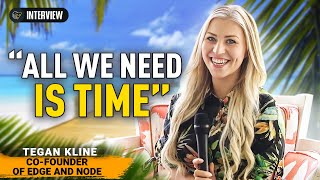
Tegan Kline, co-founder of Edge & Node, explains The Graph as a decentralized protocol that indexes on-chain data for Web3 developers. The Graph uses zero-knowledge proofs to verify queries, and Kline expects the Web3 stack to solidify with better UX by year-end.
Questions this video answers
May 16, 2022
A decentralized indexing and query protocol for Web3 (organizes open on-chain data across blockchains).
June 2nd
Snarks force (applying Zero Knowledge tech to queries and indexing)
Chapters
Hi everyone, it's Rachel Wolfson here with Cointelegraph. And today I'm here with Tegan Klein. She is the co founder of Edge and Node, which is part of the Graph ecosystem. Hey, Taegan, how's it going?
Hey, it's going well. So excited to be here in the Bahamas with you.
Yeah, I know it's an exciting time. Taegen. So you're speaking on a panel tomorrow and what would that be about?
Yeah, so tomorrow we're speaking about Web3 and infrastructure as well as indexing.
Great. Now what is the graph doing to advance Web3 infrastructure?
Yeah, absolutely. So the graph is kind of paving the way for Web3. The graph is a decentralized indexing and query protocol for the Web3 space. So what does that mean? That means open data on top of different blockchains, Layer one blockchains, layer two, blockchains. Really kind of agnostic when it comes to the underlying technology. The graph is just there to organize the data and allow that data to be available for developers to leverage that data to build really great applications that are really easy to use, easier to use than the applications on your iPhone today, which is the goal.
Got it. And so once developers take that data and they build applications, what kind of applications are we talking about and can we expect to see?
Absolutely, yeah. So it's any data that exists on chain. So there are different applications across Defi, so uniswap, synthetix, aave, gnosis, but also NFTs like known origin, Zora, Art Blocks and then Metaverse. So Decentraland also builds using the graph. So really enabling any kind of use case you can imagine gaming as well. So really all across the curve, whatever you dream of, you can build using the graph.
Okay, and how Is this the Web3 infrastructure that we're seeing and that you guys are enabling, how is that different than like the Web2 infrastructure?
Great question. Yeah. So within Web2, you still had protocols. You generally didn't have tokens. So there was no way to monetize those protocols. So it was very much open source. So what happened was you had the protocols underneath and then you had the companies that existed on top of those protocols. Think like Google, like Gmail. The problem is those companies needed to monetize. And so how they monetized was generally by extracting value from their users, either selling SaaS or selling ads, which is the models, the models that we're familiar with in Web two. In Web three, it's all about protocols. So no centralized company or platform can exist on Top of those protocols. Because Web3 is all about giving the power, the control, the decision making and the ownership back to the users. And so to do that, you can't have a centralized company in the middle extracting value. And so the Graph is one of those protocols. There are other protocols like Arweave or IPFS at the storage layer. So it's really exciting. And then what you have on top of that is the truly decentralized applications.
Okay, so what's the most innovative thing taking place at the graph right now?
Yeah, so there's a lot going on. The roadmap was just released, so the Snarks force was just announced. So Zero Knowledge is a technology that we're looking to apply to queries and indexing so that you can have verifiable data, which is a really important component of the Internet and also the future of information. Kind of like helping to solve fake truth on the web. Because you can see all the data is verified, you know where it comes from. You can kind of source it, which is really exciting. So that's something we're working towards.
Okay, Verifiable data. Now I'm assuming that's important for like, you know, healthcare app data and just to verify. And so what other applications would that apply to in terms of Web3?
Yeah, I mean, anything. So even journalism, right? It's like Rachel Wolfson put out this piece. These are the sources and so that data is verified within that. Now let's say someone takes that information and spins out a bunch of other data. All of that's verified as to where it comes from and so they can source it. Back to that Rachel Wolfson post.
Got it. In terms of data security, how is that enabled with what the graph is doing?
Yeah, great question. So when it comes to security in the blockchain space, really it comes down to the code. And so you want to make sure the code is secure. And so what projects generally do is they get audited. So we went, the graph protocol went through extensive audits before it ever was released. When it comes to the data within the graph, it's possible public data. And so you can think of like trade data. So the historical data, these trades, what tokens are priced at or how many NFTs exist in this collection. So it's really kind of like on chain data, not necessarily like private data.
I see. Okay. And with the data that we're seeing being utilized by the graph, is that mainly. Are we talking about real world use cases as well?
Like, absolutely. I mean, right now I think that a lot of these use cases are very nascent. Like the user experience isn't where it needs to be for the masses to use this tech. I think a big piece of that is because the Web3 stack hasn't been solidified yet. The Web3 stack will be solidified by the end of this year, and I think that's when we'll see the explosion of use cases. But actually at Graph Day, we're announcing something really cool that's going to bring Web3 to the masses. So that's June 2nd.
Okay, I'm excited for that. And my last question is, so you say web3 should be solidified by the end of this year. Why do you think that?
Yeah, because I see the protocols are all there. So arweave, ipfs, the graph celestia at the data availability layer, they're all there. But the problem is some haven't launched yet and others they've launched, but they haven't started interacting with one another. And so integrations need to happen so that that web3 stack can be solidified. And so really all we need is time, which is kind of exciting. Yeah. But it means that the opportunity here now.
Right?
Like, we're so early. It's still so early. Right?
Yeah. Thanks, Taegen. This has been great. Thanks for joining us.