What makes Singapore a leading crypto hub of Southeast Asia? | Singapore Central Bank CFTO explains
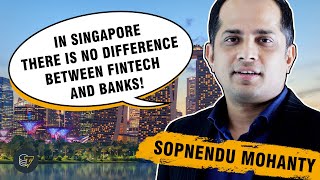
A Cointelegraph video interview (Nov 20, 2020) with Sopnendu Mohanty, Chief Fintech Officer at the Monetary Authority of Singapore, explaining Singapore’s pragmatic, use-case–driven regulatory approach to crypto and fintech. Key points: Singapore permits crypto experimentation under targeted rules (Anti‑money‑laundering, Payment Services Act), has run Project UBIN to prototype a multi‑currency wholesale CBDC/payment network, and encourages industry participation (e.g., DBS custody/exchange initiatives) while collaborating with other central banks.
Chapters
This is Singapore, the largest fintech hub in Southeast Asia, with a population of less than 6 million people. The small city state is the base of around 45% of fintech companies in the ASEAN region.
Here we don't see the difference between fintechs and the bank. Both are complementary. They come together, they work together.
This is Suspendo Mohanty, Chief fintech Officer at Singapore Central bank and financial regulator, Monetary Authority of Singapore. In anticipation of this year's Singapore fintech Festival Block show collaboration, we discuss Singapore's unique approach to crypto and blockchain. I'm Giovanni, your host. Welcome to another Cointelegraph interview. How are you, Sopnendo?
I'm extremely fine. Good time.
We saw that other Asian countries like China and South Korea have been adopting quite a tough stance on cryptocurrency lately. On the other hand, Singapore has adopted a very different approach, which is much more friendly. So, so why has Singapore decided to adopt this approach?
Look, the word friendly could be highly misleading. We are friendly to everything in life, to good ideas, good people, talent, good purpose. So being friendly to crypto doesn't mean that we are adopting crypto because different jurisdictions face their own issues and concerns. Some have currency challenges, they're worried about whether that will circumvent the controls. We see benefits through the lens of innovation and outright banning cryptocurrency doesn't really help to understand the risk and what comes with the crypto. So allowing crypto to be an experimental construct in Singapore is what we are looking at. Of course we are worried about money laundering and we have very strong policies in place to manage or guard against money laundering and terrorism financing. And more importantly, we have a very, very thoughtful Expanded Payment Service act which today governs the crypto exchanges and other players that deal in digital payment tokens. So we have regulations in place, we have safeguards in place, we have advisories in place, we constantly advise people the risk of cryptos, but we don't stop if there are experiments which is going on crypto, which can lead to something good, but that's to be looked at and we hope that that's the outcome comes out of this whole crypto exercise.
The head of the mas, Ravi Menon, last year said that Singapore does not regulate the technology, it regulates the use cases. So can you comment on this quote explaining what the head of the MAS meant?
What Ravi Menon really meant was technology itself is neutral. It is the business activity that poses risk. So we apply the regulations accordingly. We operate on the principles of same businesses, same risk and Same rules. One example we are guide to digital token offering. We have clearly laid out examples of different use cases, the type of business activity they are engaging in and the regulations applicable to the business activity. Now, if I have to expand and extend that thought, what Ravi Menon spoke about end of the day technology enables something. We look at that something, whether that something has got the right outcome and that process of getting that outcome, does it create risk? If there are risks, we think about regulations which can help to offset that risk. So the technology itself is an enabler, not the product itself.
So for the past four years the MAS has been experimenting on blockchain technology within the framework of Project ubin. So Project UBIN reached phase five this year in the summer and it developed a multi currency payment network in collaboration with JP Morgan and Temasek. Can you give us a little bit more details regarding what this phase five of Project Ubin means?
This platform gives you the ability to transact with each other on the network digitally and directly in different currencies which when previously you were able to do only in Singapore dollar Now this brings a wide range of benefits, especially when you have to do payments in multiple currencies. This can be much cheaper, faster and round the clock. And more liquid FX market could result in better FX rate discovery and the settlement of foreign currency denominated securities become far more simpler. In phase five, we tested out the integration with other blockchain based platforms to enable end to end digitalization across many industries. And use cases which runs on top of this multi currency network. And this were live technical integration with transaction happening across the payment networks. The different networks. Some of the use cases we tested were for example delivery versus payment for settlement with assets on private exchanges. Very, very pertinent to this particular use case. Sometimes we look at use cases on conditional payments and escrow for trade finance networks. Payment integration with healthcare claims. Again, this is a perfect example where you need a blockchain based network based on a smart contract to trigger a healthcare claim. And it could be multi currency.
Okay, so maybe you can explain our viewers why blockchain technology is so important and fundamental for the functioning of this multi currency payment network.
In this world of complex processes, we always look at processes as a different stream of activity. And having a blockchain with a distributed ledger simplifies the process of checking against each other. So having a distributed ledger by design takes away the whole complexity behind of settling things, checking things. And it allows some of the business rules to be built into the use cases so that the payment process the settlement process, the underlying business rule can be encoded to a single stream. Today, in the current world there are two different processes. There's a process we pay each other and there's a process which we exchange goods and services. And there are two different processes. Blockchain digital currency brings together these two process to a single process. In a single process, you're not only paying each other, you're also ensuring the goods and services are also exchanged at the point of payment.
Now I would like to talk about CBDCs or central bank digital currencies which is one of the hottest topics at the moment. What is the stance of the monetary authority of Singapore towards CBDCs? Are you planning to develop your own digital currency soon?
I think when people talk of CBDC they implicitly think about a retail CBDC or a non wholesale cbdc. We have been in particular very very focused on one part of CBDC that is the wholesale cbdc. In fact, I'll argue that we are the first central bank globally to actually pick up the wholesale part of CBDC and run with multiple experiments. And there's a reason behind why we did this way. Because we are a small country, our existing payment systems has the most optimal infrastructure. I can move money from my account to my colleague account, Jacqueline's account in three clicks. Money with zero cost. So there's no real driver behind retail cbdc. What really we are looking for is a wholesale CBDC because wholesale CBDC brings significant efficiency optimization in this whole process. And that's the reason we have been very, very vocal and very very focused on the wholesale cbdc. In fact I made a statement early part of the year. I don't think we should do any more experiment in the wholesale cbdc. We have done enough experiments. We should not think about going to production and get it implemented and take the benefit of all the good work done on the wholesale space globally. And this is mas example but I have exactly opposite example for you. Let's take the example of Cambodia and the example I would like to bring in is the Cambodia's Bakong project. And today if you go to the website you will see it says the Bakong project is actually a real time gross payment system. It's actually a payment system which runs on a retail CBDC. And what it says, it says that you can move money with an efficient retail CBTC which is powering that payment system. And why it is an interesting example because Cambodia leapfrogged traditional RTGS system to use a CBDC driven retail payment system as a way to deal with retail payments. So different examples, different use cases, different need are driving different central banks interest behind cbdc.
So back in June, the MAS has announced that it was going to collaborate with China in the development of a CBDC technology. Can you tell us more details about what this collaboration was about and what kind of results has brought?
We work with many central bank and one of the central bank which we are always interested to work is the People's bank of China. They're doing their own production, their own pilot trials for retail use. We are talking to them. Can there be a broader partnership where what are they learning from their pilot trials? And whatever we are learning from our wholesale trials, is that a way to collaborate and find a way together we can do something in this space. So this is very early stage of discussion. We hope as as we get to some tangible projects, we should be able to share more what is happening in that space.
So dbs, which is Singapore's largest commercial bank and the largest commercial bank in Southeast Asia, is going to launch its own cryptocurrency exchange which is going to be regulated by the mas. So what do you think is going to be the impact of this launch on the whole Southeast Asia cryptocurrency market?
You're referring to that supposedly they're launching a cryptocurrency exchange. Look, this is a natural progression in any innovation and there has been a very clear growing interest in digital assets and there's a definite need for custody service for digital assets and I've been talking about it for last two years that as these digital assets are coming through in different forms and ship, there's a need to think about a very recognized custody service for these assets with all the hacks and all the complex processes goes behind it. So it's only natural for a financial institution like DBS to look to capture this opportunity of providing custody service for digital assets. And there'll be greater competition in this space. I think if DBS is thinking about it, definitely that's very smart thinking. And different institution will have a different level of competition, operational scale and they'll provide different kind of services to provide the necessary custody need for such assets. As you always hear that fintechs are always pushing banks out of their comfortable traditional finance space. And it's very encouraging for us to see DBS to think about such new areas where they can add value and create a new service. And this is truly a sign of the maturity of the Singapore's fintech sector. And I always said the fintech sector in Singapore we are quite unique from rest of the world because here we don't see the difference between Fintechs and the bank. To us, both are complementary. They come together, they work together. In some cases, Fintech are providing competing financial services and if they do, we have regulation to regulate them. In most cases, Fintech are working with the bank so that banks can launch innovative products, banks can digitize faster and that's a healthy sign of partnership. So we are quite thankful to our ecosystem to show those maturity in thinking as we progress forward.
Singapore Central bank is going to host its fifth FinTech Festival this year and this year it will be in collaboration with Block show which is a cryptocurrency conference. So can you tell us what is the purpose of this collaboration from the point of view of the Monetary Authority of Singapore?
This time the background drop is Covid crisis and we want to ensure that the content has relevance to the crisis. We are all going through. We are focused on many of this aspect of recovery. We have a day called Economic Summit. We'll talk about all the necessary economic thinking behind how to recover faster. We have a day, we'll talk about the infrastructure required to digitize faster. We have a day on impact, impact to our society, impact to the green, climate change. We also have a day for investors, another day for talent. Now, for each of these days, we have something on the crypto space, something on the blockchain space. We are going to share with you speakers who are not going to give you a very generic word about blockchain and crypto. They'll be asked very tough question on how the cryptos are useful, how much they have progressed, where they see it going, what are the regulatory challenges behind it? What should we do as a regulator to make it work? Now, the question you asked About BlockShow, why BlockShow? I think personally, personally I've been extremely impressed by what they have done in this space and I spoke in their event. They have a strong line of speakers who joined the event and they have a very different way to showcase the whole space. What goes in blockchain or crypto. They are not championing a certain view of crypto or a blockchain that they're trying to bring a diverse set of opinions, partners, participants to this whole platform and trying to get a better narrative for blockchain.
Thanks a lot Sopnendu. It was great to have you on our show.
Thank you. Thank you for having me. It was a pleasure.
That was Sopnendu Mohanty, Chief Fintech Officer at the Monetary Authority of Singapore I'm Giovanni, your host. If you enjoyed the interview, don't forget to subscribe to our channel and like this video Cointelegraph like subscribe and Hodl Sam.










