What will trigger crypto’s next 10x growth? | Interview with Harmony COO
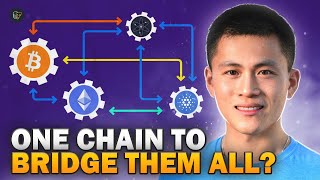
Li Jiang, CEO of Harmony, explains how sharding and cross-chain bridges could unlock the next wave of crypto growth. Harmony targets onboarding a billion users by improving speed and UX, currently at 1% blockchain adoption, and building developer communities like Harmony Africa DAO.
Chapters
Web 3.0, a fully decentralized Internet built on the blockchain. Some say it is a far fetched fantasy or even a scam. For others it is the foundation of a new digital age that will unlock trillions of dollars in value.
I would say today no one can support a billion users. No chain, no ecosystem. This industry still has 10x potential.
Li Jiang, CEO at Harmony, believes that connecting all existing blockchains is the only path towards the Internet of the future.
You should be able move assets very easily from one chain to another chain with good prices, with good rates and very fast.
How far are we from the creation of a decentralized Internet? And what would it take to onboard the first billion users on web3? Welcome to our latest Cointelegraph interview. So I would like to start the conversation with a provocative question. One of the slogans of Harmony is one chain to rule them all. That seems to be quite in contradiction with the principles of interoperability and decentralization that should be at the foundation of the ideal of web3. So can you explain to us this discrepancy?
Yeah, actually I would like to first say that that's a community meme. It's not a official project slogan, but because we have the token Harmony one, we actually have a lot of great taglines around the word one and we don't say this as a project slogan, but we do think that we're one chain to bridge all other chains to bridge, whether it's Ethereum, Bitcoin. Our Ethereum bridge has been launched for the last year, more than a year, and that we have bridges to Binance, Smart Chain, to Terra, to a few other projects as well. And actually our goal is to bridge all the layer one blockchains with us. So we're a layer one but we think that the future is multi chain, right? And it's cross chain that you should be able to move assets very easily from one chain to another chain with good prices, with good rates and very fast.
So now let's get into the plans of harmony for building Web3. So in a blog post that I recently read, you said that in 2026 Harmony is planning to become a Unify Web3 platform. So can you expand a bit on this thought and tell us what you mean by a unifying Web3 platform?
I think looking forward for the next four years, we still think that adoption, blockchain adoption is really at 1%. If you think about how many truly people are custody their own funds, using their own wallets, using blockchain Every day less than 1% of the world's population. I mean as a whole. Right. And so and the next four years is really about continuing the journey of keep building the infrastructure, keep building the ecosystem. Web3 is just the catch all word for, you know, blockchain, for decentralization, for the idea that you own your own data and you own your own money. And so we want to be the platform that allows people to, allows the next billion users to come into the space. Right. I would say today no one can support a billion users. No chain, no ecosystem. But it requires innovation on the technology level. It requires bridging to other chains that we can keep making this infrastructure layer easy for, whether it's NFT games, daos to join in defi all of the above that you've been hearing about, which we just call the metaverse, all of that together. So that's the vision. The Unifying Web3 platform is a platform that allows the next billion users to come into Web3.
So I guess that one of the main challenges facing blockchain technology nowadays is the so called blockchain trilemma. So the trilemma of scalability, decentralization and security. So each protocol comes up with its own solution for this problem. What is Harmony's solution for the blockchain trilemma?
Yes, so great question. And that's actually a key point because everyone has to choose certain design and trade offs. So what we've chosen is sharding and proof of stake. So these are not new ideas by the way. These are ideas that have been around the Ethereum 2.0 design and community ever since I would say 2015, 2016. Right. So what we've done is put those the best research into production and actually launched the first sharded and proof of stake. One of the first sharded proof of stake mainnet back in 2019. And it actually works really well because of those reasons and we'll continue to make it better. So on our roadmap is things like crossjar transactions, even crossjar smart contract. So I would say that we're probably just, you know, even there's still a long story about sharding and proof of stake that we can continue to make it better and continue to allow the protocol to scale.
So that's interesting because it's widely known that the trilemma basically forces protocols to sort of sacrifice one of these three components. So either security or decentralization or scalability for, for the sake of the other two. But in your opinion you can preserve all the three at the same high level and just expand the triangle, is that correct?
Exactly, exactly. We expand. The relationship still exists between the three components. They're all moving in relation, but you can expand the overall as well. Like for example, we have two second finality, while that's almost the fastest in the industry. But we did that without trading off on decentralization or security. And so there are ways you can get even faster by sacrificing some of the other factors. So you could be sub 1 second if you choose to be more centralized. I mean, that's what let's say AWS is, right. So our goal has actually been pushing on all three at the same time through engineering and expanding all of it at the same time.
So now I would like to touch upon one of the core aspects of harmony strategy for Web3, which is based on DAOs, or decentralized autonomous organization. So you dedicated $50 million out of a total $300 million fund for funding a number of daos. So can you tell us why DAOs play such a crucial role in harmony strategy for Web3? And what kind of daos are you funding at the moment?
So essentially we think DAOs will replace companies and in the future, countries. It's a way of organizing all human coordination and activity. So I think think about countries and companies. These are all entities that we humans invented, designed in the first place, right? Like why do we have LLCs or, you know, corporations? And there was the East Dutch India India Company. Like there are all these things that we basically made up, to be honest. And even countries, right? We made it up like someone won a war and it became a country. And so I think with Web3, with the technology, with coordination, that everyone can participate and there's a natural token incentive. You can design any way of coordinating humanity. And that's the future, right? And so people won't be starting companies anymore. People will start daos. And so that's why we think that almost everything can be done and created via a dao at some level. And it will be as the world becomes even more global. It's a much better tool than an LLC or a corporation, because those can't go across borders. It's very difficult. But daos is global. Daos are everywhere. Daos can provide incentives as soon as you join a dao. It's just a much more flexible way of getting anything done.
Okay, so that's interesting. So can you give us some concrete examples of what daos are you involved in and basically what role they play in the Harmony's ecosystem. Sure.
We have some core daos that are our community dao or validator dao. Community dao is just about growing the community. So what's nice about that is instead of us trying to hire 10 more people on our team to try to coordinate and grow community and do social media, we have daos that do all this work and it's much easier. There's no management overhead, there's no, like, coordination with the sub team. I mean, they're independent organization that, you know, delivers on their milestones and they can be anywhere in the world. It doesn't matter where they live. Right. So we don't have to like, get, you know, we don't have to. Right now, if you have a company and you want to hire someone in another country, you have to set up an entity in that country, you have to set up a bank account in that country, then you have to send money to, you know, your entity in that country and then. And then pay that person. So blockchain changes all of that. Right? You just. Anybody can raise their hand and start. The dao can be set up in one day. Essentially, it's a multi state with nine people that consent to being there and then they can start doing the work. So that's how flexible it can be. Right. So another dao that we started with a good collaborator is the Harmony Africa dao. And their goal is to cultivate and educate developers in Africa across different countries. There's five countries that they're targeting. If we tried to do that as our own team, that would have taken six months to a year to start. Right again. All the entities, all the countries, all the local people. But as a dao, it took a few weeks to get everybody organized and then we started. So that's the power.
So now I would like to go deeper into your vision of Web3, and in particular your vision of the interaction between layer one and layer two production protocols. So, of course, Harmony is a layer one solution alternative to Ethereum. And you think that basically the capability of Harmony to create this bridge to Ethereum and the blockchain makes Harmony a more attractive solution than Layer two protocols. That seems to be in contradiction with what analysts at Coinbase say. So they believe that Ethereum will remain the dominant Layer one and that the culmination of Layer two scaling solutions, combined with upgrades like the beacon chain, the beacon chain merge and sharding, could limit Progress for alternative layer 1s in their current form. So what do you think about this argument?
The reason why we think Layer one, like us, Harmony with a bridge to Ethereum is actually better because our bridge is much faster. You can transfer assets in two or three minutes versus Layer two. There's, there's a seven day settlement time for optimistic Layer two rollups. So there's a lot of different features that essentially you can use us as a scaling solution and transfer assets in the same way they use Layer two. But the experience is better. I'm nothing against Layer two, I just think the design is having a parallel layer one that's connected because we can also connect to Bitcoin and Cosmos and other layer ones. Right. It's just more flexible versus just being a layer two. You're actually only in that layer two. You can't even connect to other layer twos. I mean it's hard. You have to go back to Ethereum and then go to a different layer two. So that's the reason why I think that layer one is a better design as a bridge. And actually we want Ethereum to grow, right? So if Ethereum grows 10 times bigger, hopefully we can get 10 times bigger along with it, along with the entire industry. So there's really no conflict as long as we are in the right industry and as long as this industry still has 10x potential, which I think it does, hopefully in the next. Think about the market cap of all of crypto is about 2 trillion. It could easily be 20 trillion in a few years.
Yeah, it seems that the trend is going in that direction. So now I would like just to clarify, it's clear your position towards Ethereum, but what about your view on the competition among the different Layer one solutions that are competing with each other? Like for example, I was talking to the founder of near, another Layer one protocol alternative to Ethereum, who seemed to have a very similar vision to yours in terms of how he sees the development Web3 and specifically how he sees his own protocol, the role his protocol will play in this web 3. So this bridge connecting all different blockchains. So I was wondering, what do you think? Why would we in the future need multiple layer ones? Why would we need a multitude of these bridges? Couldn't we just have one bridge that works very well?
I would say that these ecosystems can all grow and in fact bridging to NEAR is something that we will do. It's just a matter of time whether they do it or we do it, or someone, a new project does it, but it will be bridged. And I think that we will live in that multi chain world where there will be a few There will be a few chains that will keep growing and keep growing and there'll be some others that are slightly smaller but still relevant. It's a very fluid landscape. It's not like, oh, there can be only. And it's not zero sum. It's not like, oh, this one chain has all this and then this other chain doesn't. There will be, there are, if you see applications, right, they live on multiple chains now, like Sushi Curve is on many a number of different chains. And that's how, that's how it'll be instead of. And then there will be native projects on every chain. So I think what's going to happen is each the blockchains that will grow are the ones that are great at cultivating their native projects. So for us it's like, let's say Defi Kingdoms or Tranquil. These are some great projects on Harmony that have hundreds of millions, if not billions of dollars in value and traction.
So now let's talk about your visions for 2022. So we saw that Harmony experienced a massive growth in 2021, together with other layer one protocols because of on the wave of this bull market that we witnessed last year. So this year the picture is a little bit less optimistic. We saw a huge drop in crypto prices not long ago. So what do you think? Can Harmony continue grow at the same pace even in a bear market?
I think that's a good question. I hope so. So I think obviously like bull market, everyone gets excited and inevitably this happened last time too in 2017, like the ICO cycle on Ethereum, it brought in a lot of people and then some percentage, let's say at that time probably only 20% of people stayed. Right. Because the bear market was really long and crypto winter was really long. I think now the cycles are shorter. You go up and you go down, you go up, you go down. It's more compressed. So my only prediction, of course I have lots of theories about 2022 and let's say more daos, more tools, more builders. But my only thing that I think is actually more talent will come into Web3 this year. Like the best talent, we see it everywhere. Honestly, I get pinged every day by people who say, oh, I want a career in this space, I want to build something. I'm doing a new project with so many friends who are just coming in, flooding in.
As final question, I would like to know, what should we expect from this talent that is coming into the space in 2022? What are the milestones that we should look forward to happen in terms of the development of Web3 this year.
Yeah. I think in general, my personal biggest Hope is that web3 make the user interface a lot easier for the average user so that we can onboard like the next hundred million people. Right. So that means wallets should be better, like all the tools. I mean, today, if you want to swap tokens, it's not necessarily that easy. Right. You need to know how Uniswap or sushi works and where the tokens go and how long it takes a transaction. You have to wait. All these should just be so abstracted that you can just buy some tokens on your wallet, on your phone, and then you can swap and you can trade. All of that is in the background. So I hope as an industry, we make the experience easier for your mom or my like, you're like the non crypto people.
Awesome. Thanks a lot, Lee. That was a great conversation. Thanks for coming on our show.
Yeah, thank you very much. Had a great time.










