Why NFTs are 'ten times better' than traditional art | Interview with $69 million NFT buyers
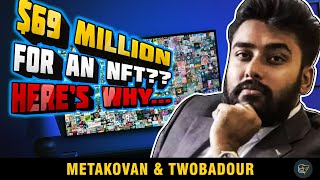
Metakovan and Tubadur, who bought Beeple's Everydays for $69 million at Christie's, argue NFTs are ten times better than physical art because they're globally accessible, composable, and cost nothing to store. They discuss fractionalization through B20 tokens and defend the sale against claims it was purely speculative.
Questions this video answers
March 11 (year implied 2021 in context).
$69 million.
2007.
5,000 days (performed every day without taking a break).
He said it should be worth $1 billion.
Chapters
On March 11, an NFT by digital artist Beeple was sold for a record price of $69 million at a Christie's auction.
Before NFTs, crypto was boring. Being able to contribute to art, that is what is going to reach the next generation.
The buyer was a crypto entrepreneur known under the synonym of Meta Kovan. So what makes people more valuable than Leonardo da Vinci, according to you?
Doing something consistent and with integrity and with honor. That's Beeple embodies.
To many, the sale of Beeple NFT marked the entrance of blockchain based art into the mainstream. But others saw it as the tipping point of a speculative hype that's disconnected from real artistic value.
We are really going to see mainstream adoption through NFTs. And if there is speculation, that's okay because we are just making everything fast.
What were the motives behind the most expensive NFT sale ever? And can non fungible tokens really disrupt the way we create value and consume art? To answer these questions, we reached out to the winner of the auction, Metakovan and his business partner Tubadur. Not long ago you revealed your real names and you did it because you wanted to bring attention to the fact that Indian people and people of color, they could be art patrons too. That crypto is an equalizing power between the west and the rest, and that the Global south was rising. So there is actually social component in your decision to reveal your real identities.
Before NFTs, crypto was boring, right? Like we were just making money for most of the time. Now it has gotten to a point where we get to interact with culture and drive culture. You work with artists, you work with artists from all over the world, right? So that, that specific idea of being able to contribute to art and like patronizing art is very important because that is what is going to be, that is what is going to reach the next generation, right? So now what's happening is the, the whole idea of this being centralized and being in some parts of the world is going to go away. So with the NFTs and this movement that's going on, what we are doing is we are decentralizing culture and decentralizing markets.
As a result, you recently bought the NFT of Beeple's every day, the first 5,000 days, for $69 million. So what exactly attracted you to, to this specific work of art?
So Beeple himself started this specific work of Art in 2007. This generation of the Internet generation, who we are all, we all lack that patience of growth, right? Like we all want to Grow immediately and tomorrow. But that value of doing something consistent and with integrity and with honor is something that does not just go away because now we are on crypto. Right? And that's something Beeple embodies as an artist. He has performed this art over 5000 days every day without taking a break. Not even one day. He was doing this when he was getting married, when he had his child. Imagine being a father and still making sure to take some time to do something. And that consistency is very interesting because end of the day, time is not hackable.
In a recent statement released by Christie's, you defined your purchase as the crown jewel, the most valuable piece of art for this generation. You also said that it should be worth $1 billion. So that sounds like a lot of money considering that the most expensive work of art ever sold, Leonardo da Vinci's Salvator Mundi, was sold for $450 million a few years ago. So what makes people more valuable than Leonardo da Vinci, according to you?
It's not just the artist. Right. Like, so obviously I don't want to take anything away from Leonardo da Vinci or Salvador Mundi because those all carry a very historical, historical importance to them. Right. I've been holding this thesis for a while now that I believe and I can define NFTs as being 10x better than the physical counterpart when it comes to art. Right. I know it's a statement that might shock a lot of people, but global market not susceptible to wear and tear. The prominence being very clear. Right. And NFTs being composable, like other defi protocols by default, is a huge, huge improvement on the physical art. Because physical art, what you get to do with it, maybe you have to keep it in one place and there is a limited number of eyes that go on it. And even if you talk about Salvador Mundi or Mona Lisa, most of them have only experienced them through an image, a copy, right. Like a digital copy, mostly on their phone or computer, whatever. But this digitally native picture, the art that is backed by this nft, becomes the movement, right? Like it's the beacon piece of this whole movement that's about to come where there is going to be so many more NFTs that come out from artists.
Yeah. I would like to dive into a little bit more into your investment thesis on NFTs. You said that NFTs are 10 times more valuable than their physical counterparts, but there are a lot of criticism about that. There are people in the traditional art world that say NFTs at the end of the day, are just a certificate of ownership on the blockchain which you cannot touch, you cannot experience with your senses. While in the physical world you have a piece of art which you can touch, you can watch, you can look at, and you can derive pleasure from it. Aesthetical pleasure. So what is your investment thesis about NFTs? Why do you think they are so valuable compared to physical art?
The same reason I've been talking about. It's a comparison of gold and bitcoin, right? Yes. Gold you can touch, you can feel it. There is this physicality to it. But I also believe that bitcoin is more valuable than gold because it's global. In the same way NFTs, NFTs are global. It's easily transferable. There is no restriction on. On who can hold it. Where can it be? Like you don't need physical space for it, right? Like if you have hundred thousand pieces of physical art, you'll be spending so much money just to store them. Now there is no storage cost to it. I understand that people are deriving that emotional value of having a physical counterpart. But digital NFTs can also have physical counterparts, right? Like you can print them. Like for example, people made these physical pieces which you could enjoy. Because of the flexibility that these NFTs offer and the composability into the defy platforms natively and without having to securitize these pieces of nft, you can still share ownership. There are so many perspectives to them. That gives a huge extra value proposition if you ask me. So maybe the people who are physical maximalist, maybe they might not get it for a while.
Yeah, I guess that it will take a while for some people to understand exactly what this technology means for art. But I also have like a question for you guys. So apparently, I mean NFTs, a strong point of NFTs is the concept of scarcity. As you said, they are comparable to Bitcoin in the sense that bitcoin is scarce and that, and that is the origin of his value. NFTs also derive their value from. From the fact that they are unique. You can make one NFT proving the authenticity of that work of art. But can't the same artist do another nft, connecting it to the same work of art and thus kind of diminishing the value of the of the previous nft?
Like yeah, that's to a large extent what you're saying is right. And so we are not in the space of totally trustless scarcity. It's not like bitcoin. There's only going to be 21 million pieces and that's it? Yes. All these artists today who we are looking at in the NFT space have to understand that as a collector we do trust them to an extent, that they will be honorable. Right. And they will make sure that they don't, they don't flood their market with their own NFTs, right. Or create duplicate NFTs, etc. It's totally a trust based system. It has no legal basis. I cannot force people to do something or not do something. Right. So whenever we buy an nft, it's like buying exactly an autographed piece of this. Right. And it's a point in history. And so we believe that he would not do it again. Now if he does it again, then it spoils his whole aura.
A lot of people are seeing this NFT craze as a bubble. So do you think that this kind of hype around it will endure or there will be a point where this bubble will burst and there will be a crash.
Again? I'm not very good at predicting bubbles and bubbles. Being collectors ourselves, what we are doing is going with the flow, right? So we go up with the tide, and if the tide is going to go down, we are going to go down with it. But I think if the tide does go down, it's temporary. So more than thinking about it as a bubble which is going to burst and nothing is going to exist forever, I think we've already created the impact on a global level. Let's not talk about people for a second and think about every other artist in the world who's not making any money right now. Right. For them, $100, maybe $500, thousand dollars is very interesting. So all those people, after what happened to this sale in different parts of the world are thinking, how do I get into this? And we are already seeing that, that movement happening. So have we triggered all these artists to already try, like adopt crypto? Yes. And so we are already winning. Right? So this could be a bubble where prices are up and at some point the prices might crash and we might not have any activity for some time. But that's just speculation. After that, NFTs are going to still stay and they'll be stronger and it will evolve. These NFTs are going to evolve in different forms. We're going to see more collaboration between artists we are going to like. I believe that we are really going to see mainstream adoption through NFTs. Right. And a lot of people are going to get introduced to crypto by NFTs. First like what NBA Top Shot did to a lot of people, right? So either collectibles, art, gaming, etc is going to be how most of the people are going to get into NFTs. So if it's a bubble, so be it. But it's nice because we are attracting so many people right now.
Yeah, it's funny how a lot of those things that you just said remind me of the discourse around Bitcoin. So this concept of the bubble growing, but then the fundamentals which will remain and that will make the price go up again, how much do you think the future development and success of NFTs is bound to to the success of Bitcoin?
We are, as I said this, in a way, we are the new class, the decentralized class. And decentralized class is the basis of that is Bitcoin. Right? Like so Bitcoin is our mother asset and Ethereum is the second most important asset for us. So end of the day, if all these things are going to go up and down, NFTs are also going to move up and down. But I also feel like there's going to be a reverse correlation where NFTs are going to affect the prices of these assets to an extent at least in a year or so when we see a lot more people using NFTs. Because right now Bitcoin and Ethereum, what is it being used for? Right? Like Ethereum is speculative and defy is super speculative. So what are we using these currencies, cryptocurrencies for? Right? And what better than buying a native product of the digital world which is nft? So we have created this circular economy now where I think people who are, who have Ethereum are paying that to artists and artists who have Ethereum now are paying it to more artists and those people are exchanging it for money for the real world.
So last year you purchased a number of artworks by Beeple and divided their ownership into blockchain based tokens called B20. You kept the majority for yourself and sold most of the rest in a public sale. So what is the rationale behind fractionalizing ownership of a work of art?
As far as fractionalization is concerned, it was again an experiment in trying to share ownership of art, thereby making this open experience a viable concept. Up until now, you either, you know, you bought art today and flipped it for a higher price, or you bought art and locked it away somewhere. But the fact that there is a third option in which you can open up the experience of art to the entire community had stopped being financially Viable for a really long time. Nowadays, we realize that there is faith in this sort of a model. And today, over 5,500 people hold those B20 tokens, effectively sharing ownership, the entire experience.
So the revelation that prior to the Christie's auctions, you were already one of the biggest collectors of Bipol's work sparked widespread criticism. The day you won the auction at Christie's, the value of your B20 tokens increased by 4,51 million dollars. And the fact that you financially profited from the auction sparked criticism around the speculative nature of the sale and of the NFT market in general. A recent article by the Financial Times said that the sale should not be thought of as representing the true market value of NFTs, but rather as a PR expenditure. So how would you respond to this kind of criticism?
Okay, so first thing, like with bit 20, it should not be thought as we fractionize people, right? Like, that was not what we did. What we did was a very interesting project. We did a crypto native, right? Like a crypto native project. First of its kind. We built museums, we bought land, we put the land, we put the museum on the land in the virtual world. We put music in these museums and made NFTs for all of that, and then put these art in these walls, made it an experience, put all those NFTs together in a bundle, a smart contract, and then tokenized that what B20s I kept back was not so that I can sell it at some point in time, but I kept it so that I knew this was an experiment. And when I initially sold it, also, I didn't sell it for 10x, I sold it for a little more than what we bought for 30% more, right? And if I kept all the people to myself, it'll be more valuable in terms of financial upside for me. And it would have been easier for me to sell those single pieces right now, right? Because Christie's auction, if we participated or not, was historic. That's very different from all of this. And if I even had the thought for a second that I had this financial incentive to do this, if someone can prove that this was why I did this, I'll just stop everything I'm doing, because that's not my intention. My intention is to show that this is possible. We are on a mission here, a greater mission, to make something awesome and bring a lot of artists into that. What we should understand here is that there is this war, a narrative war that is brewing between crypto and non crypto. And this is just an example. And A lot of people are going to pull me down. I'm ready to fight.
Those were Meta, Kovan and Tubadur from NFT Fund Metapors. I'm Giovanni, your host. As always. If you enjoyed the interview, don't forget to smash the like button and subscribe to our channel.










