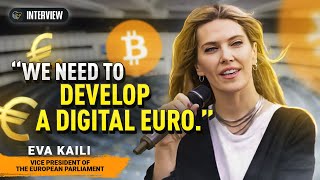
Transcript of a Cointelegraph interview with Eva Kaili (Vice President of the European Parliament). Kaili describes being interested in Bitcoin since 2015—motivated by failures in the banking system in Greece—and frames blockchain as a technology with practical uses (voting systems, cross-border payments) while acknowledging risks (market manipulation, Terra/Luna). She discusses regulatory work (crypto-assets file, DeFi challenges), experiments with blockchain voting, and the idea of a digital euro/CBDC as an option to provide citizens alternatives to dollar-pegged stablecoins.
Chapters
Hi, my name is Joe. Welcome to another Cointelegraph interview. I'm here today with Eva, vice President of the European Parliament. Eva, how are you doing?
Good, thank you for having me. I follow your work and I'm happy to meet you.
That's very kind of you. And I hear that you're a bit bitcoiner from as early back as 2015, is that right?
Yeah, 2015. It was for me an opportunity to explore solutions for the failures we had in the banking system. I'm coming from Greece, so the old system didn't work very well. We had the huge austerity and the banks took over basically our savings. You saw what happened with Cyprus. So then I explored like new, new possibilities. I saw blockchain as an opportunity.
Okay, excellent. So is it safe to say that there is a bitcoiner in the European Parliament?
Well, I would say I talk about more the technology, so I prefer to talk about the amazing possibilities that you can have. And then the use case is a different thing. You can like some. You don't have to like everything, but technology is not good or bad. So I like the technology and hopefully we can get the best out of it.
Okay.
Also with bitcoin, depends how you use it.
Okay, how you use it. What do you mean by that?
I mean, when you see cases of people trying to manipulate the market or like trading, these are things that they're not. For me, I think the best potential of blockchain is when you actually create value. You can have like real projects and you can basically give more opportunities to citizens. Because bitcoin I liked because it offered this. I think it's the most decentralized project on blockchain and I like the philosophy around that. So to give more options to citizens of how they want the financial system basically to be. So it was a great example for that.
Very good. Okay, and so I'm going to quote you here, but I think last year in a magazine piece for Cointelegraph, you mentioned that blockchain in general, everybody is positive when it comes to currencies. Everybody is skeptical. Would you be able to provide us with an update on this? Perhaps shed some more light on whether currencies people are still skeptical.
Yeah, they are, because. So trying to regulate now with the crypto assets file, we talk about the emane or asset tokens, we try to regulate that, but defi is something that we cannot get into and ensure that customers, users will be protected. So this is what I mean. And then you have this like Terra Luna thing and Then you say, okay, so I need to have some safeguards to ensure that also the financial system will function accordingly to the expectations of the citizens. Okay, yeah, so this is my work.
It's not that I like how you just sort of scarce around the Terra Luna thing, you know, 50 billion wiped out in a. Yeah, but I mean.
This is not under the scope of what we're regulating now. So that's why I say like citizens need to be able to have these options. So we them like this is safe because it's regulated and this is in the unregulated era of blockchain. So this is at least something we need to try to do. But we also. I have called to explore some possibilities of also deciding exactly to define what's defi and also see how we can put some safeguards there. So at least market manipulation will not be possible because failure you will have offline and online always.
Okay, could we. What's defi in your words? What's your idea of what defi is?
Well, I would say it's like completely decentralized. This means that nobody can control or like really manipulate a blockchain. It's not easy to happen because most of them, they're like saying they are, but they are not. So we need to have safeguards to understand who is the developer, who controls that, what are the keys, if somebody can change the code or not, where is the jurisdiction. We have to make sure we understand how it works. And this is not something like it's not an easy exercise, but I mean this is what disruption is. It's out of the box challenges that we need to see what are the benefits and ensure we work around that with smart regulation.
Okay, smart regulation. So that's when the European Parliament or the EU steps in and maybe gives a stamp of approval or perhaps rejects these projects.
Yeah, but again, it's not about the technology, it's about the applications. So how you use that, because if you use it like for a voting system, maybe it's amazing. But if somebody prepared that and it has like vulnerabilities, you have crashes of the system.
Okay, and so is that something that we might see in the next sort of two to five years, a blockchain voting system within the European Parliament?
Yeah, I'm trying to test some possibilities. Yes.
Okay, tell us more.
So I'm trying to test how we can use a system to make sure that it's trustworthy because it's really important to ensure that our democracy would not have failures of technological systems. And in the infrastructure. So this is like an effort that it takes time, but once we have that, we can start using it because we all went through this lockdown and the pandemic accelerated the need to use these technologies to vote, to discuss, to meet online, to be educated online, like to have workshops. So I think we have to get there sooner rather than later.
Absolutely. Okay. And I mean here we are at the WEF in lovely Davos where it's a little bit windy, I do admit.
Nice.
We're talking about blockchain, we're talking about decentralization, we're talking about distributed ledger technologies. And here you are talking about voting on a blockchain within a European Parliament. How have you seen this sort of sea change towards crypto or warming up towards blockchain technologies? How have you seen that develop in the recent years?
Well before the pandemic we were all excited about the potential of the technology. What we are seeing now, it's a technology that's more mature. We can understand the scalability, we can understand where interoperability problems, secure privacy issues. So we can understand a bit better the technology. We still don't have super successful applications, but everybody's ready to again test the technology into real applications and to realize some of the promises. I think the problem with blockchain was that we over promised everything, like all solutions about all the problems. So we were looking for problems and I think we have to look for solutions.
Yeah, absolutely. That's a very important thing you've just said there. Yeah, blockchain does sometimes overstretch itself.
Yeah, maybe a bit.
And what about currencies? I know we touched on it a little bit at the start of this discussion, but you know, there's a lot of discussion about a central bank, digital currency, a cbdc, maybe even the digitization of a euro. And what are you seeing from your viewpoint?
Well, I have called for a digital euro as an alternative, as an option. It can remove a lot of costs and intermediation. It could allow control of your savings of your money. So I think the central bank, the European one, is already testing it. They are trying to develop one that can be really useful. But again, each time it accelerated when the libre came out. So everybody said like, okay, we need to compete, we need to be there, we need to have an option of a digital euro. But I think that we still need time. I'm not ready to say that we're gonna experience it anytime soon.
Okay.
But for sure it's there. So when you see how the financial system is adopting it then you will see the governments, they will be ready for it with a better understanding than some years ago when they were just monitoring it.
Okay, okay. And in light of the rapid growth in stablecoins in terms of you know, market cap and obviously most of them are back to the dollar, is there a risk there that the dollar sort of eats up a lot of the market share of the money in the system currently? Not sure. I'm quite phrasing that question the way I want it to, but is there a risk that the euro in say a 5, 10 or 20 year timescale, it's a much smaller sort of global weighting against the dollar?
Well I'm not sure because we already use dollar for most of the transactions in global trade. But I would definitely say that Europe cannot be left behind. We need to do more. We need to develop the digital euro. We need to be there ready to provide options. And I think this would be the safest way to go to give options to citizens and not to have one global currency because of the different also geopolitical vulnerabilities. I would say so we need to ensure that we have that. But then if something is better, I cannot predict now what's going to happen next. What I can tell you is we're going to be there to see innovation, know happening and to make sure that it's good for citizens in the end. This is, this is my role.
Okay. Okay. And of course you come from a real position of passion here. I can feel the enthusiasm towards blockchain and obviously being Greek, you've seen how mistrust in the bank can lead to consequences. Let's say. What are you most excited about? About the blockchain or the crypto space becoming more mainstream?
For me already the target is achieved. So the moment we start talking, talking about decentralized solutions and blockchain, we saw a reduction of the hidden fees in its transaction. We saw immediately easier cross border payments and cheaper. We've seen more online banking happening and we've seen banks using blockchain for their own activities. So I see that it's happening, it's changing already. Things okay because it's there as in a technology. So emerging technologies, they, they manage to basically to disrupt in a positive manner. Hopefully.
Hopefully.
Yeah, hopefully.
A lovely note to finish on. Thank you so much Eva, thank you for having.