Why the Public internet is a bottleneck for blockchain - Austin Federa, co-founder Double Zero
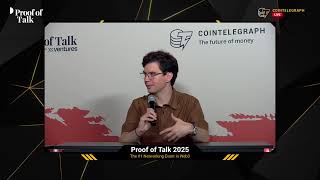
Austin Federa, co-founder of Double Zero, argues that the public internet itself limits blockchain scalability and censorship resistance. Double Zero is building a parallel fiber network for validators, using a Proof of Utility token model to incentivize contributors.
Chapters
Hello, everyone. Welcome back to Cointelegraph's live stream right here at Proof of Talk in Paris. It's been a fantastic two days here at this conference, a conference that came around last year and really made waves for the high profile speakers that they have and the really great programming and venue right here in the heart of Paris at the Louvre. I'm joined today by a man that I know quite well. We've spoken many occasions, always to do with Solana, Austin Federa. It's great to have you on the live stream. Before we get started, if you have any questions for Austin, please drop them in the comments right here on X or YouTube, whatever platform you're watching on. Go ahead, fire them away. We'll pose them to Austin. He can say yes or no. You have free will. But it's good to see you again, man, and in very different circumstances. I don't want to talk too much about Solana, but I've never asked you since you left. Tell us the story why you left Solana and what your general experience was there and the story behind that.
Yeah, well, thanks for having me. I mean, I was with Solana for four years. When I joined, there were, I think, 30 daily active programs on the network and no one really knew what Solana was. It was very much an underdog. And then, you know, you fast forward four years later and the network is one of the most dominant networks out there. It is the highest revenue generation network in crypto. It's in an incredible place. But I kind of always had a little bit of that itch to go be a founder. And at the same time, I really didn't want to go build something that was competitive with Solana or build something that was on top of Solana. Right. It was, it was really like a challenge to think of what are, what are the types of applications you can build that will really move crypto forwards a decade, in two years. How do we really get into this place? We've talked about mainstream adoption and taking on Trad5 forever, but the fundamental core infrastructure isn't there. And so the real moment for me to say 00 is worth building and there's a market here that's worth addressing, was working on the Fire Dancer project and seeing the fact that we had engineers working on this project that could build a validator client that could do a million transactions per second, but they couldn't run it on the public Internet. The public Internet was just too slow and going through this journey of like, what do we do about that? Do we go the model of dropping the validator set from 2000 validators to 100 validators. Do we try and make everyone run in the same data center? Like, how is this solved in tradfi? Because this is solved in tradfi. Right?
But it's centralized.
But it's centralized. So how do we build in a decentralized way? And that was kind of where the idea for Double Zero first kind of, you know, you get those ideas in your head and you just, some of them stick around for six months and you're like, okay, this, this is a real thing. I should go find some people and build a company out of this and launch a protocol.
So let's talk about Double Zero. Give us the tldr. What is Double Zero? How did the idea come to fruition? Who gave you money to build it? Why didn't you do it with Solana?
Yeah.
So give us the details.
So Double Zero is a physical fiber infrastructure network for high performance distributed systems. And there's a lot of different things to break down there. At its core, or what we're building is a parallel network to the public Internet. So as most people know, the public Internet runs over fiber optic cables. Like 99 plus percentage of all data moving through the Internet doesn't go through satellites or space. It goes through cables both on the ground and under the ocean. And you would think that there is these big publicly traded Internet companies that use the Internet. Right? We think of Facebook, Netflix, Google, Amazon as Internet companies. They're not really Internet companies. Most of the data they move around the world doesn't run through the public Internet. It runs through private networks that they run and they use the Internet for last mile delivery. But for the most part, all these big companies, they've gotten to a scale where the Internet no longer meets the demands that they have. They have to move too much data. Meta is one of the biggest investors in fiber infrastructure in the world. And they started off first building data centers and because they couldn't find their needs in existing data centers and, and then now they build undersea fiber. And crypto is kind of at that same point where for us to reach the next level of scale, we need to be building our own physical infrastructure as well.
That's a crazy thought. Yeah, I didn't actually know that that was the, like the core bit of that. So I mean, does that mean that Double Zero is actually laying fiber cables different?
So we're not today. And this is the same way that all these other companies started doing this is there are A large amount of existing fiber infrastructure that are run by carriers all around the world. And you can take leases on them the same way you can take a lease on a, on a bare metal server in a data center somewhere. And so double zero is comprised of today six independent contributors. And those entities are ones that either have they own fiber or they have leases on fiber, and they're contributing that to the 00 network. And so, you know, on the public Internet today, it's an incredible resource, right? The public Internet's great at what we do on it, but it's not built for high performance distributed systems. And so it's not good at that idea of we need to get data from this one validator out to the entire rest of the network and then a different validator and then a different validator and then a different validator. Everything else on the Internet is built for like one big central server talking to many, many, many clients. And this is why for years it was really hard to stream the Super Bowl. Yeah, why was it hard to stream the Super Bowl? We've had live broadcast television for, you know, 60 years at this point. Well, it's because every time you send out additional subscriber, that's more data that you have to send out. Right? And so one of the big unlocks here is on a private network we can use technology that's not available on the public Internet, like multicast. And multicast is what TRADFI uses for pricing feeds is how they move data around the world really efficiently and we can bring that to blockchain for the first time. And this is not like a small performance improvement. These are 10x to 100x performance improvements.
Compared to the public Internet, which is pretty substantial. There's a great question coming through here from the live stream and please do keep them coming through it. It says why should we or anyone trust another decentralized infrastructure when a lot of the other ones ended up like vc? Owned or dead? Who's going to be using double zero?
Well, I want to start with the first premise of who do you think owns the Internet today? Do you think it's a bunch of nonprofit foundations, or do you think it's a bunch of private equity companies and venture capitalists and pension funds and, you know, all of the normal things that own equity companies, right? There's only actually 21, 20 to 21, depends how you count tier one ISPs in the world. So that means if there's 20 companies that collude together, they can turn off the Internet for Everybody, yeah. And also if you look at like Internet to your house, if you were in the United States, chances are you have one or maybe two Internet service providers. Europe's a little better. But all the Internet infrastructure in many countries in Europe is owned by the government.
Right.
Like I believe in France, all of your fiber is actually run by the government and then leased out to companies that then operate ISPs. That is a model where you still have a centralized actor controlling it. So to get first off, the premise I think is worth pushing back on because it's not saying why would you use a physical infrastructure network like Double Zero compared to the platonic ideal of how this should be done. It's what is our benchmark we're comparing ourselves to. So then going from there, Double Zero has multiple independent contributors. And so we have that censorship resistance guarantee of if one provider starts censoring you. There are other pathways your data can take to get to the validators in the places that it needs to go to. The other thing too is on the public Internet today, you have no guarantee on traffic, and I don't just mean guarantee like an SLA of how long it takes your data to get there, which you don't have. There's no guarantee that there isn't someone in the middle inspecting your data, looking at it, modifying it, holding your data back so they can front run you. All of these types of things you have no guarantees about on the public Internet. But in Double Zero, we can provide that. We know exactly how long it takes data to get from point A to point B. And so if there's a network link in the middle that is sometimes holding some people's datas back, maybe to try and front run them, maybe for something else, we can catch that and we can slash them. And so we bring the type of crypto, economic security. And this sort of idea, like the power of Bitcoin in the early days was it weaponizes greed to produce positive sum outcomes. Right. My incentive is to catch you cheating because it makes me more money. And your incentive is to catch me cheating because it makes you more money. And. And that reciprocal system we don't have on the Internet today.
Yeah, yeah, I think you answered that very eloquently. I've got another one, another question here, and this one just goes as hard decentralized infrastructure. It sounds good, but is Double Zero just IPFS plus marketing? What's the new approach here?
So IPFS is a, first off, it's a storage network, right? And so double zero, we are not a smart contract network. No one's. This is not a new L1 or an L2. It's way below the stack in that. And we don't have any compute resources or storage resources. All this is is data delivery and bandwidth. And so you can think about this from that perspective of the challenge with most alternatives to centralized Web2 services today is they are lower performance and more expensive. Double Zero is I think the first deepin network, if you want to call it a deepin network. It's not really a deep end network, but that I've come across where the baseline service is higher than you can get in Web two. Now we don't have and we're not competing with like tradfi companies. Right. If you look at like Citadel and Jump like their high frequency trading networks are more performant than the Double Zero network, but we are much more performant than the public Internet. And so the trade off that you're usually asked to make in crypto is this thing is going to be more expensive and less performant. But it has decentralization and that matters a ton. I don't want to like downplay that that is the entire value of Bitcoin or Solana or Ethereum. But in Double Zero we are more performant than the public Internet. And so plus there's decentralization, plus there's economic security behind it. So if you are a company that can afford to run fiber all around the world, you have $200 million a year on infrastructure budget, you're not going to use Double Zero. But if you are not that, this is a very attractive solution to you. And also if you're something like a blockchain that requires multiple entities to be involved in running that network, you're not going to be happy with one centrally run network anyway.
Yeah. When it comes to this idea and how it was born, I've spoken to obviously Toli from Solana and he gave me the genesis story and his experience at Qualcomm and taking a lot of those ideas and then building out Solana's infrastructure. Did you have a similar sort of process like seeing how Solana does things, how it, how its network runs and then taking that approach and being like we can do this in an infrastructure play and many, many different distributed systems need this kind of infrastructure.
Yeah, I mean I think the probably better origin story for this is one. So there's three co founders for Double Zero. Matteo Ward's origin story here is probably the most relevant. So he actually thought about building this back in 2017 and talked to a few folks about it. And his background is, you know, he worked for Global Crossing back in the day, which is the first company to run fiber all around the world. In the late 90s he did a bunch of shortwave work, a bunch of microwave tower work, built out fiber networks across Latin America, ran a carrier business down there and was sort of thinking if crypto really is the future, like we need it to be running on this high performance infrastructure. But in 2017, the fastest thing in the world was Ethereum, which did about, you know, 14 to 21 things per second with 30 second block times. And so there really wasn't a need at that point. But now we have Solana, sui, Aptos, fast L2s, we have hyper Liquid, we have all sorts of networks that now, like for years the software was the thing holding blockchains back. Geth wasn't very good in 2017. Right. These networks just weren't mature enough that speed and latency mattered. Software is no longer the problem. The limiting factor for blockchain scalability today, it's not how fast you can prove a ZK proof, it's not how good the code is on a validator client. It's the public Internet.
Yeah, okay, when it, when it comes to rolling out the infrastructure, what is the approach here? I mean, like, where are you starting? Are you just approaching ISPs and fiber. Fiber, actual fiber infrastructure companies and saying, hey, let us, let us use your network and run our software, basically.
So as I mentioned before, most of these companies today are owned by private equity or they're publicly traded companies, neither of which is particularly crypto friendly. And so we have found that the early contributors to the network are trading firms that already have crypto divisions. And so, you know, Jump and Galaxy are two network contributors, which makes sense given their other activities. We also have two venture capital firms that have actually decided to build out network capacity as a way of earning tokens. So Distributed Global and Rockaway X are doing that as well. And then we have two companies that anyone operating in crypto will know very well, which is Terraswitch and Latitude and their network contributors as well. And they actually own and operate servers inside of data centers. And they're one of the major providers of servers for a bunch of high performance blockchains out there today. And so they've been sort of slowly eating away at a little bit of this problem by getting dedicated fiber between their data centers. But what they kind of realized is if they contribute that network capacity to double zero we can grow the performance of the entire validator network. And that's really the thing, is that getting a few validators on faster connections doesn't really help. But the minute you get most of the validators on a fast network connection, you can raise the number of CUs in a Solana block from 50 million to 500 million. You can shrink block times, you can scale capacity out even more. And that's where the sort of idea of accelerating crypto by a decade over the next two years comes from. I think it's very possible that we look forwards in two years and we see multiple networks running multiple hundreds of thousands of transactions, not on test nets with, you know, limited environments, but on mainnets that are distributed all around the world.
How hard has it been to like. I mean, you guys had a great raise. I think it was 28 million at a 400 million valuation initially. Was it easy to sell the idea to some of the VCs and initial investors were, you know, we're totally in. Raj, some of the initial investors. Maybe you can chat a bit about that.
Yeah, you know, I was thinking it was going to be more of a challenge to get people interested in this project than it was. This is the least sexy project in crypto. This is physical fiber in the ground. This is like the stuff that no one gets like really, I thought excited about. But it turns out that this is a problem that a lot of people deeply understand in crypto. And a lot of the best crypto VCs, they were junior partners or interns back in the 90s. And so they saw the first wave of the Internet and they saw the first wave of private networking come into these businesses and how transformational it was. You fast forward, you know, 25 years, 30 years now, they're the ones making better GPS of these funds. And so there's a part of this where we'd be talking to some of these folks. And it was almost like the 25 to 30 year olds didn't get it as much as the 40 year olds because they're like, oh, I saw this before. This reminds me of some of the work I was doing earlier in my career. And so we have an incredible group of backers on the project and it's been a real pleasure to work with.
Them on this when it's running like a pure infrastructure play. I mean, there's no token involved or anything like that. Right. What's the business model? How does that work?
So we are a token network. Yes. So there, there is a token for double Zero. And that token is really integral to aligning incentives and functionality of the network. So validators and RPCs and other sort of users of the network on that perspective pay to operate on it. Those rewards are paid in the double zero token. They're distributed out to bandwidth contributors, resource providers, and then a portion of those fees are also burned on the network as well as a civil resistance mechanism. The really interesting piece is most of the criticisms of proof of stake and deep end networks are that they reward basically passive existence. And our model doesn't do that. We actually published a blog post a few days ago called Proof of Utility. And really the model here is we reward useful connectivity and we reward it only from the reward pool that's coming in from users of the network. So we don't have crazy inflation on the network. We don't have sort of passive existence rewards. It's a similar model to Proof of Work and Bitcoin where If you produce 50% of the hash power, you will over an average period of time get 50% of the rewards. If you provide the most useful network connectivity pathway that reaches the most stake, you are going to be rewarded proportionally for that.
Okay, was it hard to come up with that sort of a token incentive structure? Who was the brains behind that?
I mean it's very much a team effort on this. Nihar is our chief economist, he's been instrumental in helping think through these problems. But it's very different. You know, you look at a proof of stake network and one of the things to remember is a validator in Singapore is useful to me in New York. My transaction can be included in a block that it's building just fine. Assuming of course my data gets there in time. Bandwidth connectivity in Singapore does me no good if my validator is in New York. And so we had to think of a model that was fundamentally geographically and local, aware proof of stake networks and proof of work networks. Locality does not matter in a network like double zero, locality is of paramount importance.
Yes, of course. Yeah, I mean it's like anything in the. Like we all played a lot of Internet games. Like I used to live in South Africa. Yeah, I played a lot of World of Warcraft. When I logged in and I was on a European server, I always had 300 milliseconds of latency because it is what it is. I've got a few more questions coming in here. One of these is really interesting. Defi Dynamo. Are you admitting the public Internet is already holding back blockchains?
The public Internet is absolutely holding Back blockchains today. My general thesis here is you have left curve and you have right curve and left curve is the bitcoin guys. And they're totally right. You need to be able to validate blocks on an FM radio broadcast from space, completely offline or we go all the way to private connectivity. And I think anything in the middle is, first off, the Internet is holding back blockchain. The second thing is the sort of censorship resistance guarantees that people think they have on these networks really don't exist. Like the Internet is quite easy for governments to censor. And that's the weak part. It's not how many validators you have, it's not how many. Client diversity like that all matters as well. But the fundamental choke point is if all the OECD countries say no more Etherium and they send a letter to your ISP that says no more Etherium, what are you broadcasting your blocks on? Like you have to go full Bitcoin or, or accept that. Like we need to push maximum performance.
I've got a couple more coming through. I'm just going to, I mean, entertain the questions because they're coming through. So thank you very much for engaging with us and sending these questions. Infra Insider, your validator token sale was only for accredited investors. Does that make your infrastructure exclusive and not inclusive?
Accredited investor requirements are not something we have any control over. Most countries in most jurisdictions have some version of an accredited investor rule. I will say we were the first regulated token sale that Coinlist has done in the United States since 2019. And so we went through pretty extensive efforts to make this as accessible as we as we could while still being compliant with relevant rules and regulations. One of the things that we were able to do that most sales have not been able to do is if you're outside the U.S. you know we have locks that are the minimum required in your jurisdiction. For the United States, that is a one year lock.
Okay, this is another good question. Bandwidth. Bob, fiber optics cost millions. How were you on board small infrastructure providers who lack the capital to participate.
So it depends, I guess. I'm not exactly sure which small infrastructure providers would have fiber but not the capital for like the double zero contribution is very small cost compared to the cost of actually putting in fiber. But we work with small data centers that are interested in like basically delivering double zero services to validators operating within. And so the way that that works is you basically bookend each leg of a piece of fiber with a double zero device, which is a switch. These are commercial enterprise grade switches. So it's not like some hardware we've built ourselves and then that allows validators in that data center to connect in to the 00 network. And so, you know, chances are any data center already has one of these switches in it or even quite frankly more expensive switches than this inside of it.
When it, when it comes to like increased use of Double Zero, where do you see this going? I mean like, is Solana Suite and Aptos going to tap into Double Zero's infrastructure? What does that look like in the next two to five years?
Yeah, I mean the answer there is it's really up to those networks and those validators. Right. The Solana community has largely said, and the Solana Protocol developers have said they're very interested in pushing past the bounds of what's possible, possible on the public Internet. And Double Zero is a great way to do that. And so if you saw the release of Alpenglow, there's mentions to Double Zero and Multicast in that as well, which is the new Solana consensus proposal. We've had lots of conversations with L2s and other L1s about coming on board and joining the Double Zero network. But at the end of the day, no one can force the validators to adopt Double Zero. They have to evaluate it for themselves, see if it's going to be something that makes them more money and see if the community is interested in pushing past what's possible on the public Internet. But the expansion areas for Double Zero are even outside of crypto as well. You can have storage networks, either cryptographic storage networks or non cryptographic storage networks, CDNs, AI workloads and training data that has to be moved around. There's a whole series of companies, most companies you've heard of that are software companies run their own private networks today and many of them may find Double Zero to be an attractive alternative. One thing to remember is there's no prioritization on the public Internet. You would think that Epic Games can just pay a priority fee so all the Fortnite data is prioritized and kids can have good gaming experiences. That's not part of the Internet spec.
Just get in line with everyone else. Yep, we're going to wrap it up, but one more question here. I'm not quite sure how accurate this is. So it's from Max Wrestlen. After the Solana Testnet, you plan multi chain support. Why not wait until Fiber works on Bitcoin or L1s before scaling out? I don't know. Yeah, you might be able to I'm.
Not quite sure what they're. What they're asking. You know, Bitcoin and the Ethereum L1 are not going to benefit from double zero because they're not networks that are built to, like, where speed and latency actually matter. And so the question to ask yourself, if you're looking at could double zero help this blockchain or this application is, is there a capacity question where if you get more bandwidth, things get better? Or a system where if latency is reduced, performance or value increases? Now, this is true in tradfi. If you've read Flash Boys, that's the name of the game, right? Bitcoin is not designed for that. Bitcoin is designed to be slow. The Ethereum L1 is designed to be slow. And until changes are made to that protocol, there's really no reason someone would opt to use double Z zero, I don't think.
What about lightning?
I mean, Certainly, yeah, Bitcoin L2s and whatever we qualify lightning as nowadays, those are systems where speed and performance really matter, unlike the Bitcoin L1.
All right, Austin, thank you very much for your time. Thank you to you watching for all your thoughtful questions. It's really great to see you doing something new and exciting. I think it's always interesting to hear about infrastructure plays as well and not just more of the same kind of stuff. And I think that you are really trying to prove or solve something that is a perplexing problem for a lot of infrastructure and blockchains and different distributed networks. So it's been great to catch up with you again. Thank you very much for watching the live stream. We will be back in about 30 minutes or so with our next couple of interviews. Catch us then. We're here live at Proof of Work. Thank you very much for watching, Sam.










