Why this European politician wants his salary in Bitcoin | Interview with Brussels MP
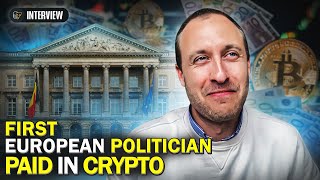
This content was created by Dr. Violet Howard. This content was uploaded by Dr. Violet Howard. This is a YouTube video titled "Why this European politician wants his salary in Bitcoin | Interview with Brussels MP" created on February 16, 2022. It features an interview with Christophe de Bucalaert, a Brussels deputy and European official, conducted by Joe from the Cointelegraph news team. The discussion focuses on Christophe's decision to take his entire 2022 salary in Bitcoin, his motivations for promoting financial awareness and education, and the potential role of cryptocurrencies in the financial system.
Chapters
Hi, my name is Joe and you can usually find me on the cointelegraph news team. My guest today is Christophe de Bucalaert, a Brussels deputy and European official. So why are we talking to a Brussels politician? Well, because he's the first Belgian member of parliament and the first European politician to take his entire 2022 salary in Bitcoin. It's quite simple. He gets paid and he puts it straight into BTC. That's a monthly salary of roughly €5,500 that gets converted to Satoshi's every single month. It's a bold MO from a politician working in a conservative arena. But Christophe has his motives, notably raising financial awareness, contributing to financial education in the country as well as in broader Europe, and of course, sending out a message that maybe, just maybe, bitcoin is a safe place to put your money. Christophe, Bonjour. How are you doing today?
Bonjour. Hi. I'm fine, thanks.
That last month you decided to take your. You would take the entire salary for 2022 in Bitcoin. Given, as you say, that it is such a long term trend, it's almost this bigger picture thing going on here. What made you decide to take your salary in Bitcoin?
Now there is a real strategy from Asia and in the US they are busy too on those topics, a lot far further than us. And I was thinking, okay, now the world is going straightforward and Europe is thinking about what would be interesting or not. And in Belgium, we had the first hearings in the Parliament. They are now making hearings to inform us for the first time about what are cryptocurrencies. So there is a big problem. And I thought, okay, if we let things go like this, we will never, Europe will never have something to say in this. And yeah, once again, in the financial world, it will be Asia and the US that decide everything. So I thought, okay, I have to do something to raise awareness much more than it's going on now. And that's why I thought, okay, maybe if I take all my salary for whole year and I put all my credibility in this topic, in the press, in the media, it can help. So that's why I made this announcement.
You know, the Digital Yuan on one side and. For example, and then, you know, El Salvador, which is. Has their El Chivo wallet on which they're giving out these $30. So it's important that, yeah, Europe plays this role. I mean, can we go a bit deeper there? What kind of message are you trying to send out to the wider public by being paid in bitco My real.
Political statement is that we have to abolish the last privilege of the rich is the financial ignorance. So for the moment we have financial system that benefits for a big, big part to small amount of people. And the largest part of the people don't benefit from that, from the financial market. So we have to ask the question why. We have to have concrete financial courses in school, at school, to learn people, to put all people on an equal level in front of the financial market. The financial market is very positive, like it's organized now, centralized, because it brings a lot of stability and that's a good thing. But there is also throwbacks, like inequalities. You see now inflation is coming, there are some crisis in 2008, financial crisis and things like that. So maybe not very transparent. The bank's costs are big costs also for the people, not very. Two billion people don't have a bank account in the world. I think we have to improve the system. And how can we improve the system? I think bitcoin and cryptocurrencies are a way to improve the actual system because they have some very good advantages, those cryptocurrencies, very transparent, the same rules for everybody, completely decentralized, so nobody can cheat. And so if you take those two systems, and that's my vision, if those two systems working together, maybe we can have monetary power like we have now.
I know that Michael Saylor, for example, is a big proponent for Bitcoin being this global reserve currency and then dollars working on top of it. So yeah, but just you make the distinction between Bitcoin and cryptocurrencies, which is also a growing trend. So why for you, Christophe, why is it Bitcoin and why is it not Ethere, Solana or any other cryptocurrency?
What I see is that Bitcoin is the oldest, the most stable protocol, maybe the only one who is really, really decentralized, completely without control of any. Of any central structure, with a proof of work, which have some issues with energy, but which brings a lot of security. I'm thinking maybe bitcoin is the most stable thing where we have to work with. But I know it's, as I told you, it's not a very strength position. I'm very open to change that position and to learn about that. But why I did the announcement with Bitcoin is also because I think it's the most. Everybody knows it and it's the most accessible of very inaccessible worlds for the moment, for the normal people.
What about your colleagues that must call for some interesting discussions at the water cooler or at the coffee table. To what extent have you received say support or I'm going to guess here, criticism from your colleagues about your decision to swap your entire salary for Bitcoin?
And to be honest, I'm not sure people and also in my colleagues, only very few understand that we touching there something very important. And you know that we're touching that we're talking about monetary systems that we are talking about. Yes. Things that. Yeah, we talk about money. Money is the blood of the economy. It's so important. And when we talk about Bitcoin, I don't think there are a lot that understand that talking about that. So there are more. Some say to me that's a good mediatic.
Yeah, media move. Yeah, yeah, sure.
But the most of the people are criticizing me really. It's. They say I'm crazy. They say I give the bad example. They say because of the climate impact of Bitcoin, it's a very. We have to stop that. They say it's to finance terrorism and all, you know, other legends we hear. Yeah, yeah. So for the moment it's more negative reactions. Okay, but I hope, yeah when negative reactions on Twitter and things like that. But I think it makes them like, like we said in the beginning, okay, Christoph is someone, he's not crazy. If he says that maybe there is something right. And I hope some will, will follow that path.
You know, just yesterday we saw that KPMG in Canada has announced that it's bought some Bitcoin to put on its balance sheet. So I think, you know, the wheels are in motion and some of these dominoes are starting to fall. Has there been any temptation? Has anyone come up to you and said, hey, Christophe, you know, how do I work out this wallet?
No, what I have is some colleagues, they criticize me in public, you know, but in private they tell me, yeah, but you have to know I already tried. Also my, my daughter or my son is teaching me how to invest, but I don't believe in the technology. But I'm going to invest because there's so many to do, you know, so they're not ready to assume their position, but you see that they're beginning to think about.
And just to go back to what you were saying earlier about these two separate systems, you know that this counter system that's fighting, well, not fighting, but maybe promoting innovation within the existing system. What does that mean? Or what is your vision for crypto in this sort of light? What can the two worlds bring to you? Know, how can they combine to work towards a better world and a better monetary system?
I think we have to look to gold. You know, when there are crises, we understand gold can be a way to protect ourselves about against the fluctuation of money or against. When there are big problems, everybody says, okay, we go back to gold. And bitcoin is a bit numerical gold, you know, So I don't know yet exactly how it will, how it all will work together, but I think there is something interesting there with the digital world. The currencies and assets can become very, very. The limit is because in the beginning you say, yeah, currencies, you have to exchange it rapidly. And so with gold it was more difficult. And with a property document of a house, it's difficult too. You cannot use it like currencies. But with Bitcoin, it's in the middle of the two. You don't know really is it an asset or a currency? So that's why all economists are debating on that question. And when we speak about Bitcoin, say, oh, but it's not a currency. Okay, maybe not maybe. Well, but what does it change? And so I think it's really a new way of thinking. It's a new. And there is still a lot of to being learned in that. So yeah, I have a vision of collaborating. Different from the vision of China who wants to use the numerical yuan.
Is there anything else that we haven't covered that you might like to add towards the end of the video? I've just got one final quick question.
Maybe just a message to give to people who are following us, because I think people who are, Who are very entrepreneurs, investors will already know a lot about blockchain and bitcoin and cryptocurrencies. And I really want to pass that message that we have. The traditional financial world. That's not the way we will make steps forward. We have to enter that vision of collaboration. People who are, are in traditional banks, political leaders, they also have other constraints. You know, they have to protect their population. They have to be sure the population will not, the citizen will not be, have problems when they invest. And because there's less, less of security in the, in the crypto world. So it's normal they want to have some restrictive legislation. And so you have to go and explain, you have to go and try to collaborate with those people to convince them to explain them, but not to treat them like, who understand nothing and be like, you know, people of the 18th century. No, they have their constraints. So it's important now we enter in a collaborative moment and not fighting moment, because otherwise we will have more and more delay in beginning really implementing new projects with Krito.
As you said at the start, we need to make sure help people along that journey and to understand and as you did, take the time to learn about bitcoin and cryptocurrencies. That's brilliant. Bitcoin price prediction for 2022. Christophe, last question. Are we going to see €100,000?
€200,000? 2022? Yeah. No, I think it will take some more time than we think. So I think that if we stabil 100,000, I think it will be already a incredible performance.
Yeah, fantastic. That was great. Thank you so much, Christophe. Best of luck to you in the future. And yeah, cheers. Bye. Bye.
Ciao. Bye.










