Will Bitcoin SV Creator Acquire $8 Billion Bitcoin Fortune? | Interview With Craig Wright
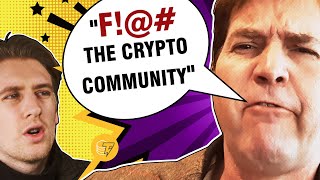
Craig Wright claims he'll eventually control an $8 billion Bitcoin fortune held in a trust, though he doesn't currently hold the private keys. He says he paid $3.2 million in taxes and filed evidence with authorities. Wright asserts Bitcoin SV is the original Bitcoin and criticizes mainstream Bitcoin and other projects.
Questions this video answers
January 23, 2020.
3.2 million (currency not restated; stated as 'I paid 3.2 million in tax').
"About 99.9999 and a few more nines percent" certain he will be taking control.
1,540 white papers (Wright: 'I've got got 1540 white papers now from Nchain').
He expects to "hopefully hit 1,000 patents filed" (stated as a near-term goal).
Chapters
Do you care about winning the hearts and minds of the people of the crypto community?
I'm about 99.9999 and a few more nines percent certain that I will be taking control of my BTC and whatever else. Will I cause BTC a whole lot of problems? Yes. But I'll do that in many different ways.
Welcome everyone to Today I'm going to be talking to you. One of the most controversial figures in cryptocurrency. He claims to have invented bitcoin. That he is Satoshi Nakamoto himself. This is Dr. Craig Wright. Hi, how are you doing, Dr. Craig Wright?
I'm doing very well, thank you. Yourself.
Good. Thanks for coming on. So my first question is, last week, bitcoin sv, as you probably know, had a big spike in price and then fell off significantly, significantly after that. What is your thoughts on this recent price action and how relevant do you think price action is to the success of bitcoin sv?
Absolutely zero. People who sit there speculating on an asset they have no idea about are absolute idiots. This entire crypto market is basically a regurgitation of every stupid thing that's happened.
So your lawyer told Decrypt recently that you don't possess or claim to possess the private keys to the $8 billion Satoshi Fund. How come you don't have these keys?
As I said, there's a staged process. So what people don't seem to understand is the other bit is I don't own the keys. A trust does. So sorry. Back when bitcoin was not worth anything at all, I set up a trust. I did that for asset protection reasons. That trust is a legally registered entity with a government with a little stamp and all the rest. And like it or not, lawyers and other wealth protection asset sort of specialists help set all these things up. And I'm not a trustee.
Why are you not a trustee?
Because I'm smart enough not to be. Because then people could force me to actually move coins. You've got this whole, you could take things from trustees. If it was mine, then people could have seized assets from me. Remember, I had a whole lot of. I had a stoush in the past with the Tax Office of Australia, wanted to take a lot of money from me. I had other people wanted to take money from me. I had lots of greedy people in the past wanted to take money off me. So how do you stop that? You set up a trust, you don't make yourself a trustee. You find people you trust to be trustees. Hence the word trustee. You Set up rules. You. You don't make it discretionary so that people can spend whatever the hell they want. You say this is how the money is going to be used and you make it very specific. And like it or not, my money is not for me to buy yachts. I set it all up to actually put back into building the ecosystem I wanted to build.
Do you think that you will ever receive these keys? When do you think you will receive these keys?
I don't know. I won't. The trust might. They're different things. So again, I'm not a trustee.
So first the trust has to receive the keys and then they can give them to you. Is that the process?
They don't give them to me. It's a trust. It's like a company. I didn't set it up so that they could give them to me.
Do you still expect to see the keys at a later date? Are you expecting them at all?
I'm hoping so. Will I cause BTC a whole lot of problems? Yes. But I'll do that in many different ways.
So you don't know for sure?
I'm about 99.9999 and a few more nines percent certainly that I will be taking control of my BTC and whatever else I don't think people realize. But I have proof of my assets because I filed a claim with the tax office listing everything. I actually did what is called a binding private ruling. I went to the tax office and I actually, when no one knew what the hell bitcoin was seeing, said, I've got this asset and this is how I want to approach it. And I paid 3.2 million in tax and moved everything overseas. And I did it legally with accountants and really expensive lawyers and paid the tax due at the time and set it up and structured it. So you know what? That's actually called evidence.
All right. So how come you decided to commit to being Satoshi Nakamoto? What do you stand to gain? Because it seems like this has been a pretty painful process so far, or at least drawn out process, teaching people.
How law actually works and that bitcoin is not anonymous or outside of the law.
So what you're saying is that you're using this, this claim to the identity as a way to educate people on the.
No, I'm not using a claim to the identity. I am the identity.
But you're using it as a way to educate people as to the original goal and vision.
I'm using it not as a way to educate people. It is the truth. And it's not something I wanted to come out with before because people had hijacked my protocol. Starting in June 2010, we had the advent of a heroin store being the first thing promoted on bitcoin. Interestingly enough, I'd already been looking at trying to commercialize things on bitcoin, but that killed it. I was actually looking at the creation of a peer overlay network for a number of entities, one of which ran them, most of which I just couldn't get past the idea of peer to peer networks. When trying to sell commercially to listed companies. They heard the word peer to peer and that scared them because of Kudzella, Limewire, Edonkey, Everything else.
Okay. It's just not. It's not exactly clear to me why you have just what your justification is for enduring this whole process.
I didn't choose the justification. I didn't choose in 2015 to release a whole lot of files that people tried to make me look like a scammer and whatever else. I didn't choose to come out and do anything. But when I tried not to talk to the media, you guys tried to track down my family and tried to follow up with everything, when I tried to just sit there and patent and write files in the background, you guys tracked me down. When I wouldn't talk about whether I'm satoshi or not, everyone kept coming out there and attacking me. So if you want the truth, then it gets to a point where whether you like it or not, I'm going to give it to you.
Okay. Thank you. So do you care about winning the hearts and minds of the people of the crypto community?
Did someone sit there and go, I'm going to have a TCP community and we're all going to get together and circle jerk around? Tcp, It's a protocol. It's plumbing. You don't need to like it, you don't need to care. You don't need to like me. It's technology. You don't sit there and go, wow, I'm going to look at how wiring is done in my house and we're going to have a wiring community and we're going to debate which particular color red we're going to use on a red wire. I mean, sorry, don't care.
So why do you care so much when people question your identity as Satoshi Nakamoto?
I didn't.
You didn't?
No, I didn't. Actually. I wasn't bringing up the fact that I was at all. So when everyone started the Whole fake Toshi and scam bit and whatever else. I was not answering the question at all. I was not addressing it at all. I was not sitting there going, hey, I'm Satoshi. Follow me. Rather the other way around. Everyone else saw me as a threat and started attacking me. So here's the thing. You push me so far and, well, I don't run.
You don't run?
No, I fight and I fight and I fight and then you knock me down and I get up and I fight and you knock me down and then I kneecap you and then you maybe knock me down and then I take out your Achilles. Gradually, I attack the corners and if I have to stab you a billion times before you fall over, I win. I win or I die trying. I always loved Andrew Carnegie. Andrew Carnegie. Self made, started from nothing, started as a steel worker. Wesleyan has much of the same philosophy as I do. I've followed what he believes, and a large part of that and his idea of how you ensure you get to be where you are is you put yourself so that you can't fail. You don't allow yourself to have an option. You basically sit there and you create a scenario where it's going to be nothing but your winning. You don't give yourself an out. You don't sit there going, well, I try again. You don't. You win. The end.
So to you, is this about winning?
Yes. Because what we have is we have my original vision for bitcoin and a bunch of criminals. That simple. And I don't like criminals. Sorry.
Now I'd like to hear what is your vision for blockchain and cryptocurrencies throughout the next decade? How is it going to impact the economy and just our everyday lives?
Okay, so as I said, it's plumbing. I want to recreate the Internet so that we don't have the shit show of Twitter and Google and everything like that. Now, the whole problem that the Internet had, that was attempted to be solved even by Google in the past was how do we have micropayments? Once you can actually do that, you can have models that aren't reliant on ads, aren't reliant on tracking your information, that allow people to have privacy, that allow people not to have their entire lives captured by a bunch of oligarchical companies. And that becomes really critical. So I want to see something that has an audit trail. Bitcoin has an audit trail forever for a reason. It's pseudonymous, which means private, not anonymous. You can embed information such as the identity of parties into keys and hierarchies. So that's, that's doable. But what you now have is a means of tracing corruption the old fashioned way. Not like the NSA do right now, where they look at metadata and, and trace that sort of stuff, but rather where they actually put together a proper evidence trail using human intelligence and follow things back. Because now they have a trail that they can go from one person to another. They can make deals the way policing used to be before we got lazy and thought. Everything just comes to metadata.
In a blog post you made in May of last year, you said, through Bitcoin, I see a world where various systems compete. I see the individual, the local, the state, and the government all competing globally. Do you see Bitcoin as the ultimate form of capitalism?
Yes, but that also is something that people don't understand. My idea of capitalism is more a nuanced view of what Adam Smith would say, updated of course, because he had a lot of ideas that were incorrect. I mean, 200 years of research gives you a lot more information. But Adam Smith was also someone who wrote about morality. Now, Adam Smith's idea of morality wasn't this laissez faire idea of get rid of all government and leave people to suffer on their own. Adam Smith basically wrote about the need to regulate markets, to protect things, to have ways of ensuring that people are safe. So we need all of that. We can't actually have this idea like a total, no government, anarchist society. You have that right now. If you want to go to Sierra Leone, you want to go to the Belgian Congo or whatever they want to call it this week. There are places in the Western Sahara. All of these have no governments right now. So you have that. You can choose no government, and guess what? You have, you have anarchy. There's a reason anarchy is not considered a good word, because whenever you have anarchy, you have murder without fail. And everyone says, oh, it's not truly anarchist. What the hell is truly anarchist? Where is this so called society? There are 1200 experiments in anarchy in the US alone. Every one of them ended in murder. Without exception. There is not a single case of an anarchist society not ending in murder ever.
So one of the things I've noticed is that you seem to start a lot of your answers to questions and interviews with some version of people don't seem to understand that, blah, blah, blah.
What people fail to understand is what people don't realize. What people also don't understand is how.
Come you feel that so many people don't understand things the way that you understand them.
Well, let's see, none of them bother to actually read up anything on the topic. The so called experts in blockchain I don't think have ever read read any of the references I put in there. No one. We're talking 11 years now and no one has realized that blockchain as a concept, a string of hashes concatenated with a binary tree or Merkle tree was invented in 1994. It's published the time chain concept or round chain or whatever they wanted to call it back then. So the terms have changed a little bit and the use is a little bit different. But Antonopoulos in his deposition utterly screwed up in saying that bitcoin's the first peer to peer cryptocurrency. Wrong. There are multiples, including PPE. Revest of the RSA fame did one in 1992. Distributed cryptocurrency. Again wrong. There's Mnet mojo, there's the reputation distribution system in Edonkey Emule. So these, I mean, and when he was asked about it, he basically said oh well, I had no involvement with any of this before. So effectively you've taken the bullshit that people have heard, you've regurgitated it and you've done no research because well, I guess you say this and coin goes up. It's called lazy assholes wanting to make money doing nothing.
So what sets you apart?
I work.
You work?
I've got got 1540 white papers now from Nchain. When everything goes through and the updates happen this month I should hopefully hit 1,000 patents filed. I spend, let's see, I'm doing two doctoral degrees simultaneously while I'm working. I work 60 to 80 hours every single week in my work. Then I study the two degrees. I've done up to 4 degrees simultaneously while working. I run multiple companies, so yes, I work.
How do you find time to do all this?
Luckily I have a wife and family who understand me well enough to put up with the fact that I'm a workaholic.
Okay, so you claim that Bitcoin SV is the real bitcoin, yet the original bitcoin is still the most dominant and widely known.
Sorry, what original bitcoin? There's no original bitcoin in bcc.
Bitcoin core.
There's no segwit in in. You've got this error in that people keep forgetting that the ticker symbol changes when the thing changes. That was set as a precedent by Vitalik with Ethereum. Ethereum Classic is The original Ethereum yet it is. Etc Eth is basically the fork. So the fork that he changed Ethereum into kept the original ticker symbol. So there's this whole bait and switch thing where a bunch of guys scamming investors keep the ticker symbol, avoiding demutualization and dematerialization law the way it is in securities. And these are securities. Because when we're talking about exchanges, it's not the actual underlying asset, it's the promise to pay. And we're going to start seeing that. I've got regulators starting to understand the fact that when you're on an exchange you have a security so crackdown starting to happen anytime now. The same with BTC. BTC changed my protocol. You cannot run a version 3 node and have it synchronize or even have SPV from version 3 and have it run. So no changed and not minorly, majorly, SEGWIT is not compatible. The underlying aspects of segwit where they sit there going, oh, it's actually backward compatible, what a load of bullshit. They've got all these changed opcodes like CLTV and whatever else that they've added. They've changed the way that end sequence and nlock time works. They have radically screwed with the protocol without having any idea what they're doing with an attempt just to try and make something that is more anonymous because they think they can get away with lightning, losing records and that law enforcement around the world are going to keep turning a blind eye as it gets bigger. These guys are morons.
So let me reformulate that question then. So you claim that Bitcoin SV is the original Bitcoin. The real Bitcoin. The real bitcoin. But yet the Bitcoin that we know now is the most widely known and dominant crypto.
No, no, sorry, there is no bitcoin that you know now. There's the way I made it and there's this whole scam of calling BTC Bitcoin. You alter the protocol that I said was set in stone and you go, oh, it's the community get to decide off. It's the community don't get to sit there and go, TCP should have a different packet size. How about how community changes the way IP processes data packets? Sorry, don't work that way. It's a protocol, it's set, get over it.
Okay, so what series of events or event would needs to happen in order for Bitcoin SV to succeed or replace Bitcoin btc?
We're already doing it. The end you can sit there and gamble on coin, will keep going up in massive giant Ponzi. That will work forever. And if you're that stupid, enjoy being broke. Very simple.
Mm.
I mean, honestly, what, four transactions a second whoop de f king doo dah? You realize in economics, you've got this thing called substitute goods, and that applies to transactions, too. Now, if your transaction cost you $40, $50, whatever else, no one's going to use it. Now, the argument, like a whole lot of them, run around going, oh, but it's free. We can fund terrorism. We can fund child porn. And Antonopoulos actually, under oath, has just said that Bitcoin's wonderful for funding child pornography. His deposition will come out. And he said that. So guess what? That's a death sentence for your thing. Liberty Reserve was bigger than Bitcoin. Liberty Reserve had more nodes than Bitcoin. This idea, oh, it's centralized. What a load of crap. People can't even tell me what that word means, why it matters.
What does decentralized mean to you?
Decentralized is actually a term in computer science which relates to robustness. So we're not talking about political decentralization. And if you're looking at political decentralization, then China is actually one of the most politically centralized places on Earth. Everyone looks at going, oh, C is actually the leader and whatever else, but by the time it filters down to the individual locations and it goes through provincial down to individual local areas, the control of the Communist party is over 50,000 people. Now, the reality of decentralization is you have nodes able to join, rejoin, and not have loss. So in number two, the idea of a timestamp server going back to the core of Bitcoin, the reason this fails, if you look at something like diginotar, if you have a single entity sign something and fail, everything that they've ever touched fails. The timestamps and the certificate signed by Diginota, a certificate authority that was hacked, including Microsoft and Google certificates years ago, allowing Iran and others, including North Korea, to issue malware as if it was digitally signed by Google or even Microsoft, well, everything at all times is compromised. Now, if you have a group of even 10 different commercial entities, more better. And you have to hack all of those simultaneously and not be detected. It's nearly impossible. That's what Bitcoin's really about.
Okay, and so I just got one last question for you. Do you think it would have been better if Satoshi's identity had remained a mystery.
For me, for my family? Yes.
What about for the good of the crypto community.
The crypto community? I mean, what are we talking about with the crypto community? You mean people actually building things? They don't care. You mean the traders on the scammers and the speculators? The people who pump coins and go coin go up? Everything look magic, I've got a fricking yacht now you too could own your own Lambo and without having to work hard because, well, coin go up.
What about for bitcoin?
I'm still working on bitcoin. I haven't stopped working on bitcoin. And if you think bitcoin is going to be valuable because I'm satoshi, not because of what I do, you're idiot. Sorry. Bitcoin will be valuable because, well, all those things that IBM would love to solve, the things to do with making Hyperledger actually a working thing rather than the piece of shit it is I've been patenting. So if Hyperledger gets to be successful, N chain makes money. Nchain makes money. I put it back in bitcoin. So banks and IBM are going to eventually either come over to bitcoin or pay us money and we'll build bitcoin.
So thank you everyone for watching. That was Dr. Craig Wright. He claims to be the inventor of bitcoin. And guys always remember to like subscribe.
And hodl Cointelegraph like subscribe and hodl.










